
By Michael Froman, Project Syndicate | January 28, 2026
The announcement of a skeletal agreement between US President Donald Trump and NATO Secretary-General Mark Rutte was good news, even if it turns out to be a fig leaf for a failed land grab. The brouhaha over Trump’s rhetoric was obscuring what is a genuinely serious geostrategic concern.
NEW YORK – One issue dominated this year’s World Economic Forum in Davos: President Donald Trump’s threats to gain US control of Greenland. The announcement of a skeletal agreement between President Trump and NATO Secretary-General Mark Rutte was good news – even if it turns out to be a fig leaf for a failed land grab – because the brouhaha over Trump’s rhetoric was obscuring what is a genuinely serious geostrategic concern.
Without a robust US presence on the island, Trump argues, China and Russia will come to exploit its vulnerability. Arctic security and ballistic missile defense would both be undermined.
But the suggestion that Russia or China has plans to attack, invade, or somehow compromise the island to the detriment of the United States is overstated. Greenland is an autonomous territory of the Kingdom of Denmark, not a forward base of operations for hostile powers. More may need to be done to shore up Greenland’s defense, but to claim that it is for the taking by the US, or its great power rivals, is to wave away NATO and Article V, the alliance’s collective defense mechanism.
Greenland’s true strategic value lies primarily in Arctic security. The island anchors the western edge of the Greenland-Iceland-UK gap, a critical maritime corridor through which Russia’s Northern Fleet submarines and surface vessels must pass to reach the North Atlantic. This makes the island, the world’s largest, central to NATO’s ability to monitor, and, if necessary, contain Russia’s maritime forces.
Moreover, as Arctic ice melts, Greenland’s proximity to potential transpolar and high-latitude shipping routes further increases its importance as an outpost to maintain open sea lanes of communication. It is also uniquely positioned for ballistic missile early warning and missile defense of the US homeland.
But control of the island is not a prerequisite for realizing its strategic potential. Under the existing 1951 defense agreement between the US and Denmark, America already has broad authority to station forces, construct and upgrade bases, and operate missile warning and space domain systems from Greenland. At one point in the early Cold War years, the US maintained 17 facilities on Greenland.
Today, the US has only one facility in Greenland that it operates on its own, not because the Danes kicked America out, but because the US packed up and left. Greenland and Denmark's political leadership have made it clear that they would be happy to have the US military back, just not at the cost of their national sovereignty. All the US needs to do is ask.
True, acquiring Greenland would significantly increase America’s size. While Greenland looks much bigger on the traditional Mercator map, which might be part of its appeal, at roughly 836,000 square miles (2.2 million square kilometers), it is about 22% the size of the current United States, adding land mass similar to the major territorial expansions of the nineteenth century.
But Greenland, 80% of which is permanently covered by ice, is unlikely to provide a bonanza of riches. Despite some early enthusiasm about its mining potential, Trump seems to appreciate that Greenland’s austere climate and limited infrastructure are unlikely to put it at the top of the list for critical minerals production.
Be that as it may, Trump also views US control as a form of payback for the US role in liberating Europe from the Nazis, and in defending it ever since through NATO, which he views as serving only Europe’s interests. But America’s network of alliances, chief among them NATO, is a core comparative military advantage, covering all strategic theaters. Neither China nor Russia has remotely similar assets.
Trump doesn’t place much value on this asymmetry. And at Davos, he went a step further by questioning the resolve of the NATO allies to defend the US if it came under attack.
But here, there is a historical record. When, for the first and only time in history, Article V was invoked after the terror attacks of September 11, 2001, thousands of allied NATO forces deployed to Afghanistan. Denmark, with a population smaller than that of Los Angeles County, alone deployed more than 18,000 soldiers to fight alongside Americans, suffering one of the highest per capita casualty rates of the allied forces in the war. NATO member states, including Denmark, also fought alongside US forces in Iraq.
And while there once may have been merit to Trump’s discontent with the commitment of most NATO countries to defense spending, the burden is now being reallocated. On a per capita basis, the US is no longer the alliance’s highest spender (Norway is). Moreover, all NATO allies now spend at least 2% of their GDP on defense, and last summer they, with the exception of Spain, agreed to a new goal of 5% by 2035, with 3.5% spent on core defense.
Trump’s doubts about the value of NATO also overlook how the alliance allows the US to leverage other countries’ resources to serve American interests. Military integration with NATO allows the US to field interoperable military capabilities at scale around the world. Trump might have been opposed to the wars in Iraq and Afghanistan, but on the off-chance that America needs to go to war in the future, it would be good to have allies.
When it comes to the resolution of the Greenland dispute, an agreement can take several forms. For example, the United States has a permanent leasing arrangement with Cuba for Guantánamo Bay dating back to 1903. And despite demands by Cuba to return the land, it can be terminated only mutually, unlike other bases where US forces have been withdrawn at the request of the host government.
The Panama Canal Zone might provide an alternative model. For most of the 20th century, Panama allowed the US to control the canal and five miles on either side of the waterway. Another example that comes to mind is the United Kingdom’s bases in Cyprus, which are considered sovereign British territory.
One asset in Greenland gets little or no attention: the island is home to some of the world’s northernmost golf courses. There is one on the edge of a former US military base in Kangerlussuaq that could use some investment. Any proposal that includes a nod to Trump’s favorite sport may well sweeten the deal.
Michael Froman is President of the Council on Foreign Relations.
Copyright Project Syndicate
Military Casualties In Ukraine War Near 2 Million
Russia’s invasion of Ukraine has caused nearly 2 million military casualties on both sides since the war began almost four years ago, a new study shows, with most losses borne by Moscow’s forces.
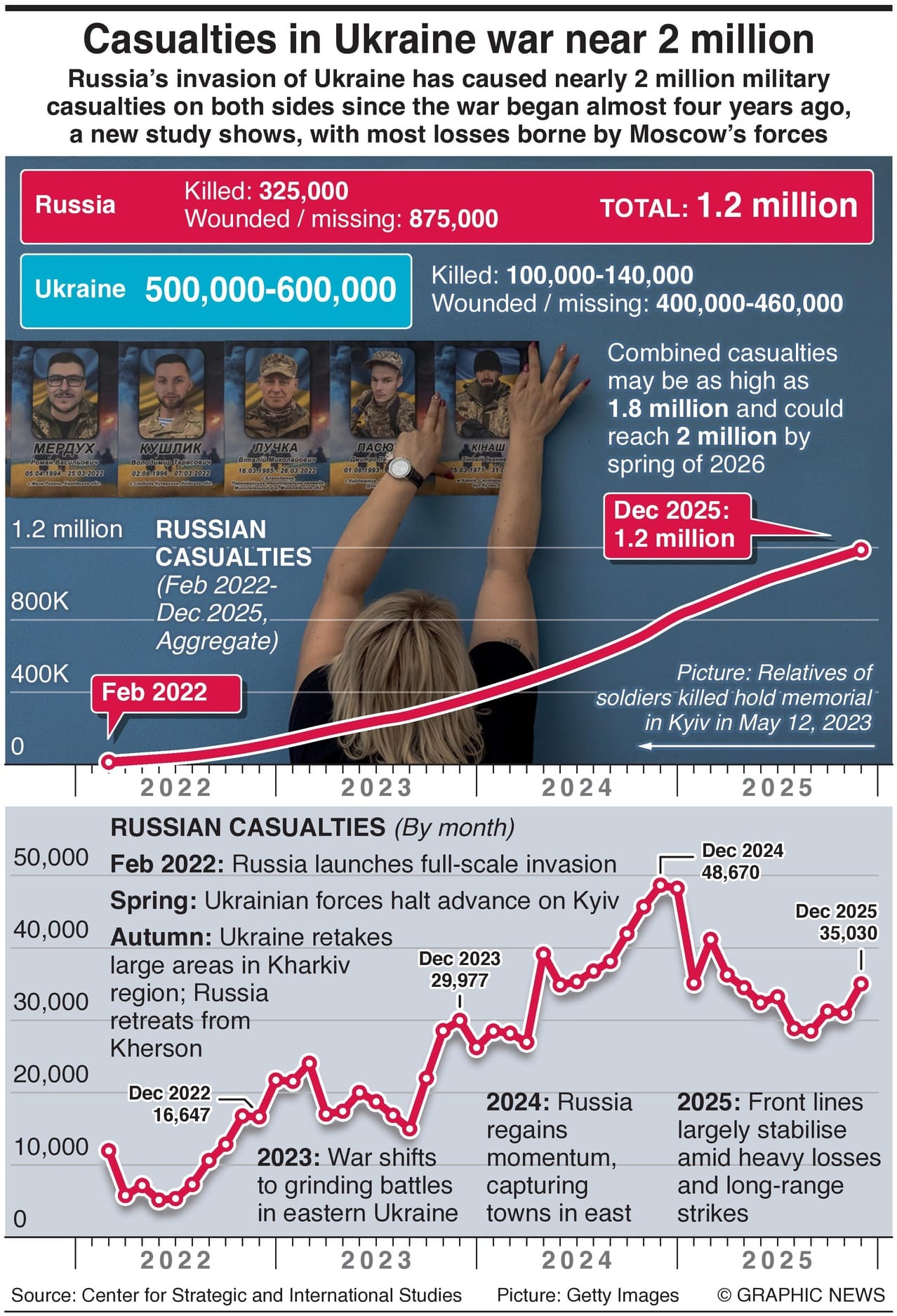
The study, published by the Washington-based Center for Strategic and International Studies (CSIS), estimates that as many as 325,000 Russian troops have been killed, out of a total of around 1.2 million Russian casualties since February 2022.
CSIS said no major power has suffered comparable levels of casualties or fatalities in any conflict since World War Two.
Ukrainian forces have also sustained heavy losses, with an estimated 500,000 to 600,000 casualties between February 2022 and December 2025, including between 100,000 and 140,000 killed.
Combined casualties from both sides may already total as many as 1.8 million and could reach 2 million by the spring of 2026, the study said.
The figures underscore Russia’s limited battlefield gains, with its forces advancing at an average rate of just 15 to 70 meters per day in major offensives – slower than nearly any major offensive campaign of the past century.
Catch up on today’s highlights, handpicked by our News Editor at TIPP Insights.
1. Rubio Asserts Venezuela Operation Was Law Enforcement, Not War
2. EU Foreign Policy Chief Says NATO Must Step Up As Trump Reshapes Ties
3. Report Says Russia’s Ukraine Losses Eclipse All Postwar Conflicts
4. Iranian Witness Says Thousands Killed In Protest Crackdown
5. Treasury Secretary Bessent Warns Canada, Slams EU Over India Trade Deal
6. What Is Driving Amazon’s Latest 16,000 Job Cuts
7. Analysts Say China’s Moonshot AI Is Closing Gap With U.S. Models
8. Trump Warns Iran Of Incoming U.S. Armada, Urges Nuclear Deal
9. JPMorgan Backs 'Trump Accounts' With $1,000 Match For Employees
10. S&P 500 Breaks 7,000 For First Time In History
11. Powell Investigation Continues As Fed Misses Subpoena Compliance: Report
editor-tippinsights@technometrica.com