📝Editor’s Note
AI may become extremely powerful, but that does not mean it will solve every problem.
This article explains that innovation is not just about intelligence or ideas. Real-world progress depends on testing, manufacturing, regulation, and human judgment. Even the smartest systems must pass through these steps.
For readers, the takeaway is clear. AI will accelerate discovery, but humans will remain essential in turning ideas into results.
🔎 Why This Matters
- AI can generate solutions, but real-world execution still depends on systems and processes
- Bottlenecks like testing, production, and regulation can delay or stop even great ideas
- Human judgment remains critical, especially in edge cases where machines struggle
- As AI improves, the value shifts to those who can deliver outcomes, not just ideas
📘 Simple Guide To Key Terms
- AGI (Artificial General Intelligence)
A form of AI that can perform any intellectual task a human can - Bottleneck
A weak point in a process that slows or blocks progress - Tacit Knowledge
Practical know-how gained through experience, not easily written down - Last Invention Thesis
The idea that once superintelligent AI is built, it will create all future inventions
By Carl Benedikt Frey, Project Syndicate | March 19, 2026
Listen to leading voices in Silicon Valley, and you might come to believe that “solving intelligence” is sufficient to “solve everything else.” But as seductive as this claim about AI’s potential may be, it rests on a number of assumptions that do not withstand scrutiny.
OXFORD – In the mid-1960s, the mathematician and Bletchley Park cryptographer I.J. Good proposed a thought experiment that has since become the secular gospel of Silicon Valley. If we were to build an “ultraintelligent machine,” he argued, it could then design even better machines, sparking an intelligence explosion that would leave human cognition far behind. The first such machine, therefore, would be “the last invention that man need ever make.”
Today, that prophecy, once the stuff of science fiction, has become the core objective of the world’s most powerful institutions. Google DeepMind’s Demis Hassabis, for example, speaks of “solving intelligence” in order to “solve everything else.” It is a seductive story. But even if we assume, for the sake of argument, that future systems can learn, experiment, and generate genuinely novel solutions far beyond today’s models, the last-invention thesis still rests on multiple questionable assumptions.
The first is that innovation resembles a frictionless sprint from idea to impact. It does not. Rather, the discovery process is more like a chain, only as strong as its weakest link.
These weak links define much of human progress. In 1986, the space shuttle Challenger broke apart 73 seconds after launch, not because of a failure in its world-class engines or software, but because a small rubber seal failed when subjected to cold atmospheric temperatures (as the Nobel laureate physicist Richard Feynman brilliantly exposed at hearings into the disaster). The “O-ring” has since become a metaphor for the kinds of critical bottlenecks that will sink even the most sophisticated systems.
Discovery works the same way. Artificial general intelligence (AGI), generally understood as a model that can perform any cognitive task, may dramatically accelerate early-stage medical research, but if it cannot navigate clinical trials, manufacture at scale, or secure regulatory approval, the “breakthrough” never becomes an invention that improves lives. When the early stages of discovery are automated, the human role does not vanish; it simply migrates toward the remaining bottlenecks, where judgment, tacit knowledge, and practical know-how are what matter.
This complication points us to an even bigger one: AGI would not just have to outperform humans; it would have to outperform humans using AGI. For the last-invention story to hold, people would have to become unnecessary even as partners or supervisors to AIs.
But intelligence is not a quantity: “more” does not simply replace “less.” Even a very capable AGI might be different in kind than a human: exceptional at speed and pattern-finding, but fragile when confronted with rare cases. Different strengths imply different blind spots, and when those do not overlap, combining human and machine judgment will continue to beat either one alone.
The game of Go offers a useful reminder. After Google DeepMind’s AlphaGo beat Lee Sedol 4-1 in 2016, its superiority to human players seemed settled. But in 2023, researchers showed that by steering top engines into unusual positions outside their training, a human amateur with modest computing skill could reliably defeat the best programs. Apparent supremacy can still hide systematic weaknesses, and that is often where human input adds the most value.
A third problem concerns knowledge itself. The last-invention thesis assumes that all relevant information can be codified, but this is usually not the case. Few inventions changed the world more than the Ford Model T, which transformed the automobile into a mass-market product. But Henry Ford’s achievement lay not just in a new design. More important was his approach to organizing production.
That is why delegations from Italy, Germany, the Soviet Union, and elsewhere traveled to study Ford’s factories first-hand. The crucial know-how could not be gleaned from any blueprint. It was embedded in routines, sequencing, tooling, and day-to-day problem-solving by those on the shop floor. Similarly, Toyota’s lean-production system was difficult to replicate because it is embedded in human routines and culture, not a schematic.
More intelligence does not automatically overcome the “knowledge problem” – the fact that what makes complex systems work is dispersed, local, often unspoken information. If knowledge were frictionlessly portable, industries would not cluster so intensely, as in Silicon Valley or the City of London.
AI enthusiasts might respond by saying, “Fine, put sensors, cameras, and microphones everywhere, and we’ll codify the missing knowledge.” But this strategy assumes that people being monitored will openly communicate and share the knowledge they generate, and it assumes away politics and the law. Recording “everything, everywhere” would collide with the European Union’s General Data Protection Regulation, which has become a blueprint for privacy regulation worldwide.
Moreover, the EU’s AI Act does not give a free pass to the surveillance-heavy deployments that would be necessary to harvest human know-how at scale. And even if it did, one cannot assume that all human know-how, let alone judgment, is so easily digitized.
Ultimately, AGI may well automate intelligence. But the process of invention depends on something more. Often, the hard part is not thinking up a solution but translating it into practice. You need local know-how, trusted routines, supply chains, and institutional capacity to make something work reliably in the real world. More intelligence does not automatically produce those complements.
AGI will change discovery by making expertise cheaper and experimentation faster. But “humanity’s last invention” is a much stronger claim. For it to be true, we would need a world where practical know-how is fully transferable through digital channels and where responsibility can be automated along with cognition. That is not the world we live in.
As intelligence gets cheaper, the assets that command the highest value will change. The advantage will go to those who can deliver outcomes. Humans are not becoming redundant; they are becoming the world’s most decisive bottlenecks.
Carl Benedikt Frey, Associate Professor of AI & Work at the Oxford Internet Institute and Director of the Future of Work Program at the Oxford Martin School, is the author, most recently, of How Progress Ends: Technology, Innovation, and the Fate of Nations (Princeton University Press, 2025).
Copyright Project Syndicate
👉 Show & Tell 🔥 The Signals
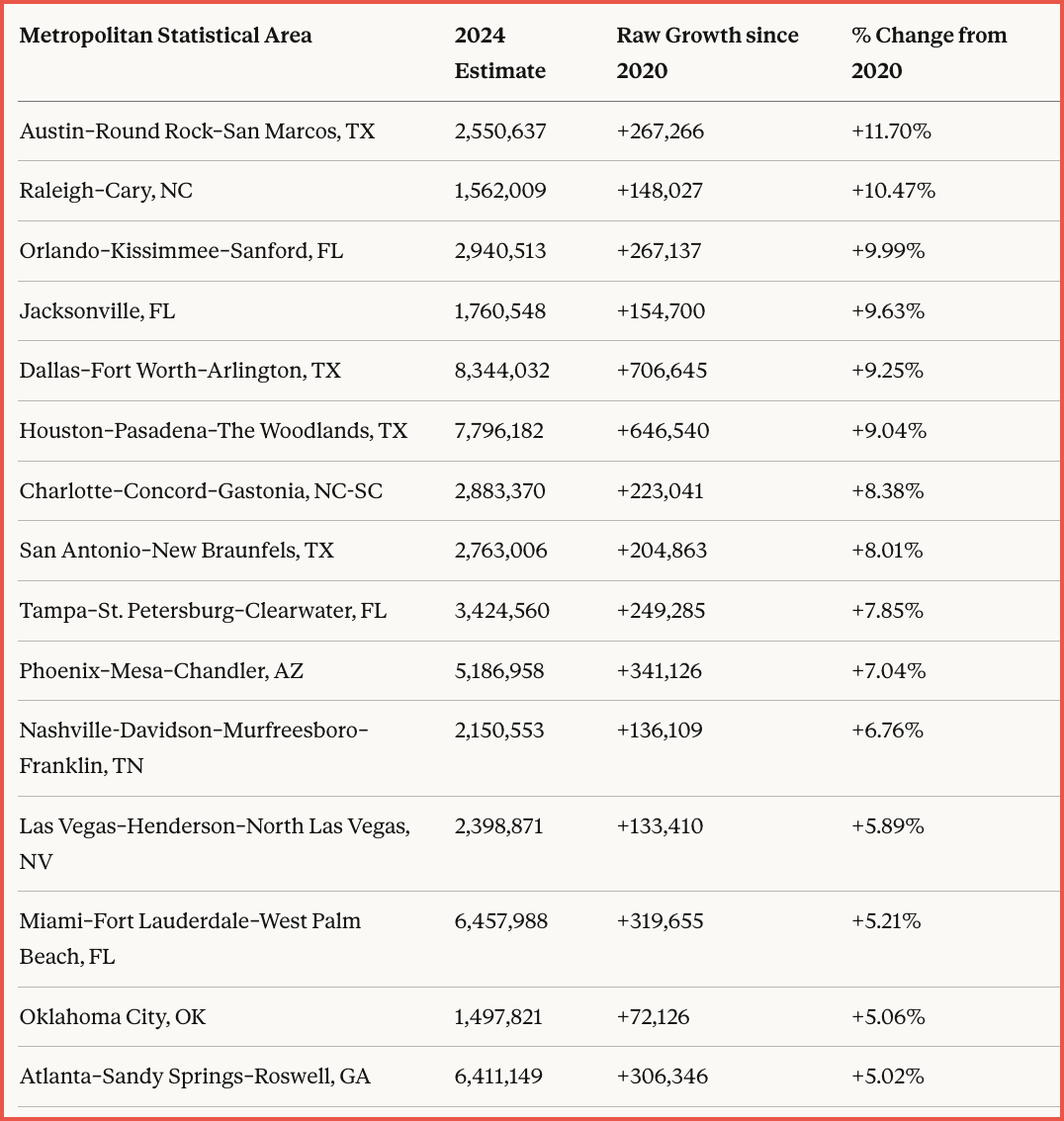
I. America’s Fastest-Growing Cities Are All In The Sunbelt
Population growth in the U.S. is increasingly concentrated in the South and Southwest. All 15 of the fastest-growing major metro areas are in the Sunbelt, with cities like Dallas and Houston adding hundreds of thousands of residents in just a few years.
The trend highlights a continued shift toward lower-cost, business-friendly regions.
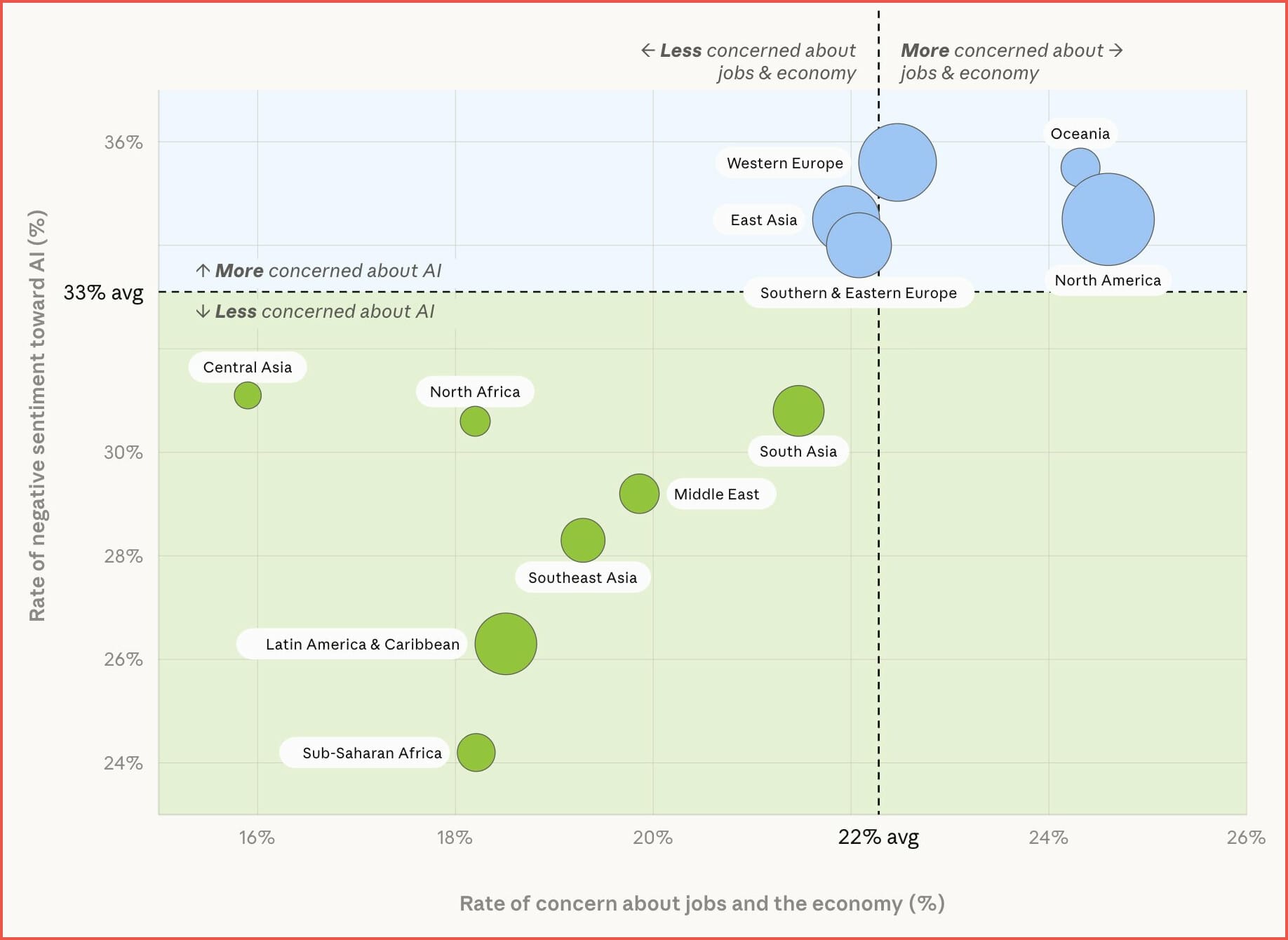
II. AI Concerns Are Highest In Wealthy Regions
Public attitudes toward artificial intelligence vary widely across the world. Advanced economies like North America and Western Europe show the highest levels of concern about AI, while developing regions tend to be less worried.
The pattern suggests anxiety about AI may rise alongside income levels and exposure to knowledge-based jobs.
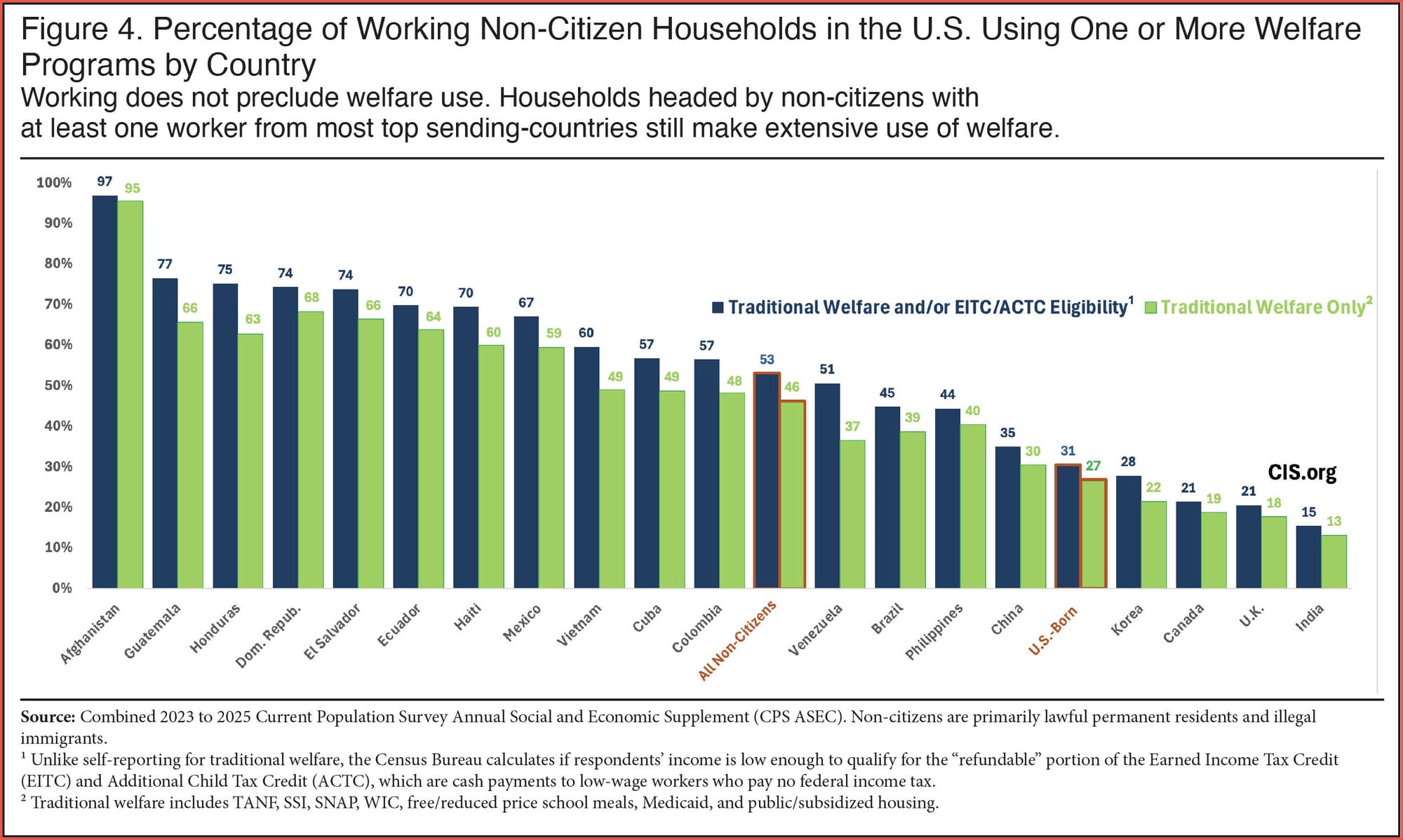
III. Welfare Use Varies Widely Across Immigrant Groups
Government data show significant variation in welfare usage across different immigrant groups in the United States. A majority of households in some groups use at least one form of assistance, while others show much lower participation rates.
The data reflect differences in income levels, household structure, and eligibility across populations.
👉 The TIPP Stack
1. ‘It’s A Very Surreal War’— Victor Davis Hanson, The Daily Signal
2. With Friends Like These…— Editorial Board, TIPP Insights
3. Trump’s China Gambit— Editorial Board, TIPP Insights
4. Xi Chooses Trump Over Tehran— Editorial Board, TIPP Insights
5. What’s Behind Beijing’s Restraint?— Editorial Board, TIPP Insights
6. The Dragon’s Fragility— Editorial Board, TIPP Insights
7. The War Iran Forced— Larry Kudlow, Fox Business
8. US Allies Rebuff Trump’s Request For Support In Strait Of Hormuz— Reuters Staff, The Daily Signal
9. More Than 60K Americans Evacuated Middle East Since Iran War Began— Elizabeth Troutman Mitchell, The Daily Signal
10. Cuba’s National Electric Grid Collapses, Leaving Millions Without Power— Dave Sherwood, The Daily Signal
11. Monroe Doctrine 2.0: U.S. Over China in Latin America— Steve Cortes, The Daily Signal
12. Media Is In A Tizzy Because We Give Troops Good Food Sometimes— Jarrett Stepman, The Daily Signal
13. White House Responds To Don Lemon On The First Amendment— Tyler O'Neil, The Daily Signal
14. Who’s Whispering in Your Chatbot’s Ear?—Marc Faddoul, Project Syndicate
15. College Education Flunks Out — By More Than 2-To-1, Voters Say It's Not Worth It: I&I/TIPP Poll—Terry Jones, TIPP Insights
16. Democrats Push DOJ To Prosecute Kristi Noem After Trump Ousts Her From DHS— Fred Lucas, The Daily Signal
17. SCOTUS Agrees To Hear Trump Bid To Rein In Temporary Protected Status—Fred Lucas, The Daily Signal
18. ‘REFUSE’: Top Trump Official Advises Medical Students Pressured To Perform Abortions— Elizabeth Troutman Mitchell, The Daily Signal
19. Democrat-Passed Law May Have Allowed Shooter To Enter Old Dominion Undetected— Virginia Grace McKinnon, The Daily Signal
20. Union Suit Claims Trump-Airport Security Rule Ousted Immigrant Workers— Fred Lucas, The Daily Signal
21. Echoes Of Ezra: ‘America Reads The Bible’ Event To Gather Leaders To Rededicate Nation To God—Al Perrotta, The Daily Signal
📊 Market Mood — Friday, March 20, 2026
🟩 Stocks Stabilize as U.S. Signals De-Escalation Efforts
U.S. futures edged higher as Washington and allies moved to calm fears of a prolonged Iran conflict.
🟧 Oil Eases but Remains Elevated on Supply Risks
Crude prices pulled back from recent highs but stayed well above pre-war levels amid ongoing Hormuz disruptions.
🟦 Central Banks Hold Firm as Inflation Risks Build
Global policymakers kept rates unchanged while warning that energy-driven inflation could persist.
🟨 Gold Rebounds as Dollar Weakens
Bullion bounced after a drop in the dollar, though rising rate expectations continue to cap gains.
🗓️ Key Economic Events — Friday, March 20, 2026
No Events Scheduled
editor-tippinsights@technometrica.com