

Do Americans care about America's fast-growing national debt, now above $40 trillion? You bet they do. In the latest I&I/TIPP Poll, an overwhelming majority of the voting-age population say they're concerned about the mounting liabilities on the nation's balance sheet, and blame out-of-control spending for the red ink.
In the latest national online I&I/TIPP Poll, taken by 1,481 adults from Aug. 25 through Aug. 28, participants were asked: "The nation's debt is close to $40 trillion. How concerned are you about the size of the U.S. national debt?" The poll has a margin of error of +/-2.9 percentage points.
As noted, the response was overwhelmingly one-sided: 77% said they were either "very concerned" (48%) or "somewhat concerned" (29%), while just 15% described themselves as either "not very concerned" (10%) or "not at all concerned" (5%). Another 8% were not sure.
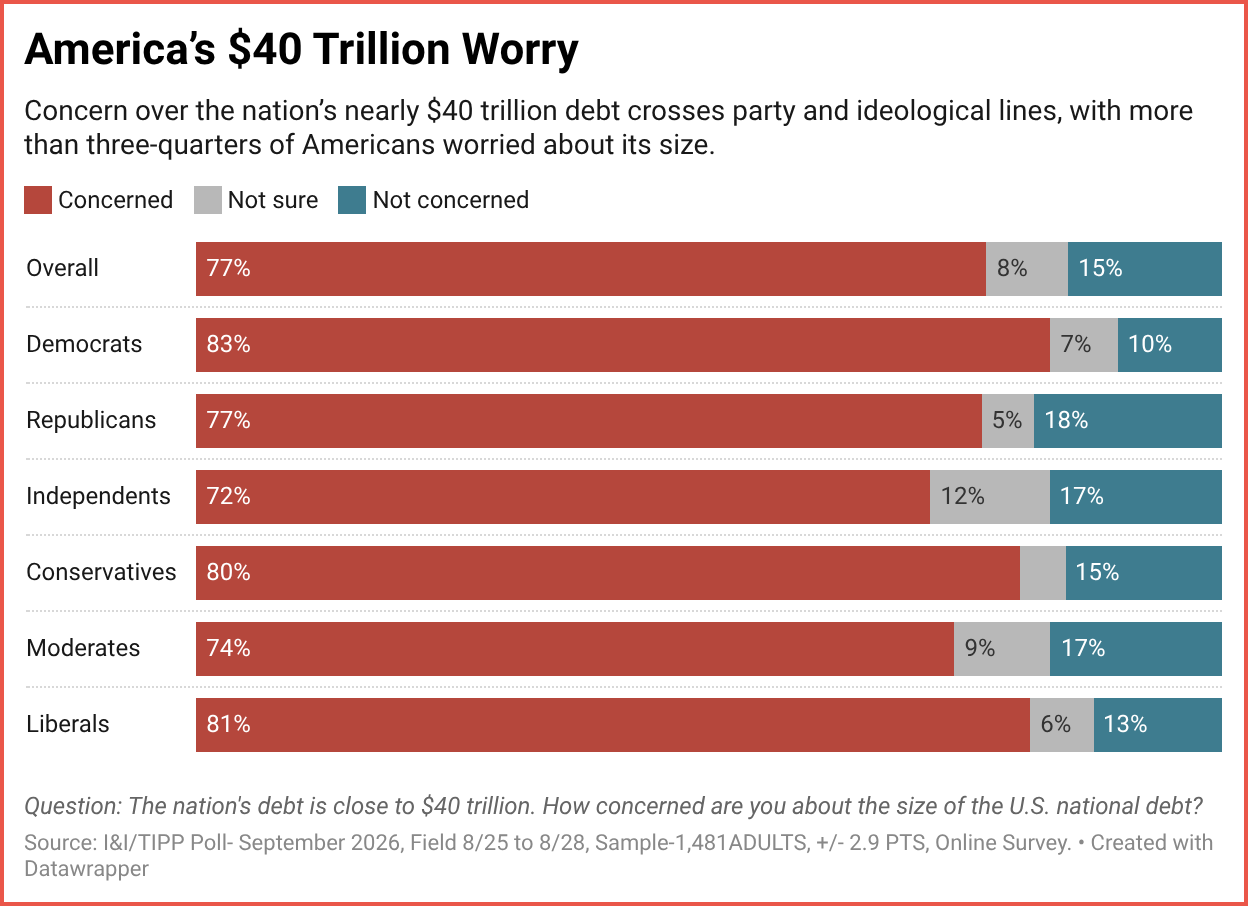
And as the chart shows, this is not a partisan issue. Differences among the political parties are small. The lowest level of concern, 72%, is found among independent voters. Democrats (83%) and Republicans (77%) evince the most concern, while Republicans (18%) and independents (17%) have the most "not concerned" responses, Democrats the least (10%). But all are fairly close.
When it comes to respondents' own political beliefs, this is one area where self-described liberals (81% "concerned") and conservatives (80% "concerned") are in near-perfect harmony. But moderates lag not far behind at 74%.
A second question about the debt asks: "In your opinion, what is the leading cause of the rising U.S. national debt?"
Once again, there's powerful agreement, as 43% cite "excessive government spending" as the culprit, with Democrats (43%), Republicans (44%), and independents (43%) once again singing in tune.
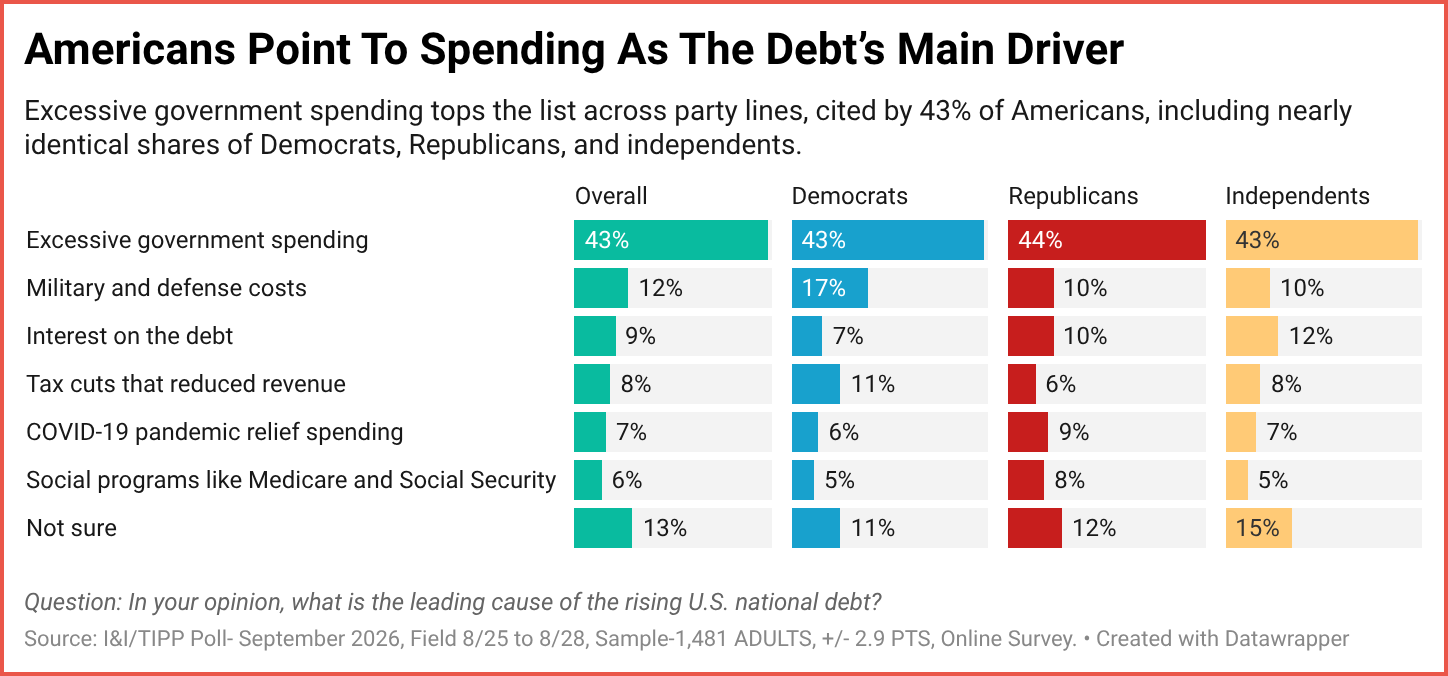
Indeed, government spending's share of blame in the responses was more than three times as large as any of the other individual possible responses: "Military and defense costs" (12%), "Interest on the debt" (9%), "Tax cuts that reduced revenue" (8%), "COVID-19 pandemic relief spending" (7%), "Social programs like Medicare and Social Security" (6%), and not sure (13%).
Taken together, the five other potential answers total 42%, still less than the 43% who blamed excessive government spending.
So what's the best way to reduce the debt? I&I asked that very question: "What should be done in your opinion to reduce debt?"
"Reduce government spending" led the charge at 49%, with "Increase taxes" at just 7%. Another 27% wanted both spending cut and taxes increased, while 5% didn't want either choice. Another 12% were not sure.
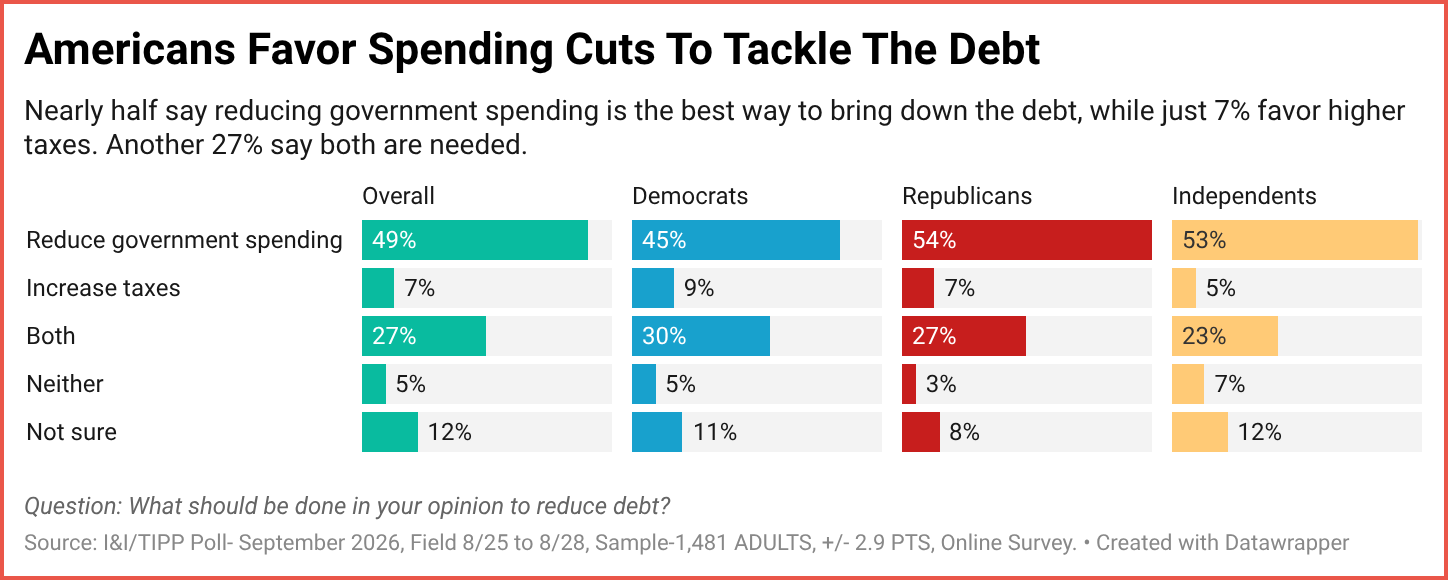
And again, the political parties were in broad agreement, with a solid plurality or majority saying reduce spending: Dems (45%), Republicans (54%), independents (53%). The "increase taxes" factions were all in the single digits, as the chart shows, while those answering they want both spending cuts and tax hikes totaled 30% for Dems, 27% for Republicans, and 23% for independents.
But just how do we "reduce government spending?"
As Americans know, cutting spending, which everyone professes to desire, is an annual exercise in fiscal futility in Washington, D.C. No or few cuts get made, while spending continues to rise with few or no restraints.
One of the most popular proposals in recent decades has been the recurring idea of a "balanced budget amendment." It would basically change the Constitution to mandate that federal spending and revenues remain roughly in balance over a single year or several years.
I&I/TIPP asked voters: "Do you support or oppose a constitutional amendment requiring the federal government to balance its budget?"
Once again, it was an overwhelming response, with 70% overall saying they would like a balanced budget amendment, and only 12% saying they would oppose it. Another 18% weren't sure.
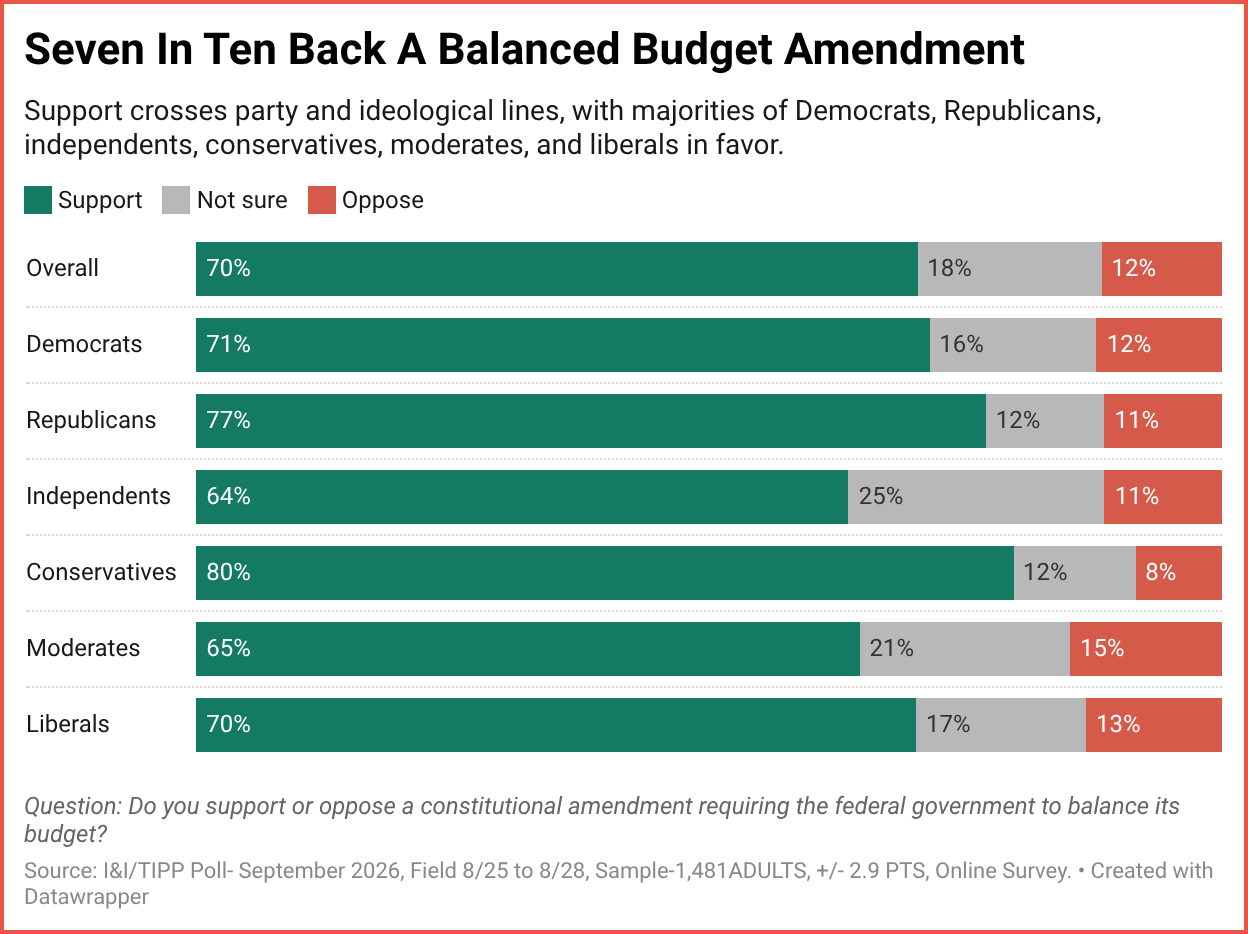
This is another area of very broad agreement among the various political factions: A solid majority of Democrats (71%), Republicans (77%), indie voters (64%), conservatives (80%), moderates (65%) and liberals (70%) backed the balanced-budget amendment.
The amendment's popularity is rare in American politics, spanning the broad spectrum of 36 demographic groups that I&I/TIPP tracks each month. That includes white Americans (73% support, 10% oppose), black and Hispanic Americans (64% support, 17% oppose), men (75% support, 12% oppose) and women (66% support, 11% oppose), and all age groups strongly supported the balanced-budget idea.
Indeed, the lowest support of any group for the idea came from 18 to 24 year old voters, at a still-hefty 61%. Support from all the 35 other demographic groups was higher than that.
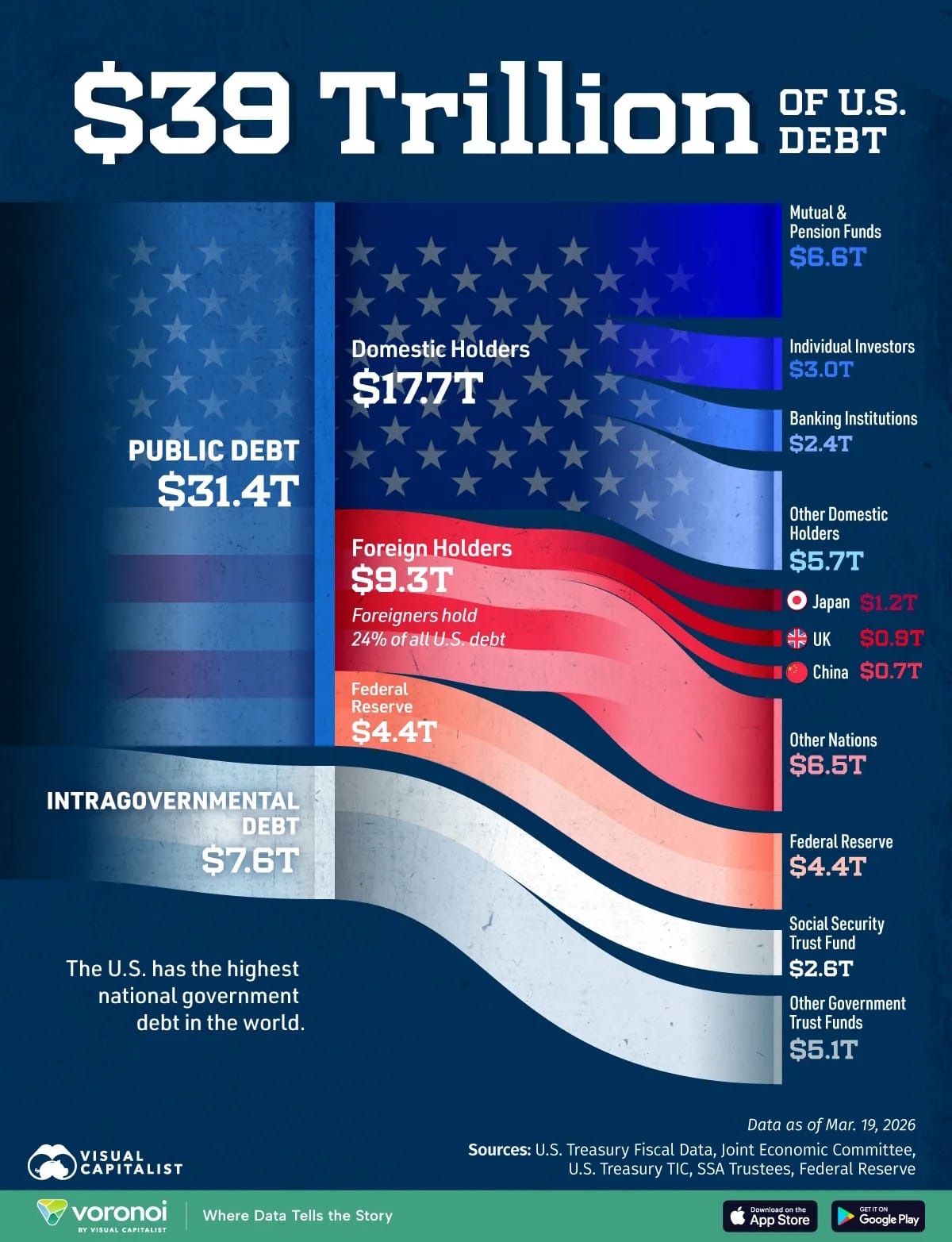
Currently at just over $40 trillion, the debt will almost certainly add at least another $1 trillion by year end. As of September 2026, the total debt amounts to $285,693 per taxpayer, a huge burden hanging over every citizen and growing by the day.
The math is simple: the U.S. will spend just over $7 trillion this fiscal year, while collecting only slightly more than $5 trillion in revenues. That leaves a gaping $2 trillion deficit, equal to more than a quarter of all spending. At a certain point, investors may refuse to buy that new debt, sending interest rates spiraling upwards, a recipe for financial and economic disaster.
Which brings us back to the final I&I/TIPP Poll question this month: If the idea for a balanced budget law seems so powerful as a possible solution, why hasn't anyone made it the centerpiece of a campaign? After all, 45 states have balanced budget laws on the books or as part of their constitutions. Why not the federal government?
In truth, it has been voted on many times.
Since 1999, writes Jill Lepore of The Amendments Project, a balanced-budget amendment has been introduced more than 100 times, "making it the most commonly proposed amendment of the twenty-first century." It nearly became law in 1995, but, after passing the House, failed to get the one vote needed for a two-thirds majority in the Senate.
Lepore adds, however, that once-solid bipartisan support "has dimmed. In 2011, President Barack Obama expressed his opposition to such an amendment." Elected Democrats have solidly rejected the idea since.
Yet, even as the Democratic Party apparatus drifts leftward on the political spectrum and away from the spending discipline of a balanced budget, its own rank-and-file members still solidly back the idea of a BBA.
Even so, it's not as if a BBA has no issues: some economists (mostly on the left) argue it would end fiscal discretion during an economic downturn, potentially making it worse. Some conservative-leaning economists, meanwhile, counter-argue that a BBA could result in dramatically higher taxes, but few or no cuts in actual spending.
Regardless, as the I&I/TIPP Poll very clearly shows, Americans want to see the debt burden reduced, and a multi-partisan majority strongly supports either spending cuts or a balanced budget amendment to accomplish the goal. But whether politicians in Washington heed the voters' voices is, as always, another matter.
I&I/TIPP publishes timely, unique, and informative data each month on topics of public interest. TIPP’s reputation for polling excellence comes from being the most accurate pollster for the past six presidential elections.
Terry Jones is an editor of Issues & Insights. His four decades of journalism experience include serving as national issues editor, economics editor, and editorial page editor for Investor’s Business Daily.
Loved it, hated it, or somewhere in between — tell us. Grade this article here and help shape what lands in your inbox next.
📊 Market Mood · September 14, 2026
How the trading day is setting up.
🟥 Oil is again setting the tone. Brent has climbed above $106 a barrel as attacks disrupt Saudi energy infrastructure and fighting around key Middle East shipping routes intensifies, keeping the inflation threat elevated.
🟧 Rate-hike expectations have hardened. Goldman Sachs and J.P. Morgan now expect the Fed to raise rates this week, while futures put the probability of a quarter-point hike at roughly 85%–90% following stubborn August inflation.
🟦 Technology is facing a fresh headwind. AI-linked shares are under pressure after leading industry figures called for a slowdown in advanced AI development, adding another source of uncertainty to already cautious markets.
🟨 The Fed dominates the week ahead. The two-day meeting begins Tuesday and concludes Wednesday, with investors focused not only on the rate decision but also on the new projections and Kevin Warsh's guidance on what comes next
🗓️ Key Economic Events
On today's U.S. data calendar.
No major U.S. economic reports are scheduled today. The week's important calendar begins Tuesday, while the Fed decision on Wednesday is the centerpiece.
Letters to the editor email: editor-tippinsights@technometrica.com
Subscribe Today And Make A Difference. Consider supporting Independent Journalism by upgrading to a paid subscription or making a donation. Your support helps tippinsights thrive as a reader-supported publication. Contact us to discuss your research or polling needs.
Reach our audience. For sponsorship and advertising opportunities, visit our Partner With Us page.