On May 25, the President’s post on Truth Social named eight nations: Saudi Arabia, the United Arab Emirates, Qatar, Pakistan, Turkey, Egypt, Jordan, and Bahrain. It should be “mandatory,” he wrote, that all of them sign the Abraham Accords at once. Those are the 2020 agreements that normalized relations between Israel and several Arab states, though he noted in passing that two of the eight, the Emirates and Bahrain, were already members. He went further than the roster, adding that once the document was signed, those same leaders would welcome Iran into the structure too.
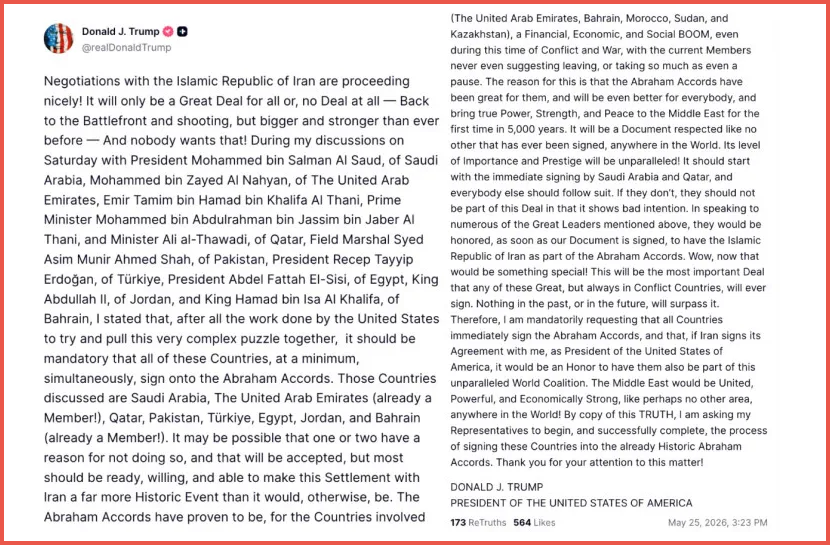
The surprising thing about the post is that it describes a whole region at peace: Israel normalized among its neighbors, and Iran, in time, brought inside the same arrangement. Most of the commentariat read it as overreach. A peace agreement works when it confirms a relationship that already exists. This one reverses the order, asking for the signature first and the relationship after.
When the Accords were signed in 2020, they ratified ties that had quietly formed for years. The Gulf states and Israel had been edging together over shared commerce and a shared wariness of Tehran, and the signing merely put ink to what was already true. When Iran’s missiles and drones struck the Emirates this year, Israel sent an Iron Dome battery and the crews to run it, the first time it had operated the system on foreign soil. A signature from 2020 had become a shield five years on. That is what a real relationship yields, and no decree can command it.
The May 25 demand runs the other way, and the ground shows it. Saudi Arabia has said consistently that it will not normalize with Israel without a credible path to a Palestinian state, and no deadline moves that condition. Egypt and Jordan already hold peace treaties with Israel, which makes the call for them to “join” redundant. Qatar has not forgotten the Israeli strikes on its soil, and Turkey and Israel now speak of each other as adversaries. As for Iran entering a framework built to contain it, that asks half a century of hostility to dissolve in the weeks after a war. Arab governments, one former American official told Politico, saw the whole linkage as a poison pill, a set of terms neither Iran nor they would swallow. The Gulf monarchies dislike being pushed, and they have the patience and the wealth to outwait a demand they never asked for.
No predecessor drew the destination in such hard lines, and that drawing has its own value, since a region cannot move toward something it has never been shown. A picture is not a place. Peace that grows on its own takes longer but it lasts. When it is announced before it exists, it tends to come apart.
The test for whatever comes next is a simple one. Does the agreement ratify a bond already forming, or only declare one that is not? The first kind tends to hold. The second ends without much to show for it. What sits on the table today is real, and more than anyone before him produced.
Letters to the editor email: editor-tippinsights@technometrica.com
Subscribe Today And Make A Difference. Consider supporting Independent Journalism by upgrading to a paid subscription or making a donation. Your support helps tippinsights thrive as a reader-supported publication. Contact us to discuss your research or polling needs.
Reach our audience. For sponsorship and advertising opportunities, visit our Partner With Us page.