
Trump heads into these midterms with the same rating he had before his last ones. But TIPP data shows the people behind that rating have swapped places. Investors are in. Rural Americans are out. We call it the Great Inversion, and on November 3 it could decide who controls the House.
The TIPP Presidential Leadership Index averaged 43.2 from May through October this year, compared with 42.8 over the same months of 2018. Urban residents, younger adults, higher earners and college graduates have joined investors in warming up to Trump. Seniors, non-college Americans and even Republicans have joined rural Americans in cooling.
Investors in, rural voters out
In 2018, rural Americans rated Trump 11.2 points higher than investors did, 56.9 to 45.7. Today, investors rate him 9.8 points higher than rural Americans, 56.0 to 46.2.
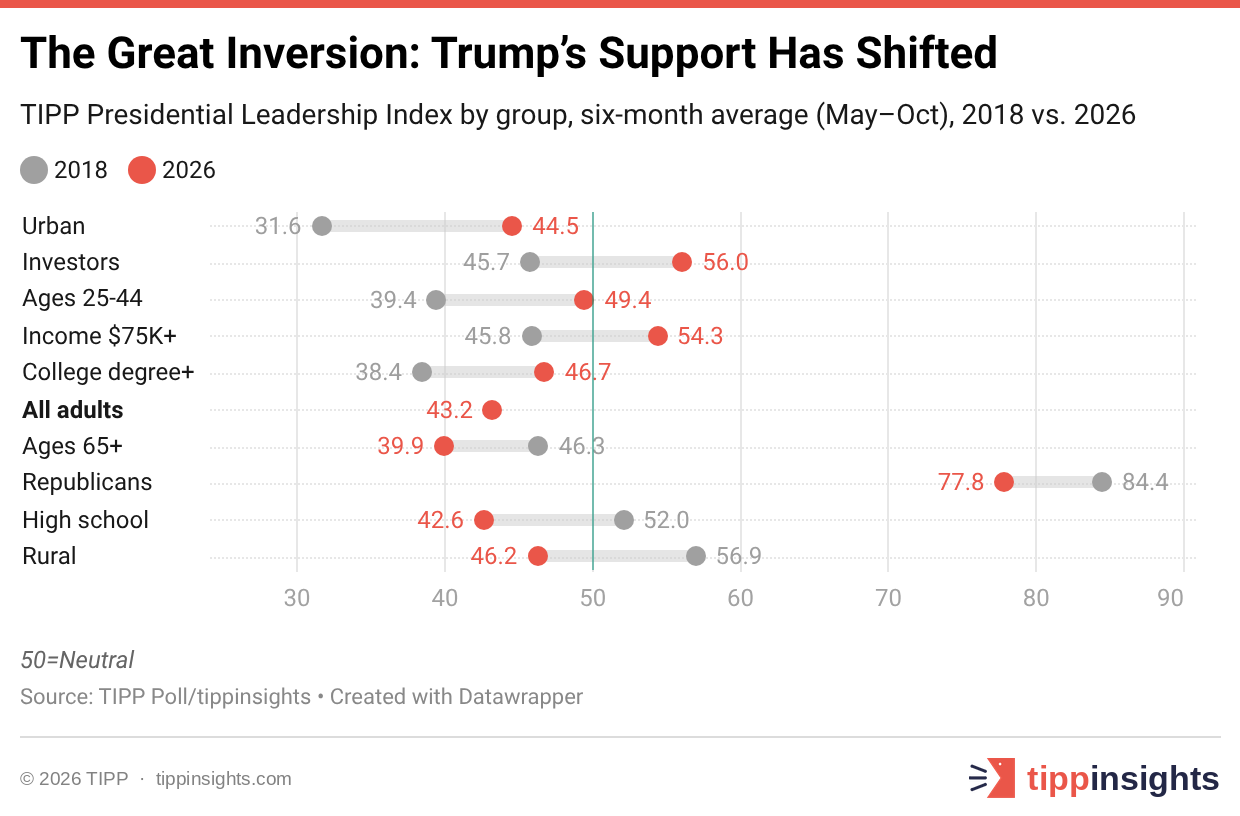
Trump’s biggest gain came among urban residents, whose rating rose 12.9 points to 44.5. Investors rose 10.3 points to 56.0, and adults aged 25 to 44 rose 10.0 points to 49.4. Americans earning $75,000 or more gained 8.5 points, and college graduates gained 8.3.
The losses came from the groups that powered his rise. Rural Americans fell 10.7 points to 46.2, and Americans with a high school education fell 9.4 points to 42.6. Republicans dropped 6.6 points to 77.8, and seniors dropped 6.4 points to 39.9.
Direction and optimism tell the same story
TIPP’s Direction of Country and Economic Optimism indexes show the same split.
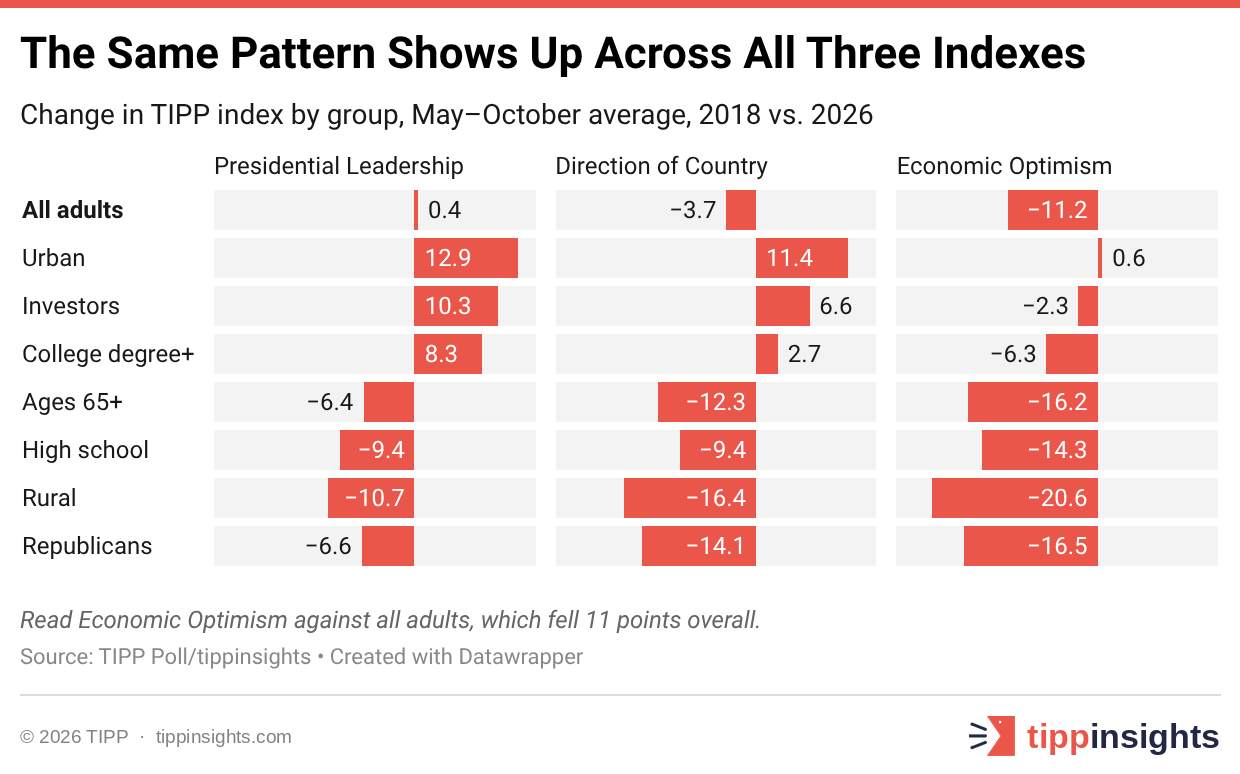
Rural Americans’ view of the country’s direction fell 16.4 points from 2018, and their economic optimism fell 20.6 points, more than any other group in the chart. Seniors fell 12.3 and 16.2 points on the two measures.
Urban Americans went the other way. Their view of the country’s direction rose 11.4 points, and their economic optimism edged up 0.6 points while the national reading fell 11.2.
Investors’ economic optimism now runs 25.1 points above non-investors’, a record in 25 years of TIPP data.
What it means for November 3
What matters now is whether these new loyalties turn into votes. Urban and college-educated Americans have warmed up to Trump, but they have not been a reliable source of Republican votes. Seniors and rural voters have cooled on him, but they have long leaned Republican.
If the new supporters turn out for Republicans and his old supporters stay loyal despite their doubts, the GOP adds new votes on top of its traditional base. Trump’s momentum helps: his Leadership score has risen every month since June, from 42.0 to 44.1 in October.
If the new supporters like Trump but don’t vote Republican, their warming makes no real difference. The result then rests on the old base, and whether its loyalty outlasts its doubts.
If the old base stays home as well, Republicans are in trouble. Seniors are the most dependable midterm voters, and even Republicans’ own rating of Trump has slipped from 84.4 to 77.8.
Which of Trump’s two coalitions shows up on November 3 will tell us whether the Great Inversion is a polling curiosity or a political force.
About the data: The TIPP Presidential Leadership Index combines the president’s favorability, job approval and leadership ratings. It runs from 0 to 100; above 50 is positive and below 50 is negative. The Direction of Country and Economic Optimism indexes use the same scale. Figures are averages of TIPP’s monthly national surveys from May through October of each year, comparing 2018 with 2026. Six-month averages smooth out month-to-month swings within smaller groups.
TIPP’s reputation for polling excellence comes from being the most accurate pollster for the past six presidential elections.
Loved it, hated it, or somewhere in between — tell us. Grade this article here and help shape what lands in your inbox next.
🧭 Power & Capital · October 23, 2026
Where state power meets the boardroom.
🔷 Trump Is Right To Lift Diesel Sanctions On Russia. He Should Go Further – Connor O’Keeffe, Mises Wire
🌍 Global Affairs
The world's flashpoints, in motion.
🟥 Trump Denies Involvement In Starlink Slowdowns In Ukraine – TIPP News
🟥 The ‘War Of Grand Design’ Transforms To More Narrowly Bolster US Hegemony – Alastair Crooke, Ron Paul Institute for Peace and Prosperity
🟥 The Victim’s Dilemma: The Fallacy Of The Strong State In Times Of War – Maksym Vlasenko, Mises Wire
🏛️ National Affairs
The fights shaping America right now.
🟫 2 Weeks Before The Midterms, DC Sent Me 4 Other People’s Ballots – Virginia Grace McKinnon, The Daily Signal
🟫 Toledo Chemical Leak Evacuation Zone Reduced As Conditions Improve – TIPP News
🟫 WNBA Disqualifies ‘Men’ From Playing But Still Can’t Define What A ‘Woman’ Is – Malia Loock, The Daily Signal
🟫 Tim Scott Makes Confident Pitch In Final Weeks Before Midterms – Rebecca Downs, The Daily Signal
🟫 Some Pinocchios Are Criticizing President Trump For Saying ‘Shylock’ – Adam Dick, Ron Paul Institute for Peace and Prosperity
🟫 Democrats Vs. Affordability – Joe Thomas, The Daily Signal
🟫 Watch: At South Carolina Campaign Stop, Rallygoers Back Trump’s Strategy Abroad – TIPP Video
🟫 Watch: Golf Ball-Sized Hail Hits Arizona As Unseasonal Severe Weather Sweeps In – TIPP Video
📈 Economy
Prices, policy, and the pressure on your wallet.
🟩 US Mortgage Rates Fall For First Time In Two Months – TIPP News
🟩 Higher Oil Prices Are Likely To Stay – Moon of Alabama, Ron Paul Institute for Peace and Prosperity
🟩 California’s Wealth Tax Fails Hayek’s Rule-of-Law Test – Daniel Sánchez-Piñol, Mises Wire
💼 Markets & Business
The deals and tickers making moves.
🟧 Moderna And Merck Cancer Vaccine Cuts Melanoma Recurrence Risk By 42% – TIPP News
📊 Market Mood · October 23, 2026
How the trading day is setting up.
🟥 AI concerns continue to weigh on global stocks. Nasdaq futures are slightly lower after Thursday's sharp selloff, as Meta's heavy spending and financing concerns raise fresh doubts about the sustainability of the AI boom.
🟧 Oil has surged to a five-month high. Brent crude has climbed above $114 a barrel following Houthi attacks in Saudi Arabia, renewing fears of wider Middle East supply disruptions and inflation.
🟦 Treasury yields have fallen sharply as investors seek safety. The 10-year yield has dropped below 5% after its biggest one-day decline since March 2023, reflecting growing concerns about technology stocks and economic growth.
🟨 Fed rate-hike expectations are retreating. Markets have reduced bets on further tightening as AI-related risks mount, while today's business activity surveys and consumer sentiment report will provide fresh clues about growth and inflation.
🗓️ Key Economic Events
On today's U.S. data calendar.
🟧 9:45 a.m. ET — S&P Global Manufacturing PMI, Flash (October)
Forecast: 55.5 | Previous: 55.9
Manufacturing activity is expected to moderate slightly, providing a fresh reading on factory output and demand.
🟧 9:45 a.m. ET — S&P Global Services PMI, Flash (October)
Forecast: 58.0 | Previous: 58.8
Services activity is expected to remain strong, with particular attention on employment and price pressures.
🟧 10:00 a.m. ET — University of Michigan Consumer Sentiment, Final (October) Forecast: 46.3 | Previous: 48.1
Consumer confidence is expected to weaken as high energy prices, inflation and borrowing costs weigh on household sentiment.
Letters to the editor email: editor-tippinsights@technometrica.com
Subscribe Today And Make A Difference. Consider supporting Independent Journalism by upgrading to a paid subscription or making a donation. Your support helps tippinsights thrive as a reader-supported publication. Contact us to discuss your research or polling needs.
Reach our audience. For sponsorship and advertising opportunities, visit our Partner With Us page.