By Richard Haass, Project Syndicate | Feb 9, 2026
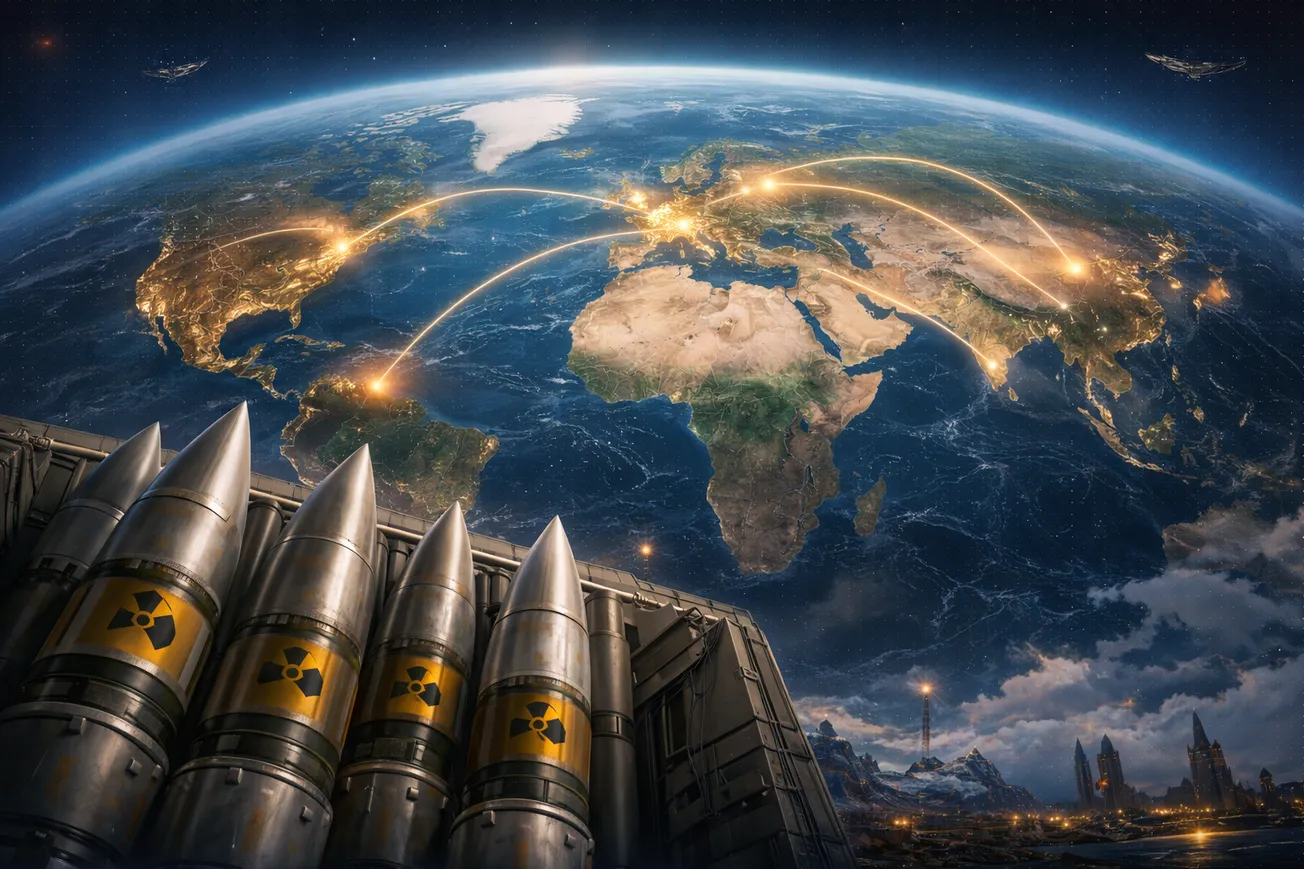
With the end of the New START Treaty last week, it is now clear that the world has grown too comfortable with nuclear weapons. Given the risks posed by larger arsenals, and even more so by new additions to the nuclear club, the time to become uncomfortable again has arrived.
NEW YORK – The countries and peoples of the world have coexisted with nuclear weapons for eight decades. These unimaginably destructive weapons have been used only twice, when the United States dropped nuclear bombs on Hiroshima and Nagasaki to hasten World War II’s end.
There were subsequent scares, of course, most notably the 1962 Cuban Missile Crisis. For the most part, however, nuclear weapons largely remained in the background during the Cold War. The US and the Soviet Union (followed by Russia) built robust arsenals that minimized any advantage to striking first. In addition to deterrence predicated on mutual assured destruction, arms-control agreements provided both governments with the transparency and predictability they needed to avoid costly and dangerous arms races.
This has all taken on increased relevance as New START, the final nuclear arms control accord limiting the arsenals of the US and Russia, expired last week. It was Russian President Vladimir Putin, of all people, who offered to extend it informally (it was already extended once five years ago), but US President Donald Trump has been cavalier, saying “If it expires, it expires.”
One reported explanation for the US stance is its unhappiness that China is not included in the formal architecture of arms control. Yes, China possesses the world’s third-largest and fastest-growing nuclear arsenal, but its desire to achieve parity with the US and Russia means it won’t sign any pact limiting it to second-class status.
Moreover, China, thinking about Taiwan, may well believe that a principal reason the US has not directly come to Ukraine’s defense is respect for Russian nuclear strength. But there is a strong case for bringing China into arms control a decade hence – and a reasonable chance of doing so.
In the meantime, the non-extension of New START, however unfortunate, is not the end of the world. Neither the US nor Russia wants a new, costly and dangerous arms race. Yes, there will be some modernization and expansion of arsenals, but it is quite possible a degree of transparency, signaling, and even stability will remain in place – and that a new, formal pact will ultimately be negotiated.
Interestingly, limiting the so-called vertical proliferation of existing nuclear-weapons countries – the expansion of existing arsenals – might not be the biggest challenge we face in the nuclear realm. Of course, it is worrisome in cases like North Korea, India, and Pakistan, India’s arch-rival, because the conditions that have underwritten US/Soviet and US/Russian deterrence will not be easily replicated.
But arguably more troubling is horizontal proliferation: additional countries seeking to join the nine countries that currently comprise the nuclear club: the five (China, France, Russia, the United Kingdom, and the US) formally recognized as “Nuclear-Weapons States” under the Nuclear Non-Proliferation Treaty, and Israel, India, Pakistan, and North Korea.
One would-be nuclear-weapons state is Iran. Israeli and US military strikes last year set Iran’s program back but did not reduce its ambitions. On the contrary, the inability to deter the attacks may well have increased Iran’s determination to press ahead.
It remains to be seen what the current talks underway in Oman or quite possibly further military action can accomplish. It is essential that Iran’s ambitions continue to be frustrated, as a nuclear-armed Iran might be more aggressive in its use of proxy forces throughout the region. And it would almost certainly prompt several countries in the region, including Turkey, Saudi Arabia, and Egypt, to develop or acquire nuclear weapons of their own. The prospect of the world’s least stable region bristling with nuclear weapons is chilling.
For countries in Europe and Asia, two other factors are increasing their interest in nuclear weapons. One is concern about the threats posed by Russia, China, and North Korea. Russia has initiated a brutal war of aggression against Ukraine and has talked menacingly about using nuclear weapons and altering the political map of Europe. North Korea has never given up its aim of gaining control over the entire Korean Peninsula. China seeks to assert its control over Taiwan and its primacy in the region.
Growing concern about the ambitions, intentions, and capabilities of countries that seek fundamental changes to existing geopolitical arrangements dovetails with increasing doubts about whether the US will continue to provide deterrence against such threats. Alliances have been a successful nonproliferation tool for decades, but the Trump administration has called into question US commitments. The alternative to dependence on the US for many – for South Korea and Japan in Asia, and for any number of countries in Europe – will be nuclear self-reliance.
The main risk is that a country developing or acquiring nuclear weapons might provoke a preemptive attack by a neighbor that is not prepared to see a perceived adversary become so threatening. And even if such a transition can take place without leading to war, small nuclear forces may invite an attack in a crisis – or their early introduction (“better to use them before you lose them”) before they are attacked and destroyed.
We need to alter our thinking about nuclear weapons. We have grown too comfortable with them. The time to become uncomfortable has arrived.
Richard Haass, President Emeritus of the Council on Foreign Relations, senior counselor at Centerview Partners, and Distinguished University Scholar at New York University, previously served as Director of Policy Planning for the US State Department (2001-03), and was President George W. Bush's special envoy to Northern Ireland and Coordinator for the Future of Afghanistan. He is the author of The Bill of Obligations: The Ten Habits of Good Citizens (Penguin Press, 2023) and the weekly Substack newsletter Home & Away.
Copyright Project Syndicate
Hormuz Looms Large In U.S.-Iran Showdown
The Strait of Hormuz is once again in focus as a possible U.S. intervention in Iran raises the risk of Tehran disrupting one of the world’s most critical energy chokepoints.
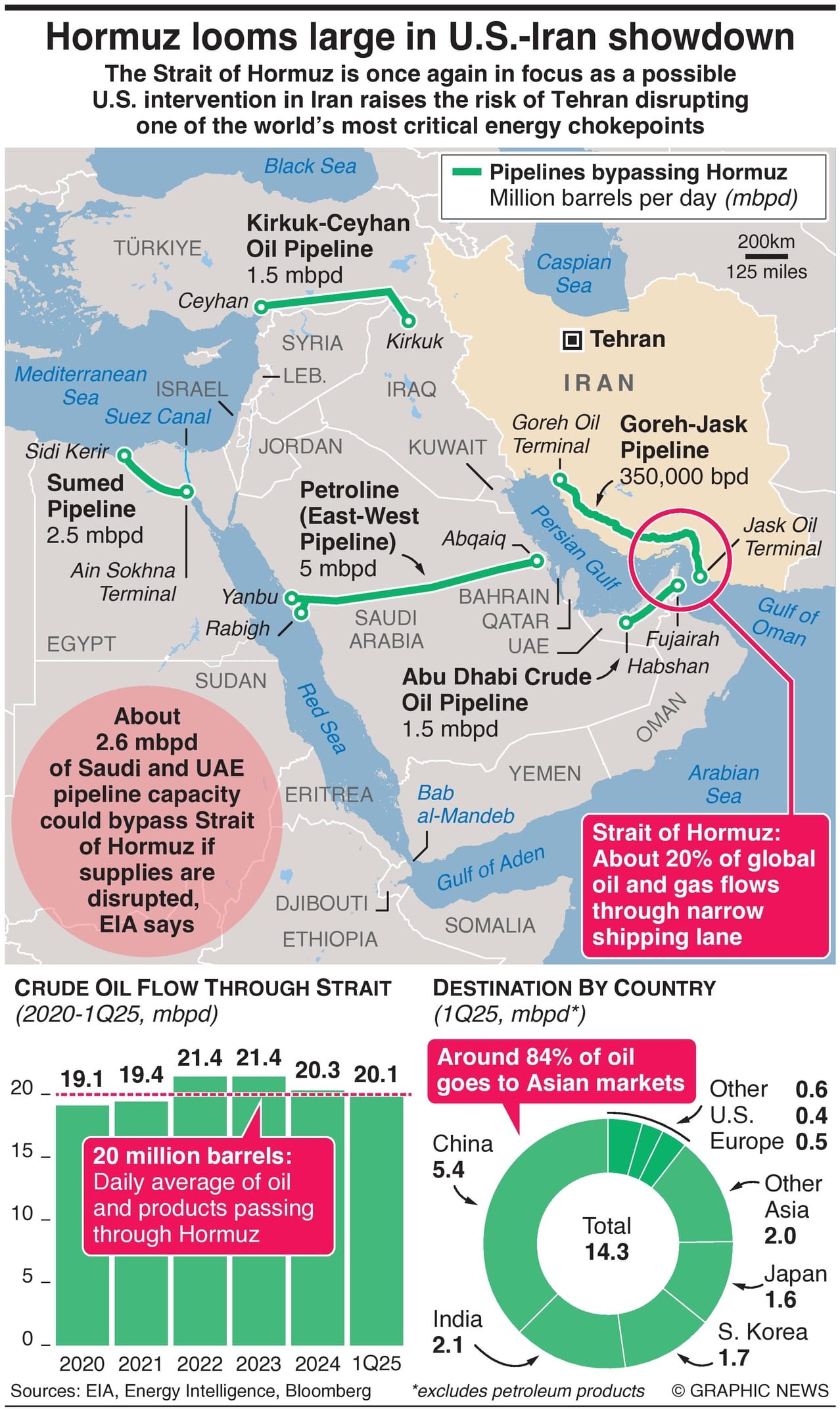
Washington has continued to build its military presence in the region as talks with Tehran began in Oman on Friday. Iranian officials, however, have played down expectations of a swift breakthrough, suggesting the negotiations are unlikely to quickly ease strains between the two sides.
Industry experts warn that any military confrontation could prompt Iran to disrupt traffic through the Strait of Hormuz, a narrow waterway linking the Persian Gulf with the Arabian Sea.
The Strait is vital to global energy markets, carrying about a fifth of the world’s total oil consumption. More than 20 million barrels a day of crude, condensate, and refined fuels transited the passage on average last year, according to the EIA.
Memory Chip Prices Surge 600% In Just Six Months
From game console makers like Nintendo to Apple suppliers, shares in consumer electronics companies are slumping amid a surge in memory chip prices driven by AI’s thirst for data center processing power.
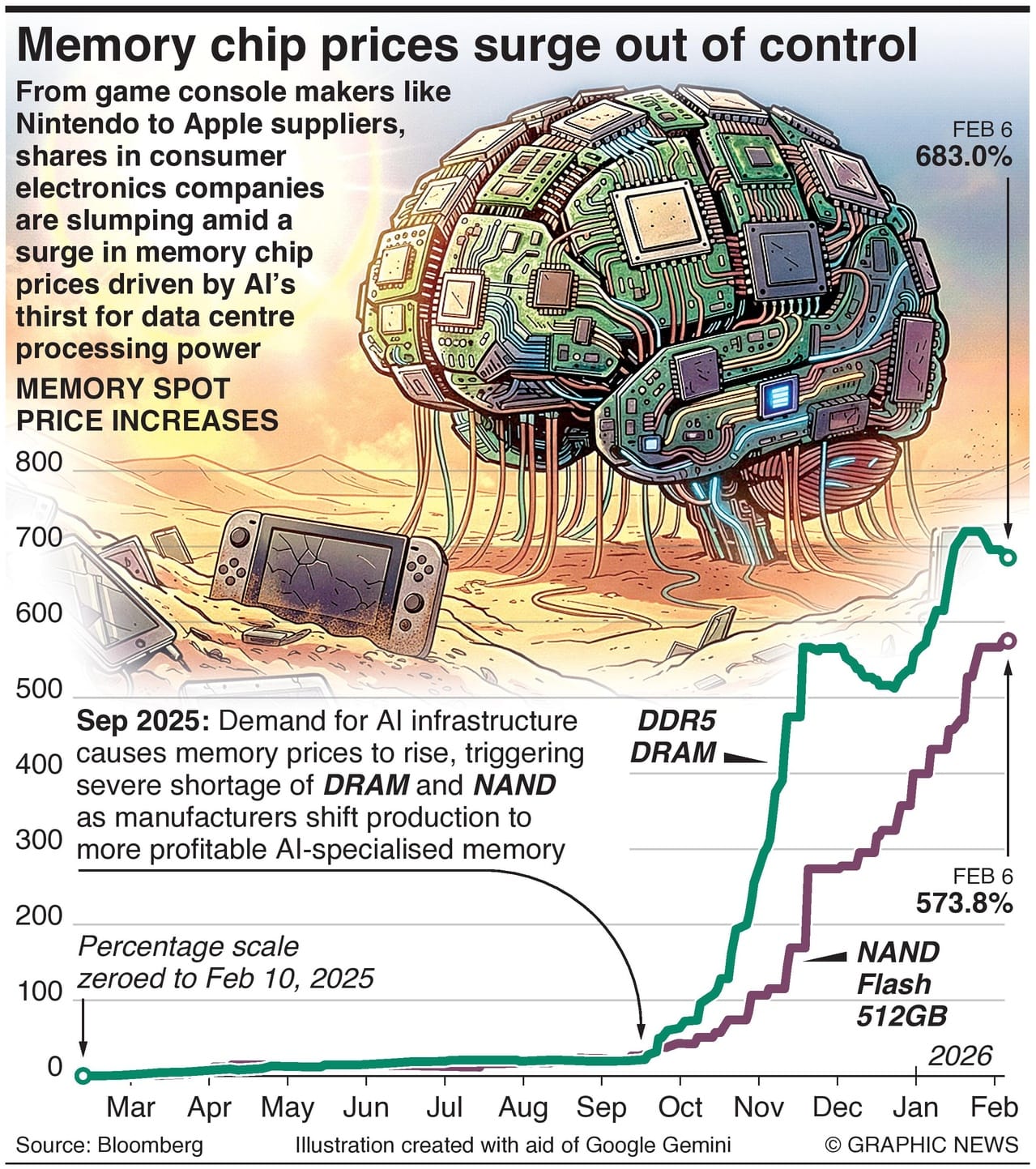
Investors are becoming alarmed as electronics companies struggle to cope with the rise – shares in Qualcomm fell more than 8% in February, and Nintendo saw its largest decline in 18 months after warning of margin pressures from chip shortages.
Of course, for every loser there is a winner – and so memory chip makers are seeing their shares rocket. SK Hynix, a key supplier of high-bandwidth memory to Nvidia, has seen its stock go up 150%. Kioxia Holdings and Nanya Technology have risen 270%, and Sandisk is up an astonishing 400%.
Catch up on today’s highlights, handpicked by our News Editor at TIPP Insights.
1. Russia Escalates Attacks On Ukraine’s Rail Lifeline
2. Takaichi's Japan Election Win Sparks China Alarm Over Possible End To Pacifist Charter
3. UK Prime Minister Crisis Highlights Europe’s Deep Anger At Political Leadership
4. King Charles Signals Cooperation As Prince Andrew Faces Epstein Scrutiny
5. Why Did Trump Threaten To Halt Opening Of New U.S.-Canada Bridge
6. Trump Sanctions Trigger New Crisis For Cuban Aviation
7. Americans Spend Similar Media Time, Habits Differ By Age
8. Frequent Marijuana Use Hits Record Levels
9. Electric Vehicles Require Far More Minerals Than Gas Cars
10. Top Immigration Officials To Testify As Congress Probes Enforcement Tactics
11. AI Giants Turn On Each Other As Pressure Mounts For Profits
12. December Retail Report Signals Consumer Slowdown
13. America Slides In Global Corruption Perception Index
14. Paramount Tries New Tactic To Derail Netflix-Warner Acquisition
editor-tippinsights@technometrica.com