

By Joel Kotkin & Jennifer Hernandez, RealClearInvestigations | November 11, 2025
In a recent focus group we held with 11 U.S. and foreign-born Latinos in Riverside, California, most of the participants expressed grave concerns about the breakup of hard-working and law-abiding families in what one participant called ICE’s “war” against Latinos. And yet, when asked if they were optimistic about the future, all 11 enthusiastically said “yes.”
Their responses reflected the broader patterns of progress and severe challenges we uncovered in an analysis of national data and on-the-ground reporting for our new report, “The Rise Of Latino America.” Even as President Trump reduces immigration flows, the country’s demographic and economic fate will be shaped increasingly by people with ties to Mexico, Central, and South America, who became the nation’s largest minority group in 2019. The key findings of our report, published by the Civitas Institute at the University of Texas, include:
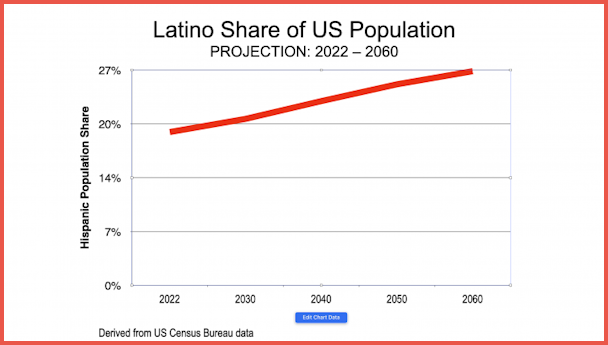
• Demographic Surge: Latinos have grown from 5% of the U.S. population in 1970 to 20% in 2023, accounting for 56.3% of population growth from 2010 to 2023. By 2060, they will drive nearly all net population growth.
• Economic Powerhouse: The U.S. Latino GDP reached $3.7 trillion in 2022, the world’s fifth-largest, growing at 4.6% annually and outpacing the national average. States like Texas and Florida see significant economic contributions from Latinos.
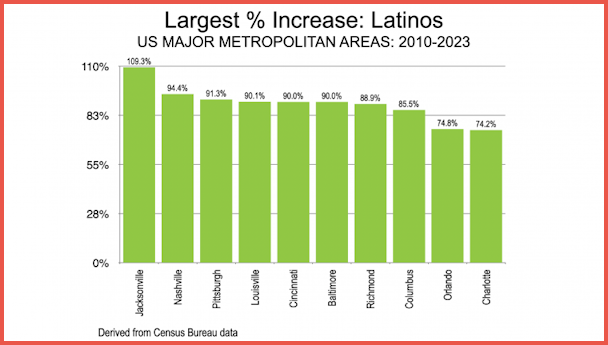
• Geographic Dispersion: Latino populations are spreading beyond the Southwest to the Midwest, Southeast, and smaller metros like Pittsburgh and Nashville, reflecting economic opportunity-seeking migration.
• Optimism Amid Challenges: Despite poverty rates (e.g., 29.6% for undocumented Latino immigrants in California) and educational gaps, 75% of Latinos remain optimistic about achieving their “dream home” and the American Dream. They also value hard work (94% cite it as key to success).
• Educational Progress and Gaps: Latino college enrollment has surged 372% since 1990, but only 16% earn bachelor’s degrees compared to 43% of whites, with lags in high-demand fields like technology.
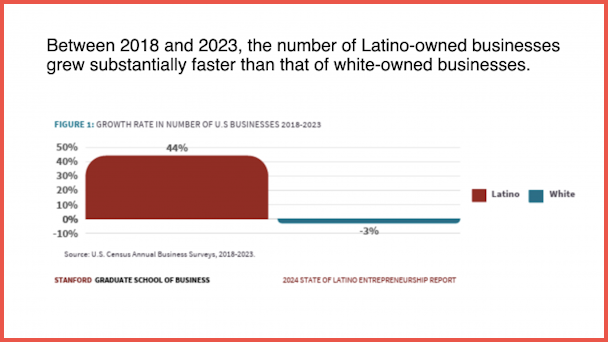
• Entrepreneurial Growth: Latino-owned businesses, especially in construction and food services, are the fastest-growing, employing 2.9 million workers with $620 billion in sales in 2019.
• Policy Barriers: High-cost housing policies, climate-driven regulations, and anti-car mandates in states like California increase living costs and limit job access, disproportionately harming Latinos.
• Policy Recommendations: We advocate for affordable single-family housing, lower regulatory barriers, sensible energy policies, and accessible transportation to support Latino priorities like homeownership, safety, and economic mobility. We urge policymakers to reject ideologically driven policies that hinder Latino progress, such as restrictive land use, costly climate mandates, and reduced personal mobility.
Embracing policies that align with Latino aspirations rooted in work, family, and opportunity will not only empower this vital population but also strengthen America’s economic and demographic future in a competitive global environment.
Population Growth & Dispersion
The fate of Latinos will only grow more important to the American story as their impact is felt throughout the country. Until fairly recently, Latino influence was felt primarily in the Southwest, with those from the Caribbean concentrating in cities like New York, Chicago, and Miami. Today, the fastest-growing Latino populations are now in the country’s interior, from the mid-South to the Great Lakes, where hard work makes homeownership affordable in communities without the usual public disorder and underperforming public schools that are common in those governed by progressives and their allies.
These new Latino “boomtowns” are largely outside the Southwest. They include such metropolitan areas as Charlotte, Pittsburgh, and Columbus, where Spanish-surnamed families were once rare, according to an analysis by our colleague, demographer Wendell Cox. Latinos in 2000 were more than 20% of the population in only four states; today, it is eight states. By 2030, the Census Bureau projects that Latinos will account for 22% of the national population.
Right now, the best opportunities overall for young Latinos lie outside the deep blue states. When looking at the two major Latino population hubs, California and Texas, employment rates for all age groups combined have grown faster in Texas. In 2023, the levels of Latino employment are higher than they were in 2018 in Texas – but lower in California.
The transformation of Latinos into a national, rather than largely regional, force is being felt even in the most iconic traditionally Anglo areas. As recently as 2000, less than 3% of metro Nashville’s population was Latino. By 2020, that percentage had more than tripled. Nashville may be the country music capital – the epitome of native White non-Hispanic American culture – but it is increasingly Latino. By 2040, one in three Nashville residents will be Latino, but so too will be many of its crooners. The new wave of country music included artists from Texas who are now based in Music City, such as Veronique Medrano, and Andrea Vasquez, host of the “Latina in Nashville” podcast.
Traditional Values
Even as many on the left sour on traditional American values and nativists on the right cast immigration as a threat to the Republic, our research shows that Latinos support America even more strongly – in terms of patriotism and public service – than the general population. Latinos are the fastest-growing portion of the nation’s active-duty military and local police departments. And when asked what the most important factors are to succeed in the U.S., 94% said “a strong work ethic and working hard.”
They also reflect the persistence of the American melting pot. In 2022, 30% of newlywed couples were interracial and included one Latino. Among native-born Latinos, 41% of marriages were interracial, compared to 11% among foreign-born Latinos. Even as they reflect specific and measurable attitudes that define them, broadly, as a group, Latinos are integrating into rather than separating from American communities.
Most remarkable is the level of optimism among Latinos about the chances of achieving the American Dream. Our polling experts confirm the diversity within the Latino community, but also many common threads in terms of aspirations for the future, and support for America – the country and its values.
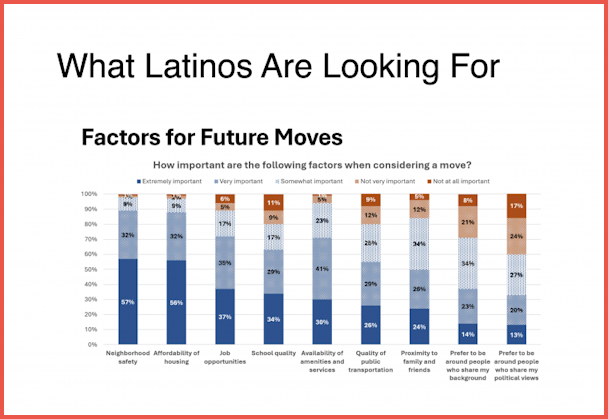
At a time when a majority of Americans who do not own homes fear they will never be able to afford one, three-quarters of our Latino respondents believe that they can achieve their dream of owning a home. We encountered similar sentiments in our two focus groups, one in San Antonio, Texas, and the other in Riverside-San Bernardino, California, made up of selected Latino leaders, businesspeople, educators, and academics. They focused notably on the importance of educational attainment and economic development, including jobs. Viewpoints varied, but many common themes, like patriotism, faith, family, hard work, and entrepreneurialism, were commonly embraced. Ultimately, their priorities, as expressed to our pollsters, are basically those shared by many Americans – affordability, safety, and good schools for their children. What matters far less? People who share their political views and ethnicity barely registered in our poll.
Break From Progressives
Although Latinos remain a key voting group for Democrats, our research shows that recent Republican inroads are not surprising given their disenchantment with many progressive policies on education and public safety – even as President Trump’s overzealous and unnuanced immigration policies appear to have driven many back to the Democratic Party, at least for now.
National polls show that Latinos are among the least likely groups to support police force funding cuts. Among self-described liberals, nearly 60% of Latinos oppose defunding police, far more than white liberals (27%) and Black liberals (44%). Communities that prioritize effective and efficient police, fire, and emergency medical services are much more aligned with Latino and middle-class goals than progressives who want to “reimagine” these basic services to advance faculty lounge ideologies.
The biggest challenge facing Latinos lies with education. To be sure, they have made remarkable progress and have increased in terms of college students by 372% from 1990 to 2020, and now represent more than 20% of all U.S. college students, up from 6% in 1990. Unfortunately, Latinos still lag behind in the key fields with the highest pay and future prospects, notably in technology, and are only now penetrating the upper reaches of management.
Ironically, often the worst results are found in progressive states like California, which tend to see themselves as most concerned with Latino and other minority residents. In California, for example, Latino students account for over 56% of all public-school students, but only 36% met English language proficiency standards, and just 22.7% met math proficiency standards. California students perform worse than their counterparts in Florida and Texas, and California Latinos rank among the bottom 10 states in higher educational degree attainment in the nation.
The education deficit clearly contributes to deepening poverty among immigrants. As recently as 1993, immigrants accounted for 14% of the U.S. population living in poverty, and non-citizens 11%; three decades later, immigrants made up almost a quarter of all poor people, and non-citizens over 13%. Immigrant poverty has risen to the highest level since 2008. Overall, Honduran (38.2%), Guatemalan (34.6%), and Mexican (27.6%) immigrants have poverty rates near or above 30%.
Here, again, Latinos are splitting from progressive politics. As many as 85% of Latino parents favor charter schools and school choice, something anathema to progressives. Wealthier families can flee dysfunctional public schools, but many Latino and other working-class families are stuck, the victims of bureaucratic inertia and decades of unaccountability for public school quality – especially in deep blue states and cities.
On immigration, a 2024 Pew survey found that 75% Latinos described the influx of immigrants during the Biden administration as a major problem. There is evidence that Trump’s aggressive crackdown on immigrants is also problematic for many Latinos.
Workforce Mainstay
Even amidst these challenges, Latinos continue to make outsized contributions to the workforce. Their labor force participation rate of 67.3% is significantly higher than the overall rate of 62.7% at a time when more white Americans are on the sidelines of employment.
Latinos are particularly critical to attempts to revive America’s “real economy” – jobs in the physical and not just digital realm. In Texas, according to a recent study by the Federal Reserve Bank of St. Louis, as many as half of all manufacturing workers are foreign-born and constitute over 20% of the manufacturing workforce in Illinois and Nebraska. In old industrial metros like Toledo, immigrant workers are the primary source of labor market growth in an area that is still experiencing population decline. Today, barely 58% of all working-class Americans are white non-Hispanics; according to a 2016 Economic Policy Institute study, Latinos and other people of color will constitute the majority of the working class by 2032.
Latinos’ critical role in real-world jobs should prove particularly well-timed in a season where the professional service and digital economy are shedding jobs. In the wake of artificial intelligence, college graduates face a job market getting tougher even for those with expensive advanced degrees.
Unlike the contracting keyboard economy, there is growing interest in high-paying alternatives in fields such as manufacturing, logistics, and construction, which require workers to be physically present and mobile to provide in-person services, manufacture and convey goods, collect, process, and distribute food and materials used by other households and employers. These are professions where the Latino presence is particularly strong.
However great their work ethic, in a world shaped by AI, machine learning, and robots, Latinos in the “carbon economy” need to get more training in key skills. While positions requiring extensive manual labordropped to 22% of all jobs in 2025 from 35% 50 years ago, the U.S. suffers a deficit of more than 600,000 skilled manufacturing workers and a projected shortage of 2.4 million by 2028. In an era where most other Western and East Asian countries face large declines in their workforces, Latinos and other immigrants provide a critical accelerant to the U.S. workforce.
The Future of U.S. Politics
Addressing U.S. Latino priorities should not be cast as a red-blue partisan conflict, but rather seen as yet another endorsement of the desirability of widespread American values and ambitions. As we state in the conclusion of “The Rise of Latino America”:
Localities that promote affordable housing, energy, and services, and allow for a full spectrum economy will attract an increasingly larger share of the nation’s fastest growing and hard-working Latino cohort. Latinos, this report shows, are more than willing to “vote with their feet” and relocate to less expensive, often peripheral, and even rural areas to obtain the housing, employment, and time with their families that they prioritize. This is particularly relevant in states like California or Texas, where Latinos have heavily settled and that represent a huge part of the economy. As Latinos disperse, this will become ever more the case in most of the country. Policymakers that align their program with this vital segment’s priorities will likely prevail in the battle for talent and capital. Those who do not will lose this population and, in effect, erode their future influence.
Despite the left’s efforts to consign people to specific ethnic groups and the racialist rhetoric of nativist forces on the right, Latinos do not constitute a permanently separate people, whose interests revolve around “La Raza” and racial reparations. Rather than a disruptive threat, Latinos represent America’s secret weapon – the latest shift in the remarkable and evolving “race of races,” as Walt Whitman put it, that has been the enduring reality of the United States. Ultimately, there is only one America, perhaps a little browner and less European, but when not actively undermined by woke identitarians, it embraces and is enriched by its diversity to make it more remarkable still.
Joel Kotkin is the presidential fellow in urban futures at Chapman University in Orange, California and a senior research fellow at the Civitas Institute at the University of Texas, Austin. Jennifer Hernandez has written three books and more than 50 articles on environmental and land use topics. She regularly teaches land use, environmental, and climate law in law and business schools, colleges, and seminars.
Original article: RealClearInvestigations
Catch up on today’s highlights, handpicked by our News Editor at TIPP Insights.
1. Zelensky Moves To Sanction Ex-Associates In Major Corruption Probe
2. Trump Urges Israeli President To Pardon Netanyahu In Corruption Trial
3. Herzog Responds To Trump’s Letter Demanding Netanyahu Pardon
4. UK Prime Minister Starmer Battles Ouster Rumors As Labour’s Poll Numbers Collapse
5. Why China’s Newly Built Bridge Collapsed Just Months After Opening
6. BBC Board Convenes Emergency Meeting Over Trump’s $1 Billion Threat
7. 20 Turkish Troops Dead After C-130 Plane Crash In Georgia
8. Venezuela Flexes Military Muscle As Trump Administration Ramps Up Caribbean Operations
9. Trump Defends H-1B Visas, Says America Needs Skilled Foreign Workers
10. Faith Meets Tech: How AI Is Transforming The Modern Church
11. Google Files Landmark Lawsuit Against Chinese Cybercrime Network
12. House Democrats Release Epstein Emails Referencing President Trump
13. Trump Officials Weigh House Push To Release DOJ’s Epstein Files
Market Pulse
editor-tippinsights@technometrica.com