
The cost of higher education has become a major issue for many, if not most, American parents and even grandparents. As education costs explode, so has the amount of debt students have to pay off after they graduate. This month's I&I/TIPP Poll asks: Is it worth the cost? And what role should government play?
The national online I&I/TIPP Poll, taken by 1,464 adults from April 28 to May 1 , asked voters four education-finance related questions. The poll has a margin of error of +/-2.9 percentage points.
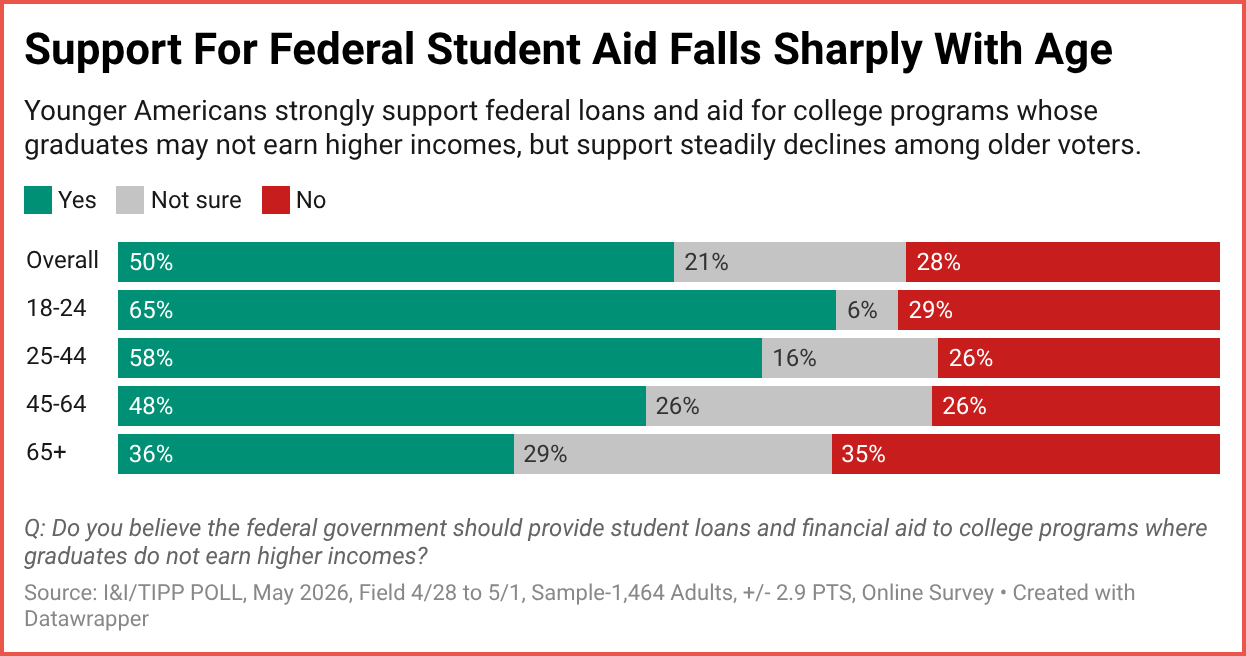
The first question: "Do you believe the federal government should provide student loans and financial aid to college programs where graduates do not earn higher incomes?"
Perhaps surprisingly, 50% answered "yes," versus just 28% who answered "no." Another 21% were not sure.
But the responses were demographically skewed, perhaps in predictable ways.
For instance, those who are likely to be paying off student debts are also most likely to support federally funded loans: Among those 18 to 24 years, support is 65%; 25 to 44 years, 58%; 45 to 64 years, 48%; and those over 65 years, just 36%.
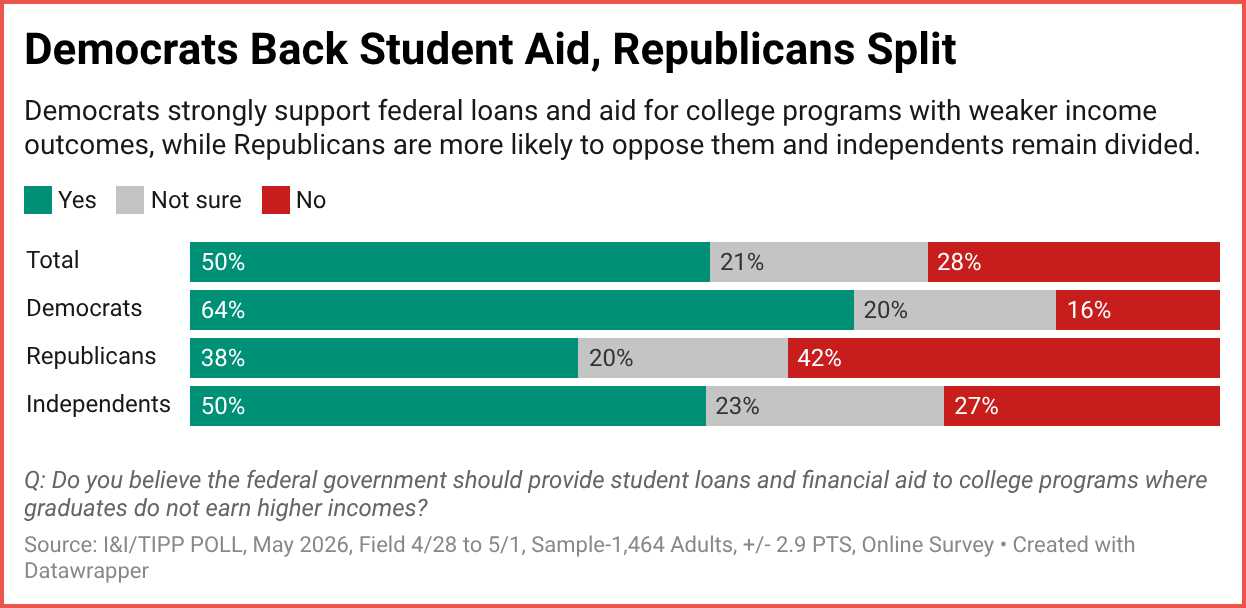
Political party affiliation also plays a role: 64% of Democrats answered "yes," just 16% "no." That compares to independents (50% yes, 27% no) and Republicans (38% yes, 42% no).
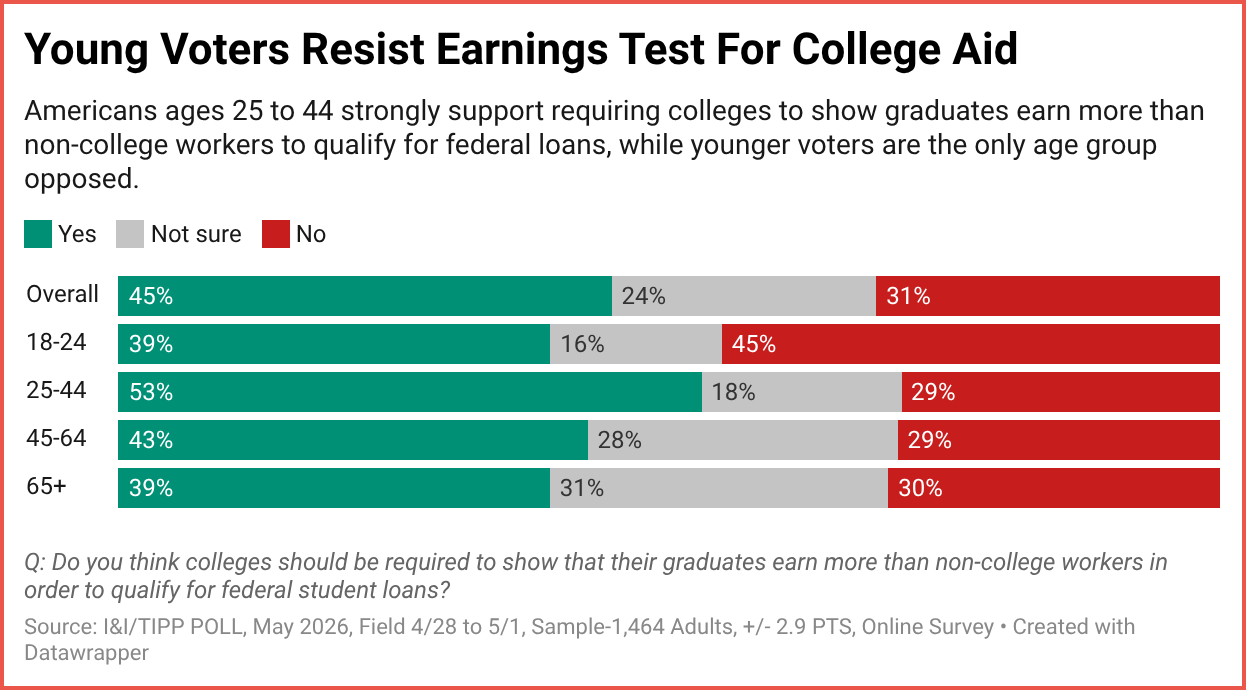
What about the colleges' and universities' role in student debt? I&I/TIPP asked: "Do you think colleges should be required to show that their graduates earn more than non-college workers in order to qualify for federal student loans?"
Again, "yes" (45%) exceeded "no" (31%) and "not sure" (24%). But as with the first question, answers varied by demographic.
For instance, of the four major age groups, only those in the youngest cohort, 18 to 24 years of age (39% yes, 45% no) opposed the idea. All other age groups supported it.
Meanwhile, men (51% yes, 31% no) were far more likely to support the idea than women (38% yes, 32% no), while Democrats (38% yes, 37% no) were a statistical tossup when compared to Republicans (52% yes, 28% no) and independents (45% yes, 28% no), both solidly in the "yes" camp.
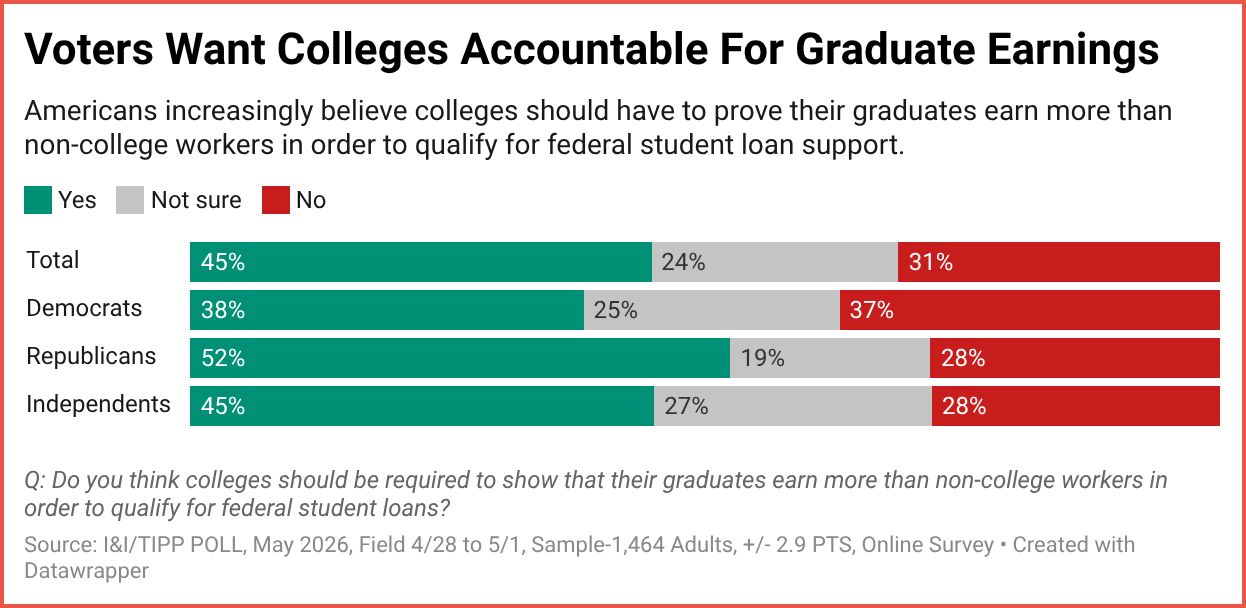
Race once again provides some contrasts, though maybe in surprising ways: white Americans (45% yes, 29% no) overall approve of the idea of having higher education prove its market worth, but they were exceeded by Hispanics (51% yes, 27% no). And Hispanics differ greatly from black Americans (39% yes, 42% no) on the issue.
A third question asks of voters: "How common do you think it is for students to graduate with degrees that do not lead to better job or income opportunities?"
On this question, Americans are unquestionably negative: 78% said it was either "very common" (35%) or "somewhat common (43%), compared to just 13% who replied that it was "not very common" (10%) or "not at all common" (3%).
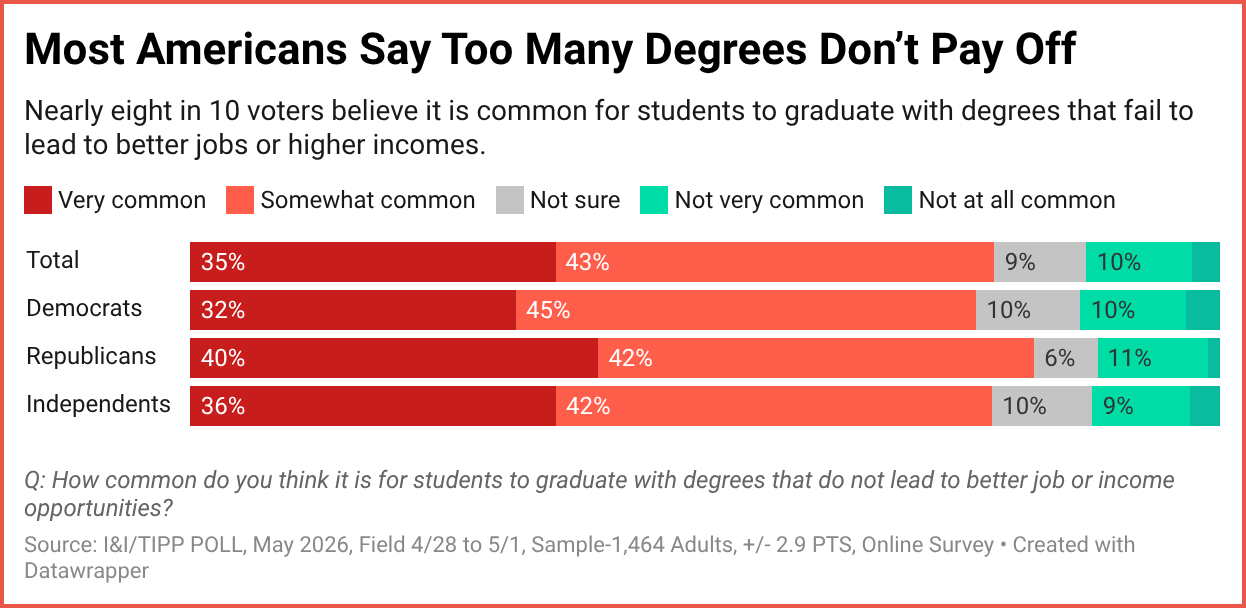
Based on this, a large majority of voters harbor deep doubts over the actual worth of a college degree, both in terms of income and opportunity. Indeed, none of the 36 demographic groups I&I/TIPP follows each month scored less than 71% saying it was "common."
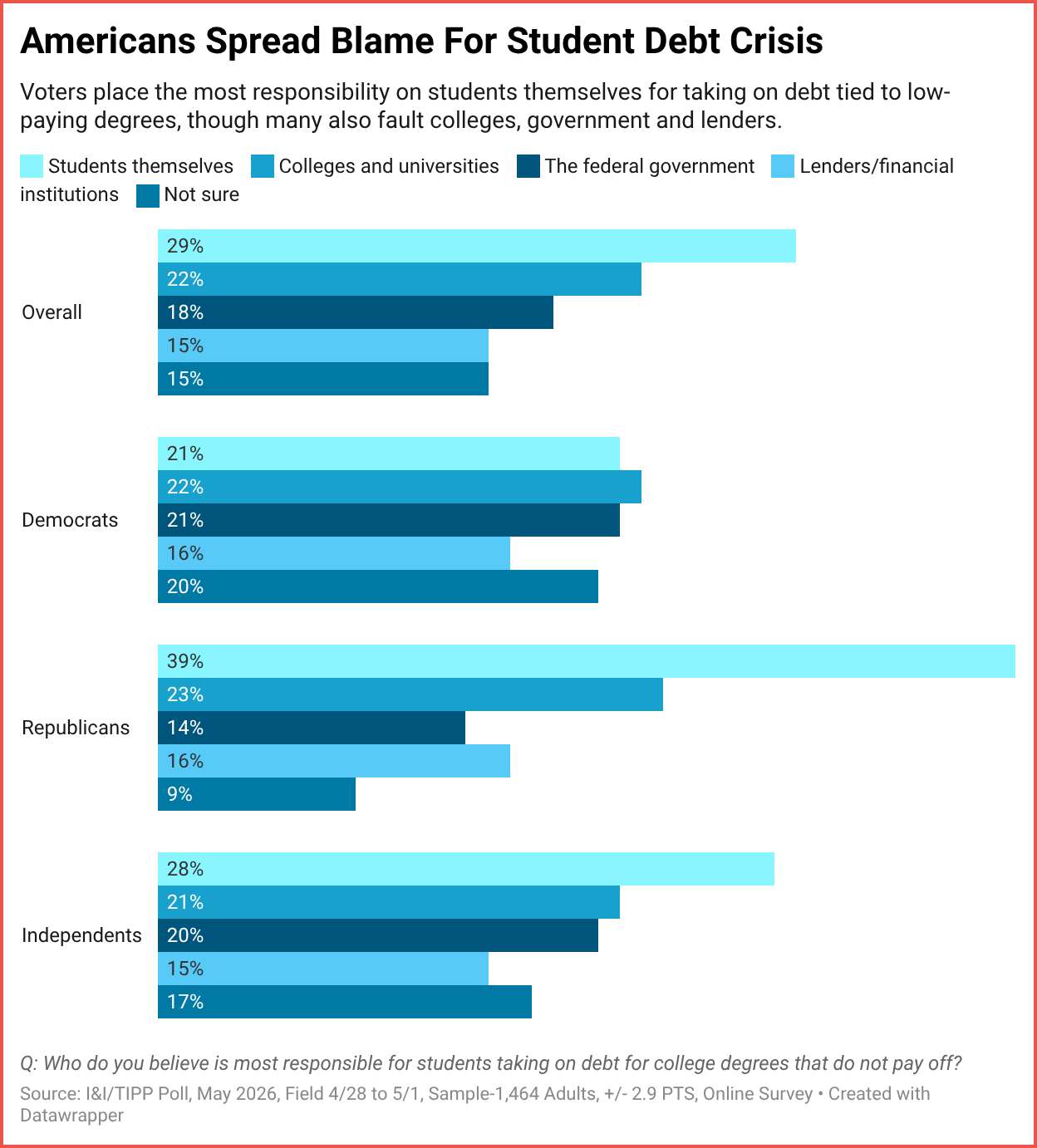
Finally, whose fault is it all? The fourth question asks: "Who do you believe is most responsible for students taking on debt for college degrees that do not pay off?"
Voters were generous in spreading the blame: 29% said "students themselves," 22% said "colleges and universities," 18% responded "federal government," and 15% said "lenders/financial institutions." Another 15% were unsure whom to blame.
A picture emerges of Americans seeing higher education, once a golden ticket to a better life, as now a cynical game that leads to young people being saddled with debts and unable to cash in on the promise of better jobs and higher pay.
"When the United States began its experiment with federally backed student loans in the 1960s, no one predicted that, by the early 21st century, students would have run up over $1.8 trillion in debt and that many of them would be unable to repay what they owe," according to a new report from The James G. Martin Center for Academic Renewal. "We were told over and over that college debt was good debt because of the huge increase in lifetime earnings that a degree was supposed to guarantee."
But it didn't turn out that way.
Americans now owe $1.84 trillion in federal and private student loan debts, a massive amount by any count. For some, the payments will be a huge financial burden they'll carry throughout their careers.
Even so, didn't the availability of debt for students turn out to be a good deal? Not really. What it mostly did was raise tuitions. A 2015 study by the New York Federal Reserve found that for every dollar in added student debt there's a "passthrough" increase of 60 cents in the cost of tuition.
Lavish student lending, in short, drives tuition prices sharply higher, clearly an unintended consequence of a system intended to make college education more affordable.
There's another looming issue, perhaps the most significant yet: Artificial intelligence. There are signs that young graduates are having a tougher time finding entry-level jobs in their chose fields due to the growing presence of AI in the workplace. Jobs once done by neophyte workers can now often be done by AI, at much lower costs.
It's already a problem, it seems. The unemployment rate for just-graduated students is 33% higher than the rate for the overall population.
The question lingers: Is more government involvement in handing out student loans needed? Or will it just prolong the "higher education bubble" that now seems ready to pop? If so, what will higher education look like in the future?
As May's I&I/TIPP Poll shows, Americans are not happy with the high levels of debt required to get a college education. They want schools, students and their parents to take greater responsibility in preparing students for a well-paying career, rather than letting them graduate with a useless degree, no job prospects, and tens of thousands of dollars in unpayable student loans.
I&I/TIPP publishes timely, unique, and informative data each month on topics of public interest. TIPP’s reputation for polling excellence comes from being the most accurate pollster for the past six presidential elections.
Terry Jones is an editor of Issues & Insights. His four decades of journalism experience include serving as national issues editor, economics editor, and editorial page editor for Investor’s Business Daily.
👉 Show & Tell 🔥 The Signals
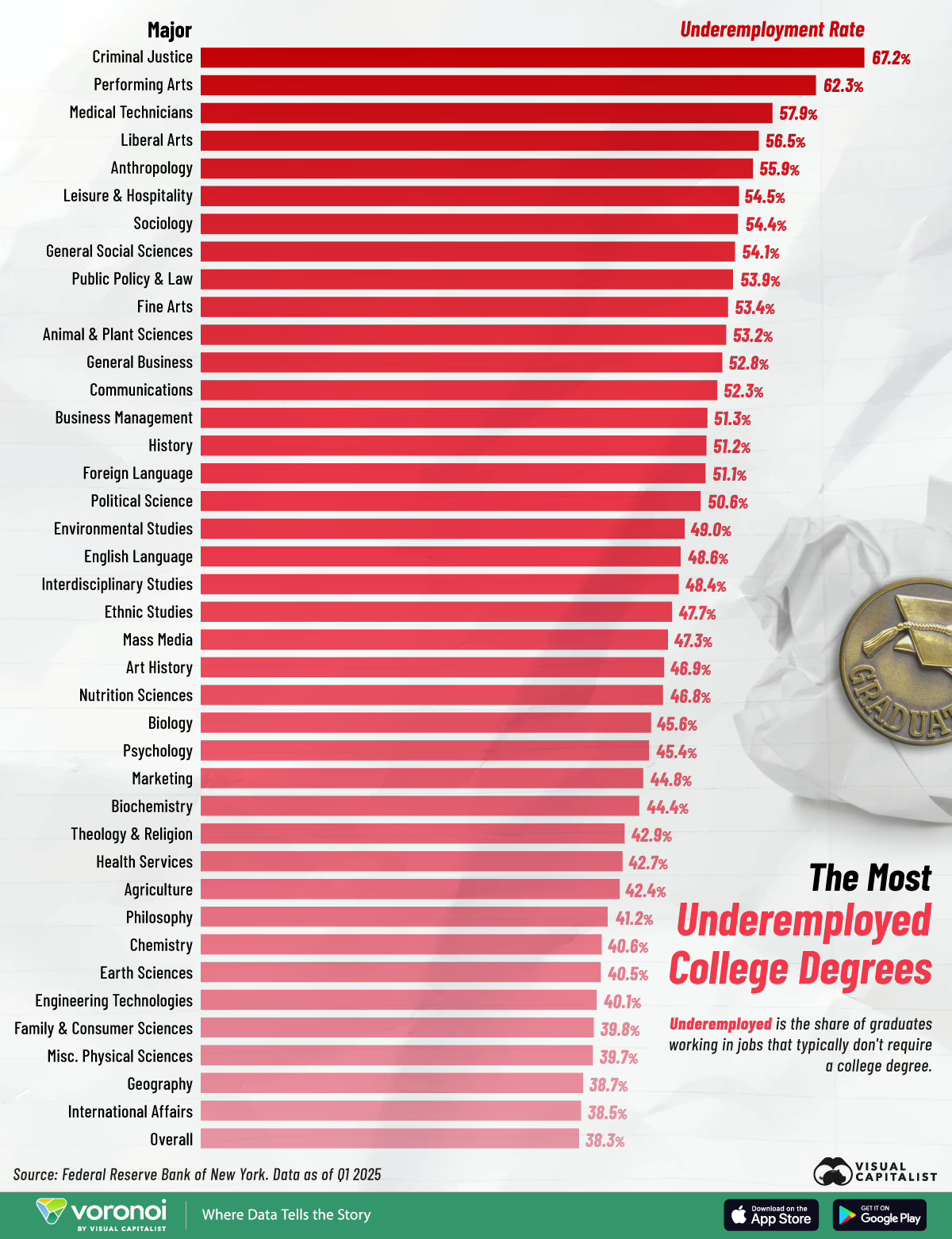
I. Many Degrees Aren’t Leading To Degree-Level Jobs
New data shows underemployment remains stubbornly high for many college majors, with more than half of graduates in several fields working jobs that typically do not require a degree. Criminal justice, performing arts, and liberal arts rank among the most underemployed majors, underscoring growing concerns about college ROI.
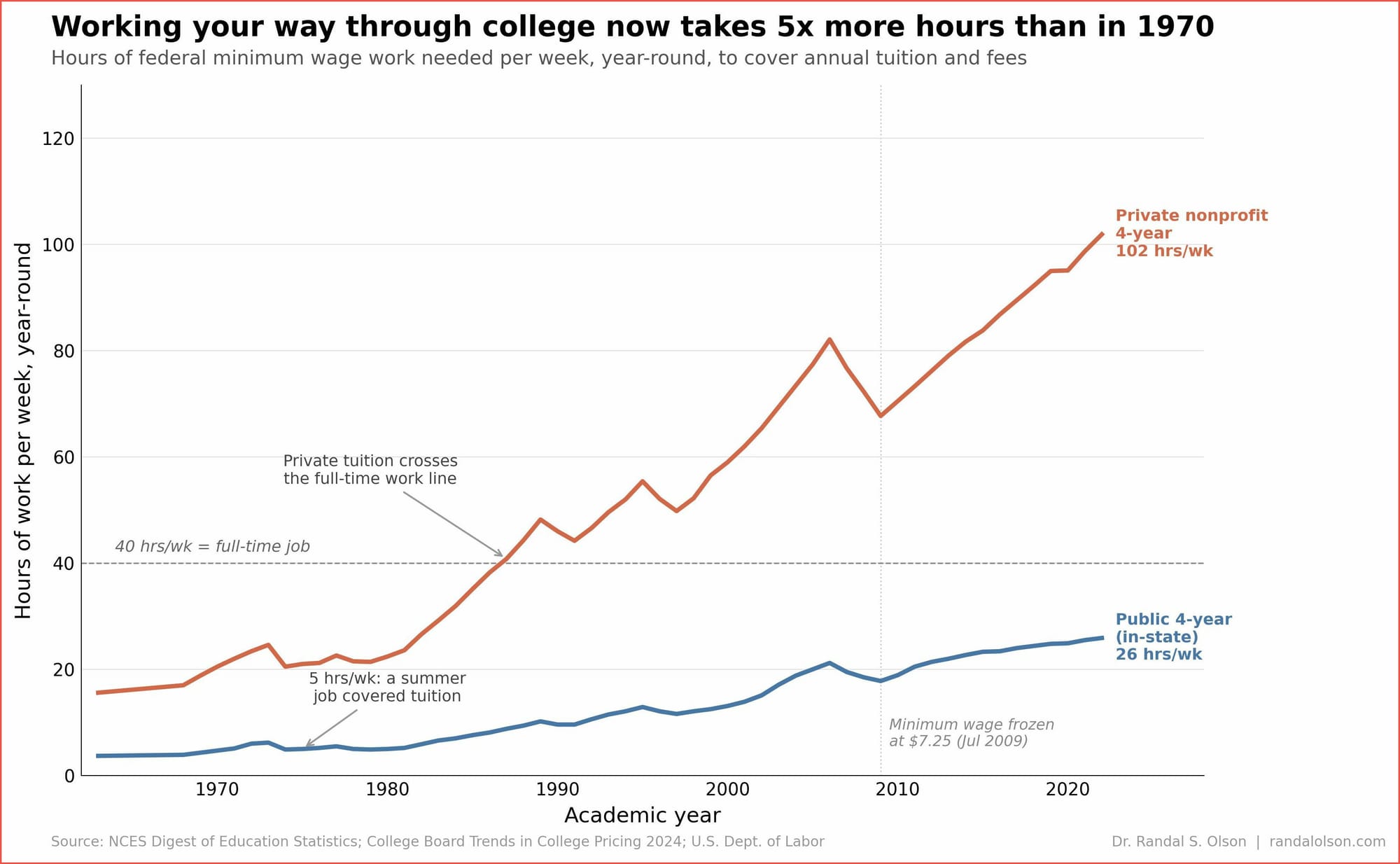
II. Working Through College No Longer Works Like It Once Did
A student working minimum wage now needs far more hours to cover college tuition than in past generations, especially at private universities. The gap between wages and higher education costs has widened sharply since 1970, raising fresh questions about affordability and student debt.
📊 Market Mood — Tuesday, May 19, 2026
🟩 Markets steadied Tuesday as hopes for a possible Iran peace deal offset lingering concerns about inflation, oil prices, and rising bond yields.
🟧 President Donald Trump said he had paused new attacks on Iran while “serious negotiations” continue, helping ease some geopolitical fears that had rattled markets in recent days.
🟦 Oil prices slipped but remained elevated near $110 a barrel, keeping investors focused on the risk that the Iran conflict could still fuel a broader global inflation shock.
🟨 The AI boom stayed firmly in focus after Google and Blackstone unveiled plans for a major new AI cloud venture, while investors awaited Nvidia earnings later this week.
🗓️ Key Economic Events — Tuesday, May 19, 2026
No Events Scheduled
Letters to the editor email: editor-tippinsights@technometrica.com
Subscribe Today And Make A Difference. Consider supporting Independent Journalism by upgrading to a paid subscription or making a donation. Your support helps tippinsights thrive as a reader-supported publication. Contact us to discuss your research or polling needs.
Reach our audience. For sponsorship and advertising opportunities, visit our Partner With Us page.