
Is there a serious crisis of confidence in the Social Security system? It certainly looks that way, based on the latest national online I&I/TIPP Poll, which was taken June 29 through July 2 by 1,473 Americans.
The poll's first question asked voters: "How confident are you that Social Security will pay full scheduled benefits throughout your retirement?"
Among those responding, 43% said they were either "very confident" (16%) or "somewhat confident" (23%). But 47% answered either "not very confident" (23%) or "not at all confident" (24%). Another 10% said they were not sure.
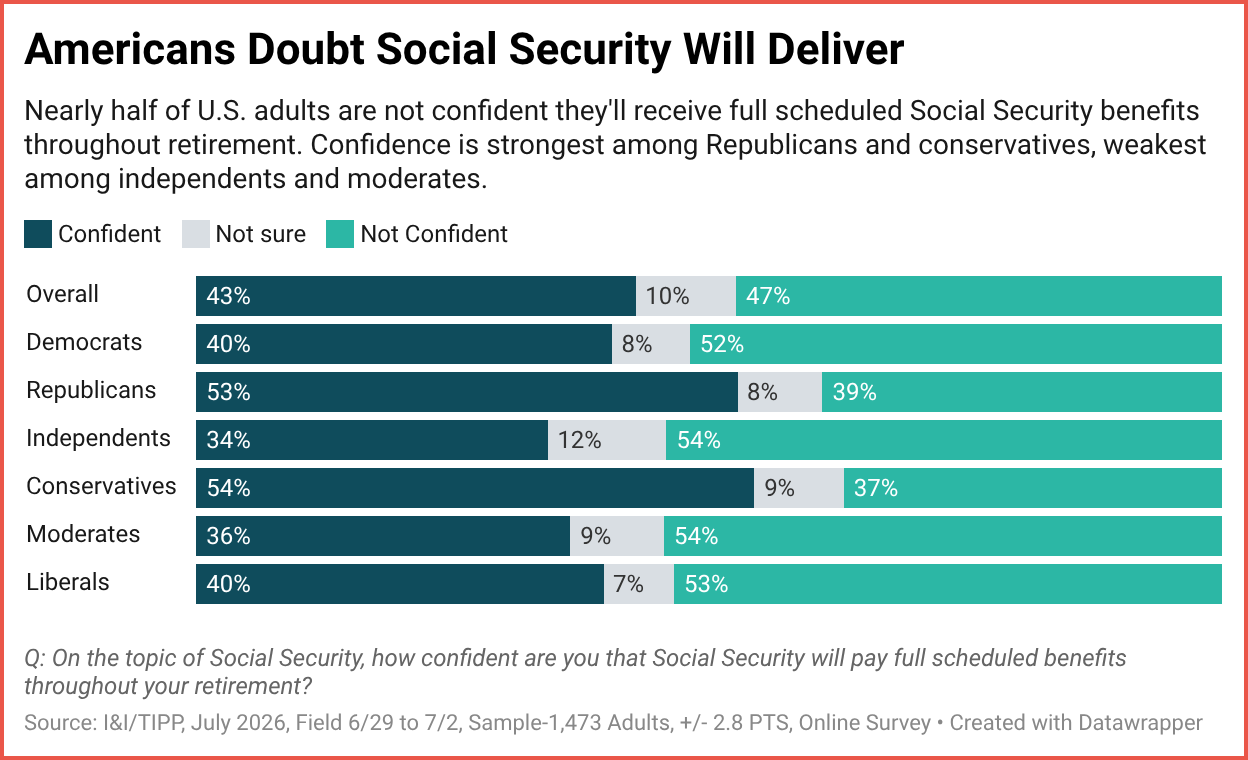
The poll has a margin of error of +/-2.8 percentage points.
Confidence in Social Security, it seems, has a political component. Democrats (52% not confident, 40% confident) and independents (54% not confident, 34% confident) were most gloomy about Social Security's fiscal solvency, while Republicans (39% not confident, 53% confident) were a near mirror image.
Age of those responding showed an interesting pattern: The youngest Americans, those aged 18-24 years (31% not confident, 53% confident) and those 65 years and older (45% not confident, 49% confident) were on net confident that Social Security would muddle through. Meanwhile, those in the middle of their working careers ages 25-44 years (48% not confident, 44% confident) and 45-64 years (55% not confident, 34% confident) were on net not confident.
So plainly, there is a confidence problem, particularly with current projections showing the Social Security trust fund will be empty by 2032, a mere six years from now, requiring either big tax hikes or benefit cuts or both to remain solvent.
By then, according to the June 2026 Social Security Trustees Report, incoming payroll taxes will cover only about 78% of expected benefits, leaving a massive financing hole to fill.
So the question has acquired a sense of urgency. Given the very real threat of Social Security insolvency, how should Congress deal with this looming potential financial catastrophe?
Specifically, I&I/TIPP asked voters: "Which should Congress prioritize when reforming Social Security?"
The most popular response was "Protect benefits for future retirees," 33%, while "Protect benefits for current retirees" was a close second at 31%. Coming in a distant third was "Keep payroll taxes from increasing" and "Reduce the federal deficit," both at 10%.
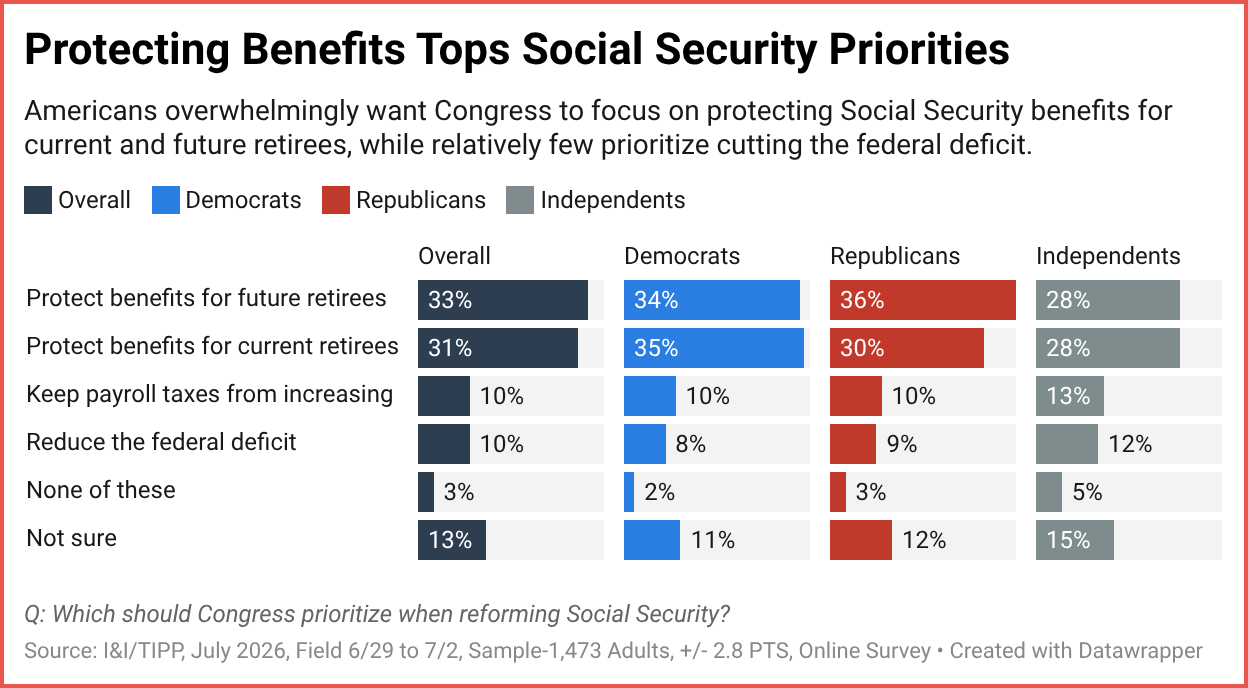
Among the three major political groupings, responses were generally of a similar magnitude, although those who described themselves as independents tended to favor not raising payroll taxes and cutting federal deficits more than either the Democrats or Republicans, who tended to favor protecting benefits.
As a final question, I&I/TIPP asked: "If only one option could be chosen to strengthen Social Security, which would you prefer?"
The responses illustrate why, from a political standpoint, fixing the problem will be hard for Congress.
The top two answers: "Raise taxes on higher-income Americans" (38%), and "Reduce benefits for wealthier retirees" 22%. Doing the math, that means 60% would back balancing Social Security by higher taxes or by lower benefits for those deemed wealthy.
Far lesser support was found for "Gradually increase the retirement age" (13%) and "Reduce benefits for everyone equally" (8%).
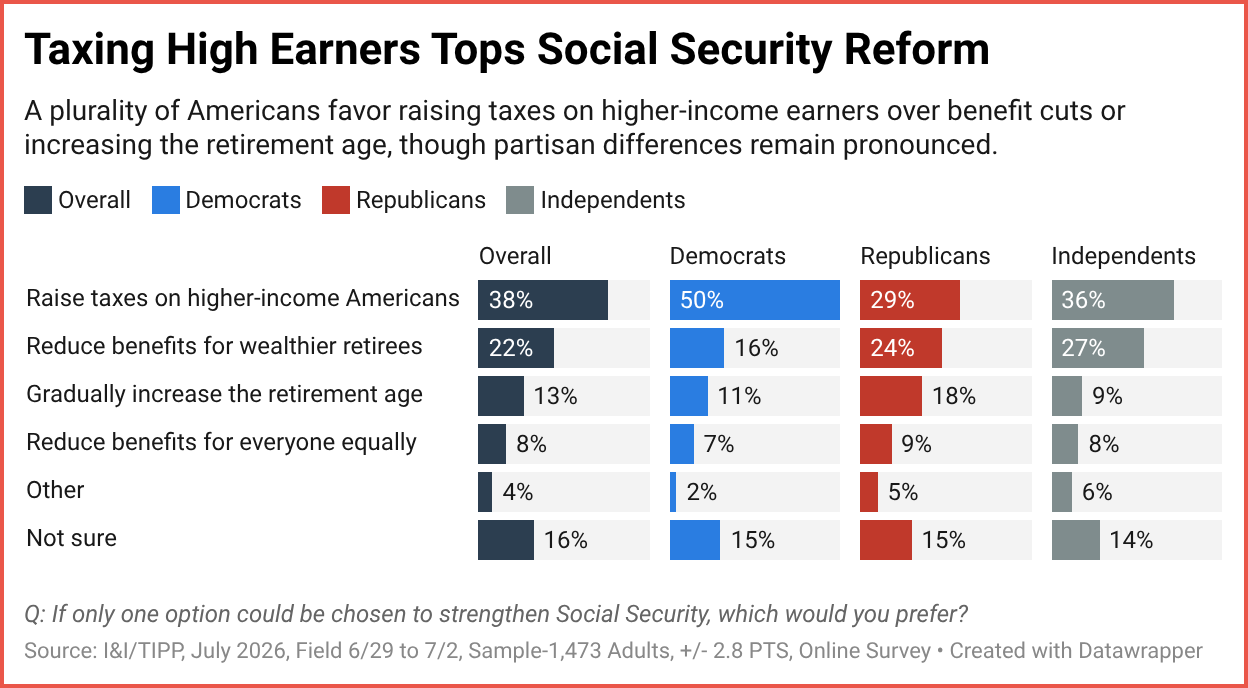
And, as often the case, political affiliation played a role in determining responses.
A 50% majority of Democrats favored raising taxes on the wealthy, compared to just 29% of Republicans and 36% of independents. Reducing benefits for the wealthy got just 16% support from Dems, but 24% from GOP respondents and 27% from independents.
Gradually lifting the retirement age found 11% support among Democrats, 18% among Republicans, and just 9% among indie voters. As for cutting benefits for everyone equally, that was the least popular solution among all groups: 7% for Dems, 9% for GOP, and 8% for independents.
Clearly, there is a plurality of Americans who lack confidence in Social Security and broad majority consensus that benefits for current and prospective generations of workers must be protected.
Will a Congress currently riven by strong ideological differences on key economic questions, including Social Security, be able to muster a working consensus to save Social Security from its imminent collapse?
That is not a rhetorical question. The last really major overhaul of Social Security took place in 1983, when the Social Security Reform Act was passed into law. It raised social security taxes on wages and the eligibility age, which "resolved the short-term financing problem and made many other significant changes in Social Security law," as the Social Security Administration notes.
That "short term financing problem" phrase is key to understanding that Social Security's underlying problems have never really been resolved. It's a tough issue, and Congress has repeatedly kicked the can down the road.
A bill currently before Congress tries to fix that. The PROMISE Act (Protecting Retirement Opportunities and Maintaining Income Security for Everyone Act), which has bipartisan support, seeks to push Congress to make significant changes to Social Security before it goes bust. The one requirement: Those changes need to provide at least 50 years of solvency for the program, now expected to go broke in 2032.
Would taxing the rich work? Currently, Social Security taxes are levied only on the first $184,500 in income. So those earning more than that don't get taxed beyond that amount. But while raising taxes on the "wealthy" has great appeal, unfortunately that doesn't fix the problem. Even advocates acknowledge it doesn't solve anything.
Cutting benefits is also problematic.
Social Security now pays benefits to 71 million Americans (that is, voters) each month. That number is growing rapidly as the Baby Boomers continue to retire, soon to be joined by Gen X and Millennials. Meanwhile, more people are living longer, as the number of workers entering the workforce is slowing dramatically as families have fewer children.
"Around the end of the baby boom in 1960, the average number of children born to a woman was 3.6; by 2020, that number had declined to 1.6," according to the Peter G. Peterson Foundation. "The decline in fertility rate means that the working generation is getting smaller relative to the generation receiving benefits."
That's the financing problem in a nutshell. One proposal in the hopper from Sen. Bill Cassidy points to reforms made to the federally-run Railroad Retirement System in 2001, which was a fiscal mess. Those reforms set up a separate investment trust fund for retirees, overseen with the same fiduciary standards that private plans have. In Congress, that plan was truly bipartisan: Every Democrat in the Senate voted for it.
"The Railroad Retirement Board (RRB) works," Cassidy said in February. "It’s truly solvent, successfully providing a wide range of benefits to rail workers and their families, including retirement, survivor, disability, unemployment, sickness, and vested dual benefits."
That's one model for a permanent fix. And there are others that would be possible. Raising the age of retirement by a year or two; giving workers a choice between private accounts pegged to major stock market indexes or continued federal funding; raising Social Security taxes; or cutting benefits.
As the I&I/TIPP Poll shows, there are no easy or wildly popular solutions. That's because in tough economic questions, there are no solutions, only tradeoffs, as the economist Thomas Sowell has said. And Americans will soon be asked to make their tradeoffs.
I&I/TIPP publishes timely, unique, and informative data each month on topics of public interest. TIPP’s reputation for polling excellence comes from being the most accurate pollster for the past six presidential elections.
Terry Jones is an editor of Issues & Insights. His four decades of journalism experience include serving as national issues editor, economics editor, and editorial page editor for Investor’s Business Daily.
📊 Market Mood · July 27, 2026
How the trading day is setting up.
🟩 Markets begin the week with cautious optimism as investors prepare for a flood of earnings from the largest technology companies and the Federal Reserve's policy meeting later this week.
🟧 The AI trade faces another critical test as results from Microsoft, Meta, Amazon, and Apple are expected to show whether heavy investment in artificial intelligence is translating into stronger profits.
🟦 Treasury yields and oil prices remain elevated, keeping inflation concerns alive and reinforcing expectations that the Fed will leave interest rates unchanged while signaling a data-dependent outlook.
🟨 Investors are entering one of the busiest weeks of the quarter, with earnings, the Fed decision, and key labor market reports likely to determine the market's next direction.
🗓️ Key Economic Events
On today's U.S. data calendar.
No major U.S. economic reports are scheduled.
Letters to the editor email: editor-tippinsights@technometrica.com
Subscribe Today And Make A Difference. Consider supporting Independent Journalism by upgrading to a paid subscription or making a donation. Your support helps tippinsights thrive as a reader-supported publication. Contact us to discuss your research or polling needs.
Reach our audience. For sponsorship and advertising opportunities, visit our Partner With Us page.