With the 25th anniversary of the 9/11 attacks nearly here, Americans are sure to be asking themselves questions. Are we still vulnerable to terrorist attack? If so who's most likely to next attack? And can the government protect us? Americans want answers, and this month's I&I/TIPP Poll provides them.
The quarter-century remembrance of the deadly attacks on the World Trade Center, the Pentagon, and the heroic passengers of Flight 93, killing 2,977 people, will no doubt bring fresh discussion of our vulnerability to terrorism.
Our special I&I/TIPP Poll focusing on 9/11 asks Americans: "How concerned are you that the United States will experience a major terrorist attack in the next few years?"
As it turns out, 25 years after 9/11 a majority still worry about terrorist attacks: 65% they're either "very concerned" (27%) or "somewhat concerned" (37%) (figures may not add due to rounding). Just 26% described themselves as either "not very concerned" (17%) or "not at all concerned" (9%). Another 10% were not sure.
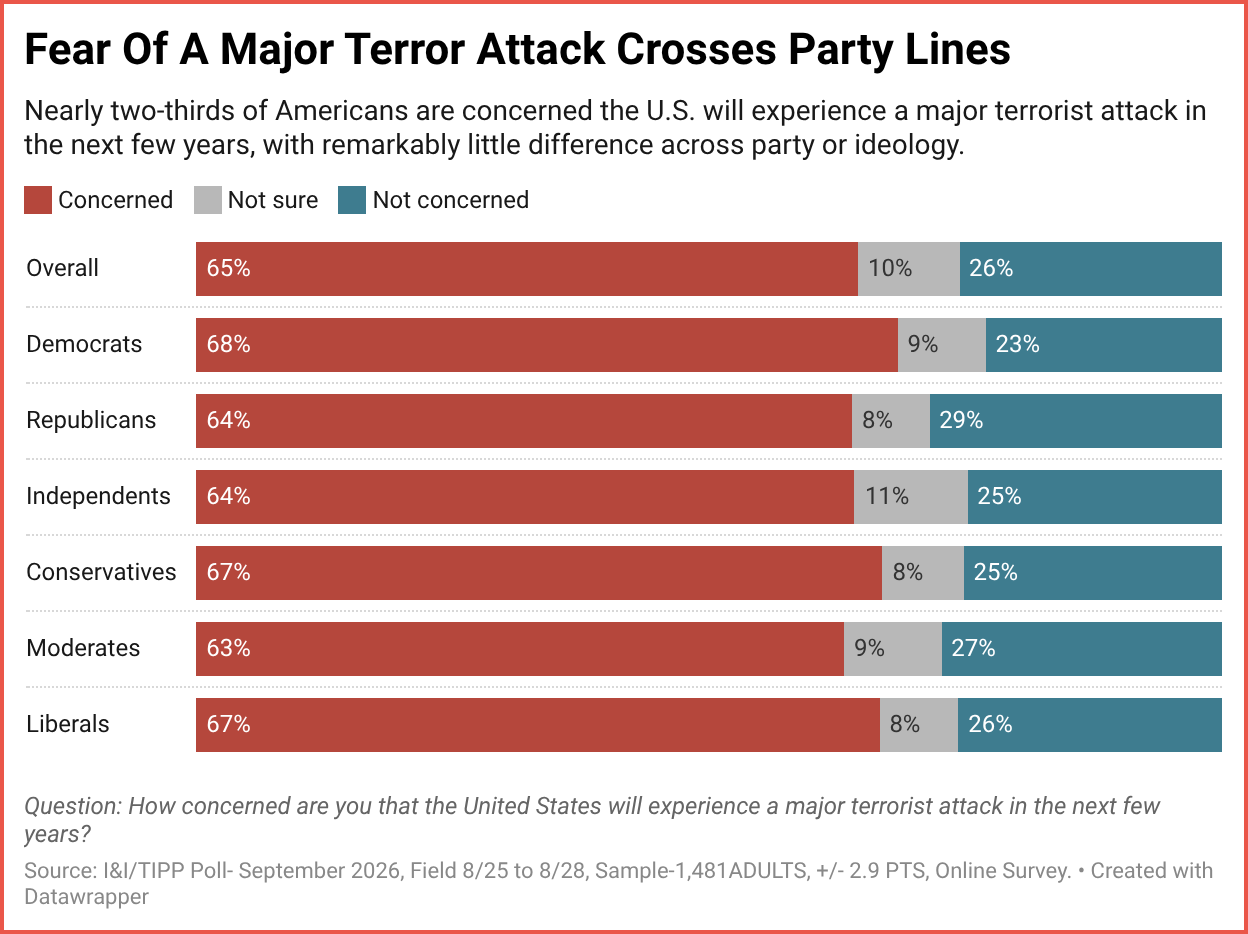
The national online poll was taken from August 25 through Aug. 28 by 1,481 adults, and has a margin of error of +/- 2.9 percentage points.
Apparently, it is a feeling shared by most, even by the three major political parties that often seem to disagree on many things. Among Democrats, for instance, 68% called themselves concerned, while only 23% said they weren't concerned. Republicans (64% concerned, 29% unconcerned) and independents (64% concerned, 25% unconcerned) were in fairly close agreement.
It's a rare case of national near-unanimity: All major American demographic groupings agree. They worry about a major terrorist attack in the near future.
Given that a major terrorist attack seems possible, even perhaps inevitable, how well prepared are we? I&I/TIPP asked a follow-on question: "How confident are you that the U.S. government and its security agencies can prevent a terrorist attack on the scale of September 11, 2001?"
On this question, Americans were slightly less confident, with 55% saying they were either "very confident" (21%) or "somewhat confident" (34%), while 34% responded they were either "not very confident" (21%) or "not at all confident" (13%).
And political opinions were a bit more dispersed. Democrats (50% confident, 41% not confident) and independent voters (47% confident, 41% not confident) were considerably less certain than Republicans (69% confident, 22% not confident).
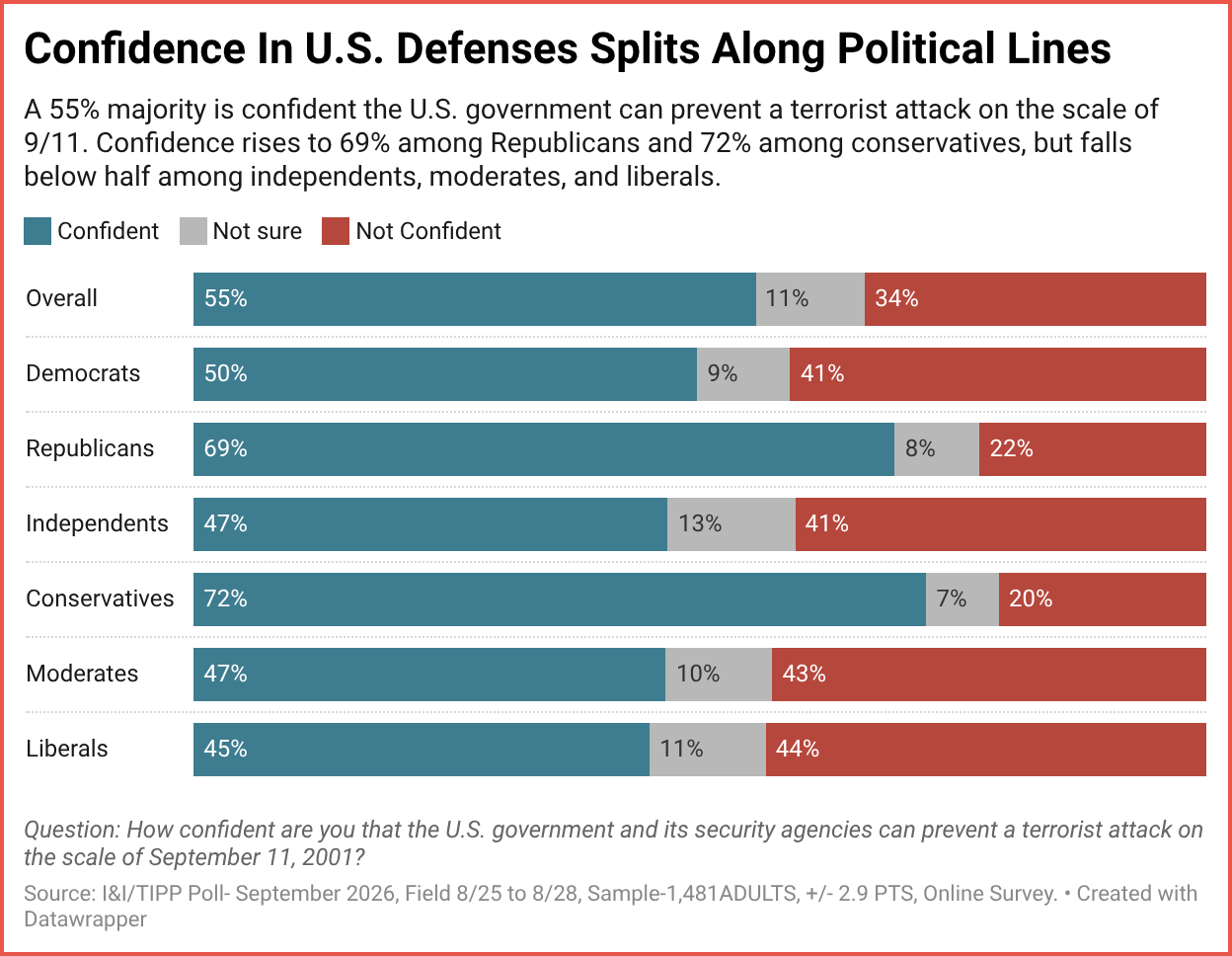
Most other demographic groups of the 36 I&I/TIPP follows each month were reasonably close, with one big exception: A solid majority of men (64% confident, 27% not confident) were far more likely to believe the U.S. government was prepared to protect from terrorist acts than the small plurality of women (47% confident, 40% not confident).
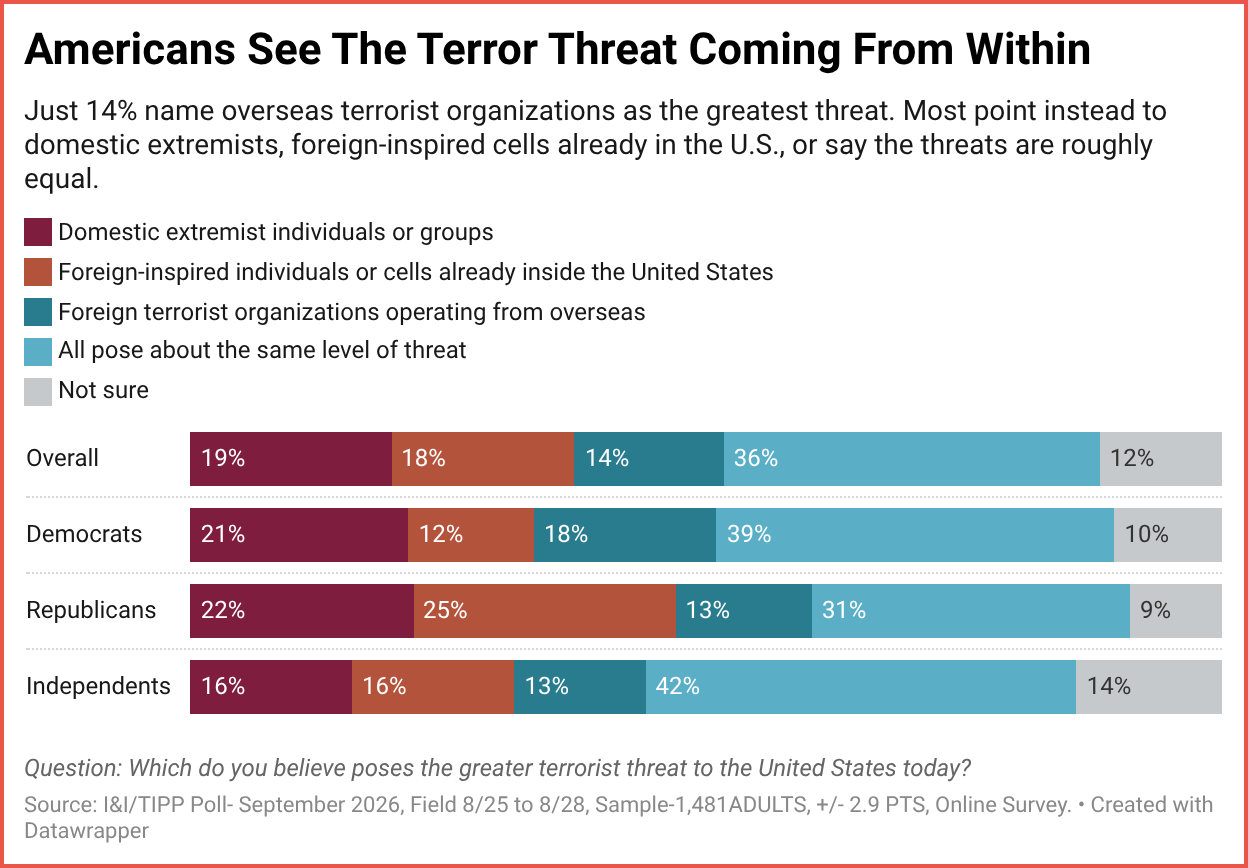
So who threatens us most? To answer, I&I/TIPP asked poll participants: "Which do you believe poses the greater terrorist threat to the United States today?"
"Domestic extremist individuals or groups," garnered a 19% response, while "Foreign-inspired individuals or cells already inside the United States" took 18%. Another 14% answered "Foreign terrorist organizations operating from overseas."
But by far the biggest response was 36% for "All pose about the same level of threat." So essentially, while Americans see many different threats, a more than 50% agree the terrorist threat is broad and very real, whatever type of terrorist group commits the act.
As all Americans know, the 9/11 attacks were planned by radical Islamists who had already spent time in the U.S. and had extensively planned their attacks. Our government was surprised, and so were the American people.
But will the next attack be an attack by Islamists? Or someone else, like the far left, where terrorist rhetoric is already on a high boil? It's certainly possible, given that 63% of Americans now say they're concerned about the rise of socialism and communism.
Some worry we're fighting the last battle, not the next one. The U.S. spent years and billions of dollars hardening our anti-terrorism protections after 9-11, with much of it focused on airlines and transportation.
But “(o)ur nation continues to face a multitude of serious and evolving threats ranging from international terrorists to hostile foreign intelligence services and operatives, from sophisticated cyber-based attacks to internet-facilitated sexual exploitation of children, from violent gangs and criminal organizations to public corruption and corporate fraud,” Michael Glasheen, operations director of the FBI, told the House Committee on Homeland Security last December.
And that just scratches the surface.
What about bio-terrorism, attacks on an increasingly fragile national energy grid, foreign-sponsored attacks on our other homeland infrastructure, poisoning food and medicine, not to mention hate-inspired foreign-sponsored riots against law-abiding Americans to intimidate and harass them into silence and acquiescence to extremism?
How about an even worse plague than COVID loosed on the U.S. or world population by a hostile power?
Moreover, what about the alarming global surge in antisemitic, anti-Jewish violence and threats, which seemed to soar following the Oct. 7 attacks on southern Israel by Hamas terrorists?
Meanwhile, a Homeland Security terrorist threat forecast in January of this year examined "threats from ISIS and its affiliates, lone actors and small cells, soft-target vulnerabilities, and the convergence of extremist movements," among other near-term concerns.
"ISIS is still in the game," wrote Dexter Ingram, noting a spate of issues in the Homeland Security report and recent terrorist arrests. "The system we built after 9/11 is catching them. What scares me is the violence coming from directions we’re barely watching."
People are concerned about future terrorism, as this month's I&I/TIPP Poll clearly demonstrates. But while Americans of all political stripes agree about the threat, as the 25th anniversary of 9/11 looms they're not sure how the next attack will come, or who'll do it. Only that it's coming.
I&I/TIPP publishes timely, unique, and informative data each month on topics of public interest. TIPP’s reputation for polling excellence comes from being the most accurate pollster for the past six presidential elections.
Terry Jones is an editor of Issues & Insights. His four decades of journalism experience include serving as national issues editor, economics editor, and editorial page editor for Investor’s Business Daily.
Loved it, hated it, or somewhere in between — tell us. Grade this article here and help shape what lands in your inbox next.
Letters to the editor email: editor-tippinsights@technometrica.com
Subscribe Today And Make A Difference. Consider supporting Independent Journalism by upgrading to a paid subscription or making a donation. Your support helps tippinsights thrive as a reader-supported publication. Contact us to discuss your research or polling needs.
Reach our audience. For sponsorship and advertising opportunities, visit our Partner With Us page.