
Like it or not, the 2026 midterm congressional election is shaping up to be both a general election but also an update on President Donald Trump's term in office. For Trump at least, the signs are good: In November's I&I/TIPP Poll, his approval among voters showed a solid improvement.
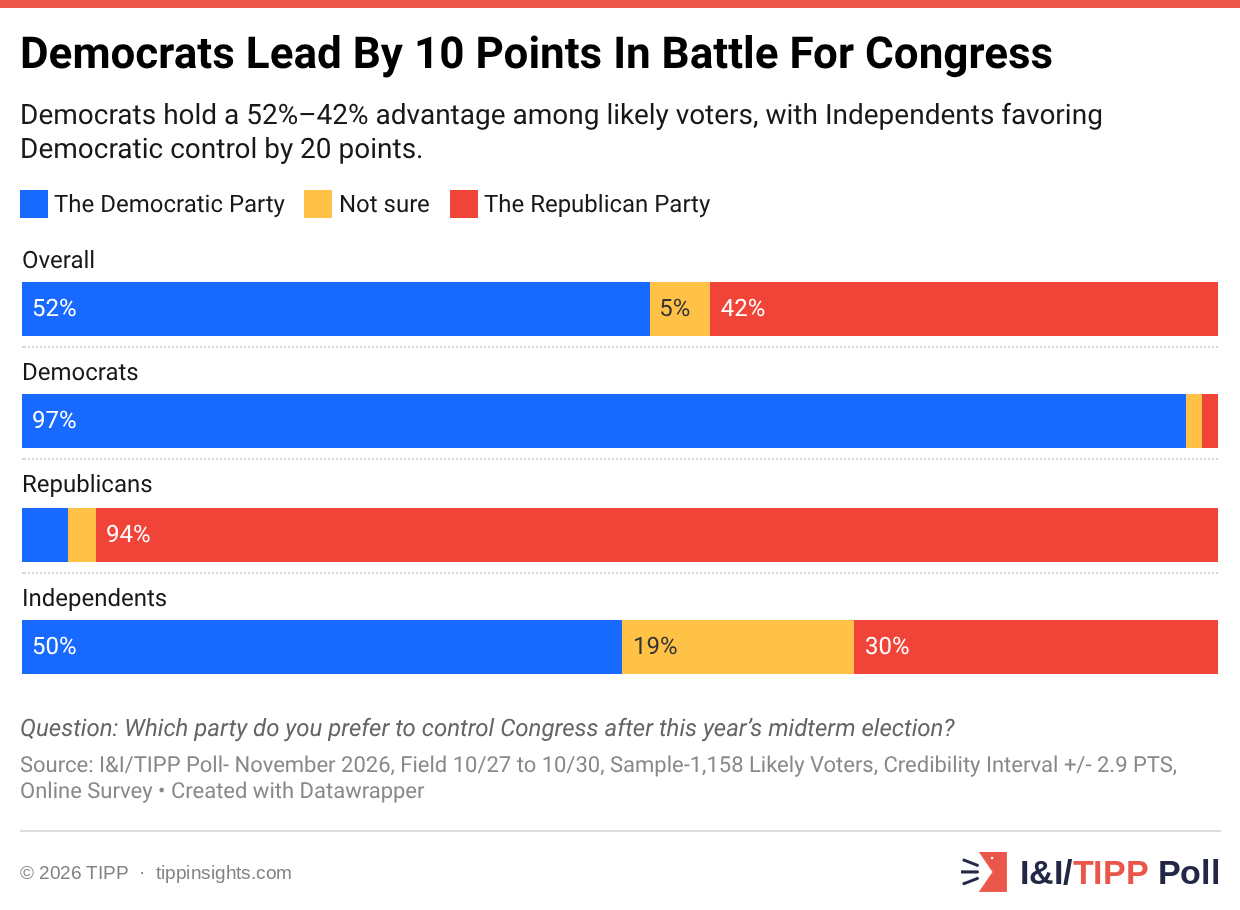
Will this help Republicans this time around? The numbers in the most recent I&I/TIPP Poll do not give much comfort to the GOP. It shows a hefty 10-point edge for Democrats over Republicans when asked "Which party do you prefer to control Congress after this year's midterm election?"
The results are below. It shows that independents, the main swing vote in major elections, are strongly favoring Democratic control, 50% Dem to 30% GOP, a 20-point margin. The poll of 1,158 likely voters has a 2.9 percentage-point margin of error.
Is there significant "silent" support out there of Trump-favoring voters who will turn out and choose Republicans? And will Trump's last-minute efforts convince enough voters to affect individual races and avoid a "blue wave"?
Many in the media have asserted that this election is as much about the controversial and polarizing presidency of Donald Trump as it is about the growing ideological gap between Democrats on the left, and Republicans on the right. If so, Trump's rebounding leadership numbers should be comforting to GOP voters.
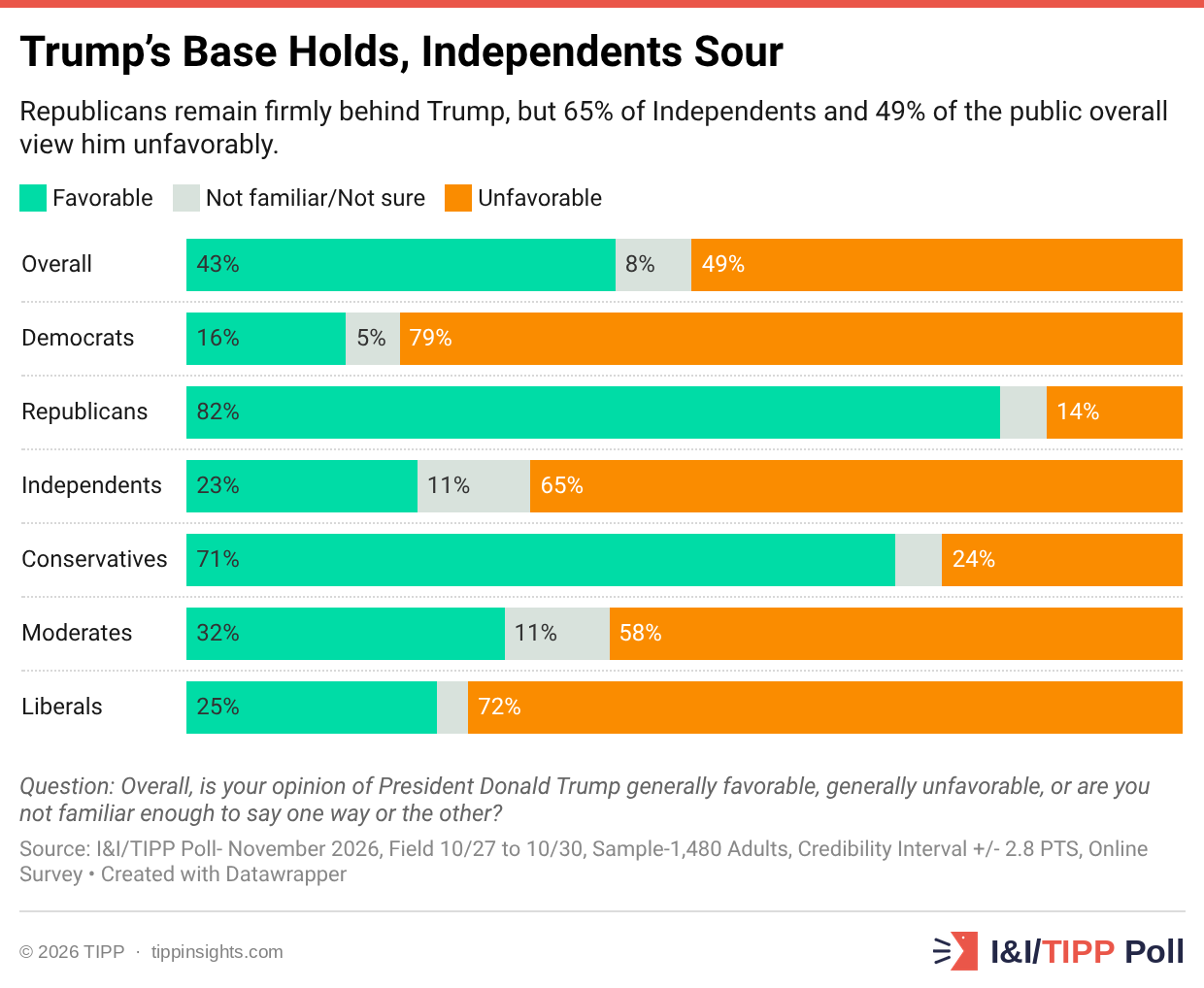
Each month, I&I/TIPP asks American voters the following question: "Overall, is your opinion of Donald Trump generally favorable, generally unfavorable, or are you not familiar enough to say one way or the other?”
For November, 43% of Americans said they had a "favorable" opinion of Trump, while 49% called their opinion "unfavorable," for a net minus 6 percentage point gap. That compares with October's reading of just 40% favorable and 51% unfavorable, a minus 11 percentage point gap.
The monthly national online I&I/TIPP Poll was taken by 1,480 adults from Oct. 27 through Oct. 30. The November poll's margin of error is +/-2.8 percentage points.
Is the improvement a sign Trump's tireless campaigning around the country on behalf of GOP candidates might have helped him claw back some of his lost support?
To be sure, Trump remains mostly unpopular among Democrats, with a 16% favorable versus 79% unfavorable reading for November, only a very minor statistical improvement over October (16% favorable vs. 80% unfavorable).
Among independents in November's poll (23% favorable, 65% unfavorable), the picture worsened from October's reading (26% favorable, 58% unfavorable).
So where was Trump's improvement? Among Republicans, of course. They gave him an 82% favorable rating and a 14% unfavorable rating, a big pivot from just a month ago (72% favorable, 19% unfavorable).
Put another way, among GOP voters, that's a swing from October's net +53-percentage point approval rating to November's +68 percentage point approval, a statistically significant shift among the party faithful in Trump's favor.
So it appears likely that Trump's tireless stumping for candidates across the country has reinvigorated both regular Republicans and those who consider themselves MAGA Republicans.
Who are the voters most likely to swing Trump's way? Younger Americans and men.
Among those 18-24 years of age, Trump gets 50% favorable, 39% unfavorable score, while for those in the 25-44 year old bracket, the comparable number rise to 52% favorable, 38% unfavorable. But Trump's numbers weaken among those in the 45-64 year group (37% favorable, 57% unfavorable) and retirees 65 and older (36% favorable, 60% unfavorable).
Men and women must be having some interesting political conversations in their homes and on dates. Men tend to think quite highly of Trump (52% favorable, 43% unfavorable) while women are the opposite (35% favorable, 55% unfavorable).
The second question of the monthly poll yields similar results: "In general, do you approve or disapprove of the way Donald Trump is handling his job as president, or are you not familiar enough to say one way or the other?”
For November, Trump again did better overall, rising to 41% approval, 51% disapproval. That's a gain from October's reading (39% approved, 52% disapproved) and September's numbers (38% approved, 52% disapproved).
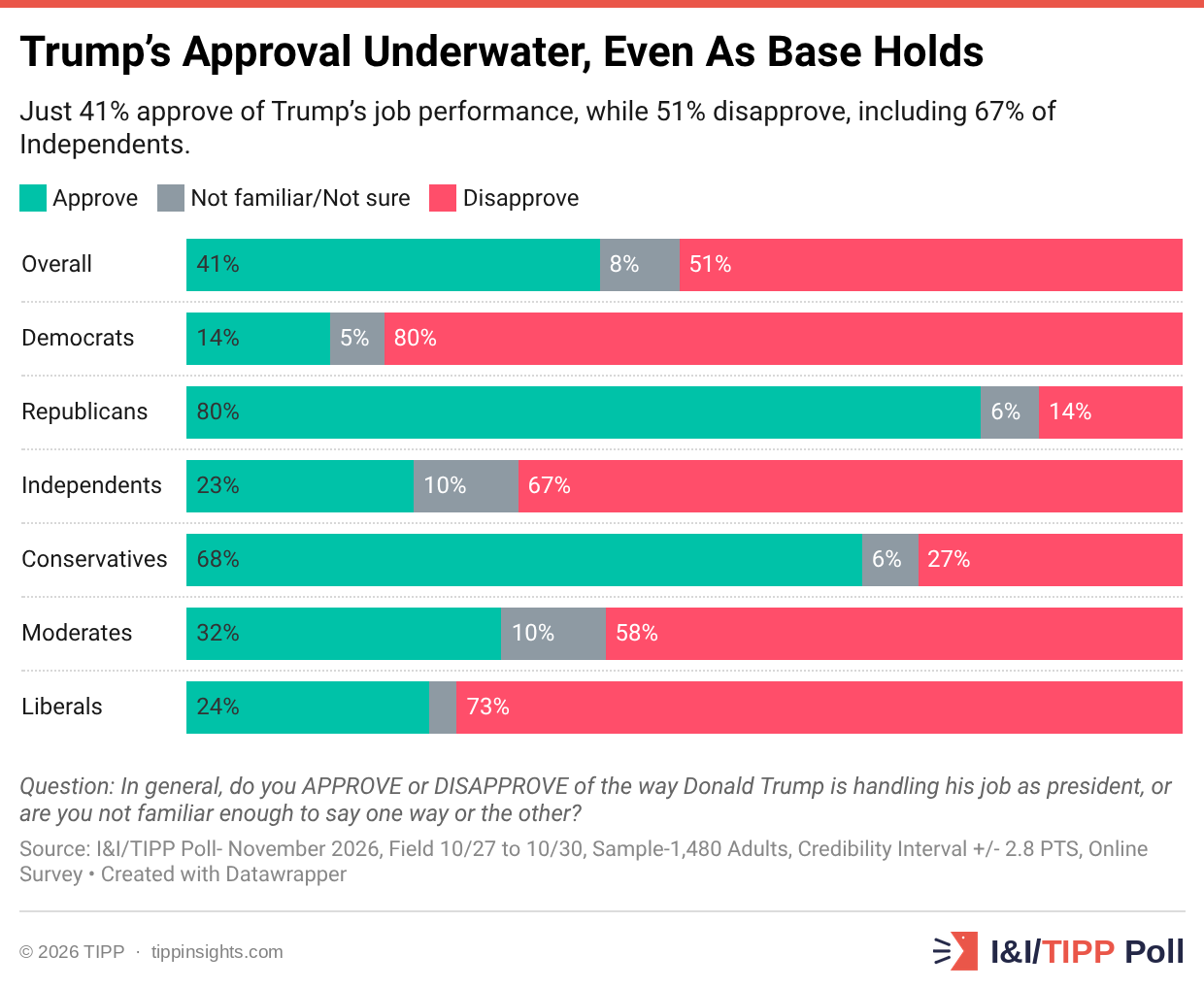
As happened above, it's again improvement among Republicans that's driving the change. Democrats (14% approve, 80% disapprove) and indie voters (23% approve, 67% disapprove) are little changed or worse when compared to October.
Republicans, however, gave Trump sterling numbers (80% approval, 14% disapproval), a statistically significant jump from October (73% approved, 20% disapproved).
Measured another way, Trump seems to have shored up his ideological support across the board in November, including among self-described conservative voters (68% approval, 27% disapproval, the same as in October); moderates (32% approval, 58% disapproval), up from October (27% approved, 58% disapproved); and even liberals (24% approval, 73% disapproval in November) up from October's data (19% approved, 76% disapproved).
Then there's the question of leadership. I&I/TIPP's monthly question to voters: "How would you describe the leadership that President Trump is providing for the country?"
In November, 40% of all voters called Trump's leadership either "very strong" (23%) or "strong" (17%). Another 15% described his leadership as "moderate." Meanwhile, 43% described his leadership as either "weak" (11%) or "very weak" (32%).
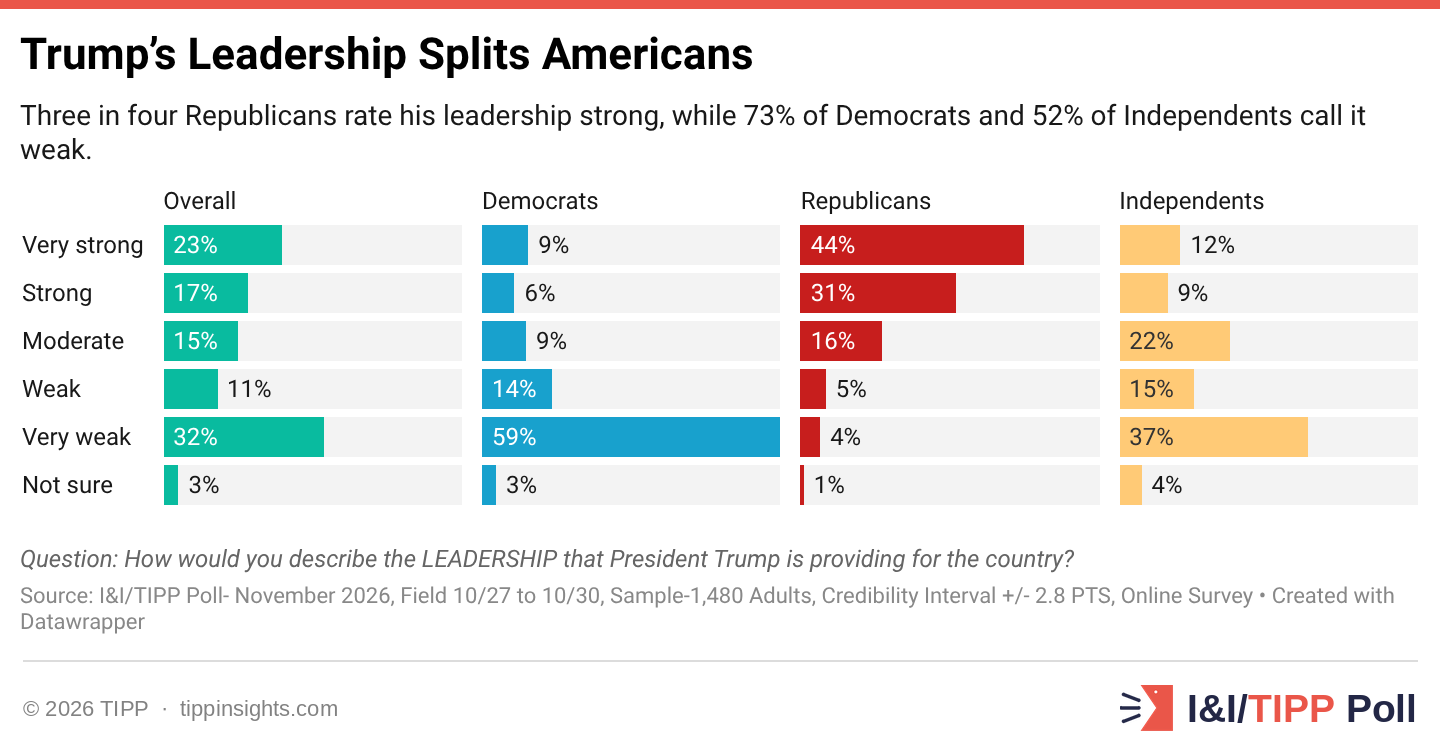
That's an improvement from October's data (37% strong, 16% moderate, 44% weak).
November's breakdown by party is perhaps predictable: Democrats (73% weak, 9% moderate, 15% strong) overwhelmingly see Trump's leadership as weak, independents (52% weak, 22% moderate, 21% strong) somewhat less so, and Republicans (9% weak, 16% moderate, 75% strong) see very little weakness at all.
And, as we've pointed out before, one of the most enduring differences on Trump's leadership is by gender. In short, men and women have an entirely different take on the whole Trump political phenomenon. But there is some improvement to be seen in November among female poll participants.
Among men, 47% see Trump's leadership as strong or very strong, the same as in October. That compares to 33% for women in November, up from 28%, a significant gain though still fairly low. Among men, 14% called Trump's leadership moderate, up from 13% in October, while 15% of women did the same, making a big jump from October's 12%. And 38% of men called Trump's leadership weak in November, up from 35% in October, while 47% of women did, down from 52% in October.
So the president made up some ground among women voters, while mostly maintaining his strength among men.
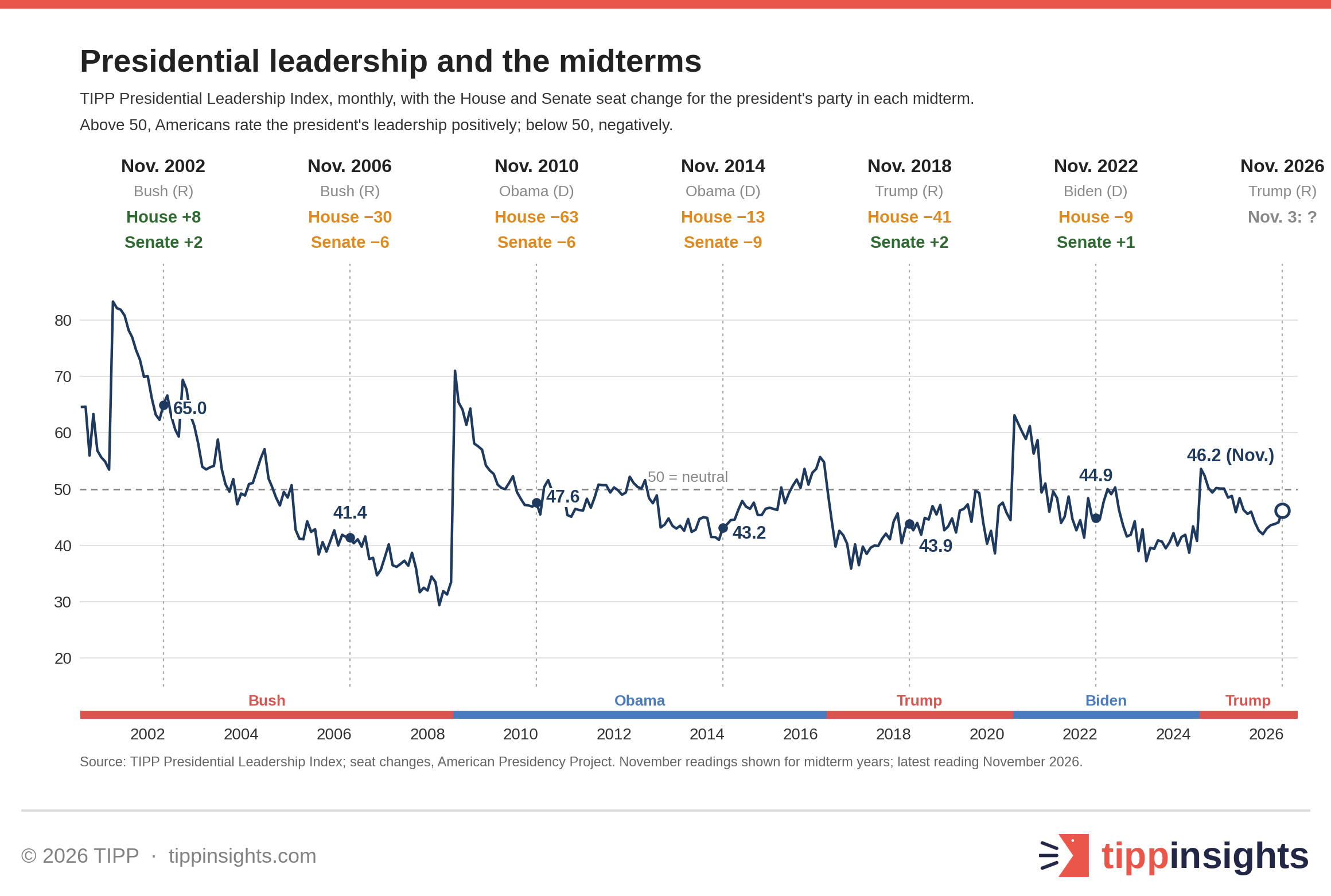
What does the big picture on Trump's leadership look like? Each month I&I/TIPP calculates its proprietary Leadership Index, a way of keeping tabs on the president using recent data to create an overall score. This month, I&I/TIPP highlights past presidential leadership index levels and election outcomes.
Another monthly feature asks those taking part in the poll to assign school-style grades of A, B, C, D and F for how Trump is handling individual issues, for a reading on what his strengths and weaknesses are. A total score is assessed by adding the share of As and Bs given for each issue.
Overall, voters awarded 39% As and Bs to Trump in November. That's up from 36% in both October and September, but also the highest since 38% last March. So Trump's scores are moving higher. Democrats gave him only 15% As and Bs, but that was up from 14% in October and 13% in September.
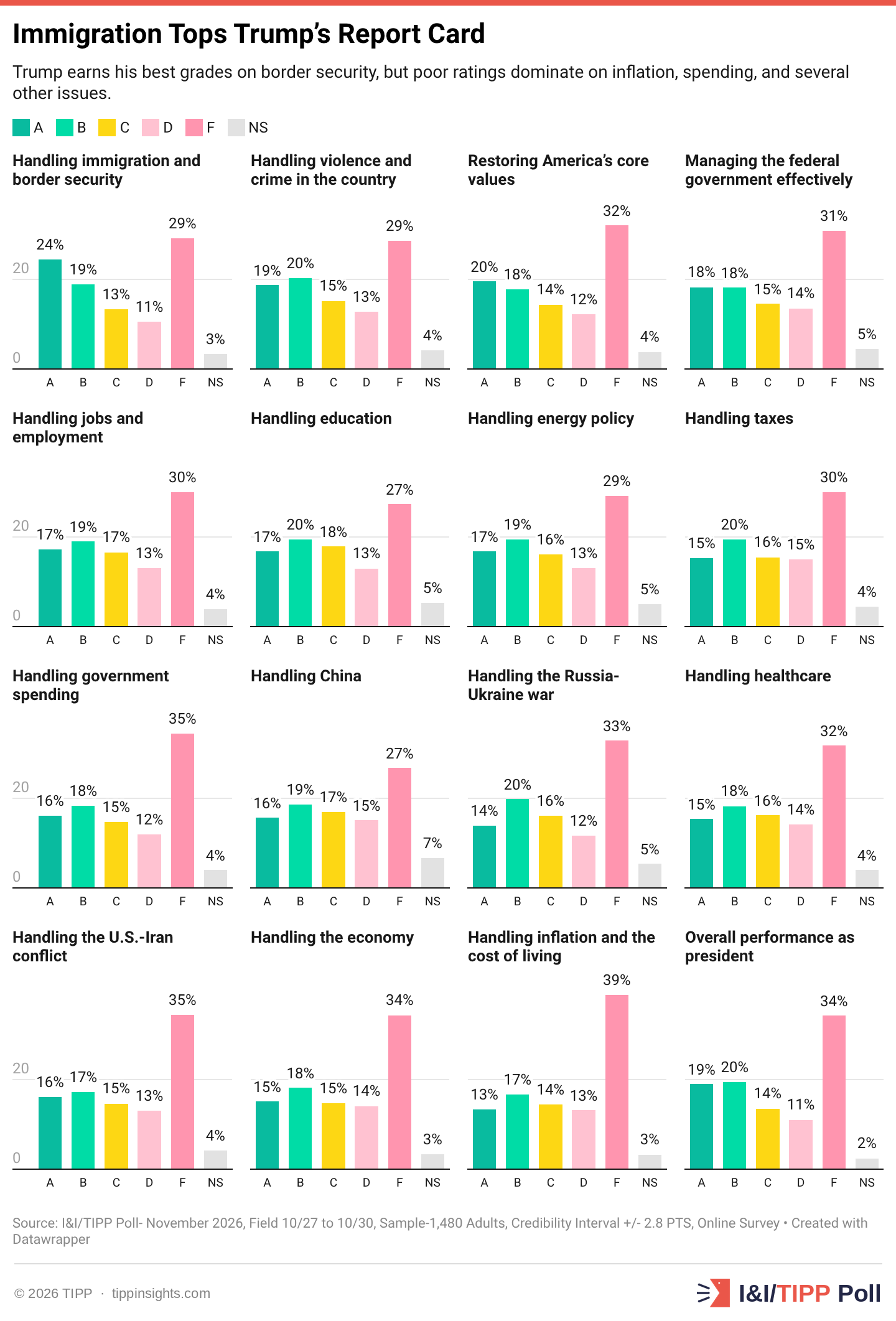
Republicans gave him 71% As and Bs, a big jump from the 65% in each of the previous three months, while indie voters delivered 23% As and Bs, down from 26% in October and 24% in September.
In November, voters gave the highest score, 43%, for "Handling immigration and border security," with "Handling violence and crime in the country" a bit behind at 39%, and "Restoring America’s core values" just behind that at 37%.
On the lower side, "Handling inflation and the cost of living" (30%) and "Handling the economy" and "Handling the U.S.-Iran conflict," both at 33%, were the bottom scores.
Meanwhile, "Handling the Russia-Ukraine war," "Handling China," and "Handling healthcare" were all bunched together at 34%, while "Handling taxes" and "Handling government spending" came next at 35%.
A handful of issues were stuck in the middle at 36%: "Managing the federal government effectively," "Handling energy policy," "Handling education," and "Handling jobs and employment."
So Trump's overall favorability scores, voter approval and grades for individual issues seem to be on an upswing. Will that be enough to get GOP voters out to vote? Or is a Blue Wave election by the Dems an inevitability.
Since many have asserted that this election is as much about the controversial and polarizing presidency of Donald Trump as it is about the growing ideological gap between Democrats on the left, and Republicans on the right, Trump's rebounding leadership numbers should be comforting to GOP voters.
It may suggest hidden strength for Trump among rank-and-file voters, despite a nonstop flood of negative stories in national media.
Of course, current polls mostly have Democrats winning at least the House and possibly the Senate.
USA Today summed up the current feeling among the media: "Statistician Nate Silver, known for his accurate odds-making in several elections, is giving Democrats a 94% chance of retaking the House of Representatives and a 75% possibility in flipping the Senate. Most Americans believe Republicans will lose the House while half think they will lose the Senate, an October Pew Research Center survey showed."
The problem is, as we've seen before, whenever Trump's name is involved polls seem to go haywire, underestimating Republican candidates and overestimating Democratic candidates.
"The consistent underestimating of Trump by polls since 2016 isn’t random error — it points to deeper issues like sampling biases and media-driven echo chambers," wrote Globely News two years ago. It's still true today.
"This challenge is magnified in midterms and primaries, contests that often have lower turnout, localized dynamics and low information," notes Pew Research. "And yet, many consumers expect a level of precision that polls can’t deliver. And the cycle of disappointment repeats."
And there's another issue here. A group calling itself Wedgewood Polls recently admitted its polling was fake, with numbers for key Senate races simply made up. Yet, its results were routinely reported with others and often included in poll averages.
How many other polling companies are either fake or fundamentally dishonest, distorting "polling averages"?
Yes, Trump isn't on the ballot. But both Democrats and Republicans agree that Trump's policies will be part of voters' consideration, especially the "affordability" issue, which the media routinely blame on Trump despite a 21% surge in prices under his predecessor, Joe Biden. And the U.S.-Iran conflict sharply divides Americans.
As for Trump, he has used the last month to stump for GOP candidates around the country, solidifying his MAGA base and spending the final days before the election working the phones and media on behalf of GOP candidates.
Can his improved standing as a leader, as shown by November's I&I/TIPP Poll, help Republican candidates outperform expectations? Or will the widely predicted "blue wave" usher in a new era of conflict between a Democratic congress and a Republican president? We'll all know very soon.
I&I/TIPP publishes timely, unique, and informative data each month on topics of public interest. TIPP’s reputation for polling excellence comes from being the most accurate pollster for the past six presidential elections.
Terry Jones is an editor of Issues & Insights. His four decades of journalism experience include serving as national issues editor, economics editor, and editorial page editor for Investor’s Business Daily.
Loved it, hated it, or somewhere in between — tell us. Grade this article here and help shape what lands in your inbox next.
📊 Market Mood · November 2, 2026
How the trading day is setting up.
🟩 Wall Street futures are rebounding after Friday's selloff. U.S. stocks are poised for a stronger opening following October's technology-led losses, although concerns about AI valuations persist.
🟧 Oil is falling on renewed hopes for Middle East diplomacy. Crude prices have dropped more than 2% as negotiations over reopening the Strait of Hormuz raise hopes of easing supply disruptions and inflation pressures.
🟦 AI spending remains a major market concern. Investors are questioning the sustainability of massive data-center investments and rising debt, with Apple's upcoming earnings providing another test of technology-sector confidence.
🟨 Midterm elections and economic data dominate the week. Tuesday's elections, today's manufacturing report, and Friday's jobs numbers could influence market sentiment and expectations for Federal Reserve policy.
🗓️ Key Economic Events
On today's U.S. data calendar.
🟧 10:00 a.m. ET — ISM Manufacturing PMI (October)
Forecast: 54.7 | Previous: 54.5
Manufacturing activity is expected to improve slightly, with particular attention on new orders, employment and input prices.
🟧 10:00 a.m. ET — Construction Spending (September)
Forecast: +0.4% m/m | Previous: +0.9% m/m
Construction spending is expected to slow as elevated borrowing costs and affordability pressures weigh on building activity.
Letters to the editor email: editor-tippinsights@technometrica.com
Subscribe Today And Make A Difference. Consider supporting Independent Journalism by upgrading to a paid subscription or making a donation. Your support helps tippinsights thrive as a reader-supported publication. Contact us to discuss your research or polling needs.
Reach our audience. For sponsorship and advertising opportunities, visit our Partner With Us page.