As Americans head to the polls, here's a primer on what is at stake.
First, President Trump isn't on the ballot. He is serving his second term, and the Constitution bars him from being elected to a third in 2028. For all intents and purposes, therefore, Americans will never again cast a vote for Trump.
But Trump has vigorously campaigned as though he were on the ballot. He has lived up to the promise he made on the opening night of the Republican convention at the American Airlines Center in Dallas in September: "I'm asking you to pretend that I'm on the ballot. I'm on the ballot. I'm on the ballot. Just one more time."
In our presidential form of government, Congress, which consists of the House of Representatives and the Senate, holds elections every two years. When elections fall during the presidential cycle every fourth year, both the presidency and control of Congress are at stake.
2026 is midway between two presidential elections. So these "mid-term" elections will help determine whether Trump's Republican Party will continue to control Congress.
The House has 435 members. Today, it has 218 Republicans, 214 Democrats, 1 Independent, and 2 vacancies. Republican Speaker Mike Johnson runs the House. Minority Leader Hakeem Jeffries, a Democrat, leads the opposition.
House members serve two-year terms, so the entire House goes to the polls every two years.
The clubby Senate has 100 members, but each senator serves a six-year term. A third of the Senate, 33 members, is up for election every two years. Currently, Republicans control the Senate 53-47, with two independents caucusing with the 45 Democrats.
This year, two Senate seats are up for special election, bringing the total on the ballot to 35. In Ohio, the winner will serve the remaining two years of the term to which Vice President Vance was elected in 2022. In Florida, the winner will serve the remainder of Secretary of State Marco Rubio's term, when he was reelected in 2022.
South Carolina's race feels like a special election, although technically it isn't. When Sen. Lindsey Graham died suddenly, the state's GOP governor appointed his sister Darline Graham to his seat as an interim senator. With President Trump's full support, Darline won the Aug. 25 GOP primary runoff to take her late brother's place on the November ballot. If she wins, she'd serve a full six-year term.
Trump has crisscrossed the country and held 28 campaign rallies since Oct. 1, ending events in Iowa and Kansas ahead of the vote. For an 80-year-old politician, the pace has been truly breathless and remarkable. His top priority is to help ensure the Republican Party continues to control both the House and the Senate during the last two years of his presidency. The stakes couldn't be higher for the country.
An October I&I/TIPP Poll found that 78% of registered voters believe the midterm outcome will have a great deal or some impact on the country's direction. The sentiment crosses party lines, with 86% of Democrats and 83% of Republicans sharing that view.
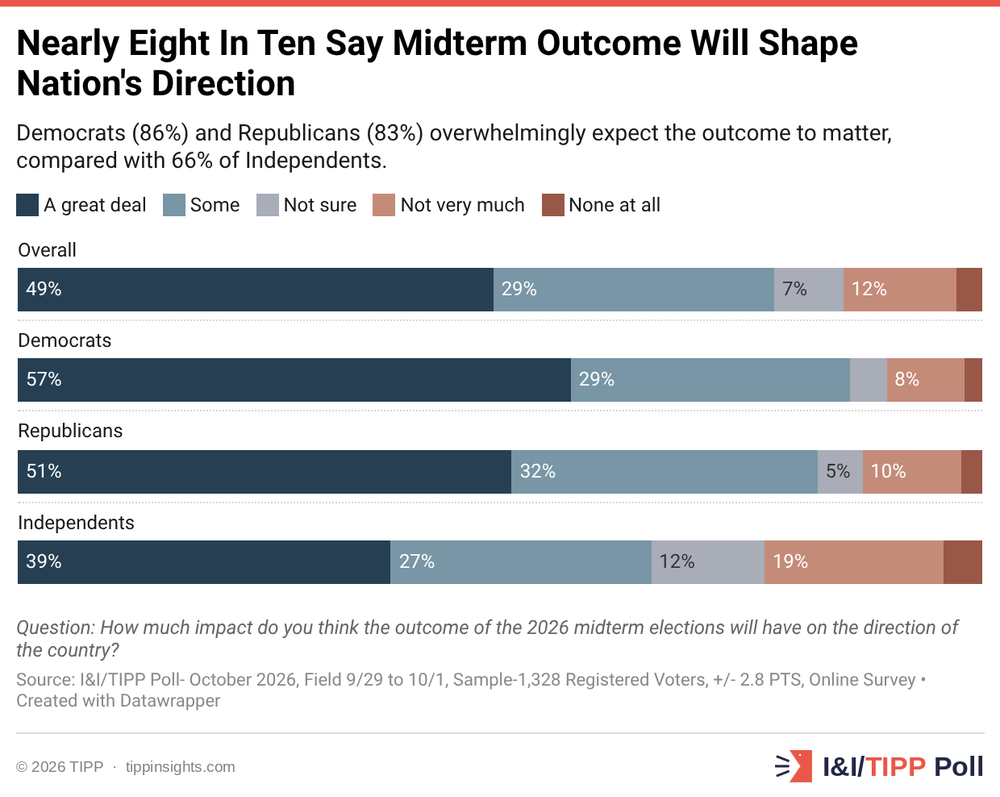
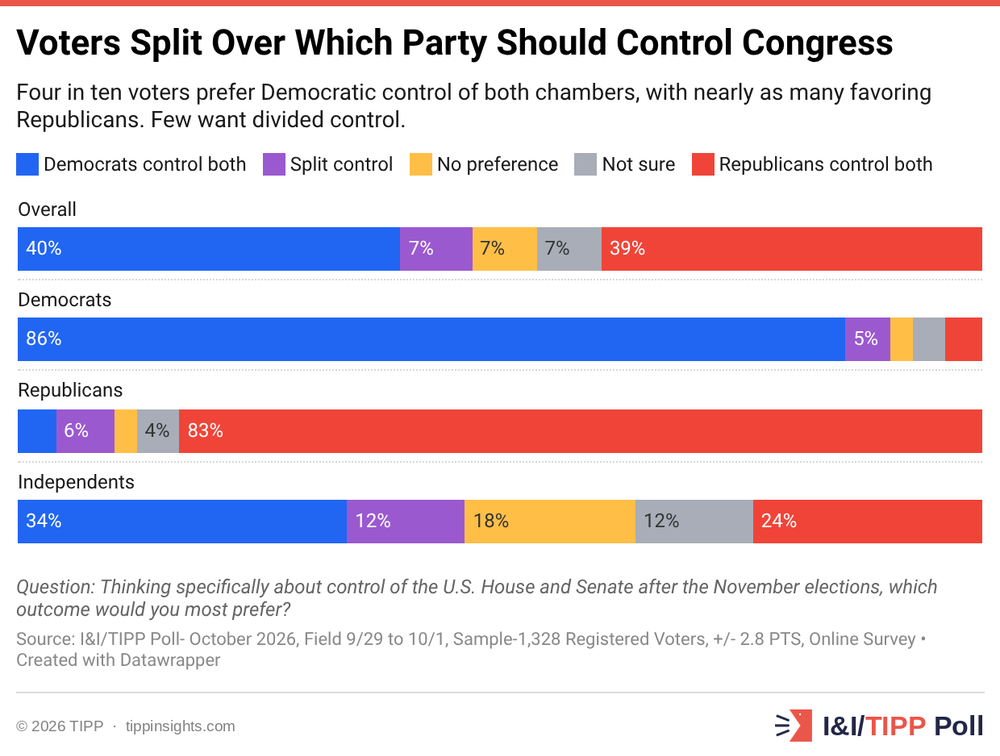
The same poll also found that 40% of registered voters prefer Democratic control of both chambers, while 39% favor Republican control. Only 7% prefer divided government, suggesting that most voters who express a preference want one party firmly in charge.
Five mathematical possibilities remain, each with profound implications.
The Republican Party holds both the House and the Senate.
The House holds enormous powers, including the power of the purse and the ability to launch investigations. Speaker Mike Johnson will likely keep doing what he's been doing. Trump's budgets and priorities will be honored. Trump will also escape any investigations into himself, his family, or his administration.
The Democrats win the House, but the Republicans hold on to the Senate.
This outcome will bring Washington to a grinding halt. Under Presumptive Speaker Jeffries, the Democrats are already lawyering up and will launch a new investigation into Trump just about every week. A third impeachment is a possibility. Every Trump budget would be dead on arrival. The courts, already emboldened, will likely stop Trump's Executive Orders at every turn.
The Republicans win the House, but the Democrats take the Senate.
Trump would take this result as a grand compromise. It would save him from playing defense in Congress every week. His administration's priorities would likely stall in the Senate, as Democrats would control confirmations of judges and officials; however, he would be safe from impeachment and endless investigations.
The Democrats win both the House and the Senate.
This outcome could end the Trump presidency as we know it. Even if the House impeaches him, a conviction requires two-thirds of the senators present, or 67 if all 100 vote, an unlikely outcome because a Democratic Senate could, at best, corral a few Republican crossovers. However, Trump's judicial appointments will be under siege, especially if a Supreme Court Justice retires or dies. The debate would then switch to 2028. Is Trumpism dead? Who could emerge to take up that mantle and revive it? Would the Democrats swing further left?
One or both chambers could end up tied or nearly so.
This scenario will also bring about gridlock. In the House, a majority of one or two seats would make factions in both parties, especially left-leaning progressives, immensely powerful, able to demand legislative changes in exchange for their votes. Horse-trading will become the norm.
The same will happen in the Senate, with Vice President JD Vance's tie-breaking vote keeping the Senate in Republican hands. Under Article I of the U.S. Constitution, the Vice President of the United States serves as the President of the Senate and has the sole power to cast a deciding vote when the Senate is equally divided.
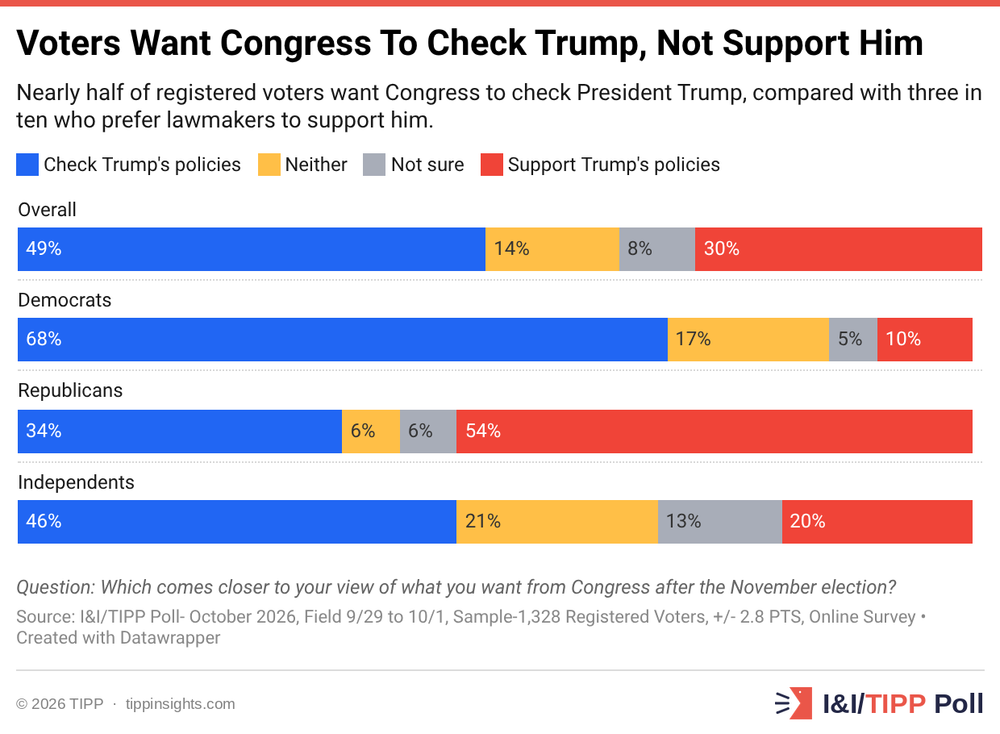
Beyond the question of party control, voters have strong views about Congress's role in the Trump presidency. The October I&I/TIPP Poll found that 49% of registered voters want Congress to check Trump's policies, compared with 30% who want lawmakers to support them. Interestingly, 34% of Republicans and 46% of Independents favor congressional checks on the president.
Whoever controls Congress, the world will still be negotiating with Trump, and the November 3 result will decide whether he arrives strong or wounded. It is little wonder that many countries, including Canada, China, Ukraine, Russia, Iran, Israel, India, and the various Middle East states, are watching the midterms closely.
Loved it, hated it, or somewhere in between — tell us. Grade this article here and help shape what lands in your inbox next.
Americans Trust the Vote Count. Independents Have Doubts
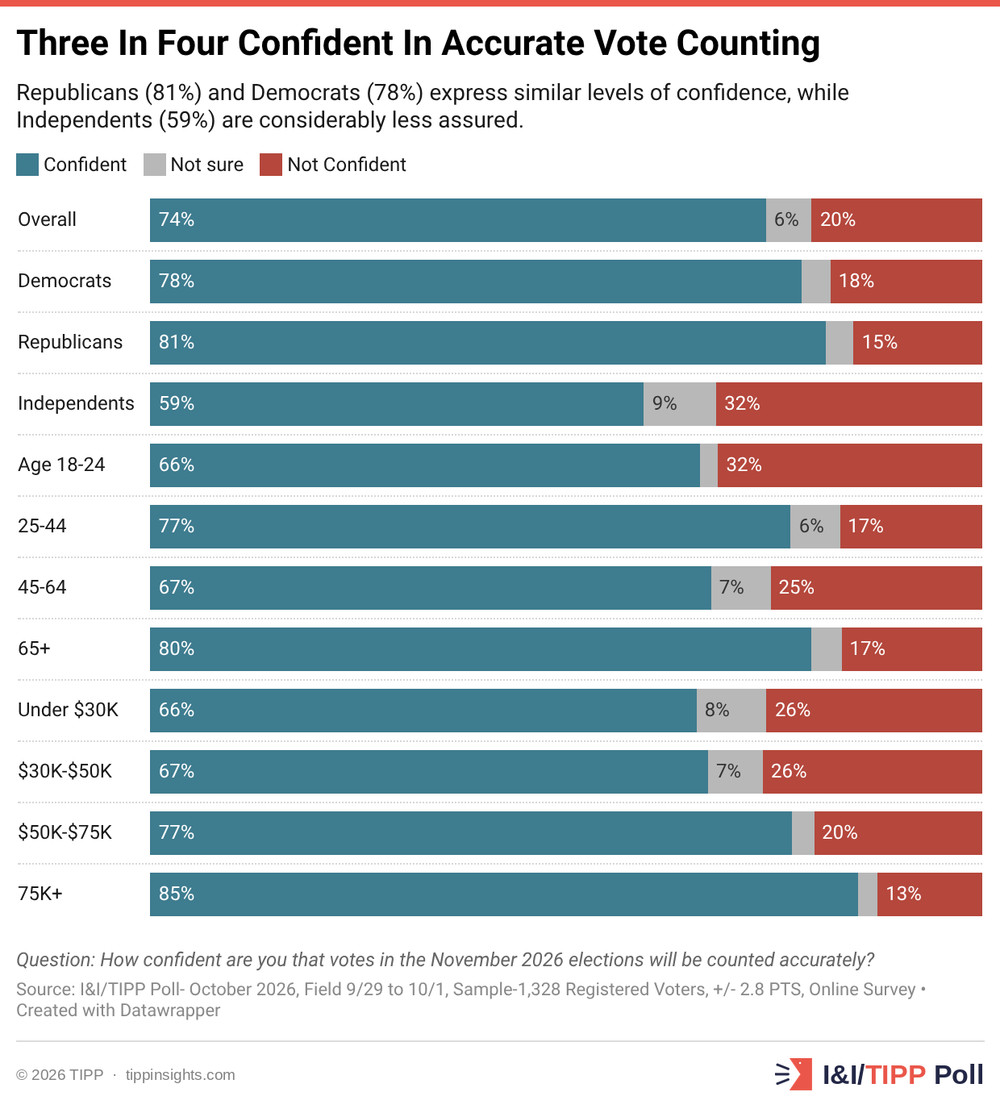
Three in four voters are confident ballots will be counted accurately in November, including eight in ten Republicans and Democrats. Independents are far more skeptical, with nearly a third expressing doubts.
A recent I&I/TIPP asked: “How confident are you that votes in the November 2026 elections will be counted accurately?”
Overall, 74% responded that they felt “very confident” (37%) or “somewhat confident” (37%), versus just 20% who said they were “not very confident” (13%) or “not confident at all” (7%). While that latter number is low, it still represents one out of five voters in this survey.
🗳️ Election 2026 Special Coverage
The races, the polls, and what they mean.
🟨 Midterms: Closing Argument – Steve Cortes, The Daily Signal
🟨 Midterm Election Incoherences, Misadventures, and Paradoxes – Victor Davis Hanson, American Greatness
🟨 I oversaw polling for Biden and Harris. Here’s how I’m reading the midterm polls – Becca Siegel, MS Now
🟨 Texas Early Vote Results ANALYSIS– Bill King, RealClearPolitics
🟨 Trump's Voter Approval Strengthens, But Deep Divisions Among Voters Remain: I&I/TIPP Poll – Terry Jones, TIPP Insights
🟨 Gas And Groceries: What's On Midterm Voters' Minds – Editorial Board, TIPP Insights
🟨 The Great Inversion: Trump’s Support Has Shifted – Editorial Board, TIPP Insights
🟨 I&I/TIPP Poll Finds Surprising Level Of Apathy Among Swing Voters As Midterms Approach – Terry Jones, TIPP Insights
🟨 Democrats Poised for Largest Generic Ballot Win Since Obama’s 2008 Blowout – John McIntyre, RealClearPolitics
🟨 Statistically Speaking, Don’t Count Republicans Out of the Midterms – Jonathan Draeger, RealClearPolitics
🟨 Who Is Funding The U.S. Midterm Elections? – TIPP News
📊 Market Mood · November 3, 2026
How the trading day is setting up.
🟥 AI worries are weighing on global stocks. South Korean and Taiwanese shares fell about 3.6% as concerns about massive AI spending and disappointing technology earnings dampened investor confidence.
🟧 Oil is climbing amid renewed Middle East tensions. Brent has risen above $106 a barrel following reports of fresh U.S. strikes on Iranian targets, reviving concerns about energy supplies and inflation.
🟦 Treasury yields are edging higher. The 10-year yield is rising modestly as investors assess inflation risks, the Fed's next move and the potential market implications of today's elections.
🟨 Midterm elections dominate today's outlook. Investors are watching the battle for control of Congress, with the results potentially reshaping fiscal policy, corporate regulation and the outlook for markets.
🗓️ Key Economic Events
On today's U.S. data calendar.
🟧 10:00 a.m. ET — JOLTS Job Openings (September)
Forecast: 7.13M | Previous: 7.08M
Job openings are expected to rise slightly, providing a fresh indication of labor demand ahead of Friday's employment report.
🟧 10:00 a.m. ET — Factory Orders (September)
Forecast: +1.2% m/m | Previous: +0.1% m/m
Factory orders are expected to rebound, offering insight into manufacturing demand and business investment.
🟧 10:00 a.m. ET — RealClearMarkets/TIPP Economic Optimism Index (November)
The monthly index provides a timely measure of Americans' economic confidence, including their outlook for the economy and personal finances.
Letters to the editor email: editor-tippinsights@technometrica.com
Subscribe Today And Make A Difference. Consider supporting Independent Journalism by upgrading to a paid subscription or making a donation. Your support helps tippinsights thrive as a reader-supported publication. Contact us to discuss your research or polling needs.
Reach our audience. For sponsorship and advertising opportunities, visit our Partner With Us page.