
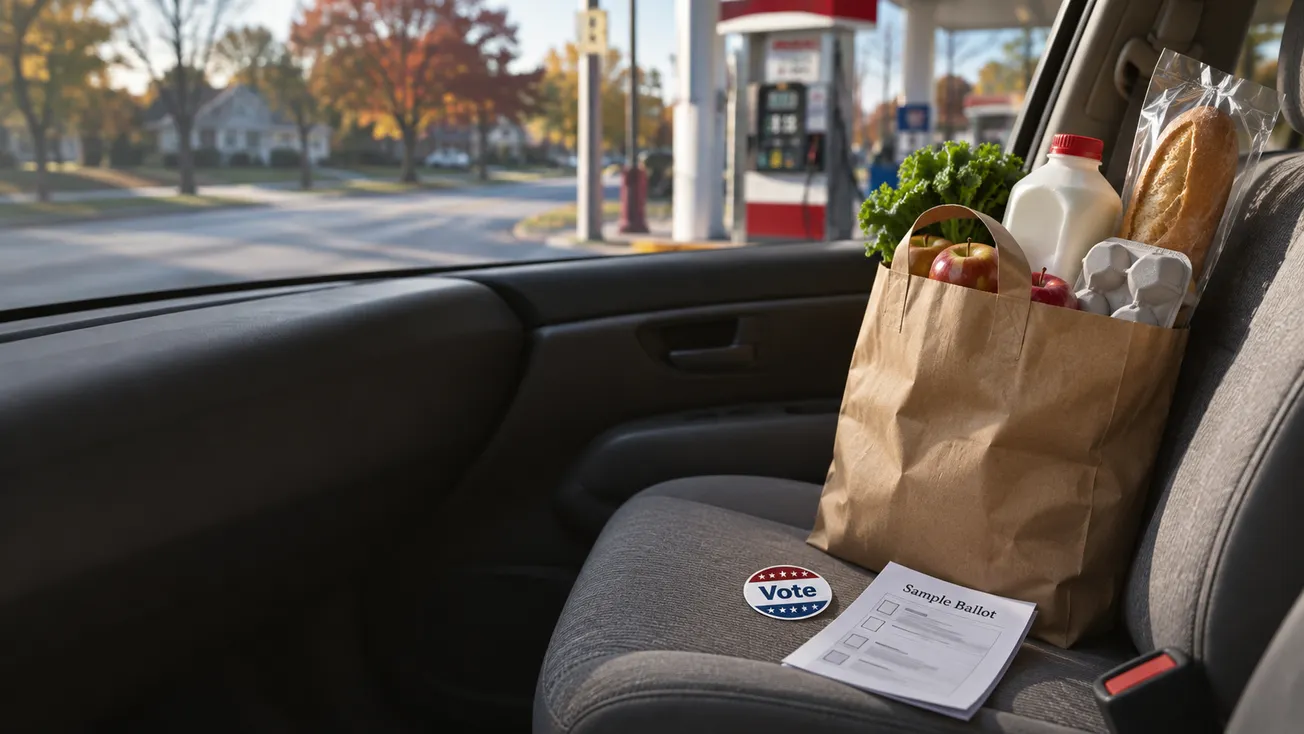
Independents head into Tuesday’s midterm elections as the group most worried about gas prices and among the least engaged. In the latest TIPP Poll, 43% of independent likely voters choose Gasoline prices as a top economic issue, compared with 36% of Democrats and 26% of Republicans. An earlier TIPP poll found that just half of independents are highly interested in the midterms, compared with about three-quarters of Democrats and Republicans.
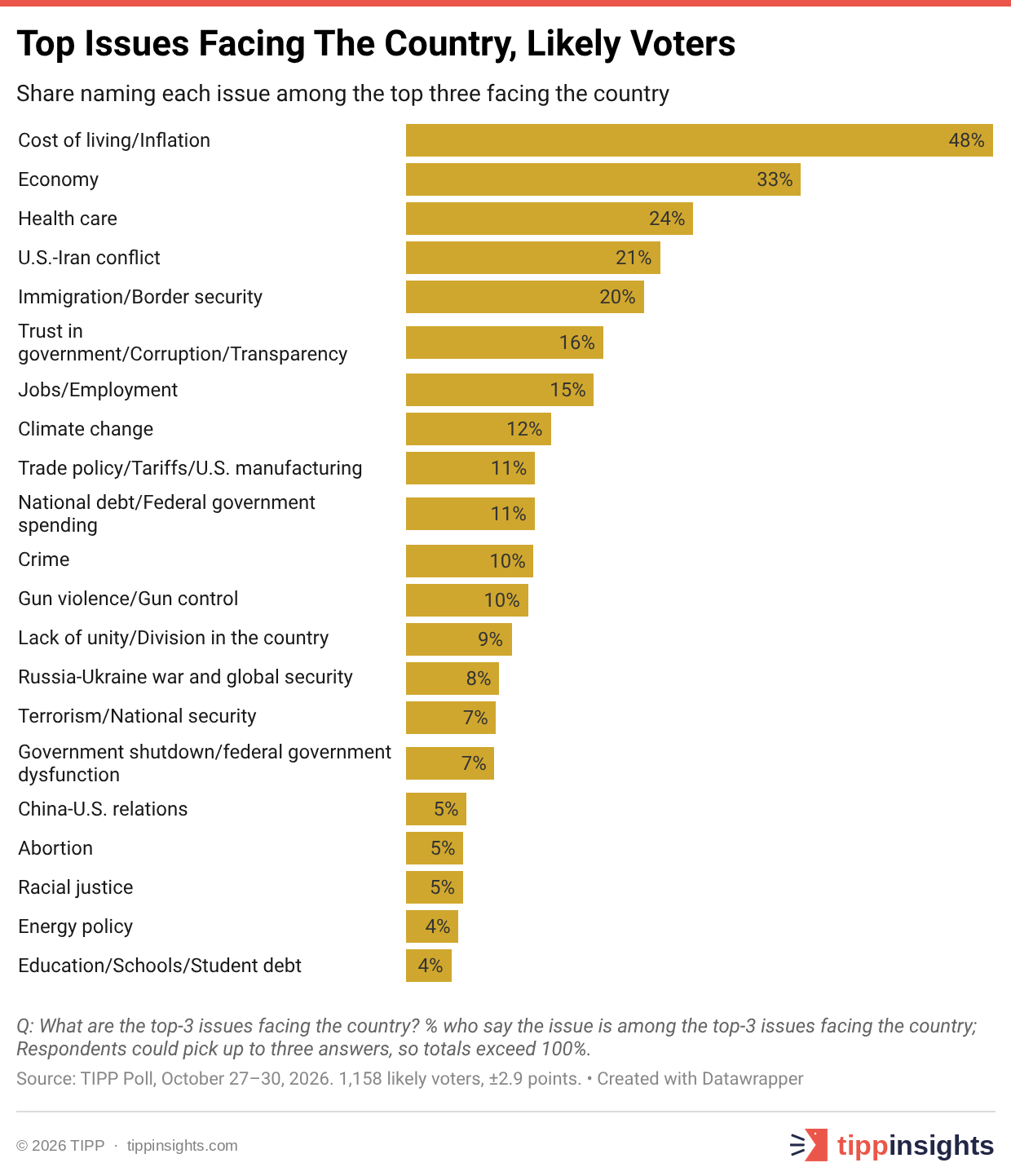
Among all likely voters, Cost of living/Inflation remains the top issue, chosen by 48% as one of the top three issues facing the country, compared with 33% for Economy. Health care (24%), U.S.-Iran conflict (21%), and Immigration/Border security (20%) complete the top five.
The nationwide TIPP Poll was conducted October 27 to 30 among 1,158 likely voters. The margin of error is plus or minus 2.9 percentage points.
Top Issues
Cost of living/Inflation leads Economy, the second-ranked issue, by 15 points, and no other issue draws more than one in four likely voters. Beyond the top five, only Trust in government/Corruption/Transparency (16%) and Jobs/Employment (15%) reach 15%. Most remaining issues fall between 5% and 12%, with Abortion and Racial justice each at 5%.
Top Issues By Party
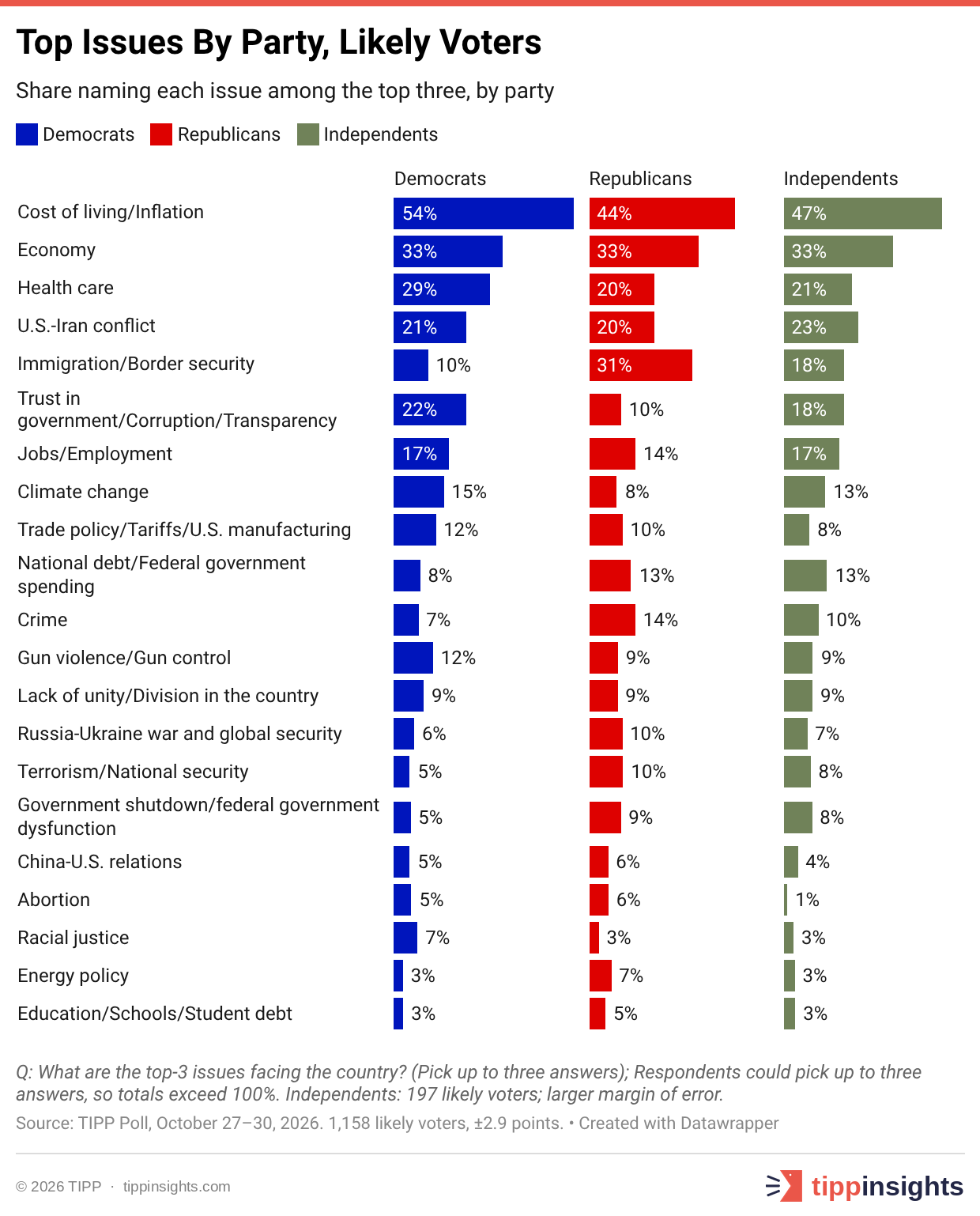
Cost of living/Inflation is the top issue for Democrats (54%), independents (47%), and Republicans (44%). Economy ranks second for all three groups at 33%. About one in five in each group chooses U.S.-Iran conflict, ranging from 20% to 23%.
Other priorities differ by party. Republicans rank Immigration/Border security third at 31%, three times Democrats' share (10%). Democrats rank Health care third (29%) and Trust in government/Corruption/Transparency fourth (22%). Among independents, U.S.-Iran conflict (23%), Health care (21%), Immigration/Border security (18%), and Trust in government/Corruption/Transparency (18%) follow the two economic issues.
Top Economic Issues
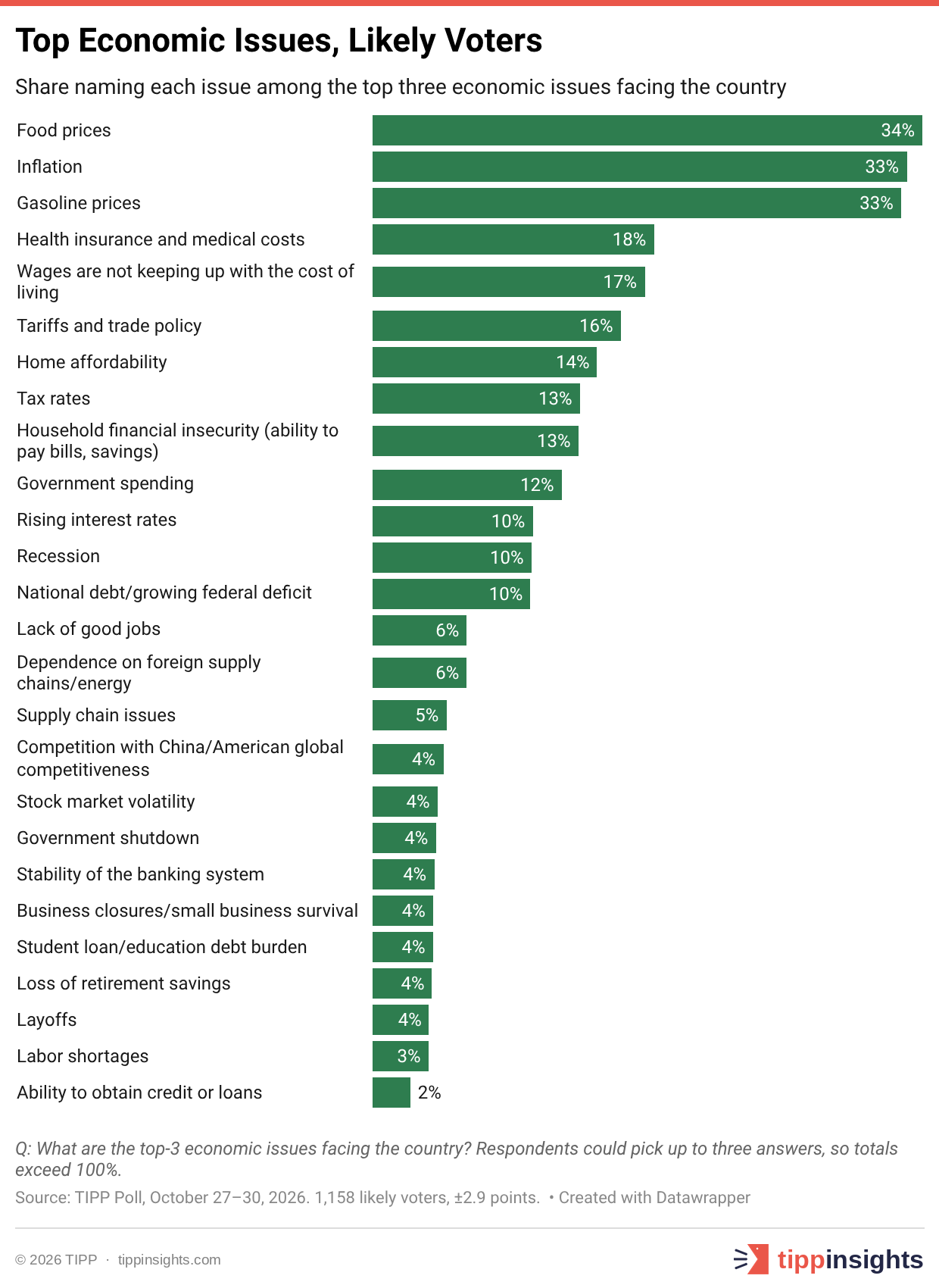
Food prices (34%), Inflation (33%), and Gasoline prices (33%) are the top economic issues for likely voters. Next are Health insurance and medical costs (18%) and Wages are not keeping up with the cost of living (17%), followed by Tariffs and trade policy (16%), Home affordability (14%), Tax rates (13%), and Household financial insecurity (13%).
Beyond Gasoline prices, independents are also more likely than either party to choose Wages are not keeping up with the cost of living (22%). For more on gasoline prices, see TIPP's earlier analysis.
Democrats most often choose Food prices (39%), Gasoline prices (36%), and Inflation (34%). Republicans choose Inflation (34%), Food prices (27%), and Gasoline prices (26%), and are more likely than Democrats or independents to choose Tax rates (18%).
Among likely voters 65 and older, 50% choose Food prices, and 46% choose Gasoline prices, higher than in any younger age group.
Direction Of The Country
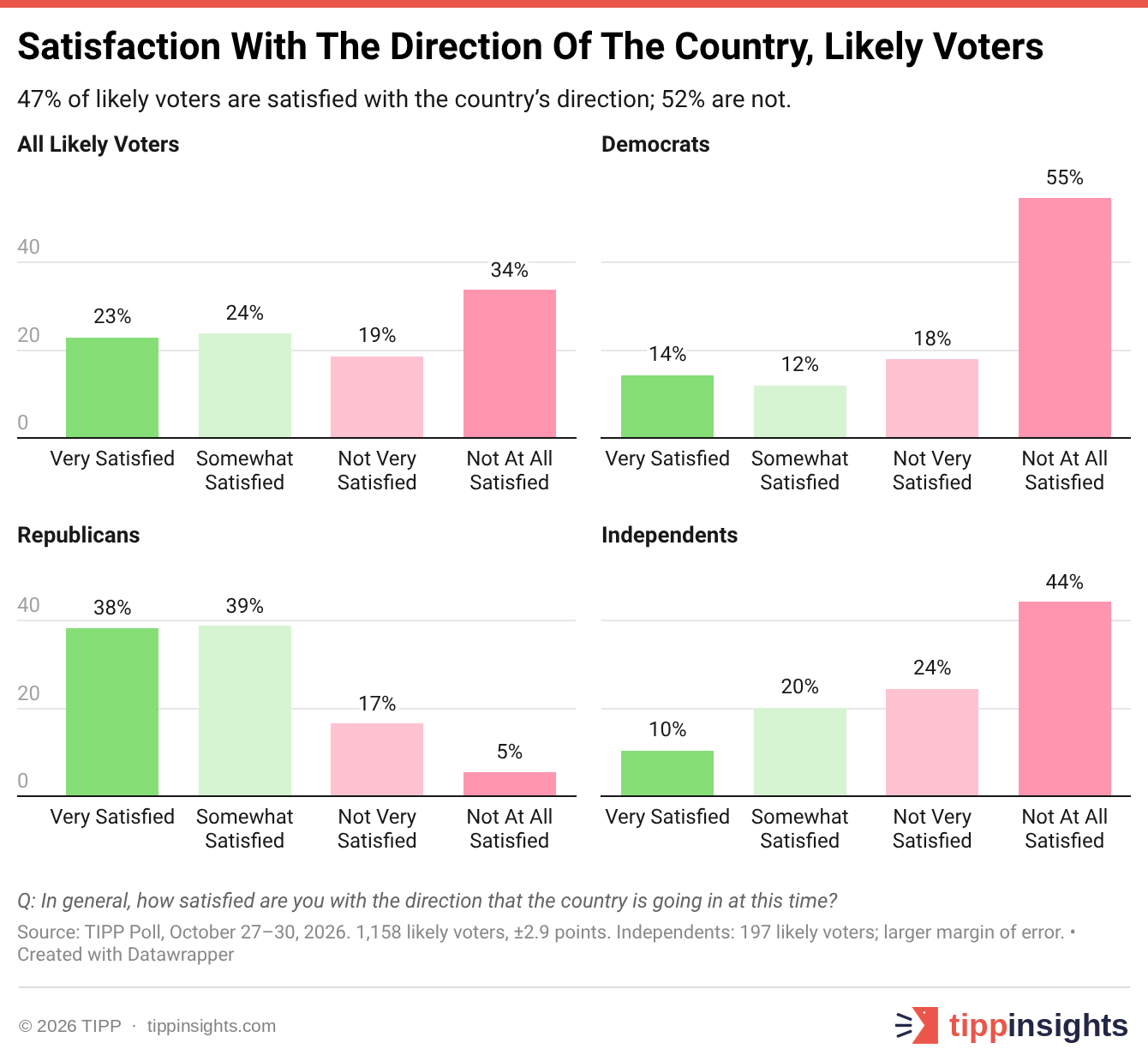
Among likely voters, 47% are satisfied with the direction of the country, while 52% are not, including 34% who are not at all satisfied.
Views differ sharply by party. Among Republicans, 77% are satisfied, including 38% who are very satisfied. Among Democrats, 73% are not satisfied, including 55% who are not at all satisfied. Among independents, 69% are not satisfied, 44% are not at all satisfied, and 10% are very satisfied.
The TIPP Index
The TIPP Direction of Country Index, based on all adults, stands at 46.0 in November. The index ranges from 0 to 100; readings above 50 indicate optimism, and below 50 indicate pessimism. The November reading is up 2.6 points from October and is the highest since October 2025.
Most of the gain came from Republicans, whose reading rose 6.4 points to 70.2. That matches their largest one-month gain of the president's second term and is their first reading above 70 since March. Democrats rose 1.8 points to 29.7. Independents fell 2.3 points to 32.0, near their lowest reading of the term.
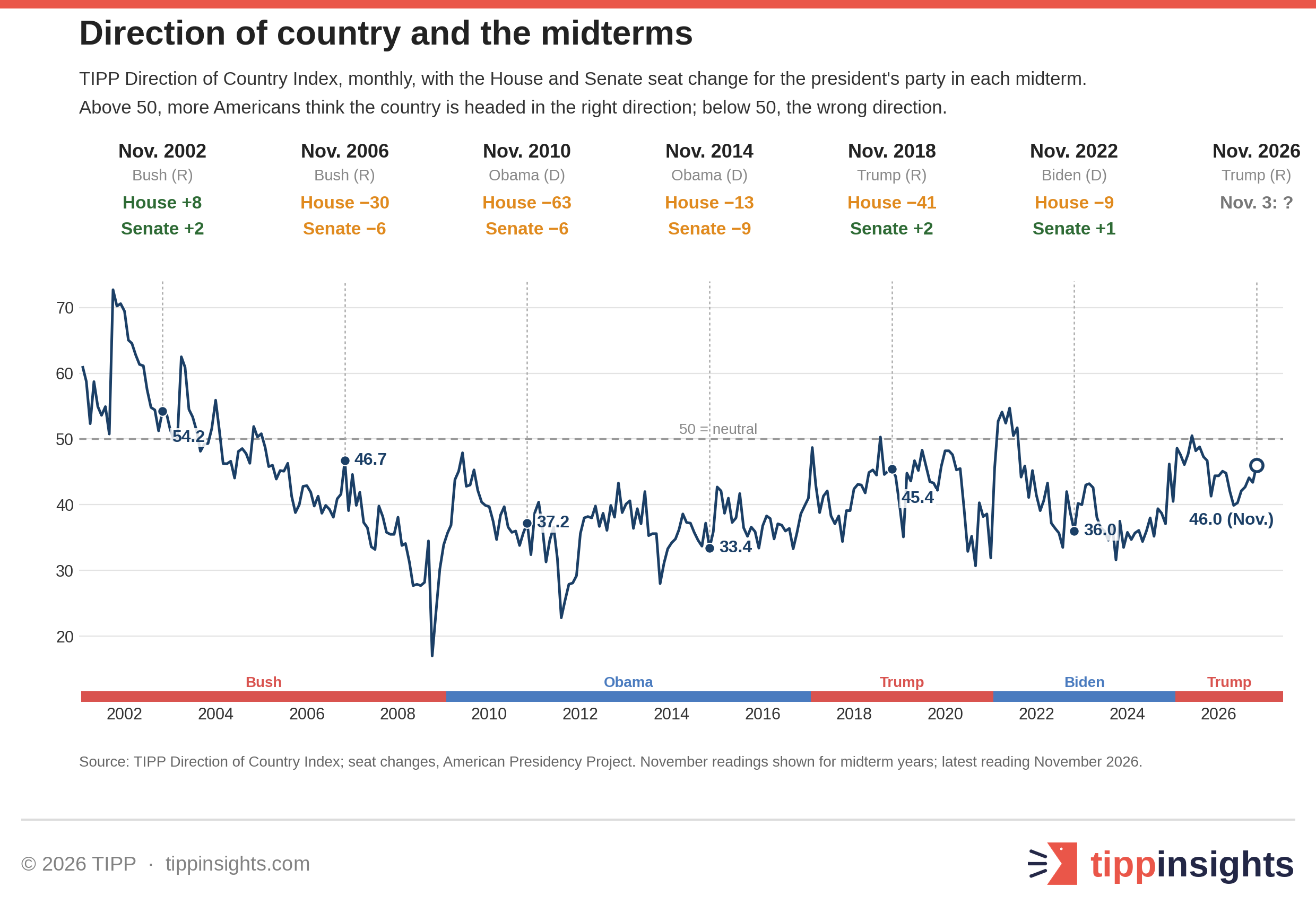
The index has been measured each November of a midterm year since 2002. It was above 50 only in 2002, the only one of those years in which the president's party gained House seats. This year's reading of 46.0 is higher than the November readings in 2010 (37.2), 2014 (33.4), and 2022 (36.0) and similar to 2006 (46.7) and 2018 (45.4). The president's party lost 30 House seats in 2006 and 41 in 2018.
The similar readings hide a shift beneath the surface. TIPP’s Great Inversion analysis found that, averaged from May through October, rural Americans’ view of the country’s direction fell 16.4 points from 2018, and seniors’ fell 12.3 points, while urban Americans’ rose 11.4 points.
Likely voters in all three party groups name prices as their main concern. Republicans are largely satisfied with the direction of the country, while most Democrats and independents are not. With independents both the least engaged and the most worried about gas, whether that concern brings them to the polls or keeps them home may shape Tuesday’s results.
About the data:
The TIPP Poll was conducted online from October 27 to 30, 2026, among 1,325 registered voters (margin of error: plus or minus 2.8 points), including 1,158 likely voters (margin of error: plus or minus 2.9 points). Issue and satisfaction results are among likely voters. Party subgroups have larger margins of error, especially independents (197 likely voters). The TIPP Direction of Country Index is based on all adults and ranges from 0 to 100; above 50 signals optimism and below 50, pessimism. Midterm seat changes are from the American Presidency Project.
Loved it, hated it, or somewhere in between — tell us. Grade this article here and help shape what lands in your inbox next.
🔗 Further Reading
Deeper on what you just read.
🟨 The Anbar Precedent – Mark Pfeifle, TIPP Insights
🟨 Democrats Poised for Largest Generic Ballot Win Since Obama’s 2008 Blowout – John McIntyre, RealClearPolitics
🟨 I&I/TIPP Poll Finds Surprising Level Of Apathy Among Swing Voters As Midterms Approach – Terry Jones, TIPP Insights
🟨 The Great Inversion: Trump’s Support Has Shifted – Editorial Board, TIPP Insights
🟨 Statistically Speaking, Don’t Count Republicans Out of the Midterms – Jonathan Draeger, RealClearPolitics
Letters to the editor email: editor-tippinsights@technometrica.com
Subscribe Today And Make A Difference. Consider supporting Independent Journalism by upgrading to a paid subscription or making a donation. Your support helps tippinsights thrive as a reader-supported publication. Contact us to discuss your research or polling needs.
Reach our audience. For sponsorship and advertising opportunities, visit our Partner With Us page.