
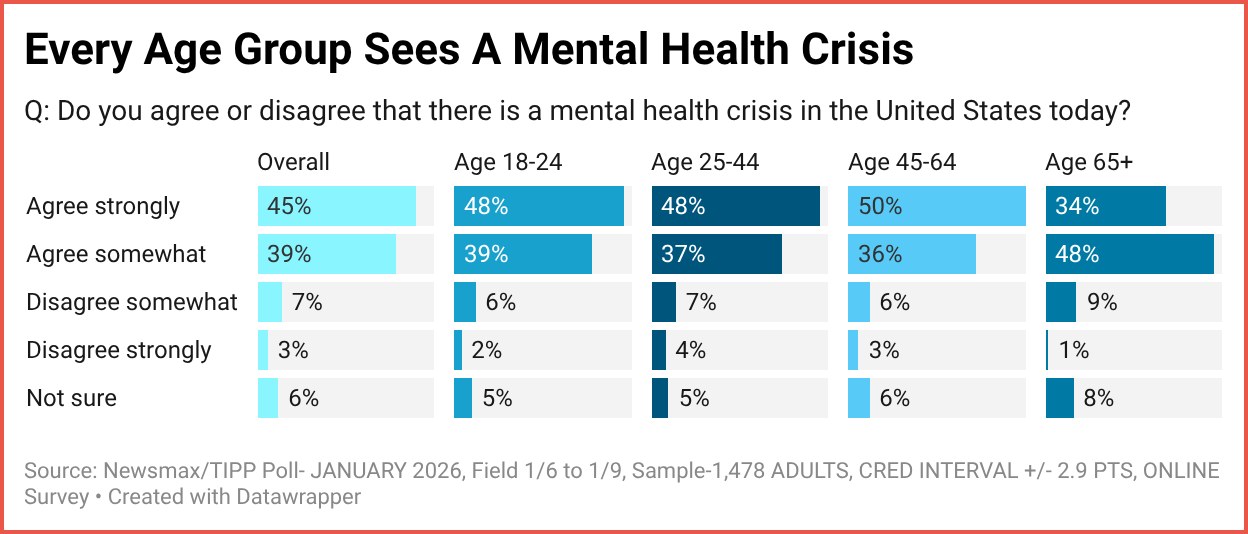
Eighty-five percent of Americans say the country faces a mental health crisis. The Newsmax/TIPP Poll, conducted in January among 1,478 adults, finds the agreement spans every age bracket, every income level, and every demographic line. The share matches what the same poll found in mid-2025. In the months since, the crisis itself has worsened. The Rula 2026 State of Mental Health Report, released in April, shows anxiety, depression, and burnout all rising. The country sees the problem with rare clarity, yet the numbers keep moving the wrong way.
Of the 85% who agree, 45% "agree strongly" and 39% "agree somewhat." Only ten percent disagree. Nearly half of adults in every age group strongly agree that America faces a mental health crisis. The same pattern holds across income brackets and racial lines.
Stigma is no longer the wall. The number of Americans in therapy has risen for years. National mental health indicators have declined over the same period. More help reaches more people, and yet the aggregate picture keeps getting worse. That gap is the question this poll is built to answer.
The poll asked Americans what is driving the decline. The largest share, 20 percent, names economic stress and the cost of living. Nineteen percent name drug and alcohol use. Fourteen percent name lack of access to care and too few providers. Another fourteen percent name the breakdown of family and community support. Twelve percent name social media and technology. Eleven percent name the cost of treatment and insurance.
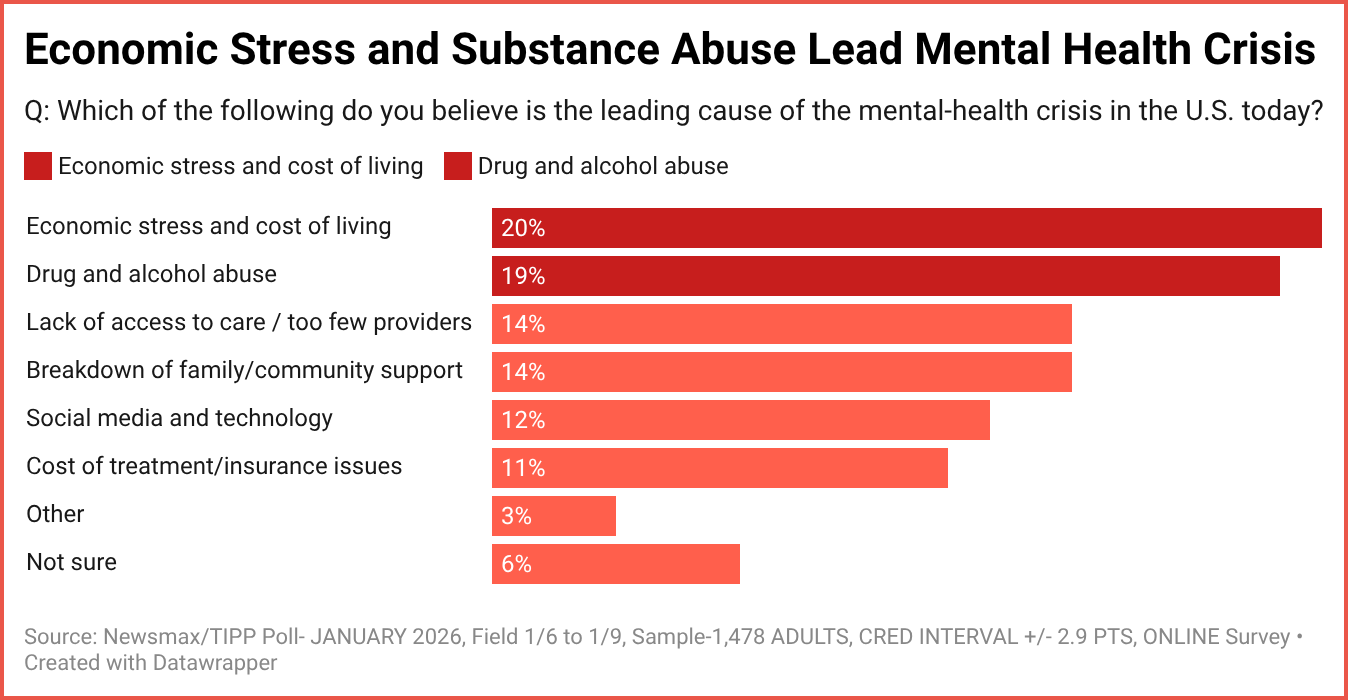
Combine the economic-stress finding with the cost-of-treatment finding and 31 percent of Americans name money as the root of the crisis. Add the access barrier and the figure climbs to 45 percent. A separate 14 percent names the breakdown of family and community support, a different kind of structural failure but a structural failure all the same. A household worried about expenses or high taxes at three in the morning needs the cost of care to come down.
A serious response begins where the poll says the problem begins: not with more public-service announcements, but with the affordability of care, the supply of providers, and the household economics underneath it all. Telehealth and app-based care can extend the reach of a thin provider network. Early intervention programs can catch conditions before they become emergencies. Policy can address the cost of treatment and the insurance gaps that turn a deductible into a barrier.
The diagnosis is settled, but the response is not.
👉 Show & Tell 🔥 The Signals
I. Americans Link Guns To A Broken Mind
A Newsmax/TIPP Poll finds 57% of Americans see gun violence and mental illness as a crisis or a very big problem. The young see it hardest.
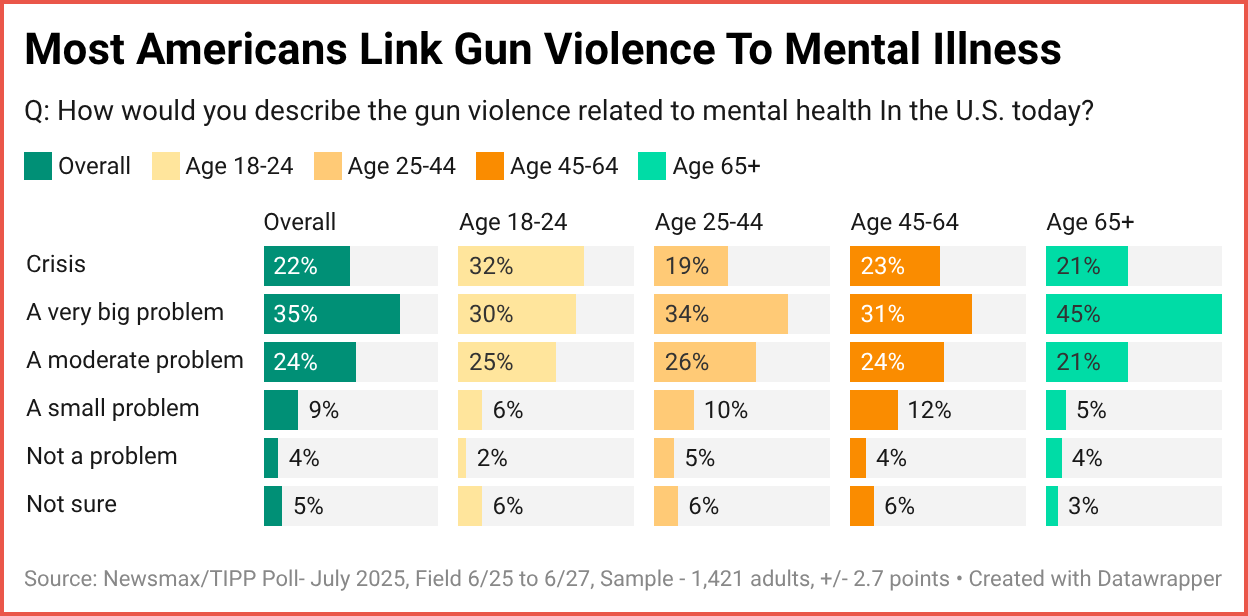
The poll, fielded in late June among 1,421 adults, finds 22% call the link a crisis and 35% call it a very big problem. Another 24% call it moderate. Only 4% say it is not a problem at all. The 18-to-24 cohort holds the sharpest view: 32% call it a crisis, ten points above the national average.
II. The Opioid Epidemic Has No Age
A Newsmax/TIPP Poll finds 62% of Americans call the opioid epidemic a crisis or a very big problem. The agreement holds at every age.
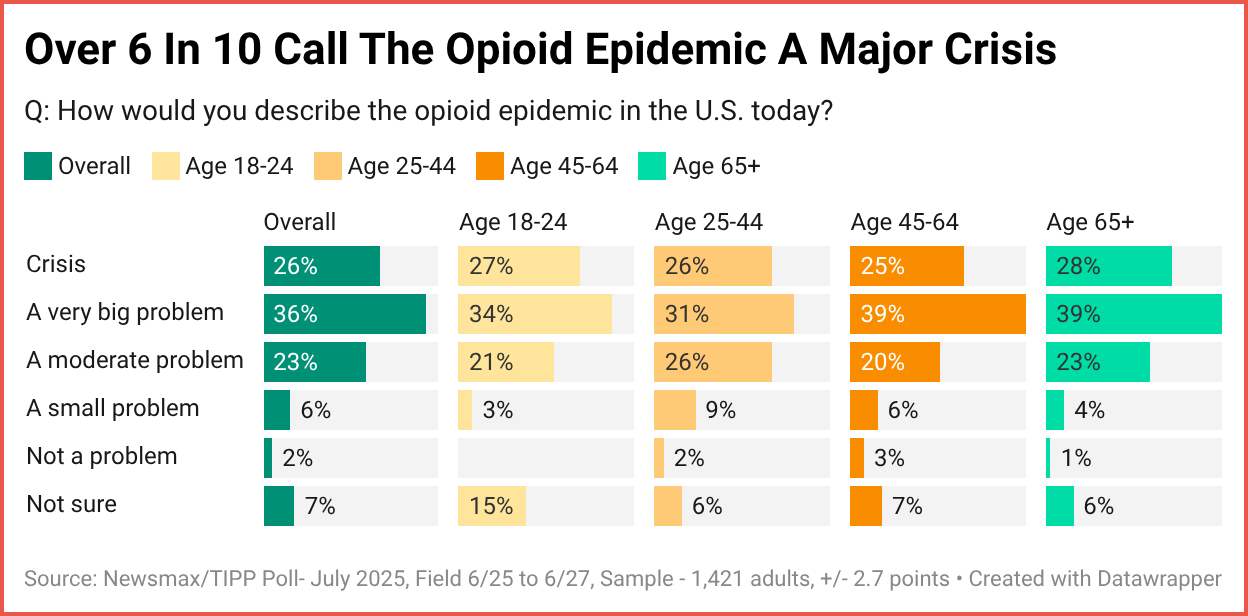
The poll, fielded in late June among 1,421 adults, finds 26% call the opioid epidemic a crisis and 36% call it a very big problem. Add moderate cases and 85% of Americans rank it from moderate to crisis. Only 2% call it not a problem. The opioid epidemic registers at full intensity across every age cohort.
📊 Market Mood — Wednesday, May 27, 2026
🟩 Markets pushed higher Wednesday as AI enthusiasm continued driving semiconductor stocks, with Micron and Samsung both benefiting from surging demand for high-end memory chips.
🟧 Investors remained cautiously optimistic on Iran peace talks after reports suggested negotiations between Washington and Tehran were still progressing despite recent military flare-ups.
🟦 Oil prices eased below $97 a barrel as hopes grew that the Strait of Hormuz could eventually reopen, helping reduce some immediate inflation fears.
🟨 The AI infrastructure race kept powering market sentiment, with chip shortages, rising memory prices, and aggressive tech spending reinforcing Wall Street’s bullish AI narrative.
🗓️ Key Economic Events — Wednesday, May 27, 2026
No Events Scheduled
Letters to the editor email: editor-tippinsights@technometrica.com
Subscribe Today And Make A Difference. Consider supporting Independent Journalism by upgrading to a paid subscription or making a donation. Your support helps tippinsights thrive as a reader-supported publication. Contact us to discuss your research or polling needs.
Reach our audience. For sponsorship and advertising opportunities, visit our Partner With Us page.