
With the sudden popularity of openly socialist candidates in recent local elections, is the U.S. turning into a socialist state? As the latest I&I/TIPP Poll shows, Americans mostly believe the country is indeed moving toward socialism, but don't want to foot the bill for the big jump in taxpayer spending to pay for it.
The national online I&I/TIPP Poll was taken from June 29 through July 2, and kicked off by asking 1,473 voters whether they agreed or disagreed with the following question: "The U.S. is evolving into a big government socialist state."
Overall, 48% agreed the U.S. was "evolving" toward socialism either "somewhat" (31%) or "strongly" (18%), while a full third less, 32%, disagreed either "somewhat" (17%) or "strongly" (15%). Of those remaining, a sizable 19% said they weren't sure.
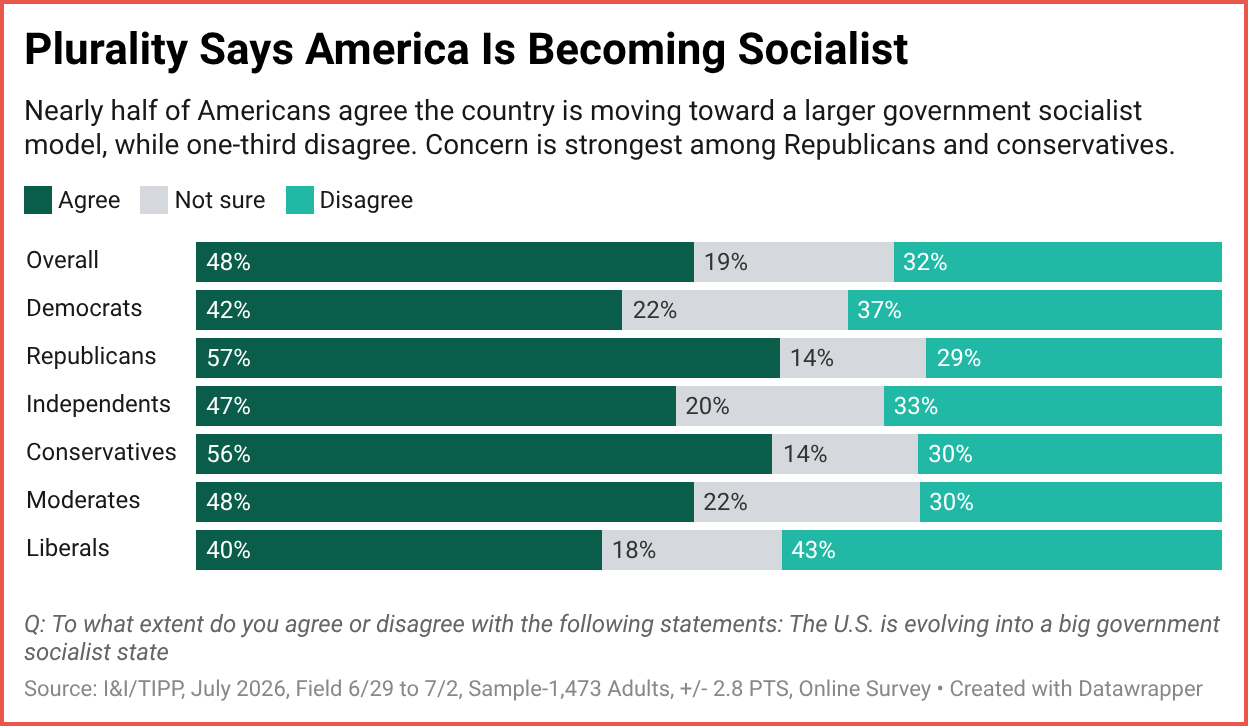
But there's a surprising degree of agreement when it comes down to political affiliation. A majority of Republicans (57% agree, 29% disagree) see a trend toward socialism, but so do a plurality of both Democrats (42% agree, 37% disagree) and independents (47% agree, 33% disagree).
Could they all be wrong?
Next, I&I/TIPP asked a question intended to discern how willing American taxpayers would be to fund a socialist government: "I am willing to pay higher taxes to support more social programs."
On the whole, only 33% said they agreed either "strongly" (13%) or "somewhat" (21%), while a clear majority of 56% said they disagreed either "strongly" (33%) or "somewhat" (23%). So by nearly 2-to-1, Americans do not want to pay more taxes to fund social spending.
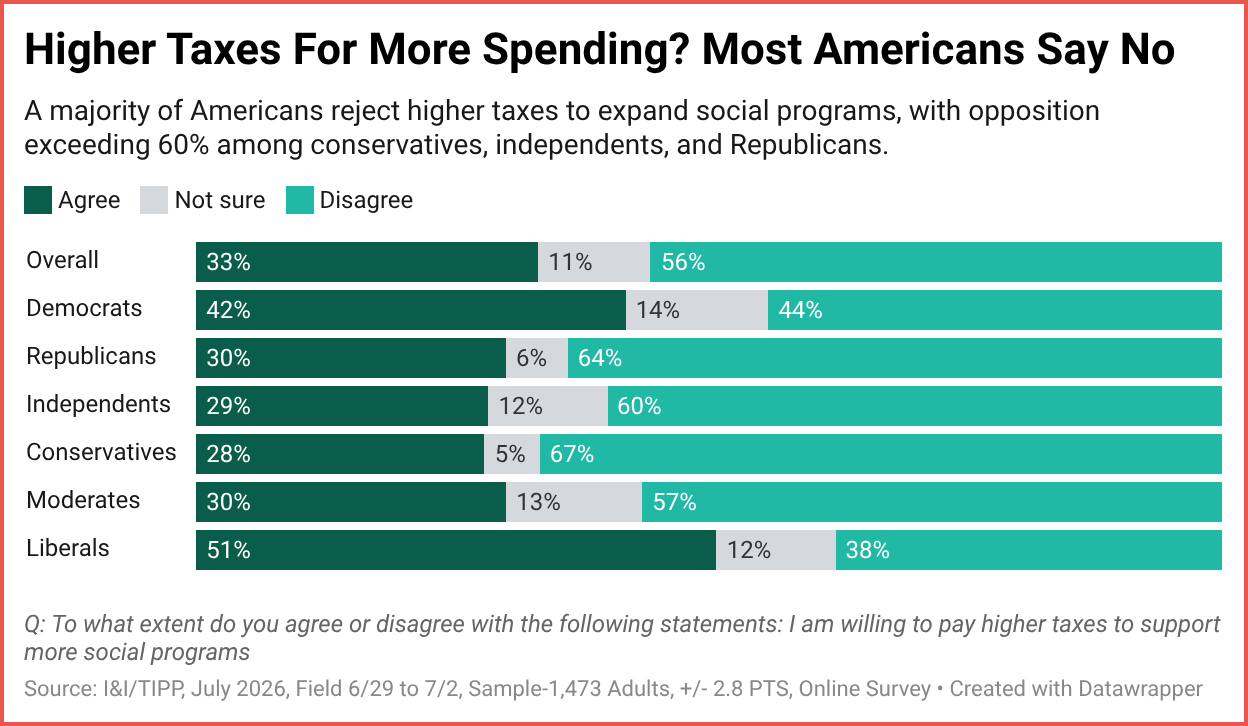
Once again, across all political affiliations, Americans didn't want to pay more taxes for social programs.
Republicans (30% agree, 64% disagree) were strong in their rejection of more social spending fueled by taxes, while independent voters (29% agree, 60% disagree) were equally adamant. Even Democrats, whose namesake party has listed toward the left in recent years, don't want to pay more taxes by a slim plurality (42% agree, 44% disagree).
Taxpayer funded expansions of social spending seem to be off the table for most voters. But one other aspect of socialist government expansion — government ownership — remains surprisingly popular.
I&I/TIPP also asked voters if they agreed or disagreed with this statement: "I believe the government should control or own key industries such as healthcare and energy."
Of the sample, 42% agreed, while a slim plurality of 44% disagreed.
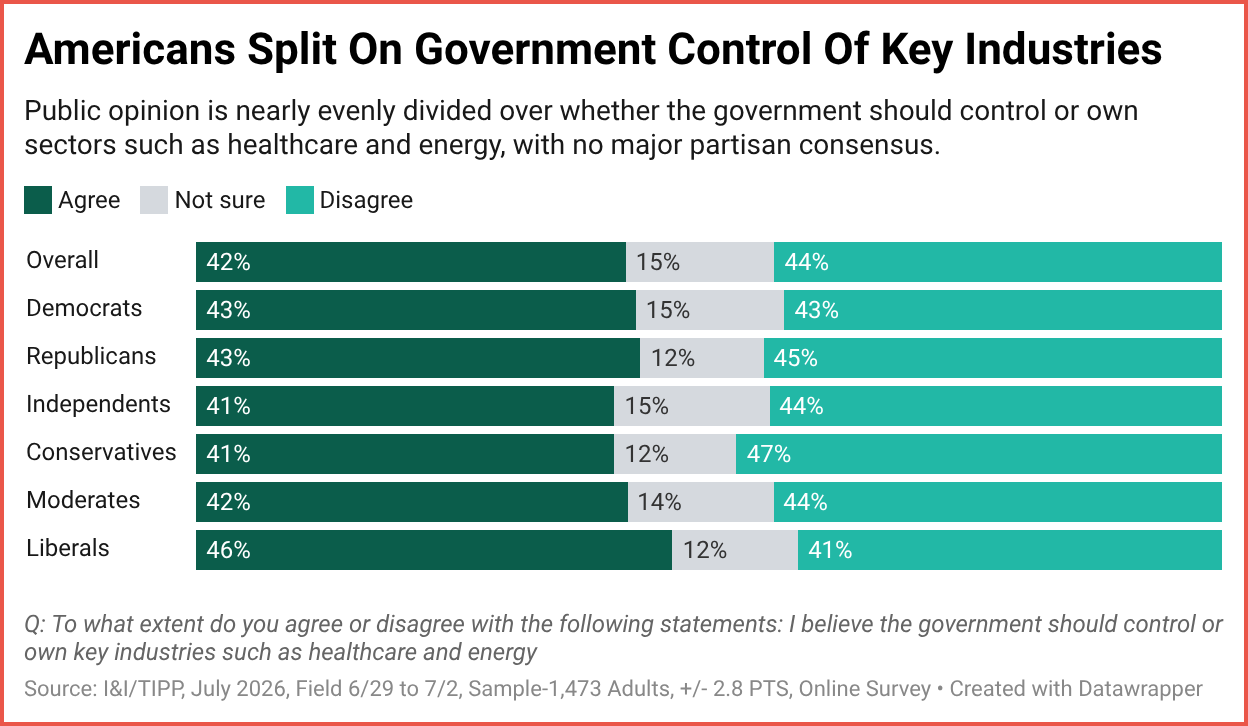
There was surprising political unanimity.
Among Democrats, 43% agreed, 43% disagreed, an even split. For independents, it was 41% agree, 44% disagree, not too different. But even Republicans were surprisingly close to both the other parties, with 43% agreeing, and 45% disagreeing.
Of those who identified themselves as liberals, 46% agreed and 41% disagreed; among moderates, it was 42% agreed, 44% disagreed; but even among those who self-describe as conservatives, 41% agreed, 47% disagreed.
Put bluntly, more than 40% of all political party affiliations and ideologies agree that public ownership or control of major industries is desirable.
That last one is a bit scary, if only because government ownership of major industries in the economy is the linchpin of both socialism and communism.
So, is socialism a "thing," as they say on social media? A passing fancy? Or the wave of the future?
Whatever your answer is, you can probably find some support.
Nearly everyone agrees that the U.S. government — with its ever-burgeoning spending, its eagerness to control free markets and industries, and a Congress that includes a growing legion of Democratic Socialists of America members — appears to be moving leftward.
But President Donald Trump draws a line in the sand, equating socialism with communism.
“America will never be a communist country,” he said in remarks celebrating the 250th anniversary of the Declaration of Independence. “Won’t happen. Communism is a loser and it always will be. Our warriors did not fight communism on battlefields across the world, only to have that menace rear its ugly head right back here in America. We’re not going to let it happen.”
Even so, most Americans don't seem too alarmed about socialism's powerful showing in recent local elections, with 38 DSA members elected to local office, including Democratic Socialist Mayor Zohran Mamdami in New York. Even Democrats worry about this trend.
"State Democratic parties have witnessed this socialist takeover," notes Arthur Schaper in American Thinker. "The grassroots demand single-payer healthcare, abolition of the Second Amendment, radical abortion and LGBT rights, and a host of demands punishing free enterprise while claiming to care for the needs of the so-called working classes instead of millionaires and billionaires."
Some argue they're only local elections. But in fact, the Democratic Party has been moving left for a long time. And the recent wave of socialist victories at the local level will surely have an impact at the national level within the Democratic Party.
As of 2025, there were 250 Democratic Socialists of America members in office nationwide, with 90% of those elected since 2019. Five DSA members won their congressional primaries last year and are expected to cruise to victory in the fall.
"Control the cities, you control the states," wrote Jeffrey Tucker at his Points And Figures substack. "Control the states, you control the national legislature. Control that, and you can control the country."
But wouldn't government control of the economy be more efficient than what appears to some to be the chaos of free markets? In a word, no.
In a comprehensive 2020 study analyzing decades of income data for 162 nations, former chairman of the President's Council of Economic Advisers Edward Lazear concluded: "The general evidence suggests that both across countries and over time within a country, providing more economic freedom improves the incomes of all groups, including the lowest group."
Indeed, there are no generally recognized major economic studies supporting the idea that socialism would be better than the U.S. system of capitalism. Or that socialist economies based on public ownership of large swaths of the economy outperform market-oriented economies. None.
Even so, today socialist ideas appear to be on an upswing.
According to a recent Yahoo/YouGov survey, "about twice as many U.S. adults say they would vote for a candidate with Mamdani's platform (50%) than say they would not (26%)." That platform includes such such socialist staples as freezing rents for low-income people, raising taxes on corporations and the wealthy, lifting the minimum wage to $30, and free child care.
Will it work on the national stage? Keep an eye on New York and find out.
I&I/TIPP publishes timely, unique, and informative data each month on topics of public interest. TIPP’s reputation for polling excellence comes from being the most accurate pollster for the past six presidential elections.
Terry Jones is an editor of Issues & Insights. His four decades of journalism experience include serving as national issues editor, economics editor, and editorial page editor for Investor’s Business Daily.
Loved it, hated it, or somewhere in between — tell us. Grade this article here and help shape what lands in your inbox next.
📊 Market Mood · July 13, 2026
How the trading day is setting up.
🟩 Markets are looking to the week ahead, with corporate earnings and inflation data expected to determine whether this year's rally can extend further.
🟧 Geopolitical tensions have returned to the forefront after renewed U.S.-Iran strikes and reports that shipping through the Strait of Hormuz has slowed sharply, reigniting concerns about energy supplies.
🟦 Oil prices have surged more than 4%, lifting Treasury yields and reviving inflation fears just days before the June CPI report.
🟨 Investors are entering one of the busiest weeks of the summer, with CPI, major bank earnings, and Fed Chair Kevin Warsh's congressional testimony all likely to shape the outlook for interest rates and markets.
🗓️ Key Economic Events
On today's U.S. data calendar.
🟧 No Major U.S. Economic Reports Scheduled
Today's calendar is light, giving investors time to position ahead of Tuesday's highly anticipated inflation report.
🟧 Fed Governor Christopher Waller Speaks — 12:30 p.m. ET
Focus: Inflation, monetary policy, and the economic outlook.
Markets will watch for any comments ahead of this week's CPI release and Fed Chair Kevin Warsh's congressional testimony.
🟧 Market Focus — Preparing for CPI and Earnings Season
Tuesday's Consumer Price Index (CPI) and the kickoff of second-quarter bank earnings are expected to be the week's biggest market catalysts, with the potential to reshape expectations for Fed policy.
Letters to the editor email: editor-tippinsights@technometrica.com
Subscribe Today And Make A Difference. Consider supporting Independent Journalism by upgrading to a paid subscription or making a donation. Your support helps tippinsights thrive as a reader-supported publication. Contact us to discuss your research or polling needs.
Reach our audience. For sponsorship and advertising opportunities, visit our Partner With Us page.