
On Tuesday, Russian military officers, Ukrainian officials, and American envoys will meet in Abu Dhabi to negotiate whether Ukraine must give up territory to end the war. The issue has blocked a settlement for nearly five years.
A new national TIPP Poll finds Americans divided on the same issue. A plurality would accept a deal that lets Russia keep some of the Ukrainian territory it occupies. One in three Americans who blame Vladimir Putin for the stalemate would accept it. And the gap between younger and older Americans is about as wide as the gap between Republicans and independents.
On Saturday, the Kremlin said its delegation will include senior military officials and diplomats, among them Deputy Foreign Minister Sergei Ryabkov, who will take part in the talks for the first time. The meeting is the first three-way round since February. Russia and Ukraine have continued to exchange strikes ahead of it.
U.S. envoy Steve Witkoff said the talks will cover post-war security arrangements, de-escalation, humanitarian measures, and ending the war.
Americans Split Over Territorial Concessions
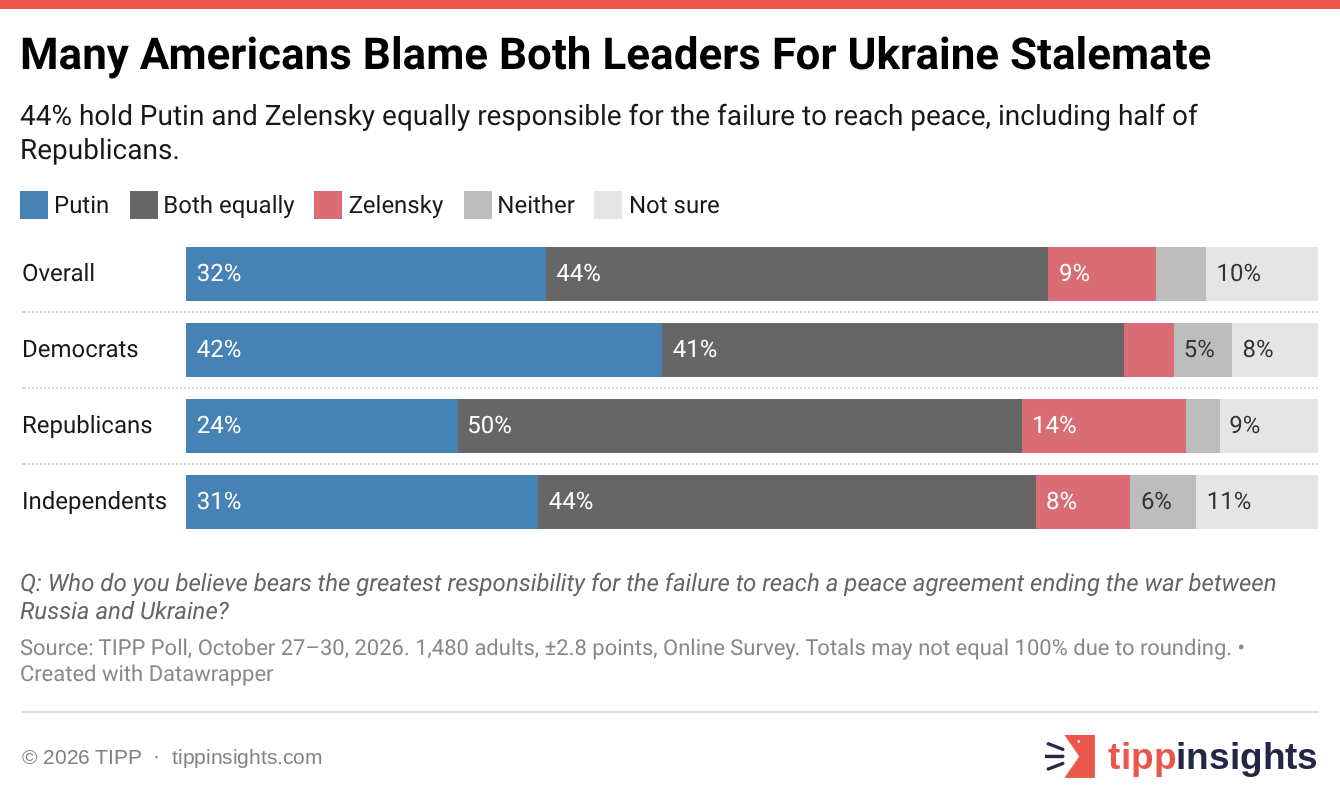
The TIPP Poll, conducted October 27–30 among 1,480 U.S. adults, asked whether respondents would favor or oppose a peace agreement that ends the war but allows Russia to retain control of some Ukrainian territory it currently occupies.
Overall, 43% favored such an agreement, 37% opposed it, and 20% were not sure.
Republicans supported it, 59% to 25%. Democrats opposed it, 46% to 37%, and independents opposed it, 47% to 28%.
Who Is Responsible For The Stalemate?
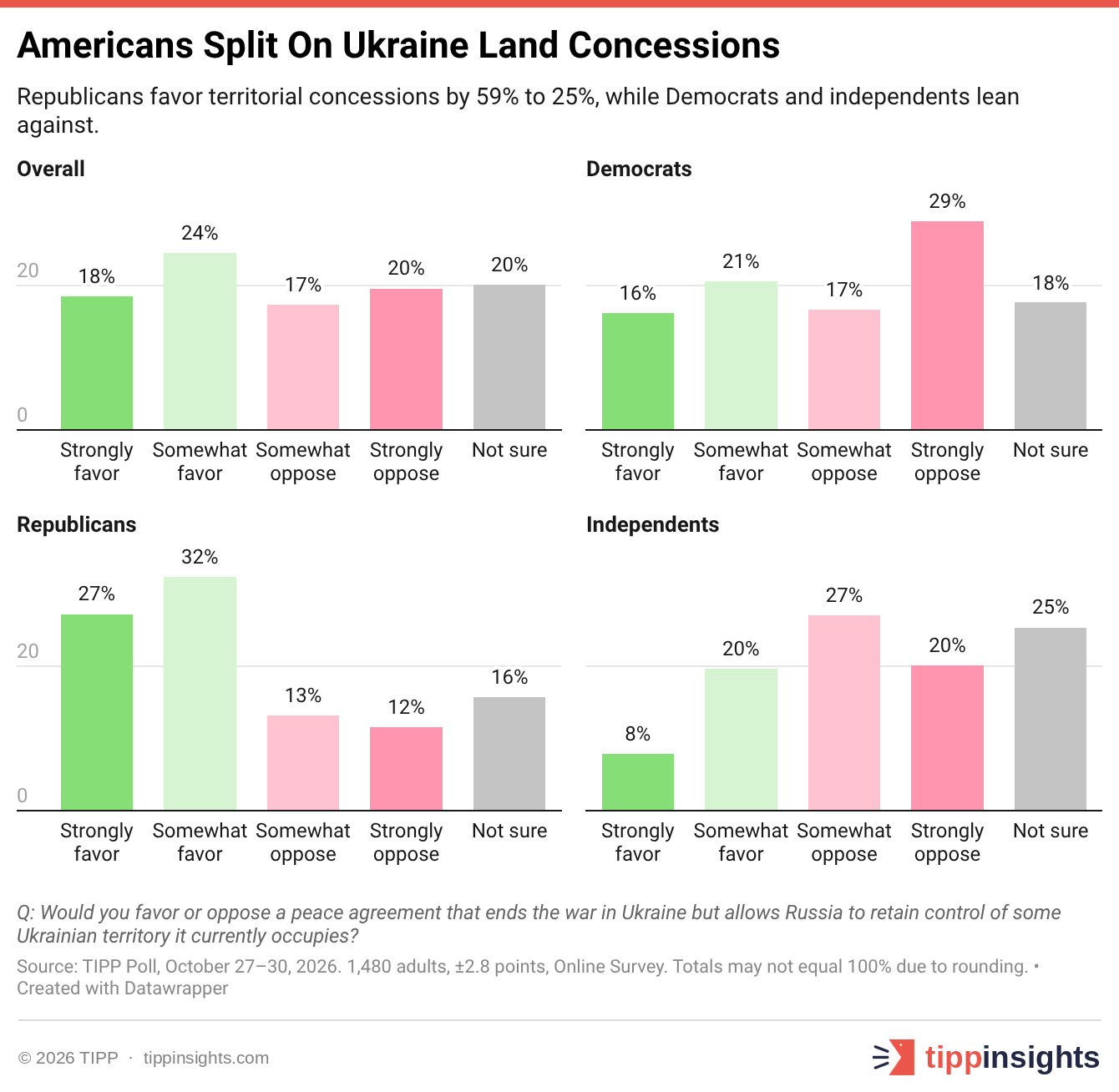
Asked who bears the greatest responsibility for the failure to reach a peace agreement, 44% said Putin and Ukrainian President Volodymyr Zelensky share it equally. Another 32% blamed Putin, 9% blamed Zelensky, 4% said neither, and 10% were not sure.
Half of Republicans (50%) blamed both leaders equally, as did 41% of Democrats and 44% of independents. Democrats were more likely than Republicans to blame Putin, 42% to 24%. Republicans were more likely than Democrats to blame Zelensky, 14% to 4%.
Blame And Bargaining
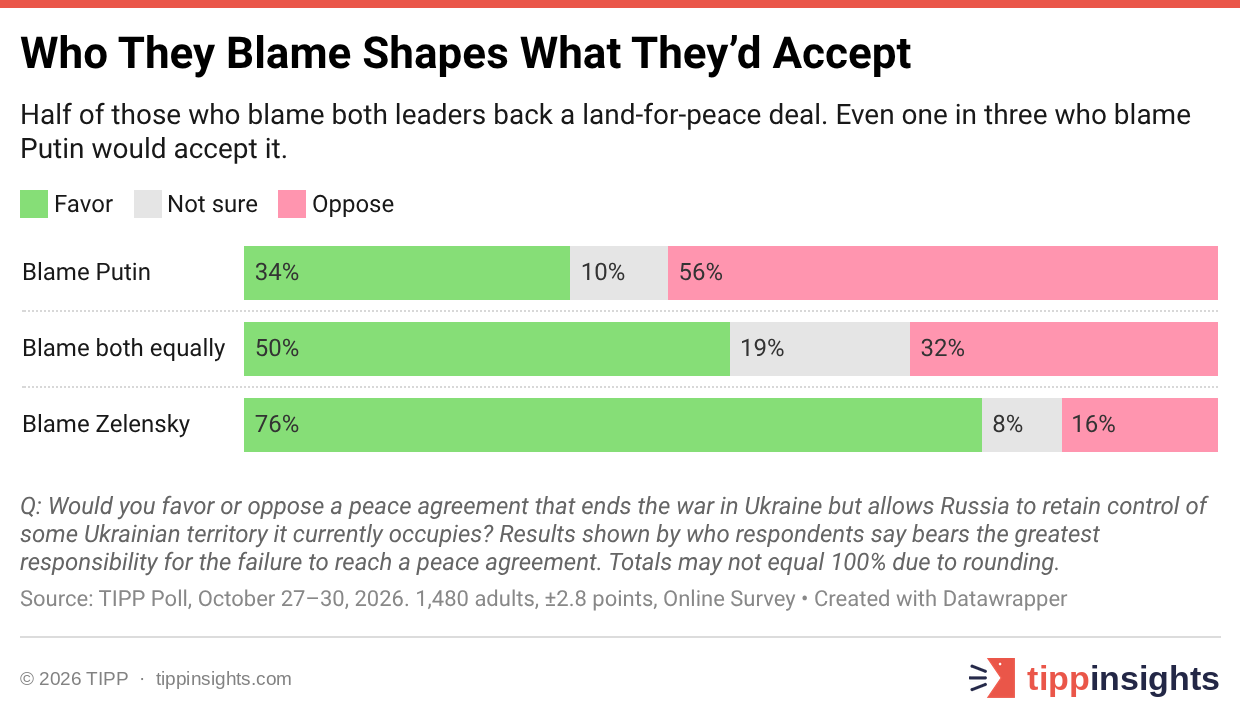
Views on blame track closely with views on concessions.
Among those who blame both leaders equally, 50% favor a deal that lets Russia keep occupied territory and 32% oppose it. This group makes up 52% of all Americans who favor such a deal.
Among those who blame Putin, 56% oppose the deal, but 34% would accept it. Among those who blame Zelensky, 76% favor it.
A Generational Divide
Millennials favor a land-for-peace deal, 59% to 25%, and Gen Z favors it, 55% to 31%. Boomers oppose it, 52% to 25%. Gen X is split, with 38% in favor and 39% opposed.
Strong opposition stands at 33% among Boomers and 10% among Millennials.
Boomers are also more likely to blame Putin for the stalemate. Forty-four percent hold him mainly responsible, compared with 24% of Millennials.
Boomers came of age during the Cold War, when the Soviet Union was the main U.S. adversary. For Millennials, the defining foreign-policy events of their early adult years were the wars in Iraq and Afghanistan.
Men favor a deal, 52% to 37%. Women are split, with 35% in favor, 37% opposed, and 29% not sure.
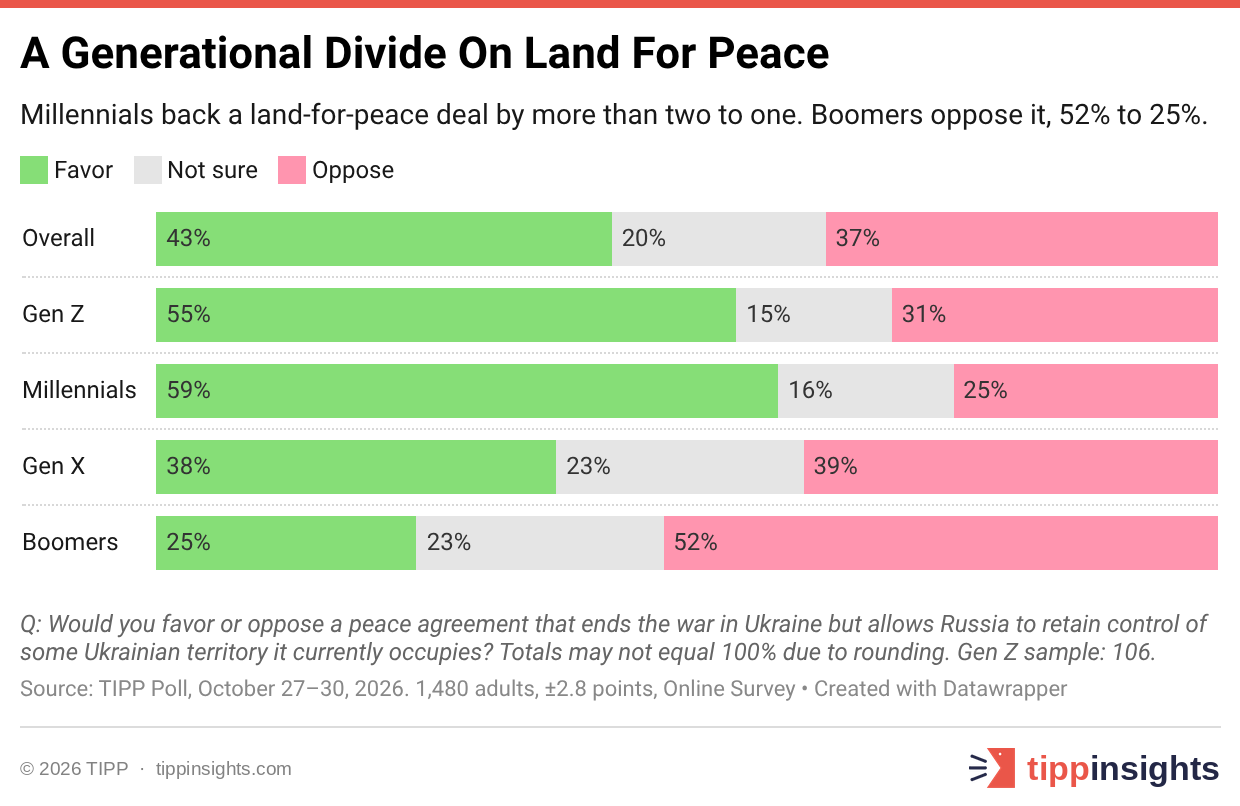
Support for a deal is highest among Republicans, Millennials, and those who blame both leaders. Opposition is highest among Boomers and those who blame Putin.
Territory is expected to be the hardest issue on the table in Abu Dhabi this week. With no majority of Americans for or against a land-for-peace deal, the poll suggests no outcome would satisfy most of the public.
Methodology: The TIPP Poll surveyed 1,480 U.S. adults online from October 27–30, 2026. The credibility interval is ±2.8 percentage points for the full sample and larger for subgroups. Percentages may not total 100 due to rounding. TIPP’s reputation for polling excellence comes from being the most accurate pollster for the past six presidential elections.
Loved it, hated it, or somewhere in between — tell us. Grade this article here and help shape what lands in your inbox next.
Letters to the editor email: editor-tippinsights@technometrica.com
Subscribe Today And Make A Difference. Consider supporting Independent Journalism by upgrading to a paid subscription or making a donation. Your support helps tippinsights thrive as a reader-supported publication. Contact us to discuss your research or polling needs.
Reach our audience. For sponsorship and advertising opportunities, visit our Partner With Us page.