

As nations across Europe continue to be roiled by violent protests, questions inevitably arise: After a tumultuous election season and increasingly strident criticisms between the two major political parties, will the U.S. be next to suffer violent political protests? I&I/TIPP's November poll of American voters seeks answers.
At first, it seemed as if Americans were writing off the Euro-violence as far away and not perhaps relevant to their country in the current moment, particularly after a hard-fought midterm election campaign. But is that the case?
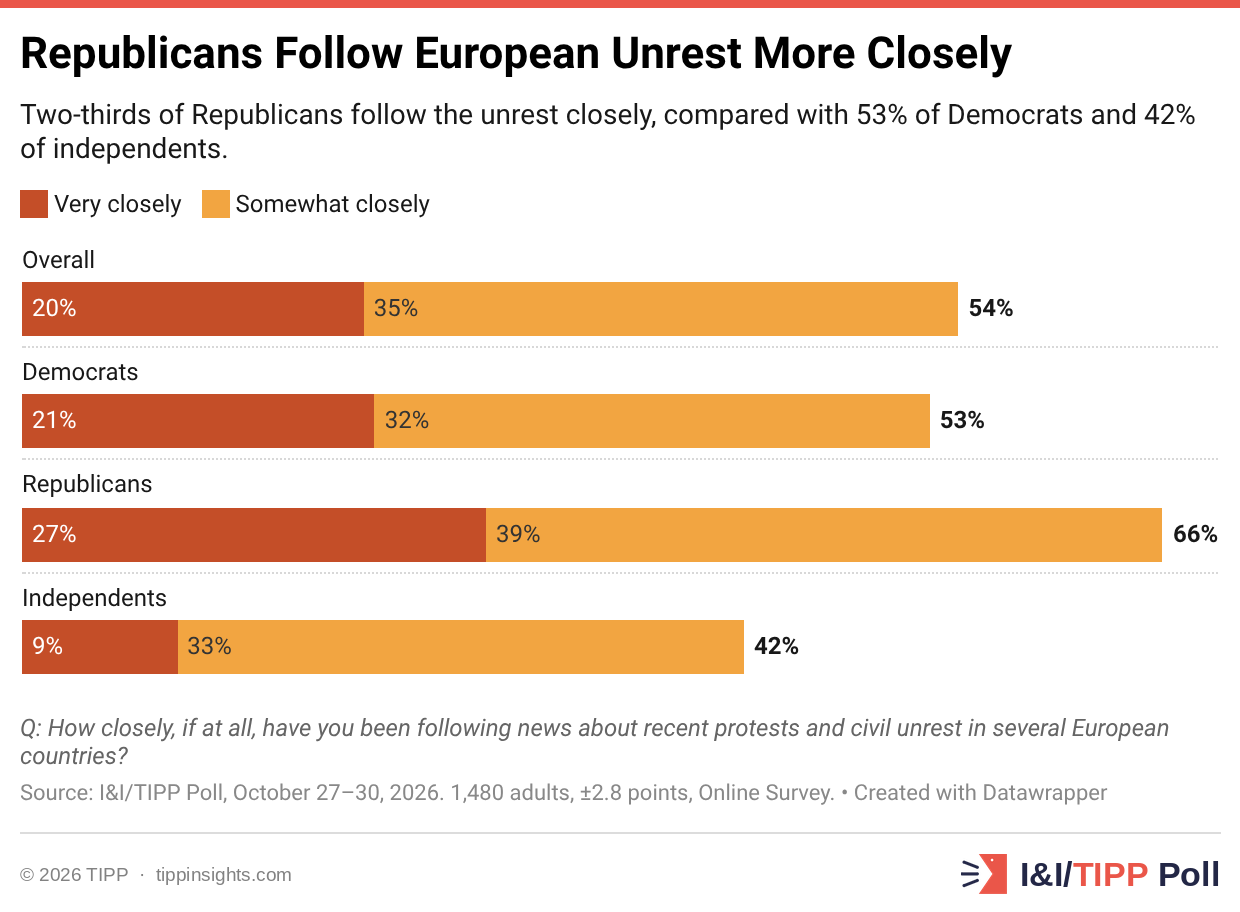
To find the answer, I&I/TIPP asked 1,480 likely voters this question: "How closely, if at all, have you been following news about recent protests and civil unrest in several European countries?"
Turns out, Americans haven't tuned out what's going on in the EU: 54% said they were either following the civil unrest in Europe either "very closely" (20%) or "somewhat closely" (35%), while just 41% said they were following the riots "not too closely" (23%) or "not at all closely" (18%). Another 4% described themselves as "not sure."
The poll, taken from Oct. 27 through Oct. 30, has a +/-2.8 percentage point margin of error.
There were distinct differences, based on political affiliations. Among Democrats, 53% said they were following the events "closely," while 43% said they were "not closely" following the events, about in line with the overall poll.
However, independents seemed least engaged, with only 42% saying they were following events closely, while 54% said they weren't.
As for Republicans, they're watching carefully what transpires in Europe, with 66% saying they were following closely, just 31% saying they weren't.
Also, men and women, once again, differ strongly. Men (66% watching closely, 32% not closely) are much more focused on Europe's violence than women (44% watching closely, 50% not closely).
Age is yet one more dividing line. Those 18 to 24 years old are most likely to be watching closely the events (75%), with it trailing off as respondents get older: 25 to 44 years old (63% watching closely), 45 to 64 (48% watching closely) and 65-plus years (45% watching closely).
With these responses in mind, the 55% of voters who said they were watching events in the EU "closely" were then asked "Which of the following factors, if any, do you believe have contributed to recent protests and civil unrest in parts of Europe?"
They were given 10 possible responses and were not restricted to just one answer, but could choose as many as they thought applied.
The most popular response was "Rising cost of living and economic hardship" at 51%, followed in order by "Dissatisfaction with government policies and political leaders" (40%); " Immigration and difficulties integrating newcomers" (37%); "Activities of organized political extremist groups" (33%); "Problems with education and educational opportunities" (27%); "Socialist or left-wing economic policies" (26%); "Foreign interference or agitation" (25%).
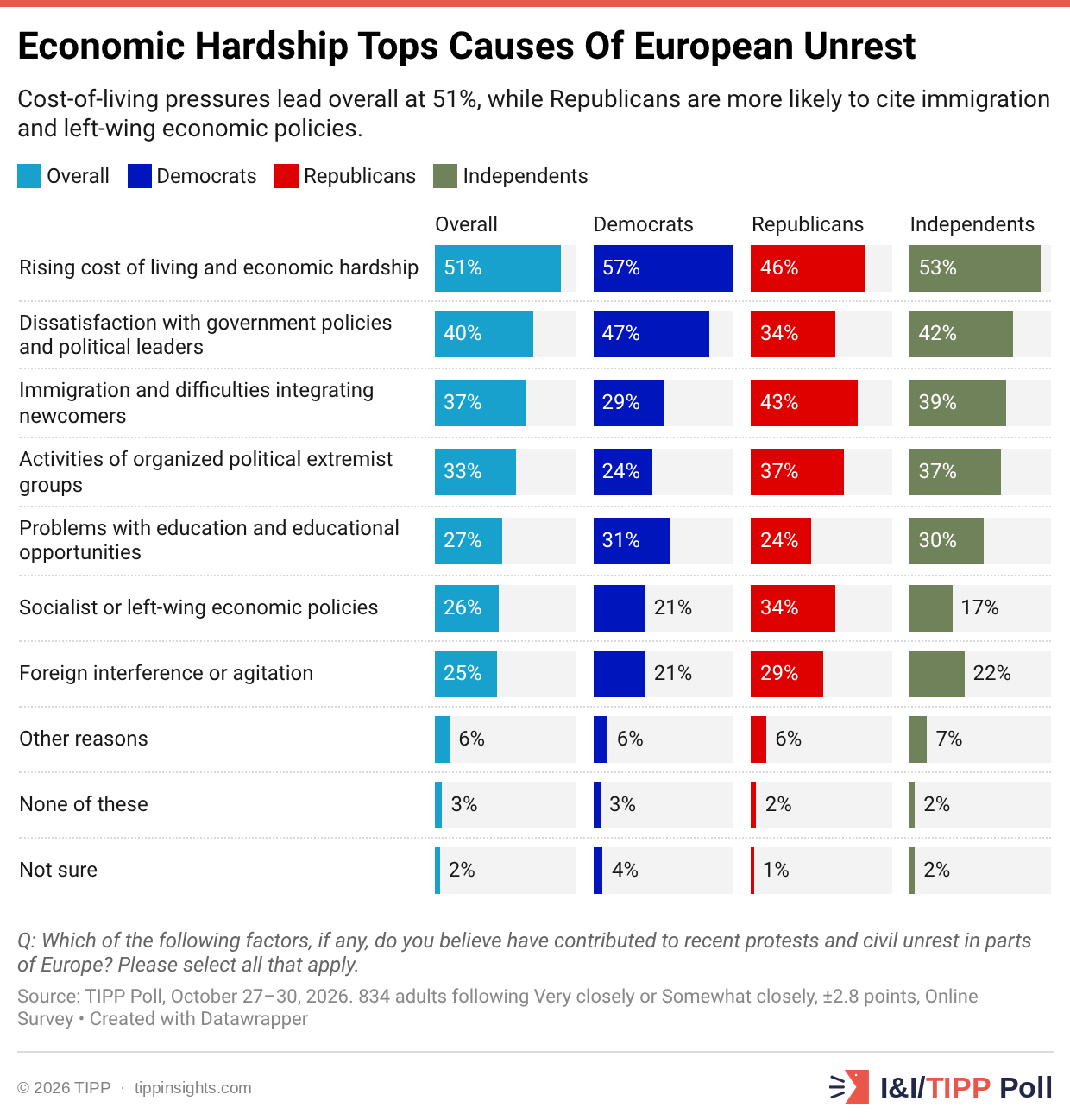
Other less popular nonspecific options included "Other reasons" (6%); "None of these" (3%); and "Not sure" (2%).
While differences by political affiliation were visible, they were not extreme. For instance, the top three responses for the most popular answer, "Rising cost of living and economic hardship," came in at 57% for Democrats, 46% for Republicans, and 53% for independents, all highs for the three political groups.
There were some differences in the No. 2 answer ("Dissatisfaction with government policies and political leaders"), but they weren't large: Dems 47%, GOP 34%, indies 42%.
For the No. 3 response ("Immigration and difficulties integrating newcomers"), Dems were least likely to cite that (29%) than either Republicans (43%) or independents (39%).
Even among the lowest responses, some obvious differences emerged. For instance, "Problems with education and educational opportunities," was cited by 31% of Dems and 30% of indie voters, but just 24% of GOP voters. Similarly, "Socialist or left-wing economic policies" got 21% of Dems and 17% of indie voters, but 34% of Republicans.
"Foreign interference or agitation," again showed the ideological gaps, with 21% of Dems and 22% of indies, but 29% of Republicans.
The final question asked, "How concerned are you that the United States could experience widespread political protests, including rioting, looting, or property destruction, in the next few years?"
The responses clearly show that most Americans are quite concerned about the prospect of politically motivated violence in the coming years. Overall 70% said that they were either "very concerned" (30%) or "somewhat concerned" (40%), versus just 23% saying they were "not very concerned" (15%) or "not at all concerned" (8%). Another 7% described themselves as "not sure."
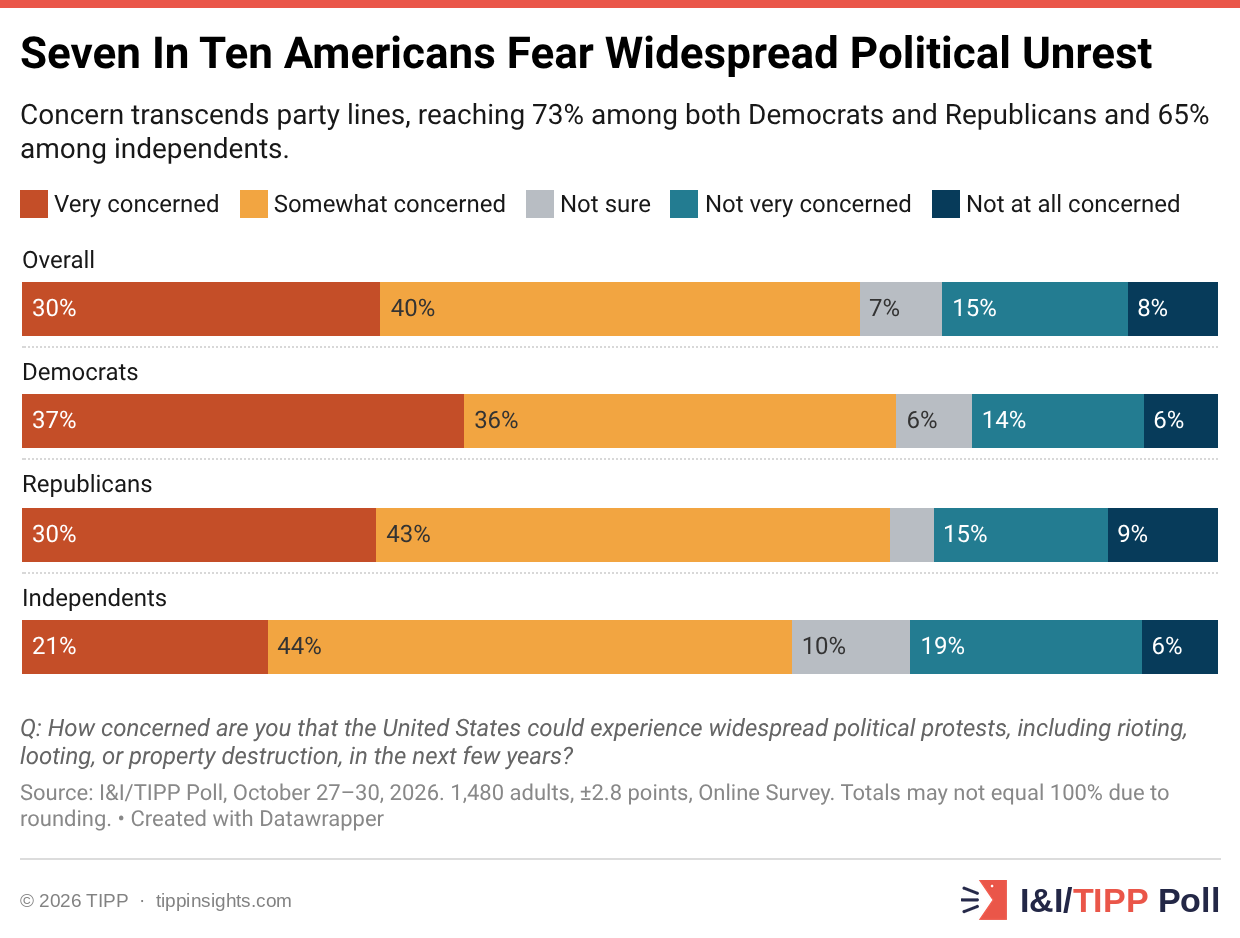
Here, the political parties were mostly aligned in being concerned: Dems and Republicans were both at 73%, while independents were just below that at 65%. The "not concerned" responses were all in the low- to mid-20% range.
So it turns out that politically-motivated violence is now "a thing." And, despite the end of a hotly contested midterm election, concern remains over possible eruptions of political violence and rioting around the country.
But are these expected "uprisings" spontaneous, or planned by individual well-funded protest groups?
Increasingly, it seems, the latter might be true.
During the recent midterms, President Donald Trump warned about France's riots, saying, "We're not going to let that happen to this country."
But is it too late? As conservative historian Victor Davis Hanson recently noted in a podcast about the riots now tearing Europe apart:
Why are they angry? Well, we have a very strange phenomenon happening. In Western countries over the last two decades especially, about 15%, up to 20%, are first-generation immigrants. I mean, they are first-generation, and they do not come from European countries. Some of them come from one country to another, but most of them are from the Middle East, Asia, Africa, and the Western Hemisphere.
And what's happening is they come at a time where the West is in crisis, and it does not believe that its culture and civilization is superior to the alternative. So, there's no state effort to assimilate, to acculturate, to integrate, to teach people about Greece and Rome, or the medieval period, or the Renaissance, or the Enlightenment, or the Founding Fathers here in the United States.
Still others argue that Democratic Socialists, now the ascendant power in the Democratic Party, will use their new-found clout in Washington after the so-called blue wave to take the left-right political debate out of Washington D.C. salons and onto the streets. As in Europe today, that's where debates are settled with fists, rocks, guns and physical intimidation, not words and logic.
"The goal is sustained mass violence and street clashes designed to push President Donald Trump into invoking the Insurrection Act," notes The Federalist, citing a widely quoted post by "DataRepublican" on X. "Once invoked, Democratic governors and progressive organizations would treat the order itself as evidence of 'fascism' and a reason to undermine federal authority."
Are these all just fevered fantasies of conservatives? Or is there something to these fears that all of us should be worrying about?
Plainly, most Americans are deeply worried about violence, as the I&I/TIPP Poll shows. But they mostly believe Europe's violence stems from the "rising cost of living and economic policies" and from "dissatisfaction with government policies and political leaders." They don't blame "political or extremist groups" or "socialist or left-wing economic policies."
Will average Americans still think the same things if violence breaks out here?
I&I/TIPP publishes timely, unique, and informative data each month on topics of public interest. TIPP’s reputation for polling excellence comes from being the most accurate pollster for the past six presidential elections.
Terry Jones is an editor of Issues & Insights. His four decades of journalism experience include serving as national issues editor, economics editor, and editorial page editor for Investor’s Business Daily.
Loved it, hated it, or somewhere in between — tell us. Grade this article here and help shape what lands in your inbox next.
🔗 Further Reading
Deeper on what you just read.
🟨Why Western Civilization Is Fighting Back – Victor Davis Hanson, The Daily Signal
🟨 A Generational Reckoning On The Streets Of Paris – Jonathan Levy, Project Syndicate
🟨 Europe Protests Intensify Over Rising Cost Of Living – TIPP News
🟨 Is Another Eurozone Debt Crisis Looming? – Desmond Lachman, Project Syndicate
🟨 Watch: French Students Stage Walkouts, Blockades Over Declining School Conditions – TIPP News
🟨Europe’s Immigration Revolt Is Just Getting Started – Victor Davis Hanson, The Daily Signal
🟨 Europe Failed the Ceuta Test – Zaki Laïdi, Project Syndicate
🟨Spain Is Overrun By Migrants – Victor Davis Hanson, The Daily Signal
🟨Europe Refuses To Enforce The Rule Of Law – Victor Davis Hanson, The Daily Signal
📊 Market Mood · November 16, 2026
How the trading day is setting up.
🟥 Global stocks are slipping ahead of major AI tests. Investors are turning cautious as Nvidia's upcoming earnings and Anthropic's IPO threaten to reshape sentiment toward technology stocks.
🟧 Nvidia faces a critical leadership and earnings test. The chipmaker's shares have fallen sharply following Jensen Huang's unexpected departure, raising questions about whether strong AI demand can sustain its growth.
🟦 Treasury yields remain above 5% as the dollar strengthens. Persistent inflation concerns and expectations for another Fed rate hike in December are keeping borrowing costs elevated and supporting the dollar.
🟨 Oil is holding near $96 a barrel. Crude prices have stabilized after recent declines, while investors monitor Middle East tensions and the outlook for global energy supplies.
🗓️ Key Economic Events
On today's U.S. data calendar.
🟧 8:30 a.m. ET — Empire State Manufacturing Index (Nov)
Forecast: 18.0 | Previous: 25.5
Manufacturing activity in New York State is expected to moderate from October's strong reading, offering an early indication of factory conditions.
This week's major events: Tuesday's retail sales report, Wednesday's Fed meeting minutes and Nvidia earnings, and Thursday's initial jobless claims.
Letters to the editor email: editor-tippinsights@technometrica.com
Subscribe Today And Make A Difference. Consider supporting Independent Journalism by upgrading to a paid subscription or making a donation. Your support helps tippinsights thrive as a reader-supported publication. Contact us to discuss your research or polling needs.
Reach our audience. For sponsorship and advertising opportunities, visit our Partner With Us page.