

During the 2026 midterm election, Democrats vowed to pursue radical reforms to the U.S. Supreme Court. Dems assert that because the court has six justices named by Republican presidents and just three by Democrats its decisions are politically biased. But would Americans agree? Many do, as the latest I&I/TIPP Poll shows.
In its November online nationwide poll, I&I/TIPP first asked 1,480 adults: "How much confidence do you have in the U.S. Supreme Court to make decisions based on the Constitution and the law rather than political considerations?"
The poll, taken from Oct. 27 through Oct. 30, has a +/-2.8 percentage point margin of error.
Overall, a bare plurality of 36% responded that they either had "a great deal of confidence" (17%) or "quite a bit of confidence" (19%) in the Supreme Court's ability to decide by law rather than politics. Another 25% said they had "some confidence," the largest single response.
Meanwhile, 32% said they had "very little confidence" (18%) or "no confidence at all" (14%). Another 8% said they "weren't sure."
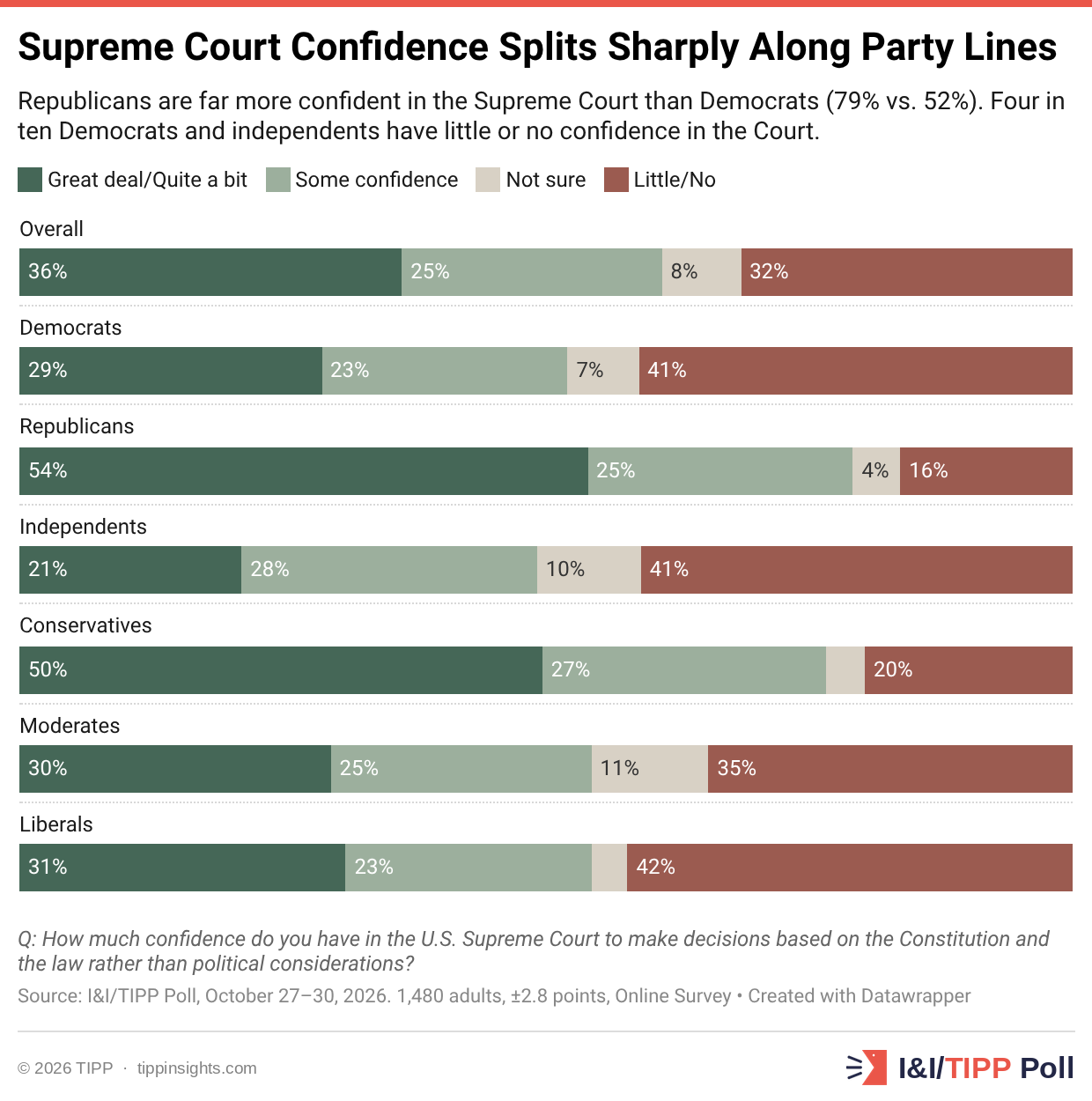
But there's little consensus among the three major political affiliations in America. Just 29% of Democrats and only 21% of independent voters said they had a "great deal" or "quite a bit" of confidence that high court members made decisions based on the law, not politics. That compares with 54% of Republicans, a significant double-digit gap in attitudes.
On the other hand, 41% of both Democrats and independents said they had "little" or "no" confidence in non-biased judging, versus only 16% of Republicans. So the political schism over the court is real.
Once more, gender is a significant divider. Men (45% "great deal" or "quite a bit" of confidence) are far more likely than women (28% "great deal" or "quite a bit" of confidence).
Age also separates us, with those 18 to 24 year old (46% "great deal" or "quite a bit" of confidence), 25 to 44 years (45% "great deal" or "quite a bit" of confidence), 45 to 64 years (31% "great deal" or "quite a bit" of confidence) and 65-plus years (27% "great deal" or "quite a bit" of confidence) showing steady decline by age.
If there's such a dearth of confidence, what should be done? Many proposals include changing the number of Supreme Court justices from the current nine to 13, as the Democrats' "Proposal 13 Supreme" would do.
I&I/TIPP asked respondents if they favored or opposed "increasing the number of justices to 13?"
Once again, a plurality supports the idea. An overall 44% said they either "strongly" (19%) or "somewhat" (25%) favor expanding the court by four, while only 34% said they would "somewhat" (15%) or "strongly" (19%) oppose it. And there was great uncertainty: 22% said they were "not sure."
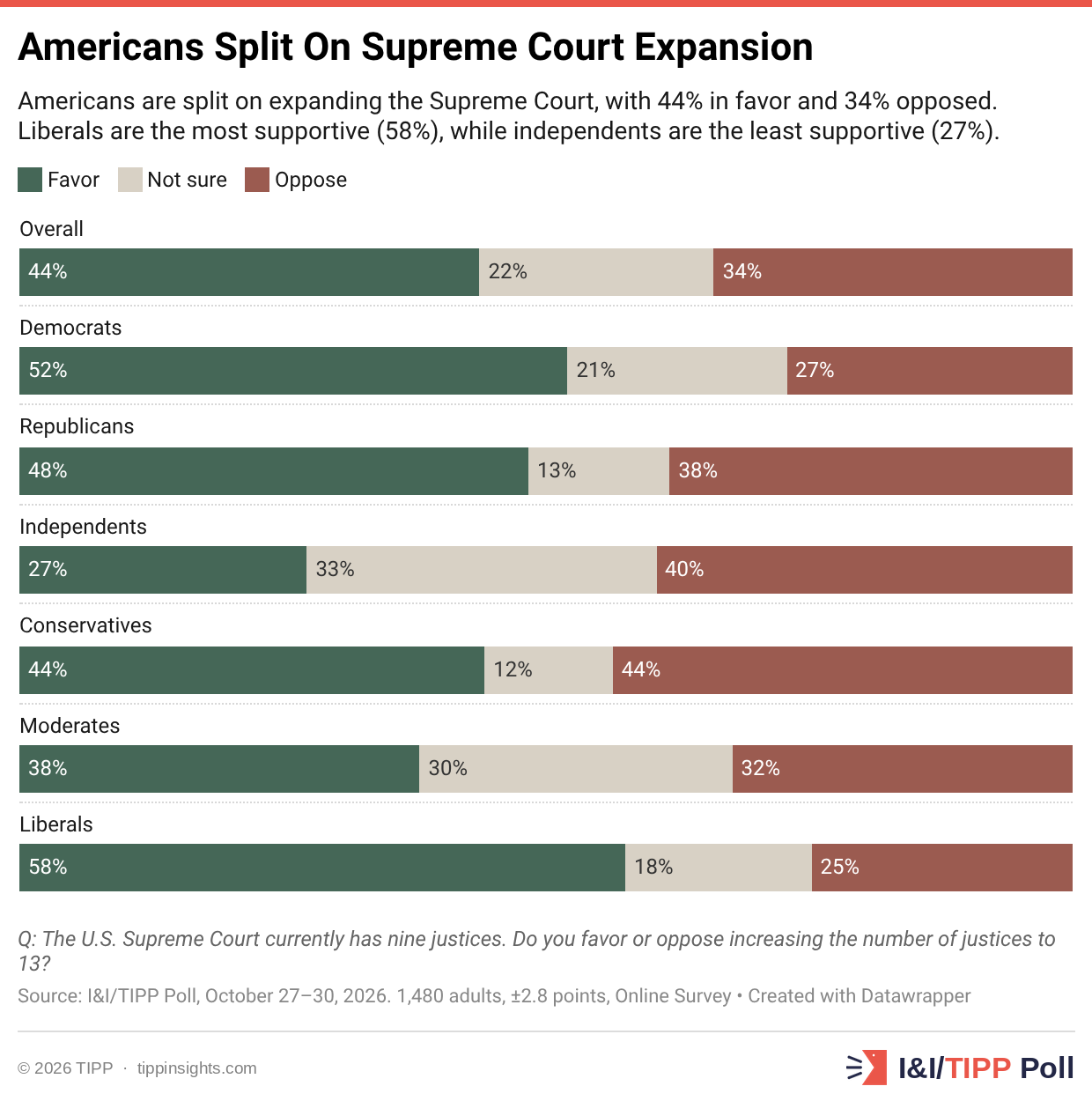
On this question, the political split gets interesting. Democrats (52% favor, 27% oppose) and Republicans (48% favor, 38% oppose) are more in alignment with each other than with independents (27% favor, 40% oppose), with the latter solidly opposing adding more justices.
Breaking it down another way, by ideology, adds some context. Self-described conservatives are evenly split: 44% favor, 44% oppose, while moderates aren't far behind at 38% favor, 32% oppose. But those who call themselves liberal strongly favor the idea by more than 2-to1, 58% to 25%.
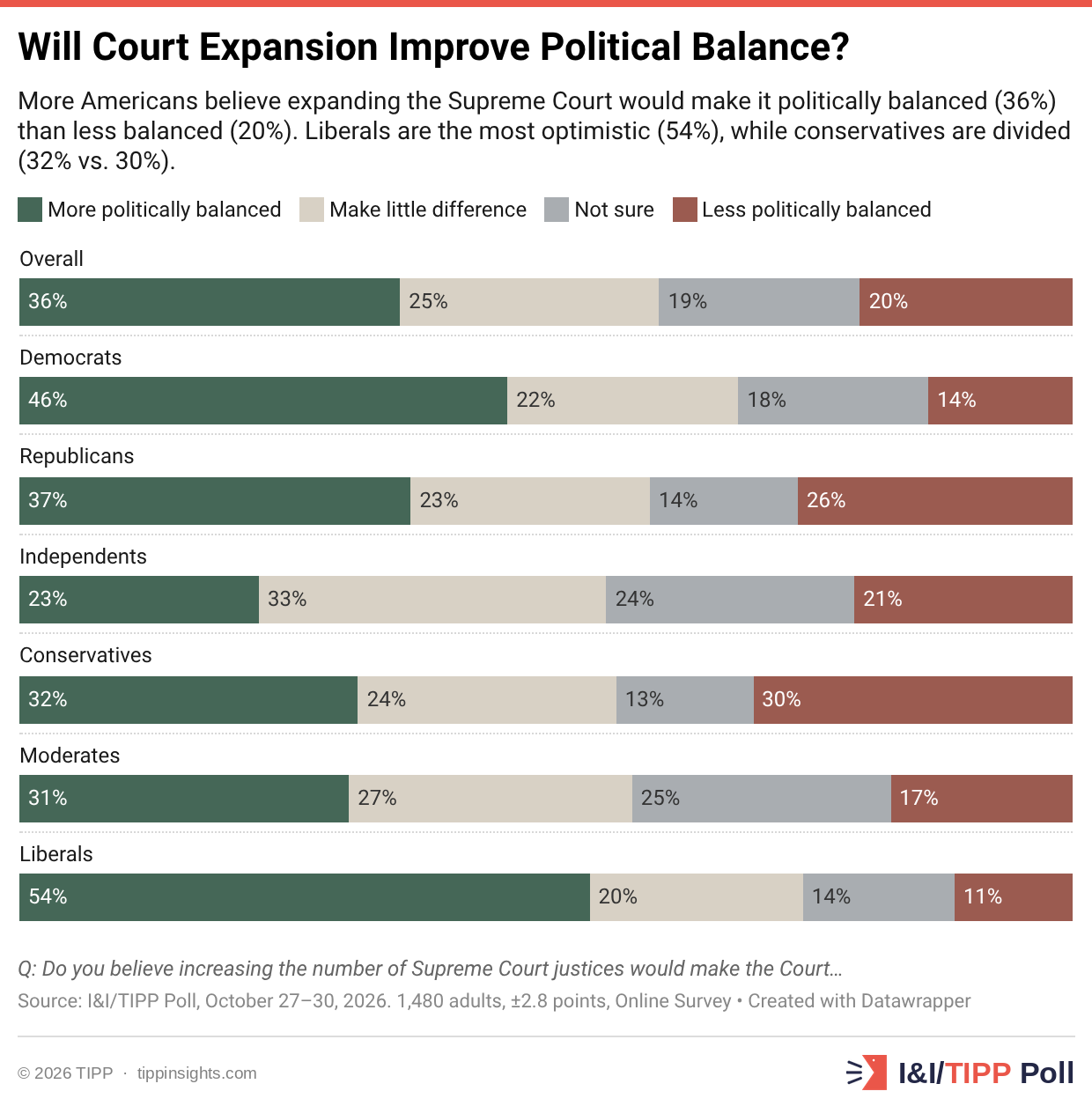
Just what would increasing the court's size accomplish? For a final question, I&I/TIPP asked: "Do you believe increasing the number of Supreme Court justices would make the Court…" then offered four possible phrases: "More politically balanced," "Less politically balanced," "Make little difference," or "Not sure."
"More politically balanced" was highest at 36% support, followed by "Make little difference" at 25%, "Less politically balanced" at 20%, followed by "Not sure" at 19%.
But looking at the results based on the political affiliation showed key differences.
For instance, "more politically balanced" got 46% Democratic support, declining to 37% support for Republicans and just 23% for independents.
As for "Less politically balanced," just 14% of Democrats felt that would be the result, compared to 26% of GOP voters and 21% of independents.
The "Make little difference" choice again got little Dem support (22%) and only slightly more backing from Republicans (23%), while a third of indie voters (33%) thought it wouldn't matter.
But there remains significant doubt among all groups: Those responding they're "not sure" were in double digits for all the parties: Democrats (18%), Republicans (14%) and independents (25%), or fully a quarter of their responses.
Clearly, based on the responses, Democrats feel there is the most to gain from expanding the Supreme Court, but Republicans aren't far behind.
But why is that? The answer is somewhat complicated by the fact that not all Democrats are alike. However, the official Democratic Party intent is clear, according to journalist John Fund, a frequent writer on America's election system.
"With control of the Court, they could adopt measures that the current majority of the Court would probably consider unconstitutional," Fund wrote in 2022. That includes:
- Reversing the Supreme Court’s Citizens United decision and imposing strict controls on independent speech in political campaigns.
- Imposing national redistricting standards by judicial fiat on states.
- Appointing activists to an expanded Federal Election Commission, the Justice Department, or another federal agency that would dictate the rules for voting and vote counting in the states.
- Guaranteeing constitutional success for their strategy of sidelining the Electoral College and disempowering voters in all but the biggest states, through the “National Popular Vote” compact.
- Rewriting labor law to disadvantage independent workers in the gig economy and those who work for small business, to force them to join the unions that fund Democratic campaigns.
- Ensuring that major universities continue to discriminate by race, especially against over-achieving Asians and other disfavored groups, in their admission policies, in the name of “diversity.”
- Cementing the power of federal regulators to rule and, if necessary, intimidate uncooperative entities and persons by administrative decrees.
- Forcing conservative nonprofit groups to reveal their donors so that those donors can be intimidated by “woke” political allies of the Left.
- Restoring the ability of teachers’ unions to collect dues from nonmembers and excluding schools run by religious groups from eligibility for school-choice funding by states, thereby stifling efforts to expand parental choice in education.
- Weakening Second Amendment rights.
- Striking down laws passed by state legislatures on abortion and religious freedom that the Left doesn’t like."
Given recent comments by Democratic officials, Fund's list still holds up today.
Clearly, many Democrats and independents fear the opposite: GOP semi-permanent control over the judiciary, given the lifetime tenure in office that Supreme Court justices have. What especially irks many is that Donald Trump already has named three members to the court as president, giving conservative-leaning justices a 6-to-3 majority.
And it's not as if Republicans' hands are entirely clean in this matter. Just 13 years ago, a GOP effort to shrink from 11 to eight the number of judges on the U.S. Court of Appeals for the District of Columbia failed. Its intent: to reduce the number of judges named by President Barack Obama.
Far more famously, in 1937, FDR tried to "pack the court" with as many as six new members to get New Deal legislation passed. His effort failed. But here's the question: Would today's Dems still support the idea if the political pendulum were to swing back in 2028 with another Republican president and a GOP majority in Congress?
I&I/TIPP publishes timely, unique, and informative data each month on topics of public interest. TIPP’s reputation for polling excellence comes from being the most accurate pollster for the past six presidential elections.
Terry Jones is an editor of Issues & Insights. His four decades of journalism experience include serving as national issues editor, economics editor, and editorial page editor for Investor’s Business Daily.
Loved it, hated it, or somewhere in between — tell us. Grade this article here and help shape what lands in your inbox next.
📊 Market Mood · November 23, 2026
How the trading day is setting up.
🟩 Wall Street futures are rebounding sharply after last week's selloff. Nasdaq futures are up about 3% as investors return to beaten-down technology stocks, although confidence in the AI trade remains fragile.
🟥 The AI selloff has left lasting damage. The S&P 500 and Dow entered correction territory Friday, falling more than 10% from their highs as concerns about valuations, heavy borrowing and AI profitability intensified.
🟦 Asian governments are moving to contain market volatility. Taiwan has tightened short-selling rules, while Chinese exchanges have announced measures to support trading as the technology rout spreads across the region.
🟨 Inflation and growth data face a major test this week. Today's business activity surveys will provide an early reading on November growth, ahead of Wednesday's PCE inflation and GDP reports.
🗓️ Key Economic Events
On today's U.S. data calendar.
🟧 9:45 a.m. ET — S&P Global Manufacturing PMI, Flash (Nov)
Forecast: 54.5 | Previous: 54.9
Manufacturing activity is expected to moderate slightly, providing a fresh reading on factory demand and business conditions.
🟧 9:45 a.m. ET — S&P Global Services PMI, Flash (Nov)
Forecast: 55.7 | Previous: 56.1
Services activity is expected to remain in expansion territory, with employment and input prices offering clues about growth and inflation.
Letters to the editor email: editor-tippinsights@technometrica.com
Subscribe Today And Make A Difference. Consider supporting Independent Journalism by upgrading to a paid subscription or making a donation. Your support helps tippinsights thrive as a reader-supported publication. Contact us to discuss your research or polling needs.
Reach our audience. For sponsorship and advertising opportunities, visit our Partner With Us page.