Asked what they are most thankful for this Thanksgiving, more than four in ten Americans gave the same answer: family. A Newsmax/TIPP Poll finds that family tops the gratitude list by a wide margin and that most Americans plan to spend the holiday with family or friends.
American culture prizes independence, self-reliance, and individual achievement, and that emphasis has often raised concerns that the traditional role of the family is weakening. The nationwide survey, conducted in late August, suggests those fears are overstated. While the definition and size of the family have changed over the decades, the family continues to play a vital role in our lives.
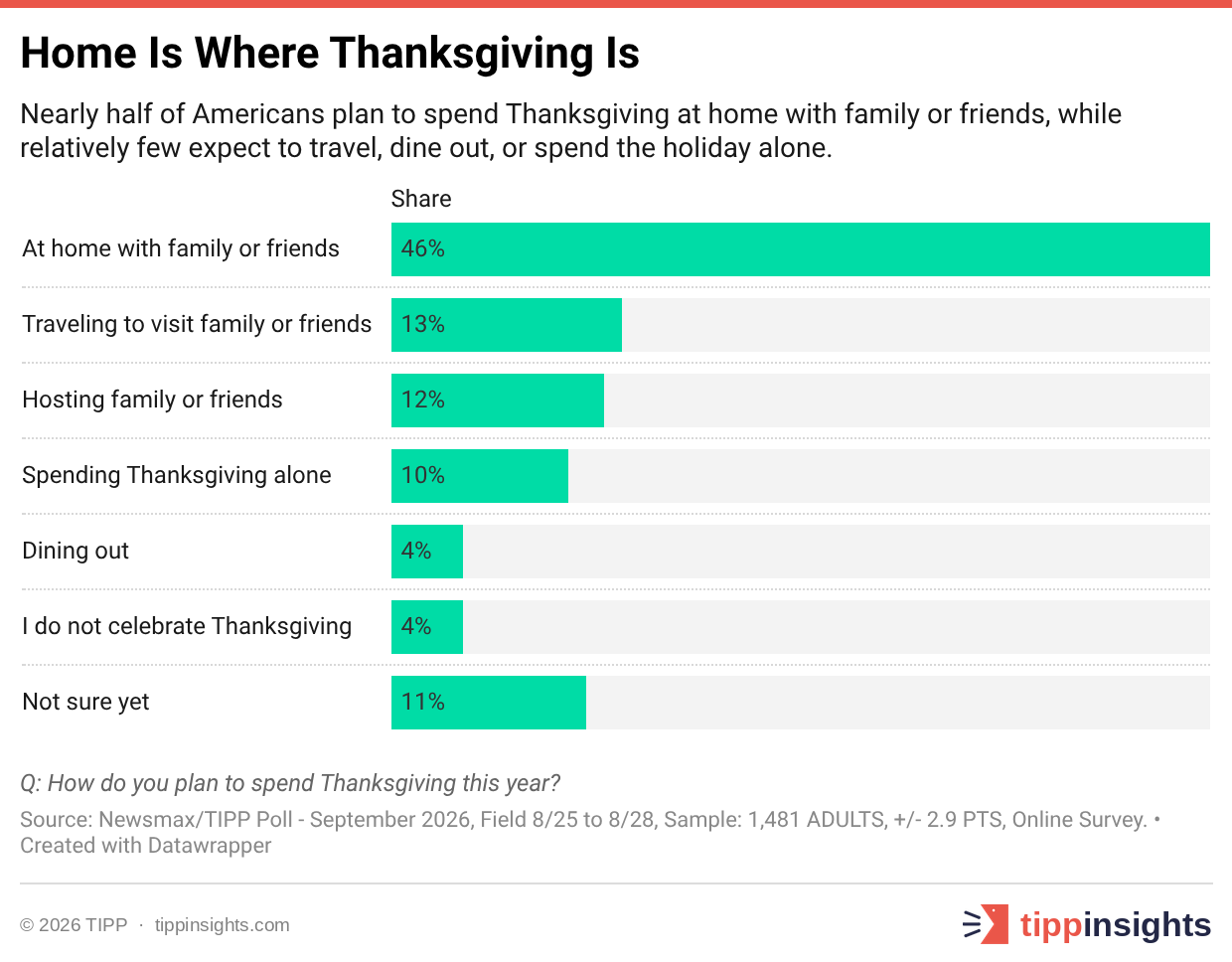
Most respondents plan to spend this Thanksgiving with family or friends. While 46% will celebrate the holiday at home with loved ones, another 13% are traveling to join family or friends for the big day. Yet another 12% plan to host family and friends this Thanksgiving. Taken together, 71%, or more than seven in ten, have plans centered on family or friends.
At the same time, 10% plan to spend the holiday alone, 4% plan to dine out, and 4% said they do not celebrate Thanksgiving. Another 11% were not yet sure of their plans when surveyed.
On gratitude, the verdict was decisive.
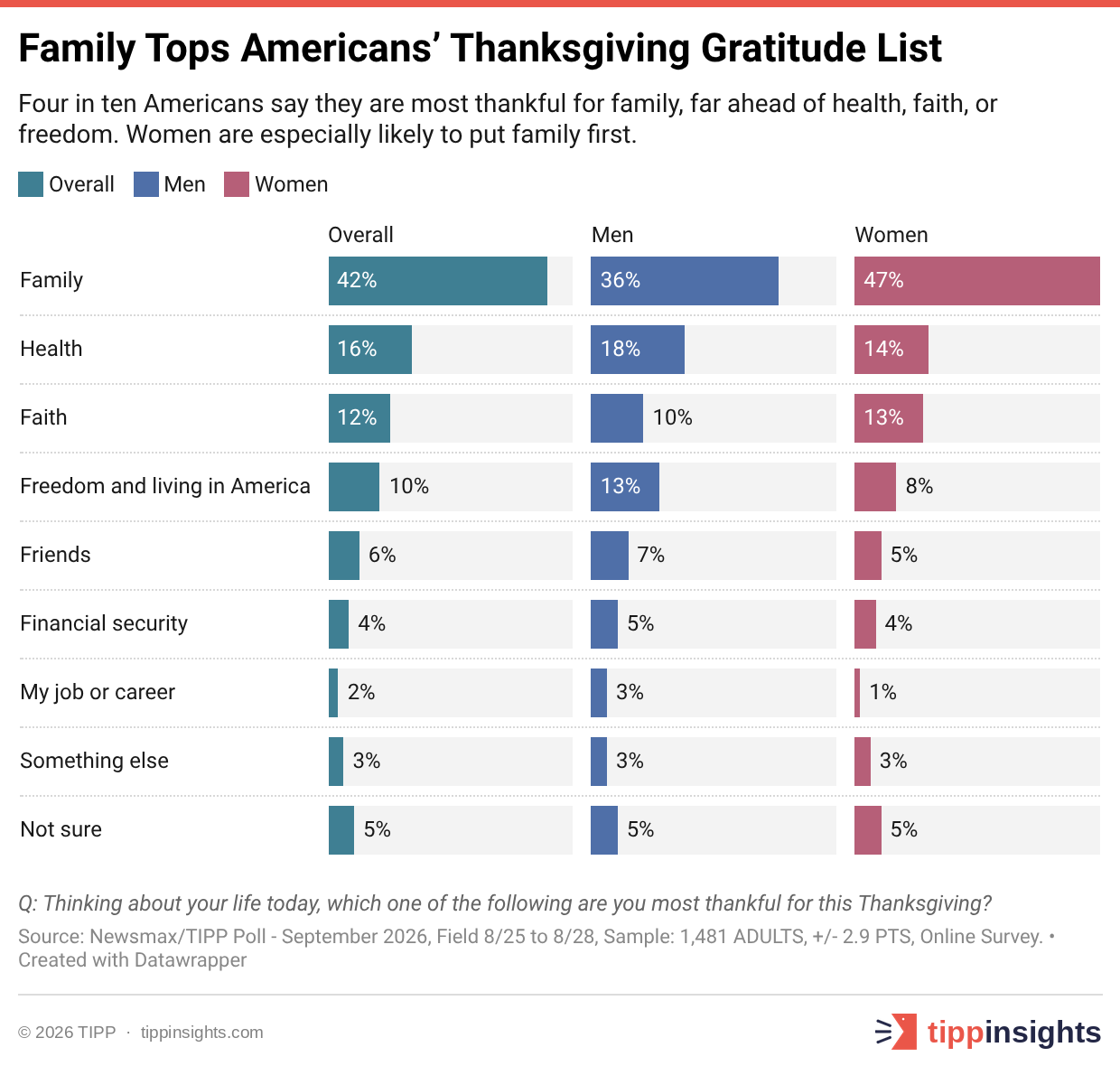
For more than two-fifths (42%) of the respondents, family was their top choice. Health, which took second place at 16%, trailed by a clear 26 points. For 12%, their faith was what they felt most grateful for, and 10% cited freedom and living in America. Only 4% put financial security ahead of everything else, and even fewer (2%) mentioned their career or job.
Men and women ranked their choices in much the same way, but women were notably more likely to put family first – 47% to 36% for men. For second place, 18% of men and 14% of women cited health. For third place, 13% of men chose freedom and the same share of women chose faith.
Across age groups, family remained the top choice, but the second-place picks differed. Seniors stood out on faith: 18% of those 65 and older named it, significantly more than any younger age group (about one in ten). Among 18–24-year-olds, 21% picked health, though that group is small. The youngest adults were also the least likely to cite freedom (2%, compared with 13% of seniors).
Family gatherings are at the center of Thanksgiving celebrations for most people, as the data show. In recent years, the political climate in America has become so fraught that politics is often seen as a topic best avoided at family gatherings. A majority agree.
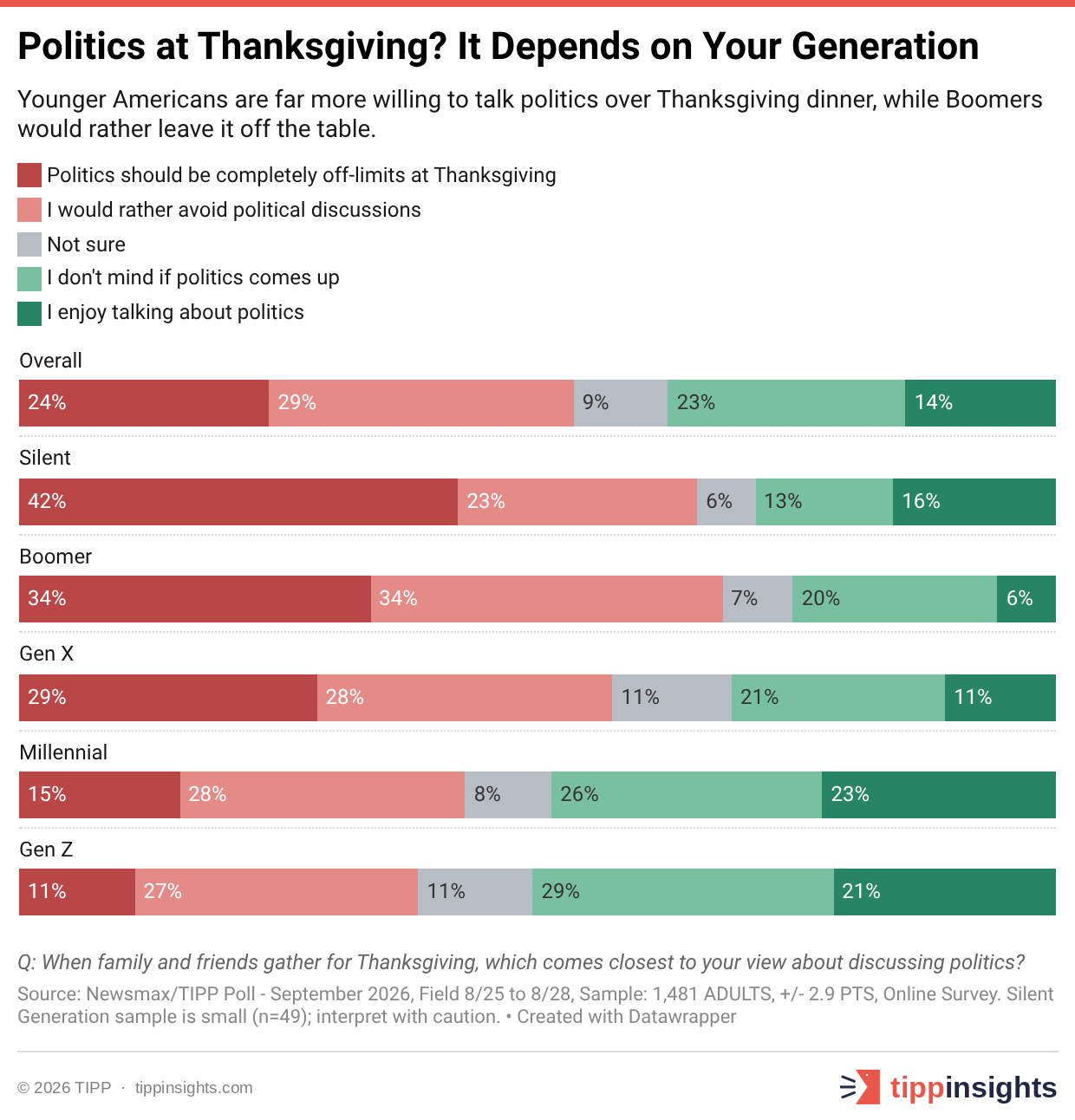
A quarter (24%) said political discussions should be completely off-limits at Thanksgiving. A slightly bigger share (29%) took a softer view, saying they would rather avoid talking politics with family and friends during the holiday. Together, that is a 53% majority. Another 23% said they don’t mind if politics comes up, and 14% said they enjoy discussing politics. Almost a tenth (9%) were unsure.
Whether political discussions should be avoided or encouraged depends largely on generation. Half of Gen Z (50%) and nearly half of millennials (49%) are open to talking politics, compared with a quarter (25%) of boomers. The gap is sharpest among those who actively enjoy it: 21% of Gen Z and 23% of millennials said they enjoy talking politics at Thanksgiving, compared with just 6% of boomers.
In the end, the numbers tell a simple story. Asked what they are most thankful for, Americans put family first by a wide margin, and more than seven in ten plan to spend the day with family or friends. Thanksgiving has never been about the size of the turkey or who sits where. For when the feasting is done, and we get back to our routines, the warmth shared and the memories made will linger until next time.
The Newsmax/TIPP Poll was conducted online Aug. 25–28, 2026, among 1,481 U.S. adults. The margin of error is ±2.9 percentage points.
Loved it, hated it, or somewhere in between — tell us. Grade this article here and help shape what lands in your inbox next.
🧭 Power & Capital · November 25, 2026
Where state power meets the boardroom.
🔷 US Jury Convicts Huawei Of Bank Fraud And Trade Secret Theft – TIPP Staff
🔷 Labor Department Moves To Strip ESG From Retirement Investing – Elizabeth Troutman Mitchell, The Daily Signal
🔷 US Military Looks To Automakers To Mass-Produce Drones – TIPP Staff
🔷 Small Automakers Could Receive Until 2032 To Meet Emergency Braking Standards – TIPP Staff
🌍 Global Affairs
The world's flashpoints, in motion.
🟥 The Strategy Behind Trump’s Russia-China Diplomacy – Victor Davis Hanson, The Daily Signal
🟥 Trump Was Right About Europe. Now It’s Paying The Price. – Victor Davis Hanson, The Daily Signal
🟥 UK ‘Trump Disinformation Syndrome’ Provides A Clue To Misread Electorate – Bob Maistros, Issues & Insights
🏛️ National Affairs
The fights shaping America right now.
🟫 Hackers Breach US Intelligence Agencies' Open-Source Intelligence Network – TIPP Staff
🟫 Trump Awards Rudy Giuliani Presidential Medal Of Freedom – TIPP Staff
🟫 FAA Orders Ground Stop At Chicago O'Hare After Equipment Outage – TIPP Staff
🟫 TSA Expects To Screen 17.6 Million Air Travelers Over Thanksgiving – TIPP Staff
🟫 Sanctuary Jurisdictions, Mostly In New York And California, Declined Almost 39,000 ICE Detainers – Fred Lucas, The Daily Signal
🟫 ‘You Chose Murderers Over Victims’: 14 GOP AGs Rip Newsom’s Plan To Commute Death Sentences – Tyler O’Neil, The Daily Signal
🟫 AI Is Supercharging Cyberattacks, And New Audit Says Defenses Are Hard To Test – Fred Lucas, The Daily Signal
🟫 The Dignity Act Is Amnesty By Another Name – Chip Wyatt & Katie Mullins, The Daily Signal
🟫 30-Watt Thune Must Supercharge Lame-Duck Senate – Deroy Murdock, The Daily Signal
🟫 America First And The Republican Deadwood – Steve Cortes, The Daily Signal
🟫 Talking Turkey About The 2028 Race – Al Perrotta, The Daily Signal
🟫 Is Connecticut Compromising With Islamism? – Andrew Olivastro, The Daily Signal
🟫 Mamdani Blames Landlords For A Housing Crisis Government Created – Jarrett Stepman, The Daily Signal
🟫 The Future Of Journalism Belongs To Outlets Honest About Who They Are – The Daily Signal
🟫 New Program Promotes Foster Care And Pro-Life Message – Malia Loock, The Daily Signal
🟫 Hegseth Takes A Sword To The Constitution – James Bovard, Ron Paul Institute for Peace and Prosperity
🟫 New Congress…Same Old Wars! – Ron Paul, Ron Paul Institute for Peace and Prosperity
🟫 Why The Poor Could Not Vote In Early America – Ryan McMaken, Mises Wire
🟫 Would President John Kennedy Have Pulled The United States Out Of Vietnam? – Gregory Bresiger, Mises Wire
🟫 The Importance Of Free Will In Historical Interpretation – Wanjiru Njoya, Mises Wire
🟫 How Progressive Presidents Abandoned The American Tradition Of Thanksgiving – Pavlos Papadopoulos, The Daily Signal
📈 Economy
Prices, policy, and the pressure on your wallet.
🟩 The Fed’s “Dual Mandate” Is One Too Many – Patrick Barron, Mises Wire
🟩 Monetary Pumping: Economic Prosperity Or Economic Impoverishment? – Frank Shostak, Mises Wire
🟩 The Problem Is Not “Late-Stage Capitalism,” It’s The Late-Stage State – Wesley Dorly, Mises Wire
🟩 The Two Powers Over Money – Luka Gubelidze, Mises Wire
🔬 Science & Tech
What's being discovered, built, and launched.
🟪 OpenAI And Anthropic Staff Fear Advanced AI Models Are Too Dangerous To Release – TIPP Staff
🟪 NIH Scientists Link Glyphosate Exposure To Blood Cancer Risks – TIPP Staff
🟪 Short Walking Breaks Improve Blood Sugar Control, Study Finds – TIPP Staff
🌙 Last Evening
The best of last night’s edition, in case you missed it
🟦 Jensen Huang And The Price Of Losing Genius – TIPP Editorial Board
🟦 Report Estimates Over 720,000 Russian Soldiers Killed In Ukraine War – TIPP Staff
🟦 China Sentences Government Official To Death For Spying For Foreign Agent – TIPP Staff
🟦 Ted Cruz Launches Saving Texas To Rebuild GOP After Democrat Wins – TIPP Staff
🟦 Federal Reserve Official Says More Action Needed To Bring Inflation Down – TIPP Staff
🟦 Elon Musk’s Tesla And SpaceX Move Forward With Merger Discussions – TIPP Staff
🟦 UK Police Investigate Break-In At Prince William And Kate’s Country Home – TIPP Staff
Letters to the editor email: editor-tippinsights@technometrica.com
Subscribe Today And Make A Difference. Consider supporting Independent Journalism by upgrading to a paid subscription or making a donation. Your support helps tippinsights thrive as a reader-supported publication. Contact us to discuss your research or polling needs.
Reach our audience. For sponsorship and advertising opportunities, visit our Partner With Us page.