
By Charles Ferguson, Project Syndicate | Feb 16, 2026
While anyone familiar with past technological hype cycles can see that today’s predominantly young technologists are overly optimistic about AI’s potential benefits, mainstream economists seem to suffer from tunnel vision of a different sort. If recent history is any guide, that should worry us all.
SAN FRANCISCO – There are times when a major global development demands a special response from many academic disciplines, industries, and departments of government. This was the case with World War II, nuclear weapons, and the Cold War, and it is the case again with generative AI.
Yet too often, discussions about AI are overly specialized or siloed between technologists, economists, and other disciplines – from political science, psychology, and sociology to law and military studies. This is a problem because the technologists are certainly right that AI will change everything, fast, and that the conventional policy world isn’t keeping up. But just as war is too important to be left to the generals, AI is too important to be controlled solely by those inventing it, no matter how brilliant they are.
Most AI technologists and entrepreneurs are wildly optimistic. They anticipate revolutionary advances in medicine, the elimination of hard physical labor, radically accelerated productivity growth, and universal abundance. They expect such outcomes partly because there is money to be made, but also because their belief in the technology’s potential is sincere.
But sincerity often accompanies naivete, as I know all too well. Thirty years ago, I founded the startup that developed the first software tool enabling anyone to build a website, and I totally drank the Kool-Aid. We told ourselves that our product would allow truth-tellers and innovators to bypass gatekeepers, liberating and enlightening everyone. Social networks would, of course, do the same, and together we would create a decentralized, egalitarian paradise of unfiltered truth. How wrong we were.
When I look at the AI landscape, heavily populated by extremely young founders, I see the same naivete. I recently spoke with a brilliant young CEO whose AI startup is already valued at several billion dollars. When asked whether the problem of AI deepfakes and disinformation worried him, he replied (to paraphrase): Of course not. All you need to do is verify that something comes from a trustworthy source. Easy.
Really? How will these trustworthy sources know what is real when someone sends them a photograph, document, audio recording, or video? What will they do when thousands of images or videos come in, each contradicting the others? How will we know whether something posted on social media is real? How can news sources remain current and profitable if they must laboriously verify the reality of absolutely everything?
Still, if the technologists are overly optimistic, the economists suffer from a different sort of tunnel vision. They tend to see everything as a smooth equilibrium of self-adjusting markets. They predict substantial but gradual productivity improvements, dismissing extreme scenarios and neglecting both radical opportunities and potentially grave problems alike.
“Calm down, we’re the adults in the room,” economists intone. In fact, contemporary economics, obsessed with its models, has too often been wrong, divorced from reality, or even compromised by corruption.
Consider Larry Summers, who recently turned into a pariah over his correspondence with the convicted sex offender Jeffrey Epstein. The outcry against him was certainly justified, but he deserved exile much earlier for a career’s worth of disastrous economic policies that devastated the lives of millions.
Recall Summers’ leading role in the deregulation of finance while at the Treasury department during President Bill Clinton’s administration. Even when confronted in the late 1990s with the Asian financial crisis and the dot-com bubble, Summers, along with Robert Rubin, who preceded him as Treasury secretary, and Federal Reserve Chair Alan Greenspan, gleefully pushed through the repeal of the Glass-Steagall Act (which separated investment banking from retail banking). They also banned the regulation of derivatives, which would become a major cause of the 2008 financial crisis.
Later, while serving in the Obama administration, Summers advocated bailing out the banks without insisting on any penalties or prosecution of bankers, despite clear evidence of massive fraud. He then made millions giving speeches to banks and banking conferences. But more to the point, Summers wasn’t exceptional. Mainstream economics has an appalling track record, having told us that globalization would lift all boats, that industrial policy never works, that deregulation could not cause a financial crisis, that development economics would solve Africa’s problems, and that we need not worry about monopolies.
Then there is the discipline’s corruption problem. Many prominent economists’ incomes during these years were dominated by corporate payments. In 2004, Goldman Sachs persuaded Glenn Hubbard, then the dean of Columbia Business School, to co-author an article with William Dudley, then Goldman’s chief economist, arguing that unregulated derivatives made the financial system safer. Four years later, the 2008 crisis revealed those derivatives to be extremely dangerous. The next year, Dudley became president of the Federal Reserve Bank of New York. Rarely has failing upward been so stark.
Of course, there are exceptions. Among technologists, Anthropic’s CEO Dario Amodei has been notably perceptive and honest both about AI’s opportunities and its dangers. In economics, the Nobel laureate Simon Johnson wrote perhaps the single best article about how the US financial industry captured federal policy and caused the 2008 crisis. But the overall record of the economics discipline does not inspire confidence, and now too many economists (most of whom know very little about AI) seem to be underestimating the technology – both its potential benefits and dangers.
My sense is that political science, psychology, law, education, sociology, and military studies get a better score. They tend to put reality before models, and they consider issues that both the technologists and economists often dismiss. But they, too, are embedded in an institutional matrix – of universities, think tanks, and government agencies – that is no longer fit for purpose. To govern AI, we need cooperation across all these disciplines, and we need it fast.
I find it striking that many of the best AI founders I meet are graduate or even undergraduate dropouts (in fact, the $200,000 Thiel Fellowship requires recipients not to have a university degree). By contrast, conventional policymaking (in both the US and Europe) relies on a staid, bureaucratic system whose creaking machinery is no match for AI.
Of course, we should not eliminate universities, think tanks, or government policymaking. But extraordinary circumstances demand extraordinary responses. For many policy issues, slow and conventional is probably okay. Not for AI.
Charles Ferguson is an angel investor, a limited partner in six AI venture capital funds, and a nonexclusive partner in Davidovs Venture Collective. His direct investment positions include three technology incumbents (Apple, Microsoft, and Nvidia) and many AI startups, including Perplexity, Etched, CopilotKit, Paradigm, Browser Use, FuseAI, and Pally.
Copyright Project Syndicate
Related TIPP Poll
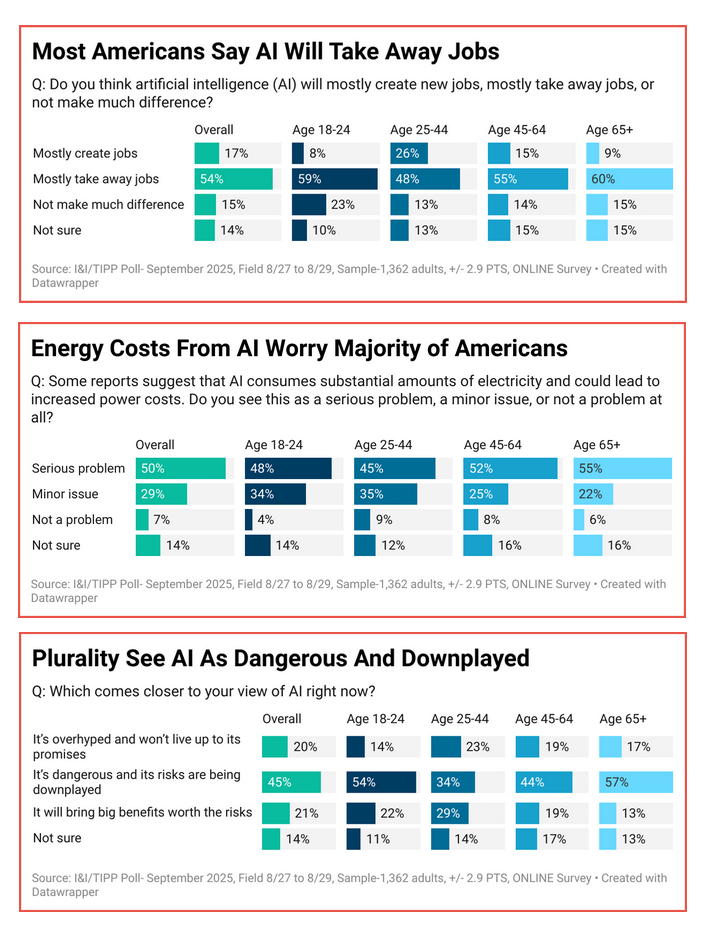
AI Anxiety Runs Deep Across Generations
A majority of Americans, 54%, believe artificial intelligence will mostly take away jobs rather than create them, including 60% of those age 65 and older. Half say AI’s growing electricity use is a serious problem, while just 7% see no issue. Meanwhile, 45% say AI is dangerous and its risks are being downplayed, compared with 21% who believe the benefits outweigh the risks.
Epstein Files Trigger Political Fallout In Europe
The U.S. Justice Department’s latest release of files related to convicted sex offender Jeffrey Epstein has triggered political repercussions in the UK and other European countries, but far fewer in the U.S.
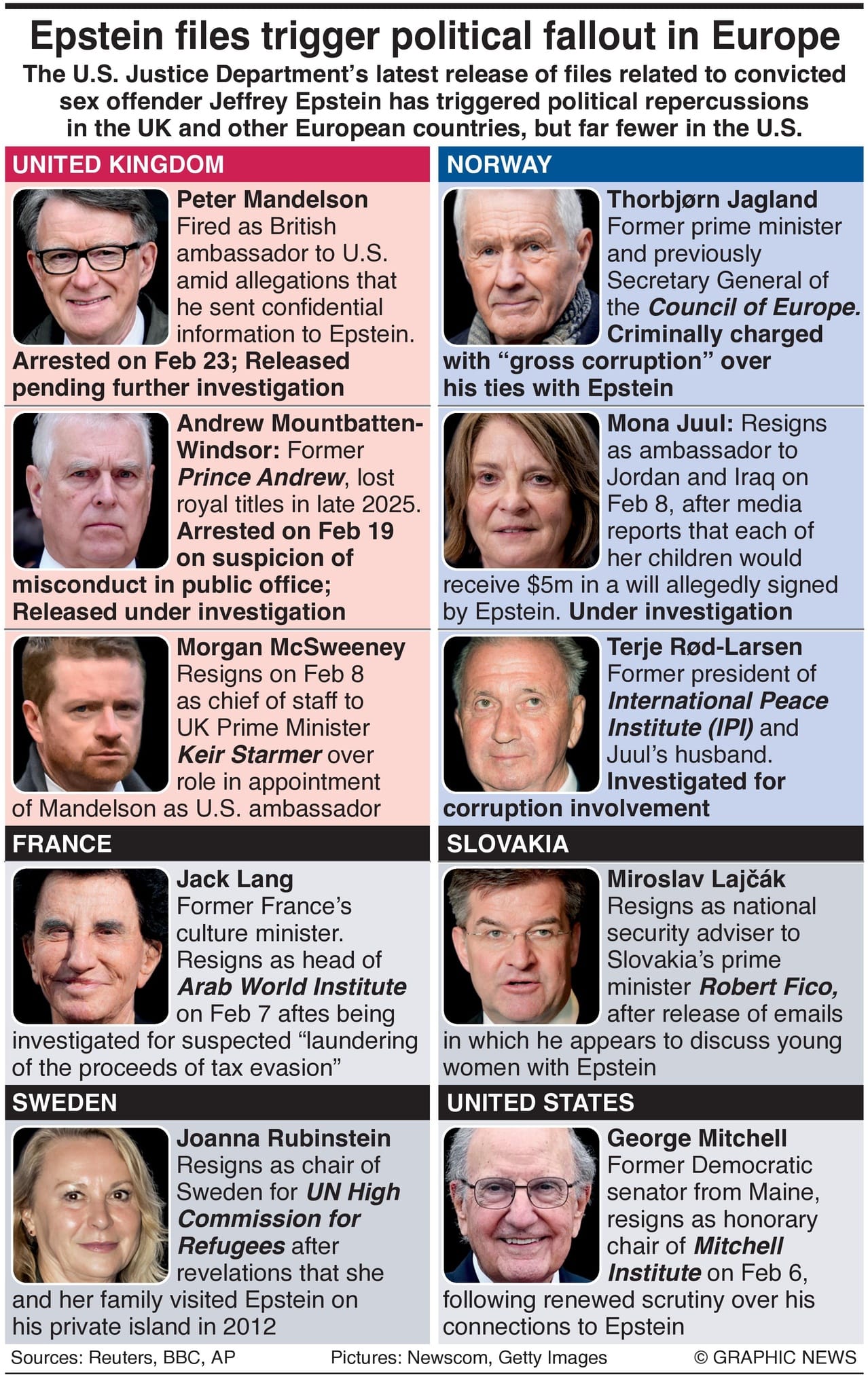
In Britain, politician Peter Mandelson was released on bail after being questioned for hours by detectives over the alleged leaking of sensitive government information to Epstein during his time as a minister in the early 2000s.
His arrest came shortly after the detention of Andrew Mountbatten-Windsor, who was also questioned over alleged misconduct linked to Epstein.
The controversy has also had political consequences within the UK government. Prime Minister Keir Starmer’s decision to appoint Mandelson as British ambassador led to the resignation of his chief of staff, Morgan McSweeney.
Across Europe, the document release has prompted authorities to open multiple investigations, and several public figures have stepped down or lost positions.
Those affected include former French culture minister Jack Lang, Norway’s former prime minister Thorbjørn Jagland, Miroslav Lajčák in Slovakia, and Joanna Rubinstein in Sweden.
Catch up on today’s highlights, handpicked by our News Editor at TIPP Insights.
1. Zelenskyy Says Russia Has Not Won As War Drags On
2. France Bars U.S. Ambassador From Access To Top Officials
3. China Slaps Export Controls On Japanese Firms Over Military Concerns
4. European Stocks React As Trump Tariffs Take Effect At Lower Rate
5. Meta Expands AI Push With Major AMD Chip Deal
6. Jamie Dimon Flags AI Hype And Risky Lending As Red Flags
7. What’s Driving America’s Rising Fear Of Artificial Intelligence
8. Sleep Too Little Or Too Much, Risk Rises
9. House Weighs Competing Bills After Deadly Midair Collision Near Washington
10. Democrats Push Tougher Limits On Corporate Homeownership
11. Home Depot Tops Estimates Despite Slump In Home Improvement Sales
12. Warner Bros. Discovery Reviews Higher Paramount Bid
13. $1 Million Reward Announced As Guthrie Family Seeks Answers
14. Melania And Trump Invite Different Guests To State Of The Union
15. U.S. Consumer Confidence Ticks Up After January Slump
editor-tippinsights@technometrica.com