Bad news for those who advocate for free markets and free choice as the basis of our economy and society. A slim plurality of voters say that they agree with the principles of socialism, including public ownership of property and natural resources, according to the latest I&I/TIPP Poll.
With a number of self-avowed socialists already winning office in a number of major cities in recent weeks, I&I/TIPP wondered how broad the support for such candidates might be. It turns out to be pretty broad indeed.
Specifically, I&I/TIPP asked: "Socialism is commonly defined as 'a social and economic system that calls for public rather than private ownership or control of property and natural resources.' Generally speaking, do you agree or disagree with the principles of socialism?"
The surprising result: 42% of those taking the poll said they agree either "strongly" (14%) or "somewhat" (27%), while 39% said they disagree "strongly" (24%) or "somewhat" (14%). But a sizeable 20% describe themselves as "not sure."
The online nationwide poll, taken from Oct. 28 to Oct. 31 by 1,418 adults, has a margin of error of +/- 2.8 percentage points.

The responses weren't just a "hard-left voter" thing, either. Among Democrats, 55% agreed with the principles of socialism, while only 27% didn't. But the shocker: Even 39% of Republicans agreed, while 45% disagreed. Independents, which includes libertarian voters, were least likely to sign on to socialist principles, as 31% agreed and 48% disagreed.
If so, what is the profile of the typical pro-socialist voter? The answer: young, male and minority.
The numbers skew sharply toward youth. Among those 18-24 years of age, a whopping 57% agreed with socialist principles, versus just 26% that disagreed. For those 25-44 years old, the numbers were 52% agree, 29% disagree.
Support drops from there. Among those 45 to 64 years old, 37% it was agree compared to 40% disagree. And for those over 65 years, the numbers plunge to 26% agree, 56% disagree.
That's a real generation gap.
Another surprise is the male/female split. A total of 50% of men agree to the principles of socialism, while 39% disagree. For women, the comparable numbers are 34% agree, 38% disagree. On socialism, there's a gender gap.
What about race? Blacks and Hispanics support socialism by 50% (agree) to 28% (disagree). Among white voters, the comparable figures are 38% and 43%.
Finally, income level is another predictor of socialist support. But not, perhaps, how you might think. For those in the bottom three quartiles of income, under $75,000 a year, the level of agreement with socialist principles came in at an average of 39%, compared to 41% disagreement.
The wealthiest part of the income spread was the most supportive of socialist principles, by far: 54% agree compared to 35% who disagree.
Gold standard in polling — the only national pollster to get six presidential elections right. Talent on loan from God. Subscribe now → $99/year
A second I&I/TIPP question asked about actual voting: "Would you vote for a candidate who describes themselves as a socialist and says they intend to enact socialist policies if elected?"
Here, the response was more negative. Of those answering 34% said either "yes, definitely" (12%) or "yes, probably" (22%), while a 44% share responded "no, definitely not" (27%) and "no, probably not" (17%). Another 22% weren't sure.

The political breakdown was a bit more emphatic than for the first question. Among Democrats, 47% said they would definitely or probably vote for a socialist candidate, while 33% said they would probably not or definitely not vote for a self-avowed socialist candidate.
Republicans basically flipped those numbers, with 31% saying they'd definitely or probably vote for a socialist candidate, while 52% said they definitely not or probably not vote for one.
Independents were closer to the GOP respondents than Dems, with just 24% saying they would "definitely/probably" vote for a socialist, while 50% said they would "probably not" or "definitely not" vote for a socialist.
It is perhaps a bit shocking that even those who belong on the center and the right side of the political spectrum (Democrats and independents) would find such a high degree of acceptance for socialist candidates. After all, by any reasonable definition, socialist placed on the far-left side of the conventional political spectrum.

Has woke, politically-correct media, Hollywood and education eroded Americans' faith in free markets and capitalism?
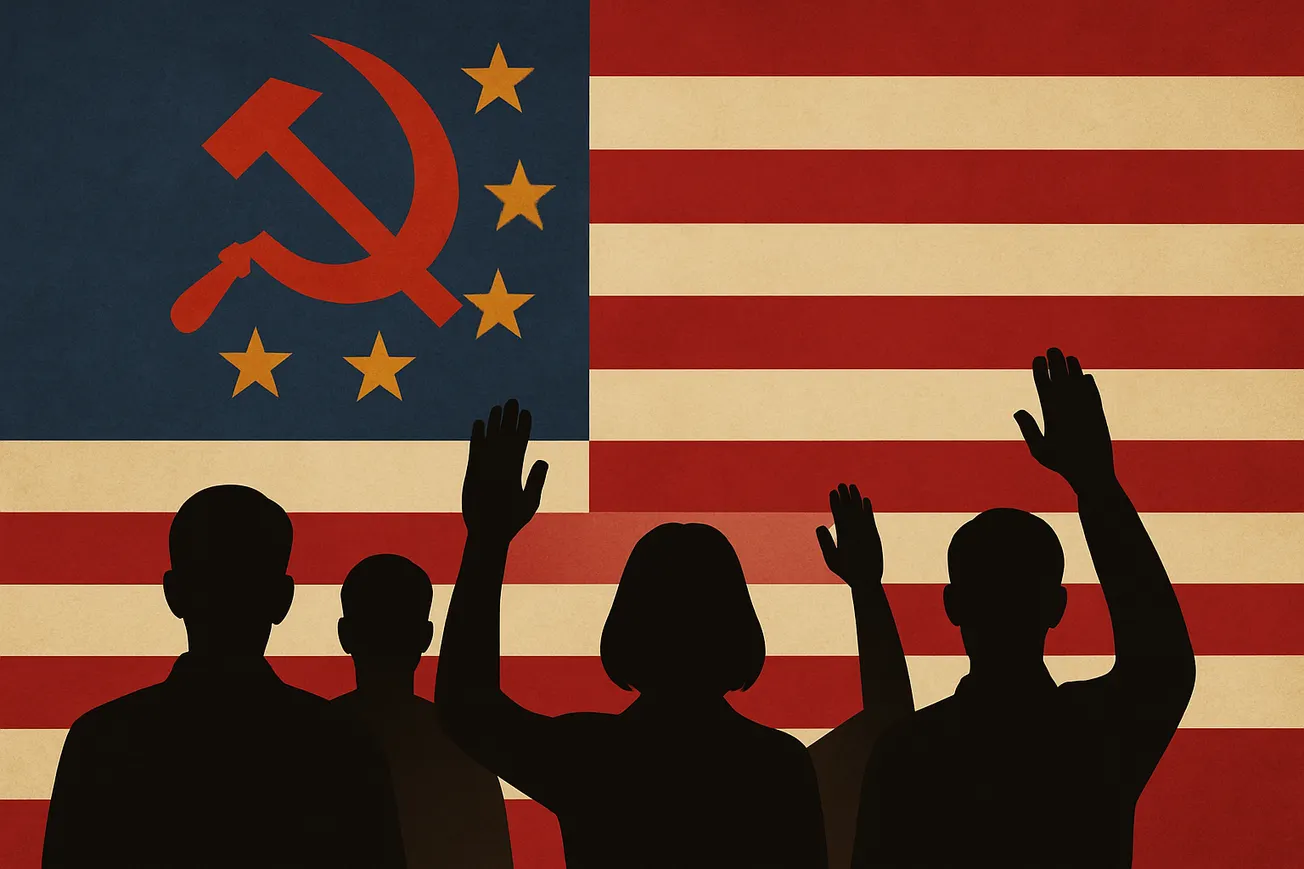
One possible answer: Just under 40% of voters in the 2024 elections were 45 years of age or younger. That's significant, since someone 45 years old today was just 10 years old when the Berlin Wall fell and communism (the most extreme for of socialism) collapsed in 1990.
Communism's demise set off a furious debate over the virtues of socialism versus free-market democracy. The latter won the debate, hands down. And yet, today 39% of Republicans say they "agree" with the principles of socialism.
That's reflected in the Heritage Foundation's global Index of Economic Freedom, which declined for the 23rd straight year in 2024. So while free-market capitalism won the debate, socialism, communism and other types of strict government economic and political control won many of the battles on the ground -- despite socialism's failures.
A study by the Coolidge Foundation summed it up this way: "Over the past 25 years, the average country that became more capitalist experienced an increase in Gross Domestic Product (GDP) per person from about $7,600 to $11,800, an increase of 43%."
It added: "Moreover, the average citizen in these countries gained almost five years in added life expectancy. Meanwhile, in countries that became less capitalist over the same 25-year period saw their life expectancy drop and their income growth stagnate."

Even so, socialism remains surprisingly popular.
As influential political analyst Michael Barone wrote earlier this year: "As one who shared the hope, after the fall of the Berlin Wall in November 1989, that representative government, guaranteed liberties and global capitalism laced with some measure of welfare state protections would spread across the globe, I naturally look back over the intervening long generation and ask what went wrong."
Democrats, in general, remain infatuated with the promises of socialism. A recent Gallup Poll found that 66% of Democrats view socialism positively, while just 44% saw capitalism the same way. Is it any wonder, then, that both New York City and Seattle have recently elected self-described "socialists" or "communists" as their mayors?
Meanwhile, a recent vote in Congress, lawmakers voted 295 to 98 to denounce socialism in "all its forms," with 86 Democrats joining Republicans in the denunciation, and two abstaining. No Republicans voted against it.
Socialism does not have a great track record of success. Yet, many high schools and universities have become virtual academies for advocating socialist ideas, according to Campus Reform.
In a recent poll of 1,574 college students nationwide, 67% said they held either a positive or neutral opinion of the word "socialism," while just 40% said the same about "capitalism." More than anything, this might help explain why socialism is now acceptable, in particular among younger voters, as the I&I/TIPP Poll shows.
I&I/TIPP publishes timely, unique, and informative data each month on topics of public interest. TIPP’s reputation for polling excellence comes from being the most accurate pollster for the past six presidential elections.
Terry Jones is an editor of Issues & Insights. His four decades of journalism experience include serving as national issues editor, economics editor, and editorial page editor for Investor’s Business Daily.
TIPP Curated
Handpicked articles from TIPP Insights & beyond
1. The Embarrassments Of Ideology—Victor Davis Hanson, The Daily Signal
2. Kellogg Fired Over Leaking 28-Point Plan – Proposal Designed To Trap Putin—Moon of Alabama, Ron Paul Institute for Peace and Prosperity
3. Europe Barks Back: Riposte To Trump Peace Plan Is DOA—Gerry Nolan, The Ron Paul Institute for Peace and Prosperity
4. Central Bankers Disagree About Gold—Vincent Cook, Mises Wire
5. How We Can Finally Overcome The Affordability Crisis—EJ Antoni, The Daily Signal
6. Our Golden Age—John Stossel, The Daily Signal
7. What Is An American?—Josh Hammer, The Daily Signal
8. Enforcing Immigration Laws Is Not The Moral Equivalent Of The Holocaust—Michael Barone, The Daily Signal
9. 50-Year Mortgages Won’t Fix The Affordability Crisis—EJ Antoni, The Daily Signal
10. Democrats Love Epstein—Deroy Murdock, The Daily Signal
11. As Religion Weakens, Socialism Strengthens—Star Parker, The Daily Signal
12. 127 Democrats Refuse To Vote To Condemn ‘Horrors of Socialism’—George Caldwell, The Daily Signal
13. ABC’s Mary Bruce Wasn’t A Courageous Reporter On Declining Biden—Tim Graham, The Daily Signal
14. Does A Growing Economy Require Increases In The Money Supply?—Frank Shostak, Mises Wire
15. Rank-And-File Doctors Oppose ‘Gender-Affirming Care’ For Minors, Contrary To Medical Associations, New Study Finds— Tyler O'Neil, The Daily Signal
16. Why “Pro-Family” Government Programs Don’t Increase The Fertility Rate—Ryan McMaken, Mises Wire
17. Minarchism: The Worst Kind Of State Idolatry—Per Bylund, Mises Wire
18. Hoover Was An Economic Interventionist—That Was The Problem!—Joshua Mawhorter, Mises Wire
19. The Futility Of Utility—David Gordon, Mises Wire
20. Politics And Government: The Weakness Of The State—Agustín Toptschij, Mises Wire
21. Do Markets Ever Reach Equilibrium?—Jonathan Newman, Mises Wire
22. What The Founders Feared—Andrew P. Napolitano, Ron Paul Institute for Peace and Prosperity
23. Legal Nonsense To Justify Non-Judicial Killings—Jacob G. Hornberger, The Ron Paul Institute for Peace and Prosperity
24. Mexico’s ‘Gen Z rebellion’ Exposed As Viral Right-Wing Plot—Wyatt Reed, Kit Klarenberg, The Ron Paul Institute for Peace and Prosperity
25. Education Department Saves Taxpayers Hundreds Of Thousands By Closing Costly Unit—Elizabeth Troutman Mitchell, The Daily Signal
26. Delivering On President Trump’s Call To Strengthen Foster Care: A Home For Every Child—Alex J. Adams via The Daily Signal
27. Washington DC Is Changing—And These Stats Prove It—George Caldwell, The Daily Signal
28. Bisignano Meeting The Urgency Of Now In Running The Social Security Administration—Salena Zito, The Daily Signal
29. Iranian Regime Is ‘Very Afraid,’ Expert Warns—Virginia Allen, The Daily Signal
30. Academia Failed To Pass On The Western Tradition. But There’s Hope For Keeping History Alive.—Jarrett Stepman, The Daily Signal
31. Christian Persecution In Russia-Ukraine War Becomes Flashpoint For GOP—Jacob Adams, The Daily Signal
32. Georgia GOP Thanks Greene, As Trump Says She ‘Went Bad’—Kim Jarrett, The Daily Signal
33. Does Mamdani Know Best? New York City Is About To Find Out—Rachel Greszler, The Daily Signal
34. Even Far-Left State Department Employees Celebrate Rubio’s Anti-DEI Move—Elizabeth Troutman Mitchell, The Daily Signal
35. Foreign Policy, Justin Raimondo Style—David Brady, Jr., Mises Wire
36. The NBER Framework To Asses Business Cycles Describes But Does Not Explain Them—Frank Shostak, Mises Wire
From TIPP Insights News Editor
37. Kremlin Rejects Europe’s Ukraine Peace Plan, Backs Parts Of U.S. Proposal
38. Zelenskyy Calls Russian Land Demand The “Main Problem” In Trump's Plan
39. Zelensky May Visit U.S. To Negotiate Trump Peace Plan
40. Japan’s New Missile Deployment Near Taiwan Sparks China Fury
41. Chinese Airlines Slash More Japan Flights As Tensions Continue To Surge
42. Trump, Xi Hold Call As Taiwan Tensions Rise And Trade Talks Stall
43. Trump To Visit China After ‘Very Good’ Call With Xi On Taiwan And Ukraine
44. U.S. Designates Venezuela’s Maduro As Terrorist As Military Buildup Grows
45. Top U.S. General Visits Caribbean As Trump Considers Action Against Maduro
46. Trump’s Government Efficiency Department Ends Early After Turbulent Run
47. U.S. Ends Deportation Protections For Myanmar Immigrants Amid Crackdown
48. Court Dismisses Comey And James Indictments After Finding Prosecutor Improperly Appointed
49. Amazon’s $50B AI Push Sparks Crypto Rally, Lifts Bitcoin Above $87K
50. Japan Moves Toward Crypto Investment Trusts As Demand Surges
51. Why JPMorgan Is Facing A Crypto Backlash Over New Debanking Allegations
📊 Market Mood — Tuesday, November 25, 2025 (Pre-Market)
🟩 Futures Edge Lower Ahead of Fresh U.S. Data
U.S. futures dipped slightly as traders positioned for a heavy slate of delayed economic data, including retail sales and producer prices. Hopes for a December Fed rate cut remain, boosted by dovish comments from Daly and Waller, though policymakers are still split as the shutdown left the Fed operating with stale data. Sentiment is cautious but stabilizing after recent AI-driven volatility.
🟨 Key Economic Data Back in Focus
With the shutdown over, markets finally receive September readings for retail sales and PPI. Consumer spending and inflation remain central to the economic debate, but analysts warn the data may already be outdated. Still, today’s releases help shape expectations heading into the December Fed meeting.
🟧 Fed Officials Divided on the Rate Path
Fed members remain sharply split: some argue for another cut to support a cooling labor market, while others want to wait for clearer data. Markets still price in meaningful odds of a December cut, but uncertainty persists as Powell faces a difficult, high-stakes decision.
🟦 Google–Meta Chip Talks Shift the AI Race
Google is stepping up its challenge to Nvidia, pitching its TPUs directly to enterprise data centers. Meta is reportedly considering a multibillion-dollar deal to deploy TPUs starting in 2027. Nvidia shares slipped pre-market, while Alphabet gained as investors reacted to the potential reshaping of AI hardware competition.
🟥 Dell Earnings on Deck
Dell reports after the bell. The company has doubled its long-term profit growth target thanks to soaring AI server demand. Investors will watch margins closely, as high costs and stiff competition remain risks despite the tailwinds from AI infrastructure spending.
🗓️ Key Economic Events — Tuesday, November 25, 2025
🟨 08:30 AM — Core Retail Sales (MoM)
Tracks underlying consumer spending by excluding autos — a key gauge of demand strength.
🟧 08:30 AM — Producer Price Index (PPI) (MoM)
Measures price changes at the factory/wholesale level — an early signal of inflation pressures.
🟨 08:30 AM — Retail Sales (MoM)
Shows total consumer spending at stores and online — a major driver of U.S. economic activity.
🟧 10:00 AM — CB Consumer Confidence (Nov)
Surveys households on economic conditions — a leading indicator of spending and sentiment.

editor-tippinsights@technometrica.com