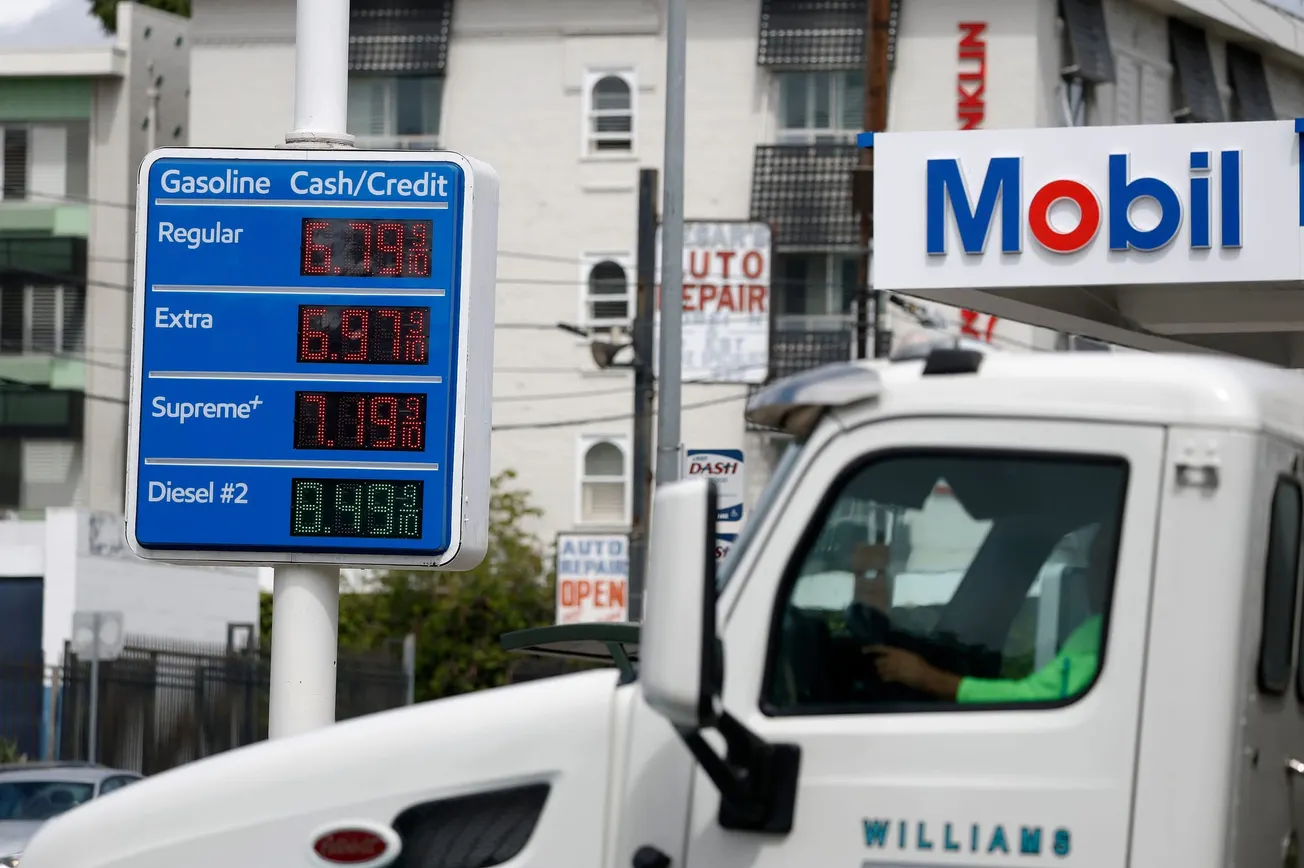
Gasoline prices have soared to their highest levels since 2022's pandemic inflation sent prices to record highs across the nation. Why are prices so high now? If you ask average Americans, they overwhelmingly choose one answer: The U.S. war with Iran, which has sent crude oil prices soaring above $100 a barrel. As the latest I&I/TIPP Poll shows, Americans are feeling the pinch from higher energy costs.
With prices now at a national average of $4.53 a gallon (still below the all-time high of $5 a gallon in June 2022), the cost of gasoline again has seized Americans' attention.
But what do they believe is the reason for energy price surge? In a survey of 1,464 voters conducted from April 28 to May 1, the national online I&I/TIPP Poll asked: "Do you believe the recent increase in gasoline prices is mainly due to the war with Iran, or other factors?"
The answer came back loud and clear: Two-thirds — 67% — said prices were higher "mainly due to the war with Iran," while just 21% responded "mostly due to other factors," and 11% said they weren't sure. The poll has a +/- 2.9 percentage point margin of error.
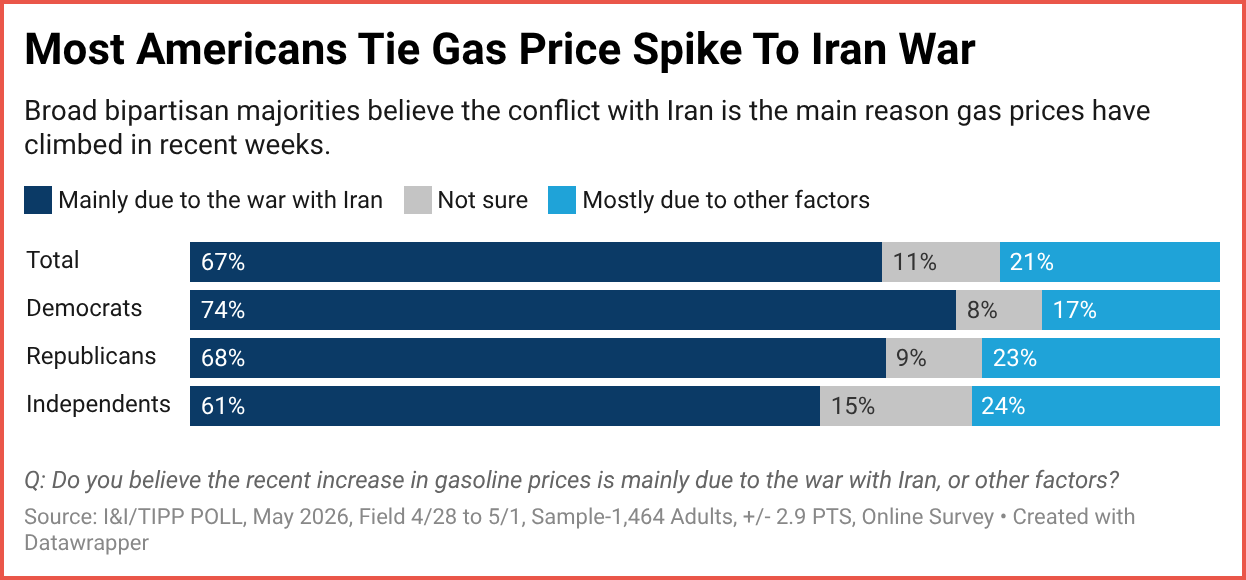
Unlike many recent polls, where political differences show up very strongly in the data, this question found a significant amount of agreement on why gasoline prices are so high. (Currently, among Democrats, 74% blamed the Iran war, 17% blamed other factors; among Republicans, it was 68% Iran, 23% other factors; independents, 61% Iran, 24% other factors.
Indeed, of the 36 demographic groups regularly tracked by I&I/TIPP Poll, all were above 50% and only two groups were below 60%: Those 18 to 24 years of age (51% Iran, 36% other factors) and Hispanic voters (58% Iran, 31% other factors).
So there is a solid consensus that the Iran war is the main cause of the higher prices.
I&I/TIPP asked a follow-up question to gauge respondents' priorities: "Which is more important to you right now?" On this question, responses were somewhat more mixed, with "keeping gasoline prices low" (45%) just edging out "U.S. actions related to the war with Iran" (43%), and 12% not sure.
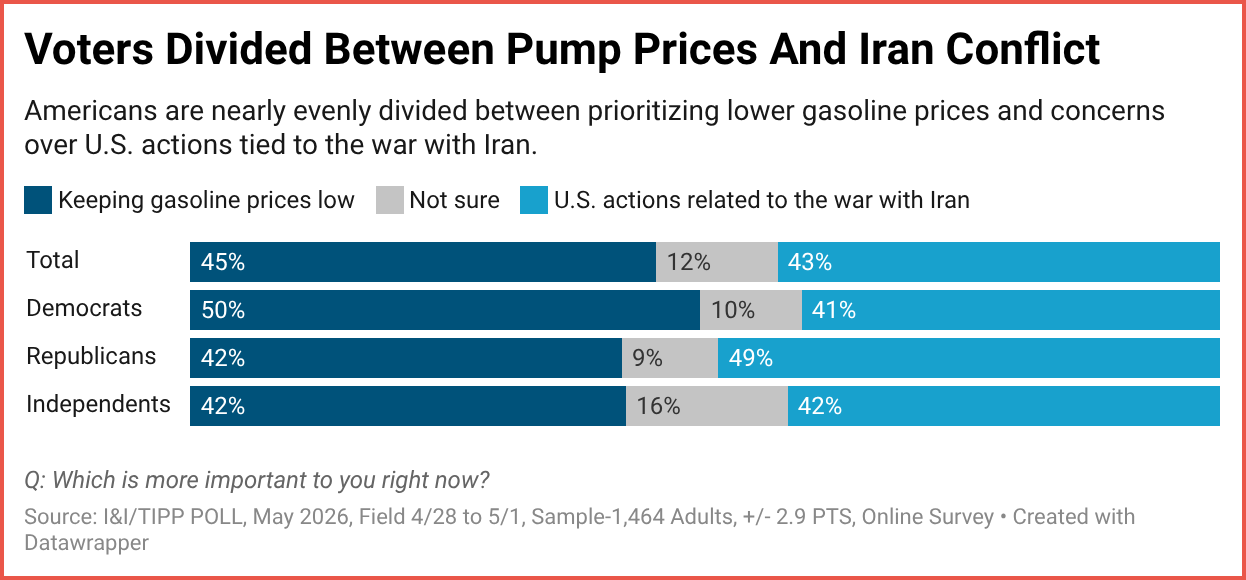
But this time political differences appeared. Democrats (50% low gas prices, 41% war with Iran) were a near mirror image of Republicans (42% low gas prices, 49% war with Iran) and independents were evenly split, 42% low gas prices, 42% war with Iran.
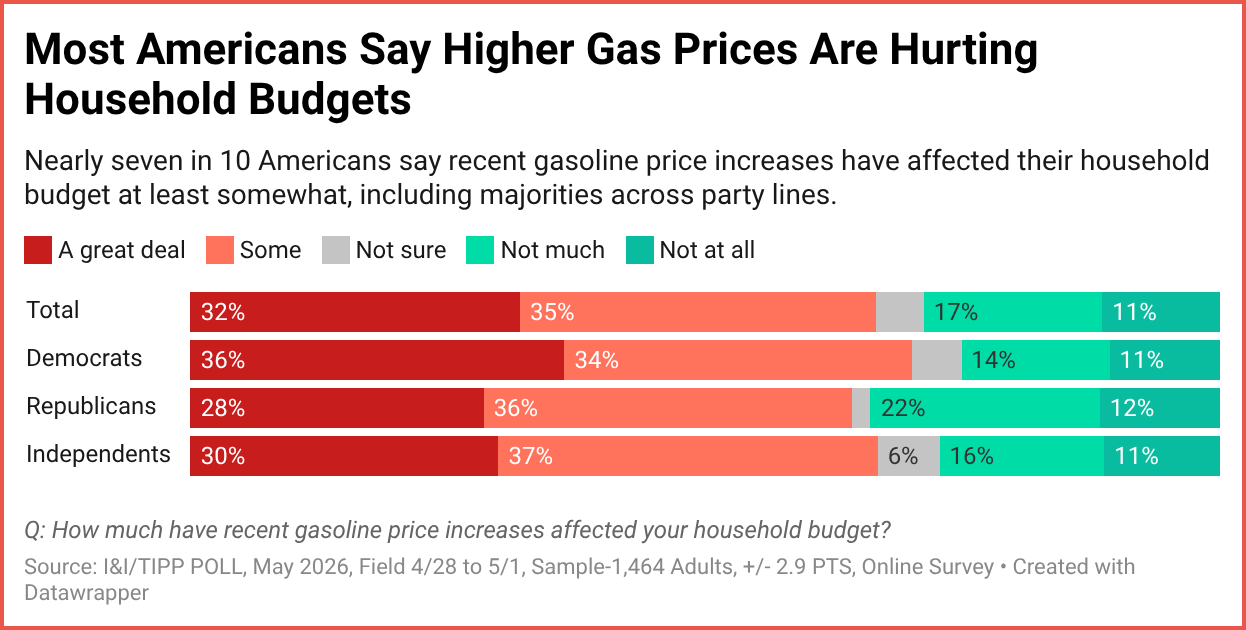
The final question was meant to hit home, literally: "How much have recent gasoline price increases affected your household budget?"
Two-thirds (67%) said either "a great deal" (32%) or "some" (35%), while 28% answered "not much" (17%) or "not at all" (11%). Only 5% said they weren't sure.
This was another question in which there was broad partisan agreement: Democrats (70% "a great deal," or "some," vs. 25% "not much," "not at all"), Republicans (64% "a great deal," or "some," vs. 34% "not much," "not at all") and independents (67% "a great deal," or "some," vs. 27% "not much," "not at all") all were in the same ballpark, statistically speaking.
As another Memorial Day passes, Americans no doubt experienced disappointment at watching gasoline prices hit four-year highs. And, as the I&I/TIPP Poll shows, roughly two-thirds blame the Iran war for the price spike. So they know that the current high prices will come down fast once the war is settled.
In the meantime, President Donald Trump has taken steps to ease the pain at the pump, releasing "record amounts of oil from the Strategic Petroleum Reserve" to hold prices down, and calling for a federal gas tax holiday. He's also temporarily waiving provisions of the Jones Act that will allow ships to carry fuel and other goods more quickly and cheaply between U.S. ports.
None of these, of course, ends the immediate problem of higher prices; they merely mitigate the impact.
And, "despite the soaring (gasoline) costs due to the ongoing conflict in Iran causing shipping bottlenecks and blockades, AAA expects more than 39 million people to hit the roads over the holiday weekend," according to Fox News.
The public seems to understand that current high oil prices, and thus gasoline prices, aren't a long-term problem.
Thanks to fracking, new oil and gas pipelines, more drilling for oil onshore and offshore, and a strongly pro-energy stance by the current administration, the long-term path for energy prices looks favorable. Indeed, fracking alone "saved (consumers) $3.1-$4.3 trillion between 2007 and 2025, equivalent to $164-$227 billion annually," according to a recent study by the University of California at Berkeley’s Haas Energy Institute.
Yes, politically, "affordability" is a major issue. And certainly, higher energy prices are a factor in that and in consumer sentiment hitting a recent all-time low.
But it's important to remember that the 21% surge in inflation during the previous administration was fueled by $4 trillion in COVID-related government spending and by record energy prices related to another war: The 2022 invasion of Ukraine by Russia.
Today, Russia looks ready to wind down its costly war, and Trump appears eager to end the U.S. conflict with Iran.
As the I&I/TIPP survey shows, a majority of Americans feel the pain from higher energy prices. Even so, a surprising 43% still want Trump to focus on "U.S. actions related to the war with Iran," a statistical tie with the 45% wanting him to focus on "keeping gas prices low." It seems many Americans think either focus leads to the same result: an end to the U.S.-Iran war and lower energy prices.
I&I/TIPP publishes timely, unique, and informative data each month on topics of public interest. TIPP’s reputation for polling excellence comes from being the most accurate pollster for the past six presidential elections.
Terry Jones is an editor of Issues & Insights. His four decades of journalism experience include serving as national issues editor, economics editor, and editorial page editor for Investor’s Business Daily.
👉 Show & Tell 🔥 The Signals
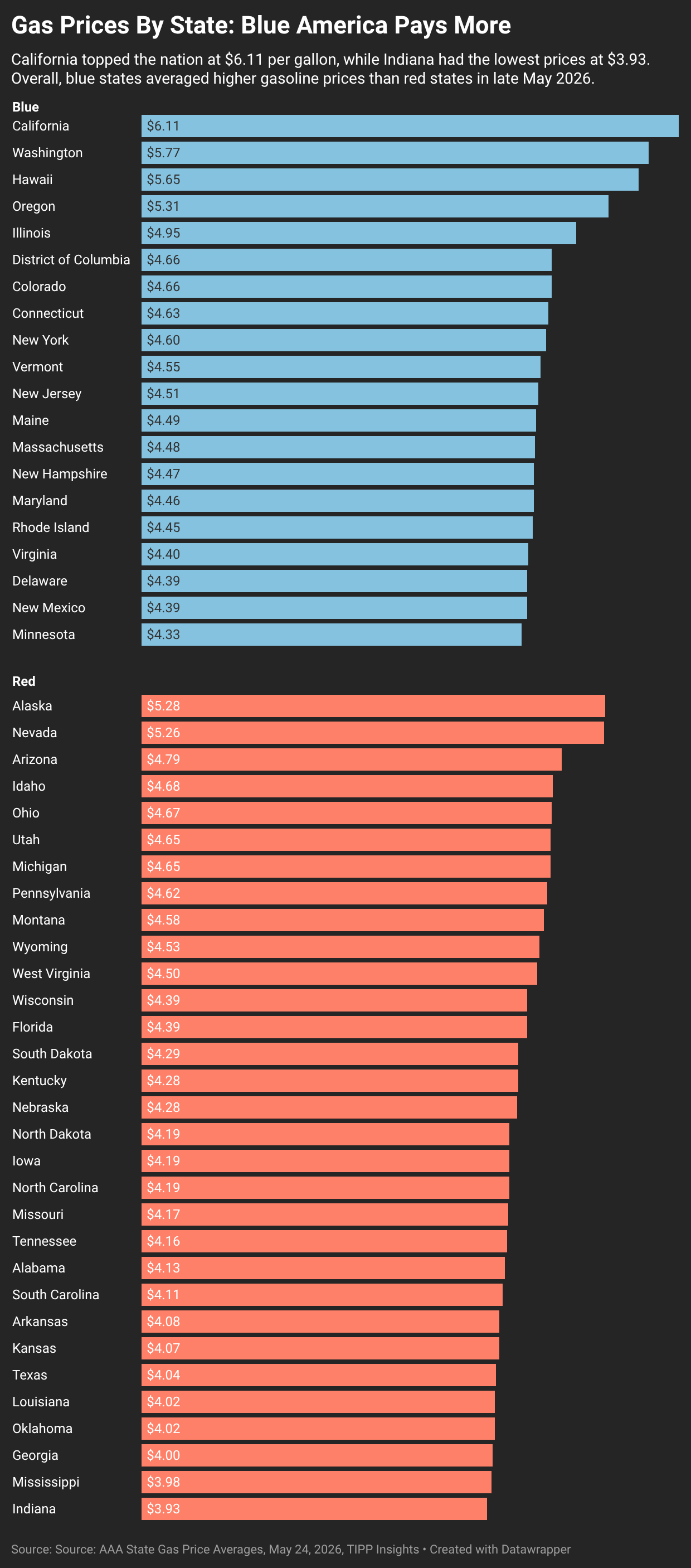
I. Blue States Paying More At The Pump Than Red States
Gasoline prices remain sharply divided across the U.S., with drivers in states that voted Democratic in the 2024 presidential election paying an average of $4.76 per gallon for regular fuel, compared with $4.36 in states that voted Republican. California posted the nation’s highest average price at $6.11 per gallon, while Indiana had the lowest at $3.93, reflecting major regional differences in taxes, environmental fuel standards, and refining capacity.
The TIPP Off
What you should be reading right now
Iran
Victor Davis Hanson Calls Out The New York Times Over Explosive Israel Story—Victor Davis Hanson, The Daily Signal
The Blood Libel—Daniel Pomerantz, TIPP Insights
The Gulf’s Post-OPEC Order—Rabah Arezki, Tarik M. Yousef, Project Syndicate
Russia's Grind, Iran's Clock—Mark Pfeifle, TIPP Insights
Beijing’s Chokepoint—Mark Pfeifle, TIPP Insights
The Decision—Editorial Board, TIPP Insights
Dire Straits—Mark Pfeifle, TIPP Insights
Find Your Strait Of Hormuz Before It Finds You—Mark Pfeifle, TIPP Insights
China
The China Trilogy—Editorial Board, TIPP Insights
- The American Kill Line
- One Child, One Soldier
- Xi's Reelection Theater
- The China Triology (Audio Version)
Why Are China’s Young People Fed Up?—Yi Fuxian, Project Syndicate
Victor Davis Hanson: America Being Overtaken? We’ve Heard That Before—Victor Davis Hanson, The Daily Signal
Xi Warned US Not To Fall Into ‘Thucydides Trap.’ What’s That Mean?—Victor Davis Hanson, The Daily Signal
Xi's Question—Editorial Board, TIPP Insights
To Be Continued—Editorial Board, TIPP Insights
The 25th Visit—Editorial Board, TIPP Insights
The World Economy After the Trump-Xi Summit—Shang-Jin Wei, Project Syndicate
The Handshake In Beijing—Editorial Board, TIPP Insights
The Death Sentence—Editorial Board, TIPP Insights
Mr. President, Don't Go To China—Editorial Board, TIPP Insights
Cuba
‘Justice Has No Expiration Date’: Raúl Castro Indicted In US—Pedro Rodriguez, The Daily Signal
Cuba’s Freedom Is An ‘America First’ Cause—Roberto J. Gonzalez, The Daily Signal
Letters to the editor email: editor-tippinsights@technometrica.com
Subscribe Today And Make A Difference. Consider supporting Independent Journalism by upgrading to a paid subscription or making a donation. Your support helps tippinsights thrive as a reader-supported publication. Contact us to discuss your research or polling needs.
Reach our audience. For sponsorship and advertising opportunities, visit our Partner With Us page.