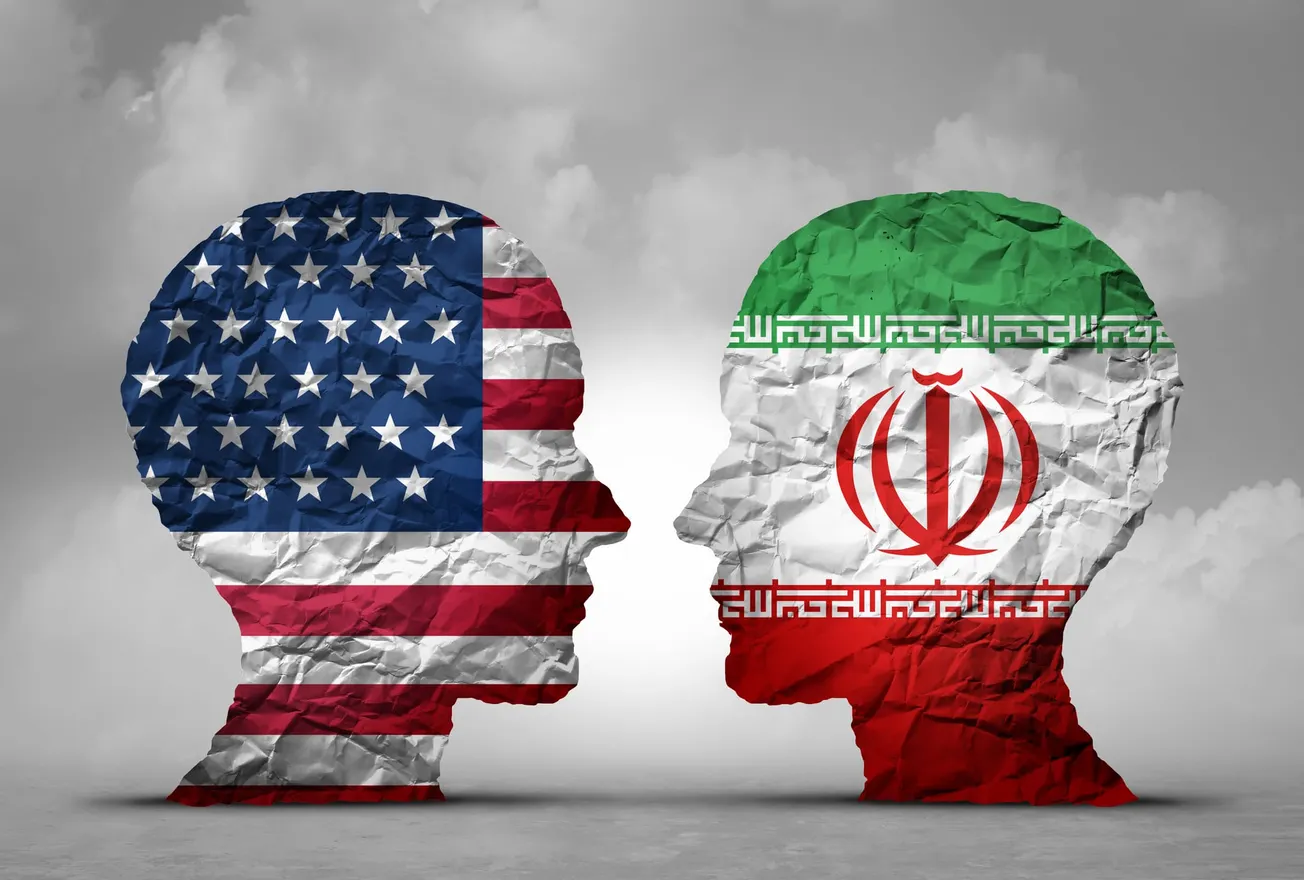
President Donald Trump has worked hard to forge a deal to end the U.S.-Iran war and avoid a wider conflict. But, as the latest I&I/TIPP Poll shows, Americans remain sharply split over the U.S. military action, and strongly oppose sending ground troops into Iran.
The national online I&I/TIPP Poll, taken by 1,464 adults from April 28 to May 1, asked: "Do you support or oppose the United States military action against Iran?" The poll's margin of error is +/-2.9 percentage points.
Among all those responding, 43% said they support the U.S.-Iran war either strongly (23%) or somewhat (20%), while 47% said they oppose the war either strongly (30%) or somewhat (17%). Another 10% described themselves as "not sure."
This appears to be a "bright line" dividing issue, with sharp opinion differences within many demographic categories.
The most obvious, not surprisingly, is political affiliation. Republicans strongly back the war (73% support, 19% oppose), while Democrats are a near mirror image (73% oppose, 20% support). Independent voters are less vehement in their opposition (54% oppose, 34% support).
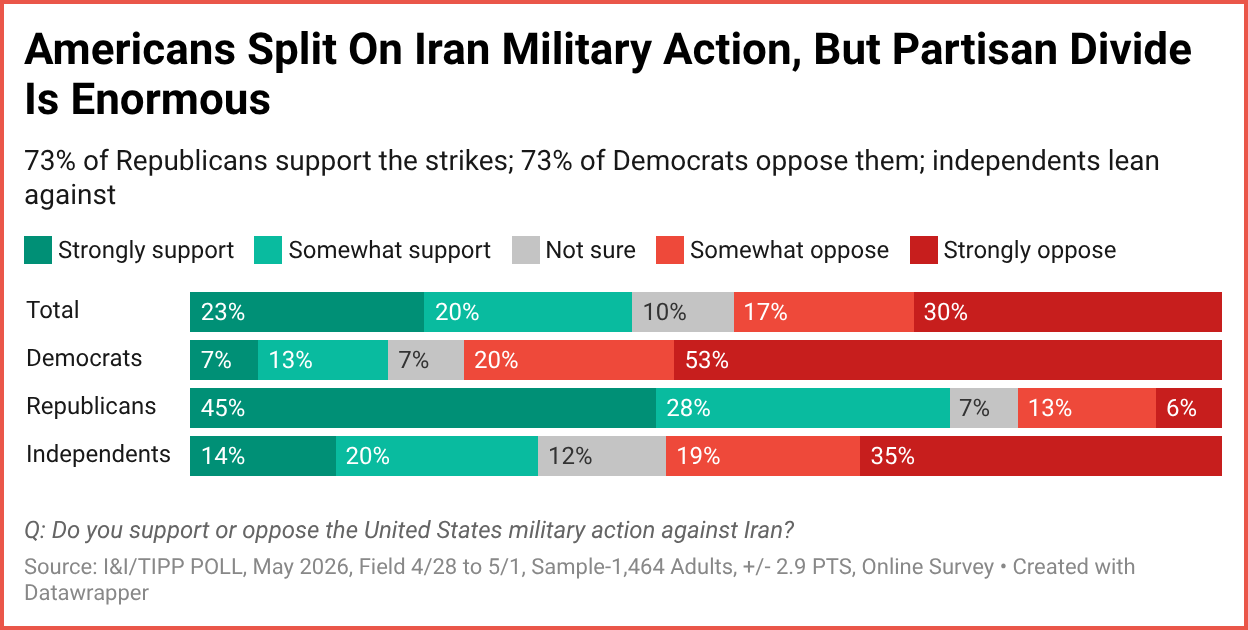
Other splits among and within groups are evident.
Overall, men endorse the war by a slight amount (48% support, 46% oppose), while women reject it (38% support, 48% oppose); meanwhile, white Americans mostly back the conflict (48% support, 42% oppose), while Hispanics and black Americans together strongly turn it down (31% support, 60% oppose).
But the biggest split by far is by age. Put simply, younger Americans tend to reject it, with those age 18 to 24 years (31% support, 62% oppose) and those 25 to 44 years (42% support, 46% oppose) most likely to reject the war. Among those 45 to 64 years, it's a tossup (44% support, 45% oppose) and only those 65 years and older back it (48% support, 45% oppose).
Clearly, there are uncomfortable dinner conversations taking place across America, at least when it comes to the U.S.-Iran war.
A separate question asked: "Would you support or oppose the United States sending ground troops into Iran?"
The response was clear: Most said no. Overall, just 32% said they would support ground troops in Iran either strongly (13%) or somewhat (19%), while a solid majority of 57% answered that they would oppose it either strongly (39%) or somewhat (18%).
Party affiliation as usual showed some differences, but the gaps weren't enormous, as sometimes they are. Democrats' opposition is strong (15% support, 77% oppose); independents likewise solidly oppose the move (25% support, 61% oppose).
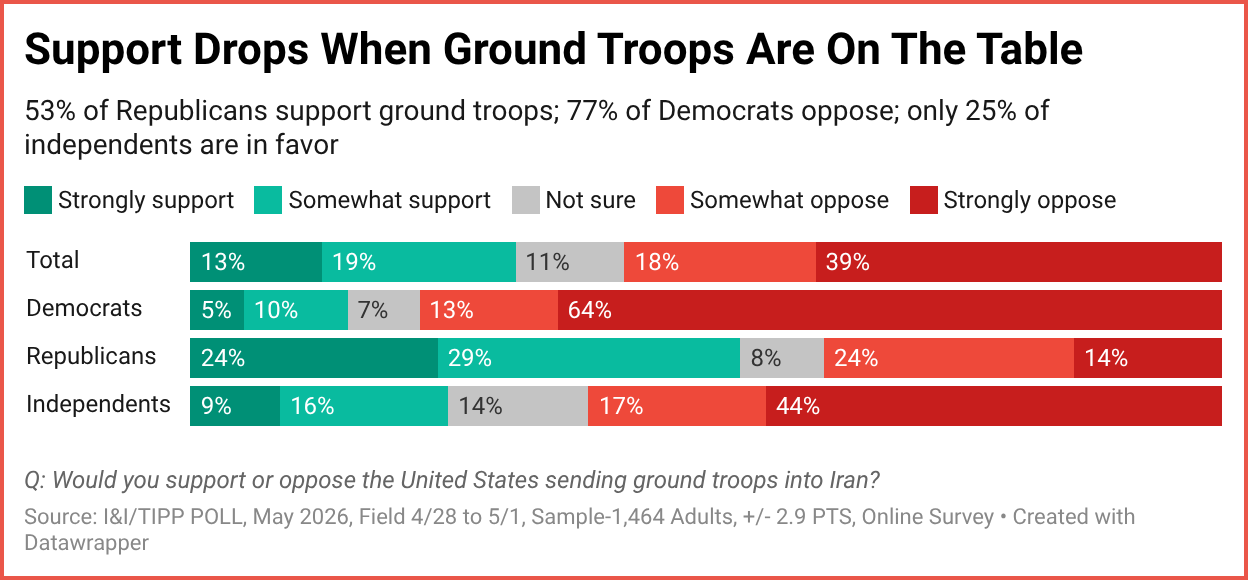
But even GOP voters appear somewhat ambivalent about the introduction of ground troops into Iran (53% support, 39% oppose). So no matter what, it will be a tough sell, politically speaking.
A final question broadens out the Iran war impact, asking: "How concerned are you that the conflict with Iran could expand into a wider regional or global war?"
On this question, the majority was solid, with 69% saying they were either very concerned (37%) or somewhat concerned (32%), while only 23% said they were either not at all concerned (8%) or not too concerned (15%).
Agreement was found across the political spectrum, with Democrats (85% concerned, 10% not concerned), independents (69% concerned, 20% not concerned) and Republicans (58% concerned, 38% not concerned) in broad majoritarian accord.
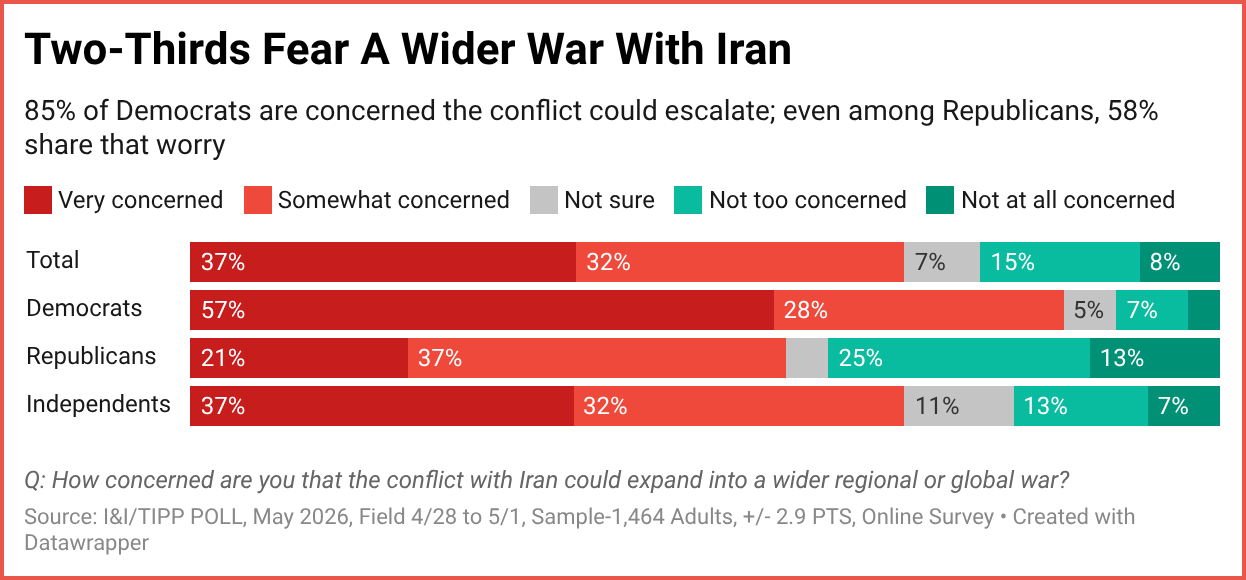
Indeed, of the 36 separate demographic groups tracked each month by the I&I/TIPP poll, no group was below 50% on the question of whether they were concerned or not about a broadening of the conflict regionally or globally. A majority of all are concerned.
Perhaps that's not surprising, given that few news accounts of the conflict fail to mention the reactions of Russia, China and the EU to Trump's decision to end Iran's nuclear threat. That threat has long been denied by many here in the U.S., but as we all know now is very real.
In the case of China and Russia, it's part of the ongoing geopolitical chess game between the U.S. and its two oldest, and most powerful, rivals. But it's also about energy and influence in the volatile Mideast.
China was, in effect, a mono-market for Iran's oil, accounting for more than 90% of the country's crude exports. As China's Xi Jinping and Trump prepare to meet this week, Chinese policymakers will understand that Trump's bold moves against both Venezuela and Iran put the Middle Kingdom in an energy bind of epic proportions: just under 20% of China's total oil supply comes from those two troubled countries.
So China is likely to exert pressure on Iran's current rulers to forge a deal soon with the U.S. that will reopen Iran's oil spigots, halt enrichment of uranium for a nuclear weapon, and release its grip on the Strait of Hormuz.
As for Russia, it continues to arm Iran with drones, missiles and other equipment, and provides it with badly needed satellite intelligence on U.S. ship movement and troop deployments. Russia desperately needs Iran to maintain its economic, military and diplomatic influence in the Mideast, serving as a powerbroker across the region.
Many have forgotten that, earlier this year, Russia co-signed a "trilateral strategic pact" with China and Iran, further deepening ties among the three nations. Indeed, the three described the deal as "a cornerstone for a new multipolar order," not just in the Mideast, but around the globe.
While at the time the tripartite deal was viewed as a kind of "anti-NATO," doing for Iran, Russia and China what NATO does for the U.S. and Europe, namely bind them together militarily and economically.
Trump seems to have severely disrupted that. With Putin now talking about ending the Ukraine war and encouraging others in the Mideast to back U.S.-Iran talks, and China now in a mood to talk to the U.S., Trump may find he has elbow room to find a peaceful end to the Iran war.
For Trump, already infamous as a dealmaker, this could be his biggest and greatest deal yet.
But political danger also awaits, especially if the current gulf conflict becomes a protracted war on Iranian soil. As the latest I&I/TIPP Poll shows, Americans now offer lukewarm support for the Iran war, and clearly aren't keen to expand it further.
I&I/TIPP publishes timely, unique, and informative data each month on topics of public interest. TIPP’s reputation for polling excellence comes from being the most accurate pollster for the past six presidential elections.
Terry Jones is an editor of Issues & Insights. His four decades of journalism experience include serving as national issues editor, economics editor, and editorial page editor for Investor’s Business Daily.
👉 Show & Tell 🔥 The Signals
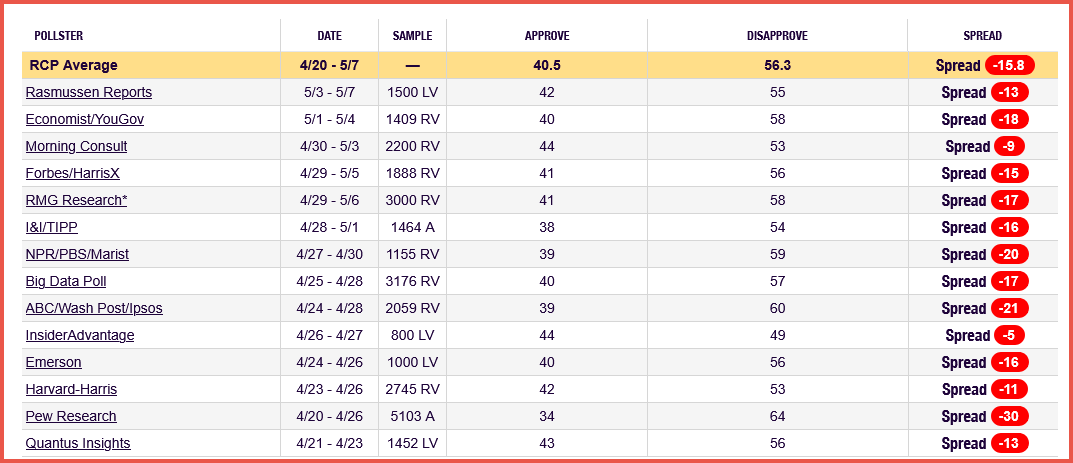
I. Trump Approval Remains Deeply Underwater
The latest RealClearPolitics average shows President Trump with a 40.5% approval rating and 56.3% disapproval, a net spread of -15.8 points. Most recent national polls continue to show disapproval outweighing approval by double digits.
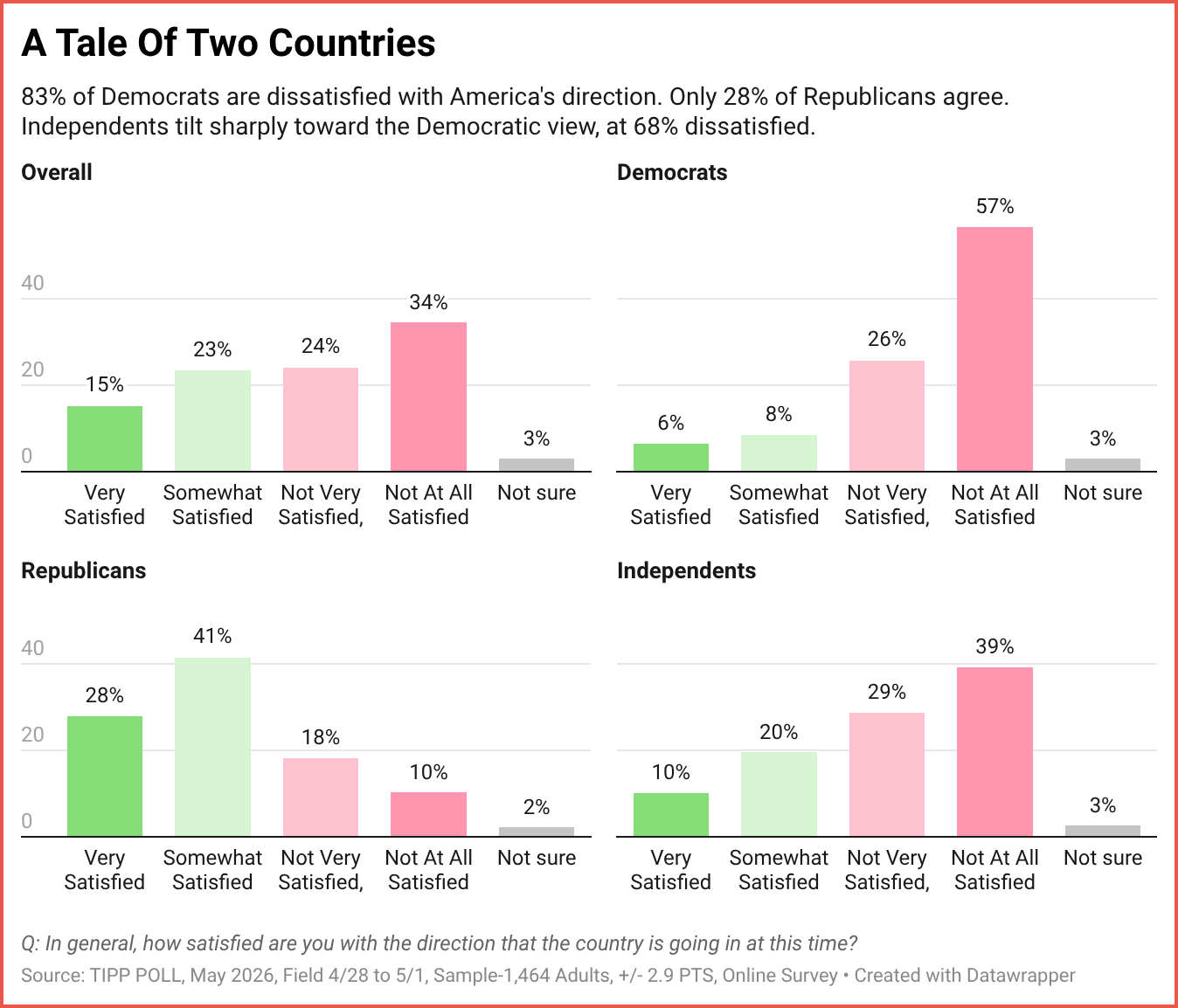
II. America Remains Sharply Divided
Views of the country’s direction split dramatically by party. Among Democrats, 83% are dissatisfied, while only 28% of Republicans say the same. Independents lean closer to Democrats, with 68% expressing dissatisfaction.
📊 Market Mood — Monday, May 11, 2026
🟩 Markets Pause After Record Run
U.S. futures slipped modestly as investors reassessed optimism around the Iran conflict.
🟧 Oil Jumps After Trump Rejects Iran Proposal
Crude climbed above $104 after Trump called Tehran’s counteroffer “totally unacceptable.”
🟦 AI Euphoria Continues to Support Stocks
Strong earnings growth and relentless AI spending kept the broader bull case intact.
🟨 Inflation Data Becomes the Next Big Test
Markets now turn to Tuesday’s CPI report for clues on how the oil shock is feeding into prices.
🗓️ Key Economic Events — Monday, May 11, 2026
🟧 10:00 ET — Existing Home Sales (Apr)
Expected at 4.05M (vs. 3.98M prior), providing a read on housing demand amid elevated mortgage rates and economic uncertainty.
Letters to the editor email: editor-tippinsights@technometrica.com
Subscribe Today And Make A Difference. Consider supporting Independent Journalism by upgrading to a paid subscription or making a donation. Your support helps tippinsights thrive as a reader-supported publication. Contact us to discuss your research or polling needs.
Reach our audience. For sponsorship and advertising opportunities, visit our Partner With Us page.