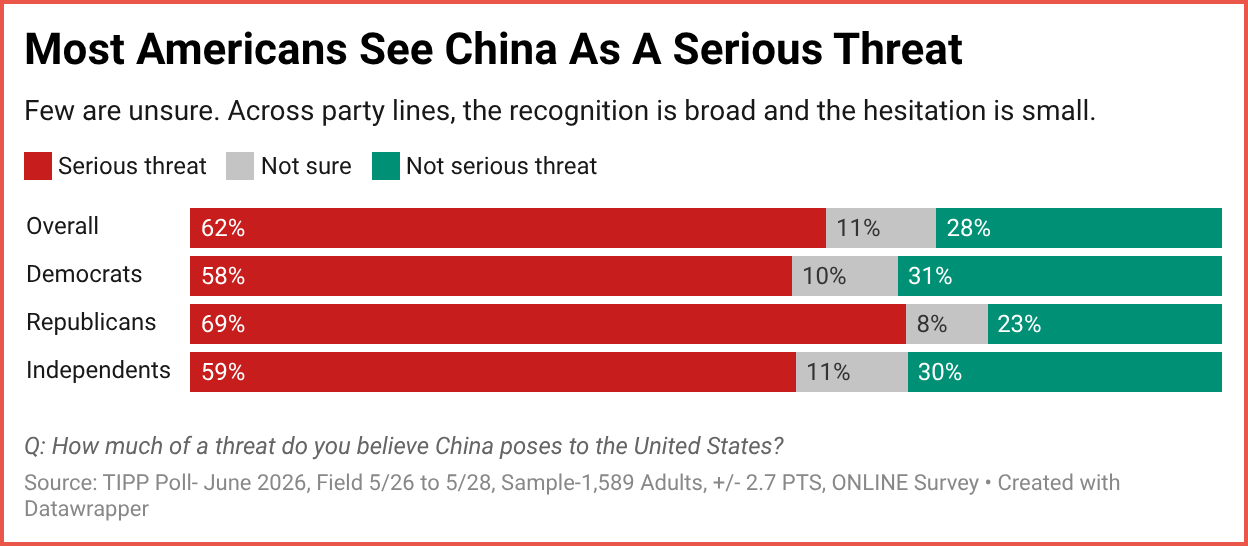
Ask Americans to rank the country's worries and China lands near the bottom of the list, at six percent. Ask them directly, and sixty-two percent call it a serious threat to the United States. The danger is real to them, just not urgent. The recognition reaches across the parties. Republicans rate it highest, at sixty-nine percent, and majorities of Democrats and independents agree.
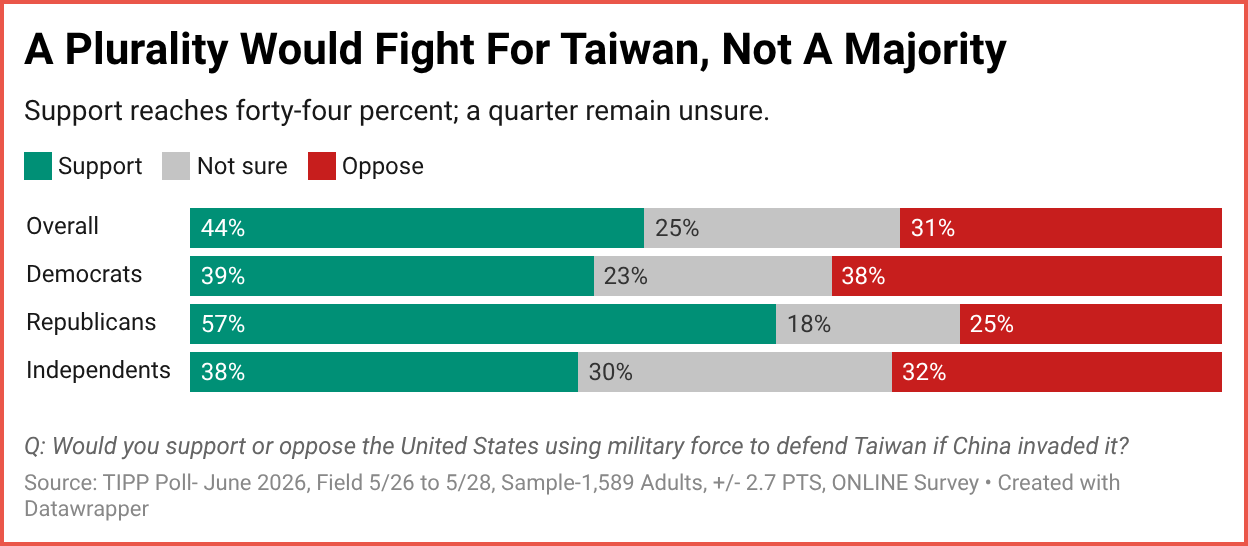
What they have not settled is what to do about it. The same survey asked whether the United States should use military force to defend Taiwan if China invaded. Support came to forty-four percent, a plurality but not a majority, and only Republicans crossed fifty. The share with no answer climbed from one in ten on the threat question to one in four on Taiwan. More Americans have no answer than feel strongly the country should fight.
Congress approved a fourteen-billion-dollar weapons package for Taiwan in January. Months later the President has not sent it forward, the step the sale needs to move. He has called the package a bargaining chip with China and promised a determination he has yet to make. The sale has since been described as paused, its timing tied to the ammunition demands of the Iran war and to his pursuit of a steadier relationship with Beijing.
A president who hedges on Taiwan pays a price at home only if the public has made up its mind. A quarter of the country holds no position at all, and no majority forms on either side. With nothing pushing him to act, the President is free to wait. The pause needs no defense at home, because there is no settled country to demand one.
On the flight back from Beijing this month, the President said Xi had asked him directly whether the United States would defend Taiwan, and that he declined to answer. Behind the question is a doctrine called strategic ambiguity. The 1979 Taiwan Relations Act commits America to arm Taiwan but stops short of promising to defend it, and for forty-seven years that gap has held by keeping Beijing unsure America would step in and Taipei unsure it would not. The posture was always set and kept in Washington.
The poll says it no longer lives only there. Strategic ambiguity used to be a posture in Washington; now it is the condition of the country. The President keeps it at the top by choice, the public at the bottom by indecision, and the question Xi asked goes unanswered all the way down.
The China Trilogy — Editorial Board, TIPP Insights
Three editorials on how Beijing projects power, manufactures consent, and stages its own legitimacy:
Prefer to listen? The China Trilogy, audio version
The TIPP Off
What you should be reading right now
The Blueprint—Editorial Board, TIPP Insights
The American Kill Line—Editorial Board, TIPP Insights
The Donroe Doctrine—Mark Pfeifle, TIPP Insights
America's Stoic Mental Health Crisis—Editorial Board, TIPP Insights
Americans Feel The Pinch From Higher Gas Prices, Blame Iran War For The Surge In Energy Costs: I&I/TIPP Poll—Terry Jones, TIPP Insights
The Policy Pivot Trump Needs—Glenn Hubbard, Project Syndicate
The Reagan Formula For A Dangerous World—Larry Kudlow, Fox Business
Sharia’s Growing Influence on U.S. Finance—Paul Sperry, RealClearInvestigations
The Replacements: How US Helps Foreign Workers Take American Jobs—Steven Edginton, RealClearInvestigations
FBI, DHS Monitor New "Anti-Tech Extremism" Threat Vector Amid AI Backlash—News Editor, TIPP Insights
California Democrats Show Signs Of Apathy Ahead Of Crowded Primary—News Editor, TIPP Insights
Letters to the editor email: editor-tippinsights@technometrica.com
Subscribe Today And Make A Difference. Consider supporting Independent Journalism by upgrading to a paid subscription or making a donation. Your support helps tippinsights thrive as a reader-supported publication. Contact us to discuss your research or polling needs.
Reach our audience. For sponsorship and advertising opportunities, visit our Partner With Us page.