
Last week, Minnesota enacted a law requiring social media companies to obtain a parent’s consent before a child under 16 can open an account. The same law switches off the endless scroll and the autoplay on those accounts and turns on the strongest privacy settings by default. It cleared both chambers of the legislature almost unanimously, with support from both parties.
That near-unanimity is no accident of one state’s politics; it reflects what the country already believes.
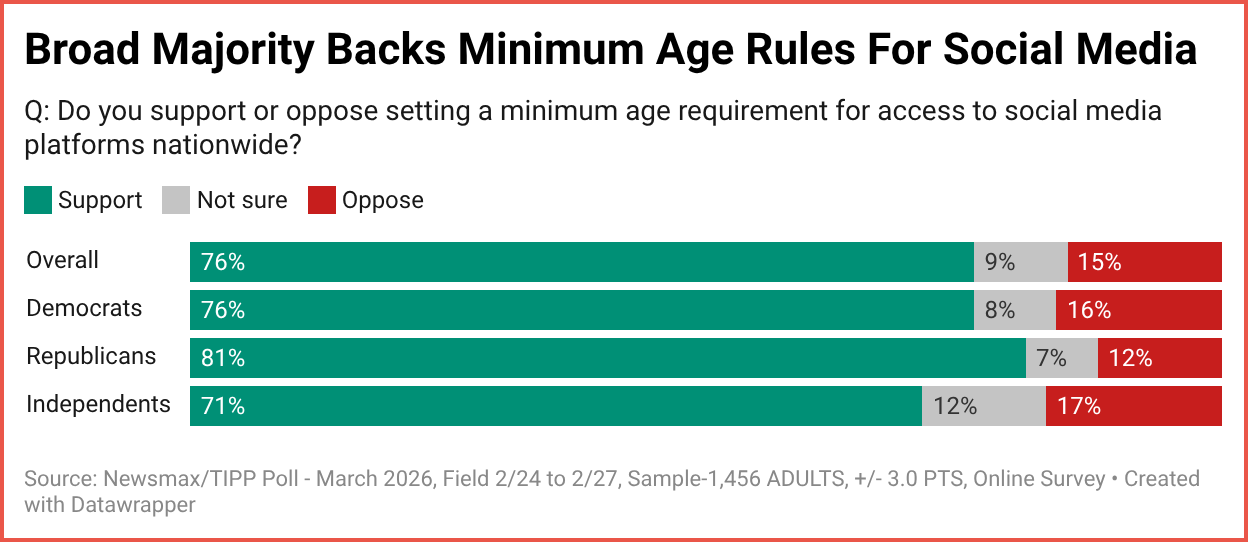
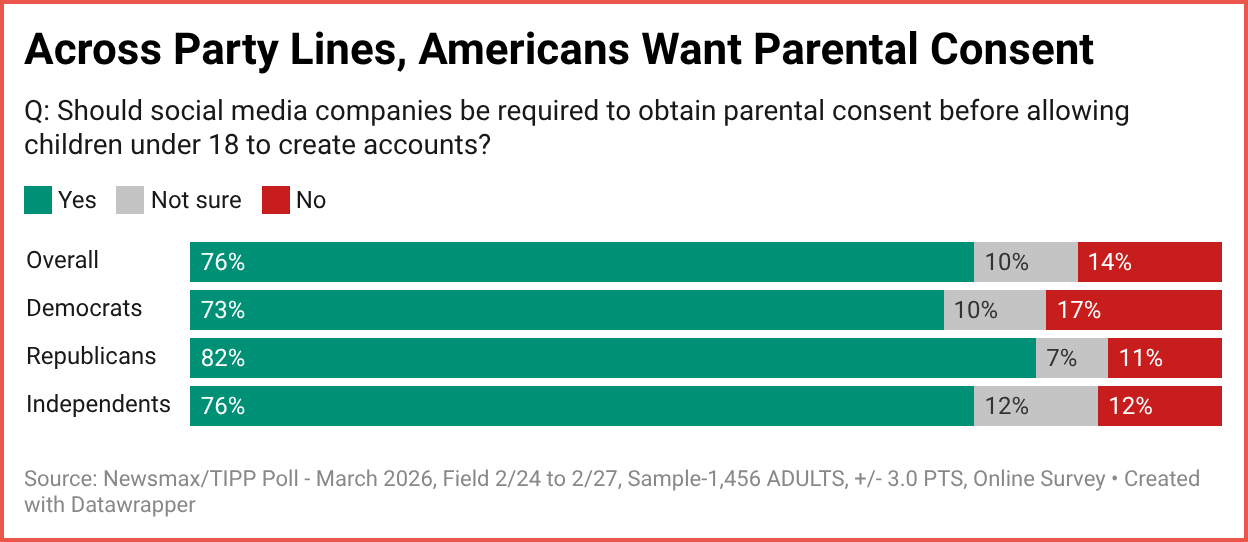
A nationwide Newsmax/TIPP Poll of 1,456 adults, conducted in late February, asked Americans how children should be protected online. The answers were not close. 76% want a minimum age requirement for access to social media. 76% want platforms to obtain a parent’s consent before a minor can create an account. On both questions, the agreement runs straight across the political divide.
Support for parental consent climbs with age, from 64% among adults under 25 to 84% among those over 65, and it holds across camps: 73% of Democrats, 82% of Republicans, 76% of independents. The minimum-age question draws the same broad coalition: 76% in favor versus 15% opposed, with Republicans at 81%, Democrats at 76%, and independents at 71%. The youngest adults are the most hesitant, yet majorities of them favor both.
An age floor and a consent requirement do the same thing: they keep the decision inside the family rather than handing it to the government. Each leaves the call to a parent.
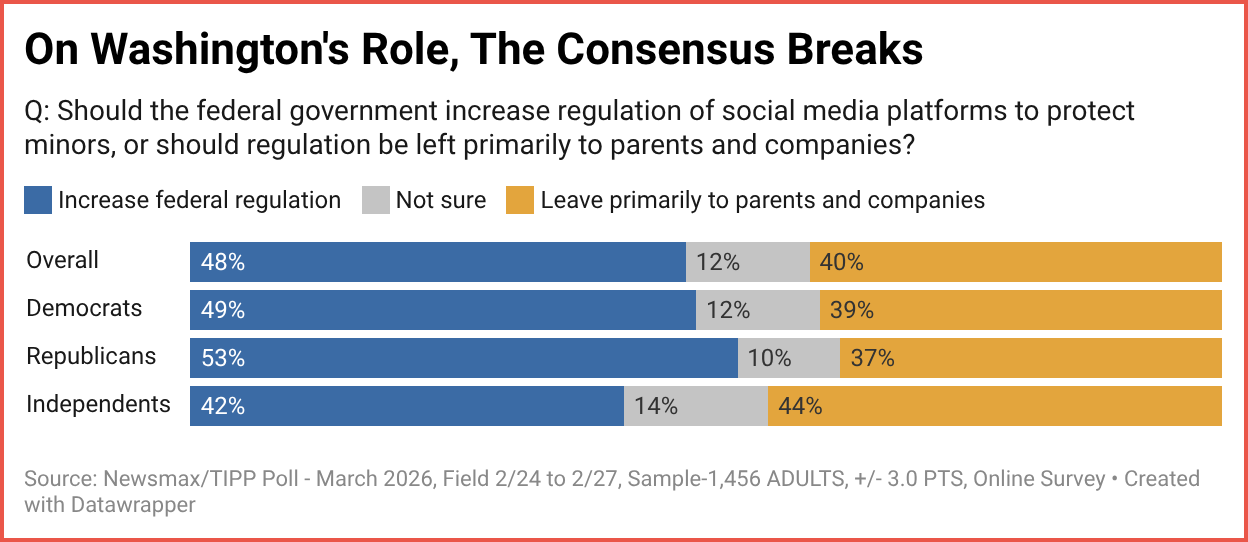
Then comes the question that splits the room. Asked whether Washington should increase its regulation of social media to protect minors, or leave the job primarily to parents and companies, Americans are divided. 48% want more federal regulation. 40% would keep it with parents and companies. 12% are unsure. There is a plurality for a larger federal hand, but no supermajority, nothing like the three-quarters who agree on a parent’s authority. The country is united on the gate, yet divided over whether the government should hold it.
Two days ago, we reported that 85% of Americans believe the country faces a mental health crisis, while only 12% named social media and technology as its leading cause. They ranked it below the cost of living, substance abuse, and the shortage of care. They have looked at the evidence and declined to blame the phone for the whole of it.
Let us not misread that 12%. It came from a poll about all adults, and children are not small adults. The judgment and impulse control that make a bottomless feed manageable are still developing through adolescence. What an adult can take or leave, a child is still learning to handle. That’s the distinction.
The country is not waiting for permission to act. At least 19 states have now passed laws governing how minors access social media, according to the Age Verification Providers Association. A handful are in force, while others are tied up in court, like Virginia’s, which took effect on New Year’s Day and was paused weeks later by a federal judge. Washington has set no national standard at all. The patchwork grows because the public will is outpacing the institutions meant to carry it out.
Mental Health Awareness Month ends this week, and it would be easy to close it by naming a villain. The polling asks for something simpler. The country has already decided that a child’s social media should have a gate, and who belongs beside it. What’s left is whether the law will put the key where the public has: in a parent’s hand.
The TIPP Off
What you should be reading right now
Global Affairs
The Donroe Doctrine—Mark Pfeifle, TIPP Insights
Iran Strikes Threaten Fragile Peace Efforts—George Caldwell, The Daily Signal
National Affairs
Victor Davis Hanson: The 1.2 Million Reasons America Exists Today—Victor Davis Hanson, The Daily Signal
America's Stoic Mental Health Crisis—Editorial Board, TIPP Insights
Law School Threatened Disciplinary Action Against Students Who Opted Out Of DEI Training—Pedro Rodriguez, The Daily Signal
Thomas Slams Court For Refusing to Hear Florida’s Case Against California On Illegal Alien Drivers—Tyler O’Neil, The Daily Signal
Seminary President Explains Why More Young Men Are Religious—Francesca Cella, The Daily Signal
Mehek Cooke: GOP Primaries Show A Distinct Mandate—Daily Signal Staff, The Daily Signal
Texas, DC Republicans Rally Around Paxton To Battle Talarico—George Caldwell, The Daily Signal
Middleton Wins Republican Nomination In Texas AG Runoff—Pedro Rodriguez, The Daily Signal
Economy
Americans Feel The Pinch From Higher Gas Prices, Blame Iran War For The Surge In Energy Costs: I&I/TIPP Poll—Terry Jones, TIPP Insights
Sharia’s Growing Influence on U.S. Finance—Paul Sperry, RealClearInvestigations
The Policy Pivot Trump Needs—Glenn Hubbard, Project Syndicate
Powell’s Federal Reserve Mess Is Now Warsh’s Problem—Steve Cortes, The Daily Signal
A Cold Shower For The AI Mania—Raghuram G. Rajan, Project Syndicate
Does Demand Create Supply?—Frank Shostak, Mises Wire
📊 Market Mood — Friday, May 29, 2026
🟩 Markets pushed higher as investors welcomed reports that the U.S. and Iran may be close to extending their ceasefire and reopening the Strait of Hormuz to commercial shipping.
🟧 Oil prices continued to retreat, with Brent crude falling toward $92 a barrel as fears of a prolonged supply disruption eased.
🟦 Inflation concerns softened after the Fed’s preferred PCE measure came in cooler than expected, although signs emerged that higher energy costs are beginning to weigh on consumer spending.
🟨 AI and technology stocks remained market leaders, with Dell boosting its outlook and lifting sentiment across the broader AI infrastructure and data-center ecosystem.
🗓️ Key Economic Events — Friday, May 29, 2026
🟧 9:45 a.m. ET — Chicago PMI (May)
Forecast: 50.6 vs. 49.2 previous. A reading above 50 signals expansion in business activity. Markets will watch whether Midwest manufacturing is gaining momentum despite higher energy costs and lingering economic uncertainty.
Letters to the editor email: editor-tippinsights@technometrica.com
Subscribe Today And Make A Difference. Consider supporting Independent Journalism by upgrading to a paid subscription or making a donation. Your support helps tippinsights thrive as a reader-supported publication. Contact us to discuss your research or polling needs.
Reach our audience. For sponsorship and advertising opportunities, visit our Partner With Us page.