Americans have always dreamt of a national come-together moment when all felt unified in purpose and intent. But, as the latest I&I/TIPP Poll shows, unity among America’s many factions and demographics has been elusive since the start of this decade.
Each month, the national online I&I/TIPP Poll asks Americans across the nation whether they would say the U.S. is “very united,” “somewhat united,” “somewhat divided,” “very divided,” or simply “not sure.”
From this, I&I/TIPP creates a national Unity Index, which allows for comparisons over time.
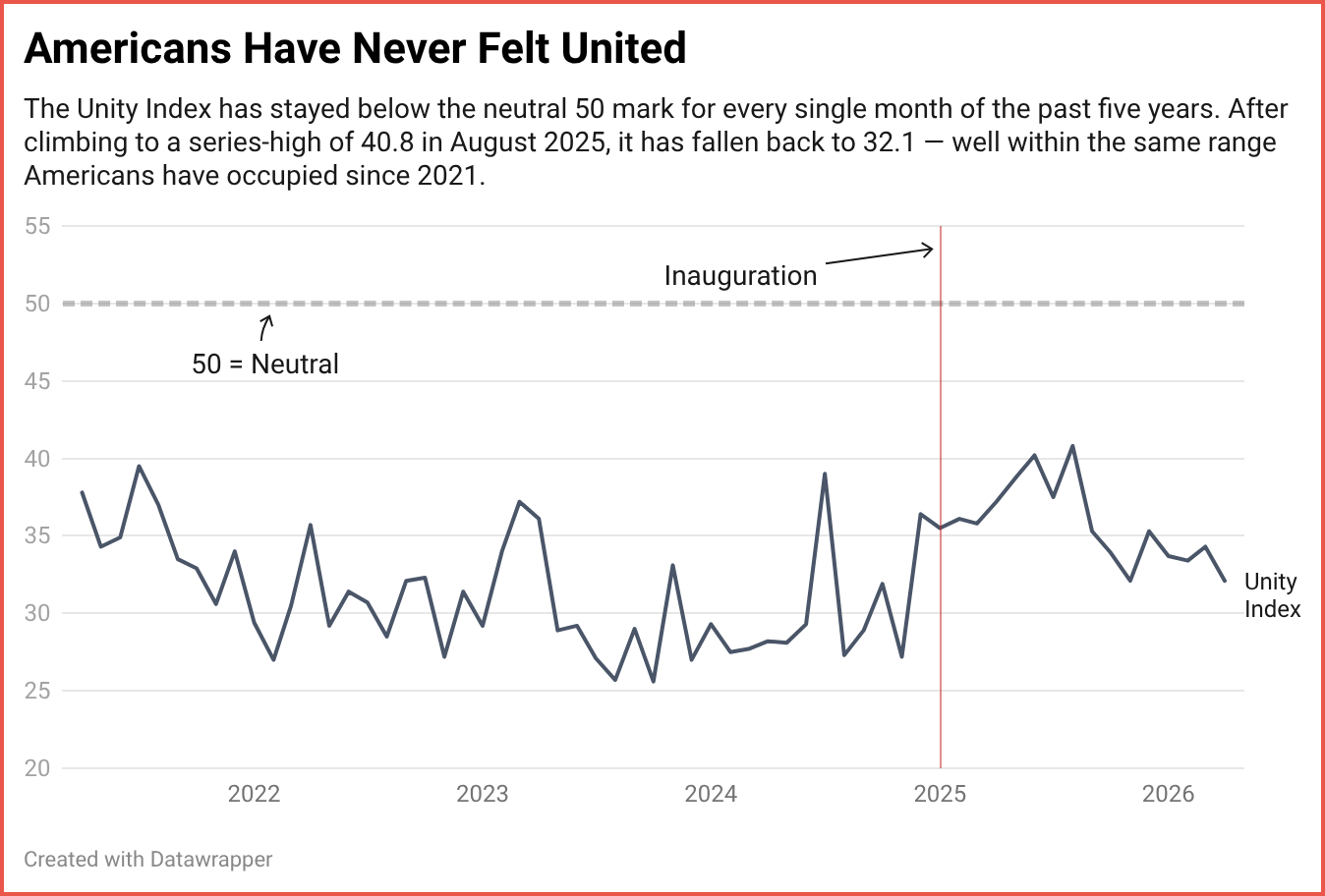
What is it saying? Well, for one, Americans over the past five years or so have never been unified, even though there have been times the Unity Index has trended up.
Indeed, the Unity Index has never breached the neutral 50 level in the past half-decade. In August of last year, not too long after Donald Trump took office, it briefly touched 40.8, its all-time high. But since then, it has dropped back to April’s current reading of 32.1.
While that might seem dramatic, it’s in fact in keeping with the long-trend range for the index, as the chart below shows.
“Americans have never felt united,” notes TIPP Poll founder and President Raghavan Mayur. “The post-election rally happened, then unwound.”
But does that mean everyone is equally glum? Not at all. It largely depends, it seems, on who is president.
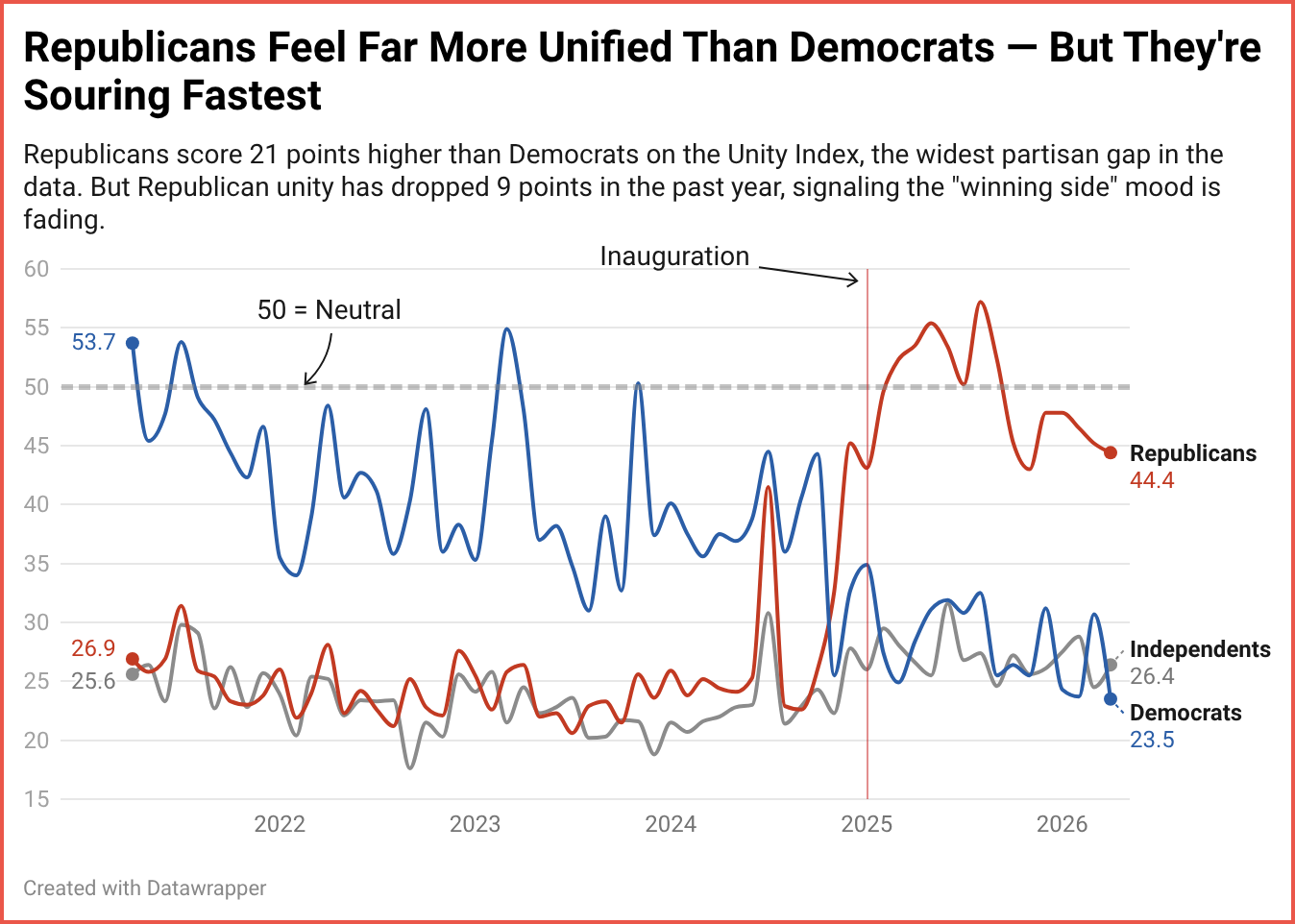
During the years of Joe Biden’s term in office, Democrats routinely expressed a far greater sense of unity than either Republicans or independents, the latter group uniformly showing the least amount of unified feeling during the index’s existence.
As the chart below plainly shows, Democrats and Republicans essentially swapped positions on unity as they swapped presidential parties.
During the Biden years, Democrats bounced between a reading of just over 30 to as high as 55; today, they’re at 23.5, and haven’t been above 35 during Trump’s second term.
Republicans reached a giddy high 57.2 in August of last year; today they’re at 44.4.
For independents, it’s very much a “un-unified” feel for the entire half-decade of unity readings.
They’ve been above 30 only twice, once in July 2024, following Biden’s disastrous June 27 debate with Trump, and again in June 2025, as fears of a U.S.-China trade war subsided. But today, indie and third-party voters are at 26.4, just barely higher than the Dems.
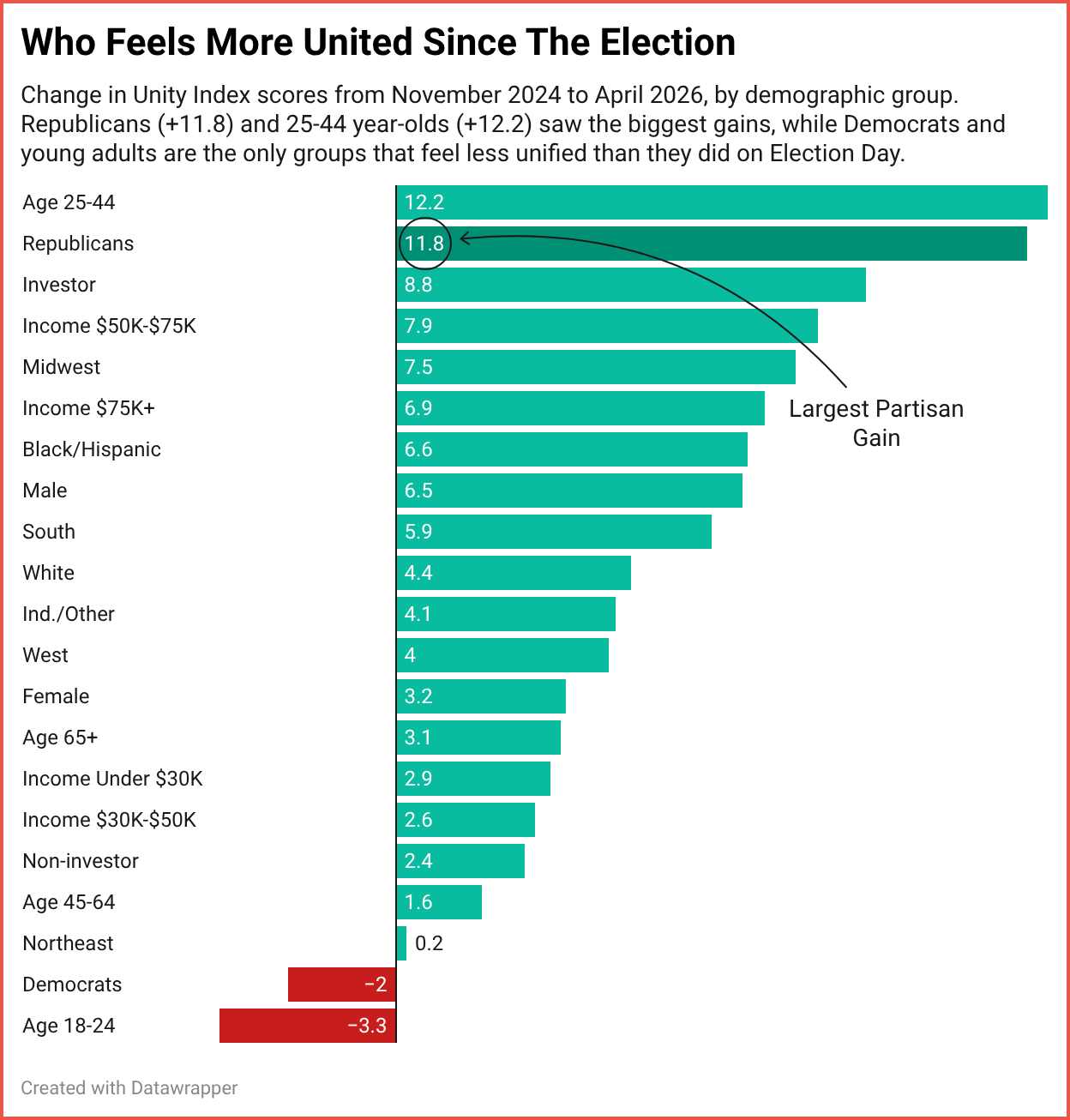
The important fact to note is that since the November 2024 election, there have been gains by many groups, even though overall the index remains stuck below 50.
As noted, since Trump’s election, there have been changes among many of the demographic groups regularly indexed by I&I/TIPP. All regions have reported gains, with the Midwest showing the largest (7.5 points). But the Northeast, with its blue state political tilt, showed a barely perceptible 0.2 point rise.
Meanwhile, that 12.2 point gain for 25-44 year-olds is significant, since they form the bulk of the active U.S. workforce and are thus a kind of bellwether for the overall economy.
Similarly, the 8.8 point gain for investors has significance, since recent Securities and Exchange Commission data show that 58.1% of all households own either stocks or bonds or both. Investors are feeling the unity post-Trump.
The two outliers among the demographic groups in the chart below: Democrats (-2 percentage points) and the smallish number of 18-24 year-olds (-3.2 percentage points). The latter group no doubt feels threatened by the artificial intelligence revolution and its possible negative impact on entry-level jobs for careers.
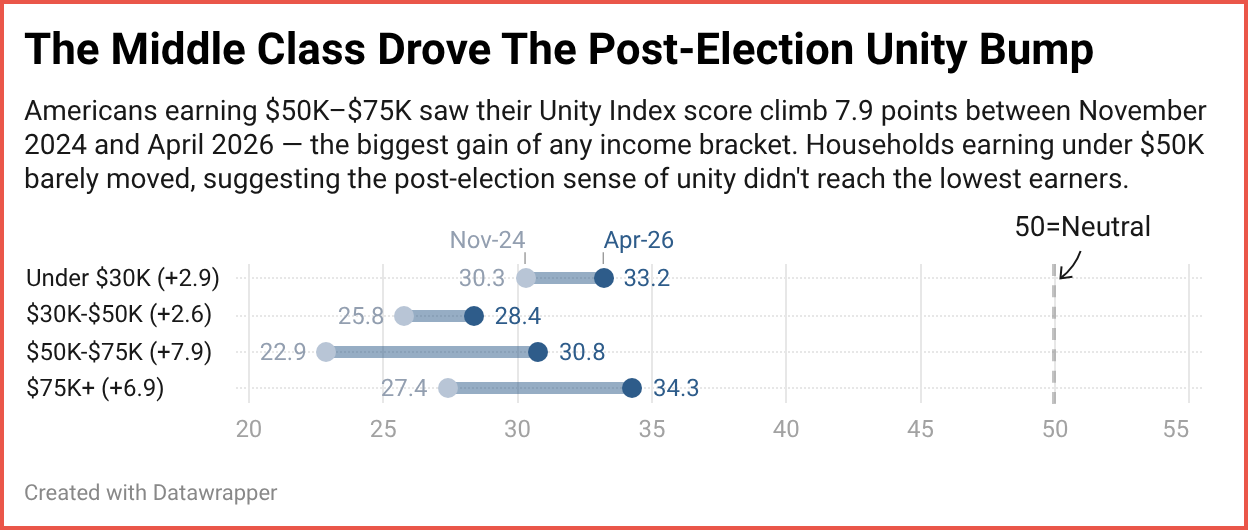
So why did the I&I/TIPP Unity Index move up right after Trump’s election? The middle class, which didn’t fare so well under Biden’s economic policy, as inflation eroded their standard of living.
“This record of inflation is accompanied by a record of a decline in real (or inflation-adjusted) wages,” a report from Texas A&M’s Private Enterprise Research Center noted. “From January 2021 through January 2025, the Biden administration saw a rise in wages of 19.9% and a rise in prices of 21.5%. Average hourly earnings adjusted for inflation actually declined by 1.3% during these four years.”
Not surprisingly, middle-class relief at the prospect of declining inflation and rising wage growth under Trump buoyed their Unity Index readings, along with other post-election polling data. Even so, despite gains — especially among those at the upper-end of the middle-income spectrum — the overall index for all four income levels averages just 31.7.
And those at the lowest end of the income spectrum saw the least gains in unity.
“Unity” is a slippery idea, hard to define. Even so, it is relevant, especially after the third attempt on Trump’s life on April 25 as he attended the annual White House Correspondents’ Dinner.
To recap, a would-be assassin brought a small but potent arsenal into his room at the Washington Hilton, the hotel where the dinner was to be held. He apparently planned to use his weapons not just to take out Trump, but as many Trump administration officials as he could.
Fortunately, he failed. But he couldn’t be written off as some loner, a sociopath; he was a politically far-left Los Angeles science teacher, unable to control his anti-Trump rage.
And he cold-bloodedly planned to kill Trump, even if it meant disenfranchising millions who voted in 2024 and irreparably damaging our tradition of peaceful transitions of presidential power and honest elections.
What does an assassination attempt have to do with unity? After the failed assassination, some Trump foes took to the internet to suggest that they would have been fine if the president had been killed. Given that level of ideological rage and political polarization, perhaps Americans shouldn’t at all be surprised that our feelings of national unity remain so weak, as the I&I/TIPP Poll clearly shows.
I&I/TIPP publishes timely, unique, and informative data each month on topics of public interest. TIPP’s reputation for polling excellence comes from being the most accurate pollster for the past six presidential elections.
Terry Jones is an editor of Issues & Insights. His four decades of journalism experience include serving as national issues editor, economics editor, and editorial page editor for Investor’s Business Daily.
The TIPP Off
What you should be reading right now
Iran War
Congress Has Days To Decide On The Iran Wary—Mark Pfeifle, TIPP Insights
Redefining Energy Security— Richard Haass, Carolyn Kissane, Project Syndicate
From Russia, Without Love— Editorial Board, TIPP Insights
Drink the Poison— Editorial Board, TIPP Insights
The Squeeze— Editorial Board, TIPP Insights
Economy
Squad Pushes $25 Minimum Wage In The Name Of ‘Racial Justice’—Pedro Rodriguez, The Daily Signal
Transparent Monetary Policy And Economic Stability—Frank Shostak, Mises Wire
Legal
Supreme Court Punts On Parental Rights Case Of School District Concealing Gender Transition— Fred Lucas, The Daily Signal
Monsanto V. Durnell Could Hand Pesticide Manufacturers Sweeping Liability Protections— Judy Lopez, The Daily Signal
Report: James Comey Indicted Again—Fred Lucas, The Daily Signal
Religious Broadcasters Urge FCC Probe Of ABC After Jimmy Kimmel Joke About Melania Trump— Fred Lucas, The Daily Signal
Governance/Politics
FBI Raids Minnesota Daycares In Fraud Investigation—Elizabeth Troutman Mitchell, The Daily Signal
$10.5 Million In Medicaid Given To Illegals In Mississippi, State Auditor Says— Pedro Rodriguez, The Daily Signal
RFK Jr. Must Cease Flow Of Tax Dollars To CAIR, Roy Says—Pedro Rodriguez, The Daily Signal
Trump Assassination Attempt Was Not Just A Security Failure. It Was A National Warning.— Mehek Cooke, The Daily Signal
INSIDE THE BALLROOM: Being At The White House Correspondents’ Dinner During An Assassination Attempt On Trump—Keith Koffler, The Daily Signal
Question After Correspondents’ Dinner Shooting: Is California An Incubator For Leftist Violence?—Angelina Delfin, The Daily Signal
Charlottesville: The Deceit Underlying the Hoax—Steve Cortes, TIPP Insights
The Potemkin Party — Editorial Board, Issues & Insights
Other
Hawley’s AI Chatbot Bill Expected To Pass Committee—Elizabeth Troutman Mitchell, The Daily Signal
Multiple Actions Being Taken To Combat Oil Theft In Texas—Bethany Blankley, The Daily Signal
Free Speech Is About Individual Liberty, Not Viewpoint Discrimination—Wanjiru Njoya, Mises Wire
When A Chicken Isn’t Just A Chicken— Patrick J. Lee, Mises Wire
The Problem With Eternal Vigilance— George Ford Smith, Mises Wire
‘Permanent, Irreversible Harm’: How Trump Is Protecting Parents From Losing Kids To Gender Ideology— Elizabeth Troutman Mitchell, The Daily Signal
‘Worst Of The Worst Of Government’: How Trump Admin Is Ending ‘Orphan Tax’ —Elizabeth Troutman Mitchell, The Daily Signal
Letters to the editor email: editor-tippinsights@technometrica.com
Subscribe Today And Make A Difference. Consider supporting Independent Journalism by upgrading to a paid subscription or making a donation. Your support helps tippinsights thrive as a reader-supported publication. Contact us to discuss your research or polling needs.
Reach our audience. For sponsorship and advertising opportunities, visit our Partner With Us page.