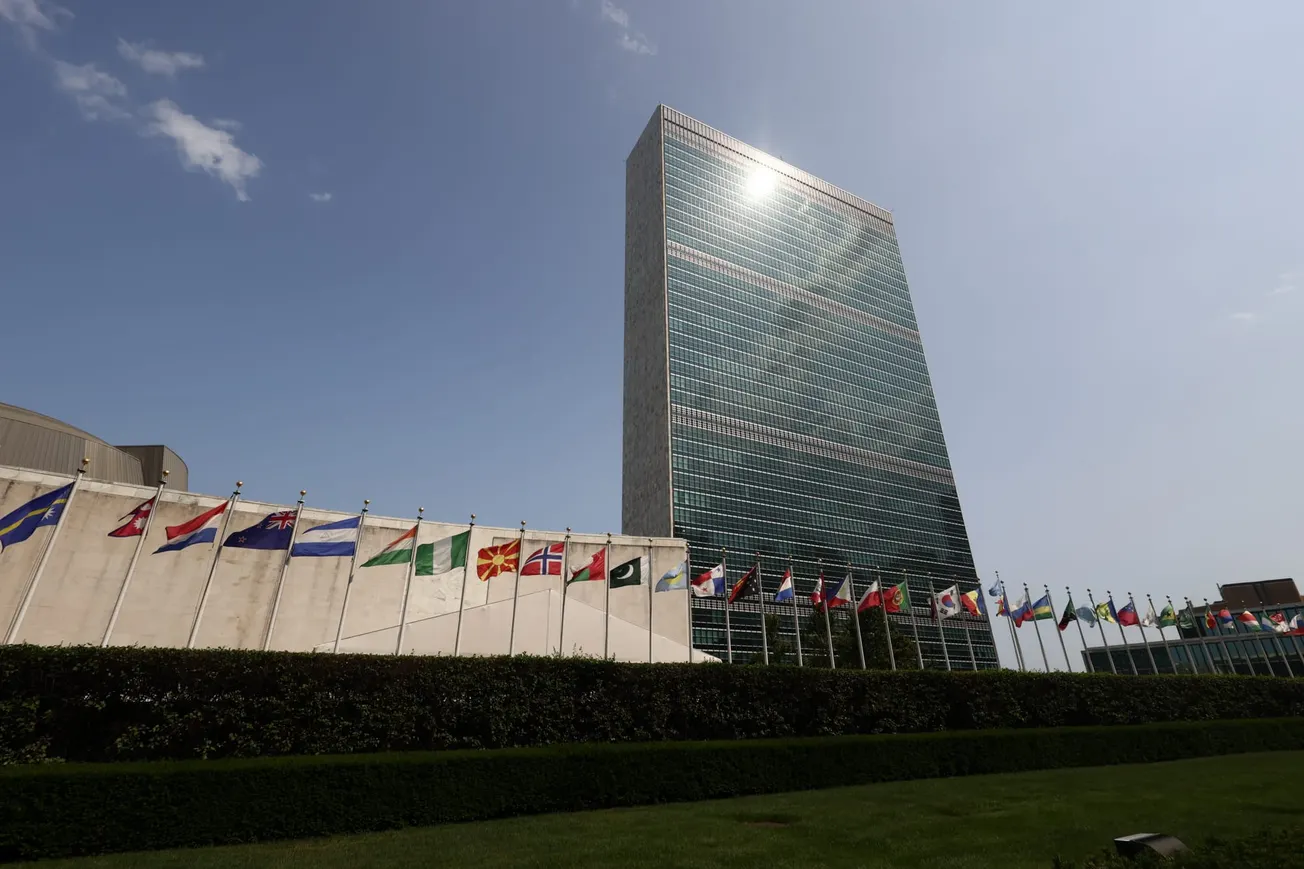
The United Nations, founded in 1945 in the aftermath of World War II, has come under harsh political criticism in recent years. But how do average Americans see the U.N.? Despite some misgivings about the U.N.'s mission and effectiveness, Americans still largely support it, according to the latest I&I/TIPP Poll.
With President Trump set to address the U.N.'s General Assembly this week, the latest national online I&I/TIPP Poll, taken from Aug. 25 through Aug. 28, asked 1,481 voters: "How relevant is the United Nations in addressing the major international challenges facing the world today?"
Overall, Americans view the U.N. as still relevant, even as harsh criticisms of its effectiveness and corruption have been leveled against the global organization in recent years. Overall, 58% called the U.N. either "very relevant" (26%) or "somewhat relevant" (32%), while just 26% said it was either "not very relevant" (16%) or "not at all relevant" (10%). A sizeable 16% said they were "not sure."
The poll has a margin of error of +/-2.9 percentage points.
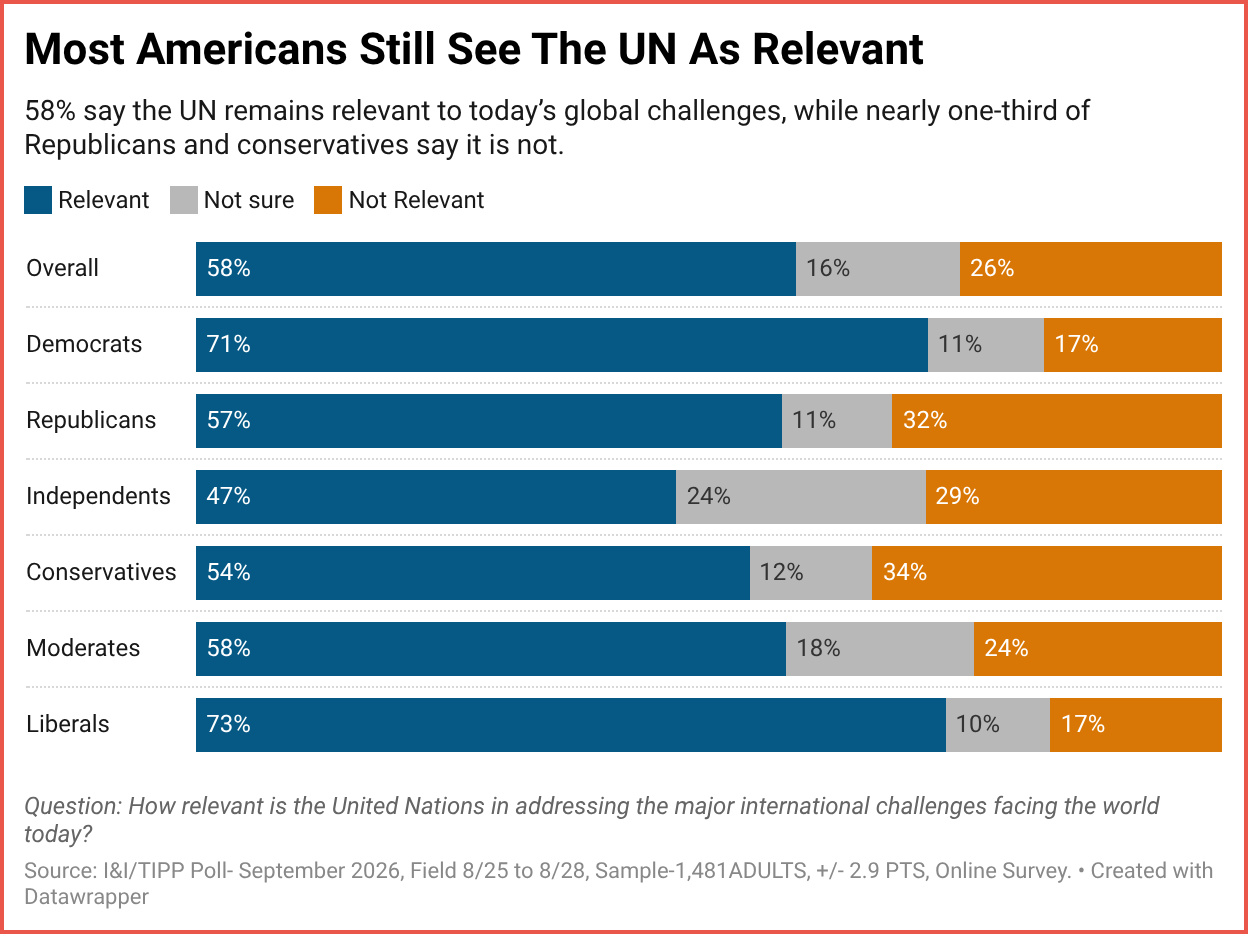
But as the breakdown shows, the political party affiliation of respondents made a big difference. Among Democrats, 71% saw the U.N. as relevant, a big majority. But among GOP voters, that drops to just 57%, still a majority. As for independent voters, they fall further to 47%, a plurality, with 29% calling the U.N. not relevant and 24% not sure.
Of the 36 demographic groups regularly tracked each month by I&I/TIPP, only two failed to show a majority in the "how relevant is the United Nations" question: Those over 65 years of age (48% "relevant") and independent voters (47% "relevant"). All other groups posted majorities.
So it's safe to say U.S. voters are mostly convinced that the U.N. remains relevant today.
That leads to I&I/TIPP's second question on the U.N., which asks about the global organization's "effectiveness" at preventing wars and handling conflict. On this, Americans are a little less likely to praise the U.N.
For this question, 44% say the U.N. has been either "very effective" (18%) or "somewhat effective" (26%) in preventing wars and resolving conflicts, while 39% say it is either "somewhat ineffective" (21%) or "very ineffective" (18%). Another 17% aren't sure.
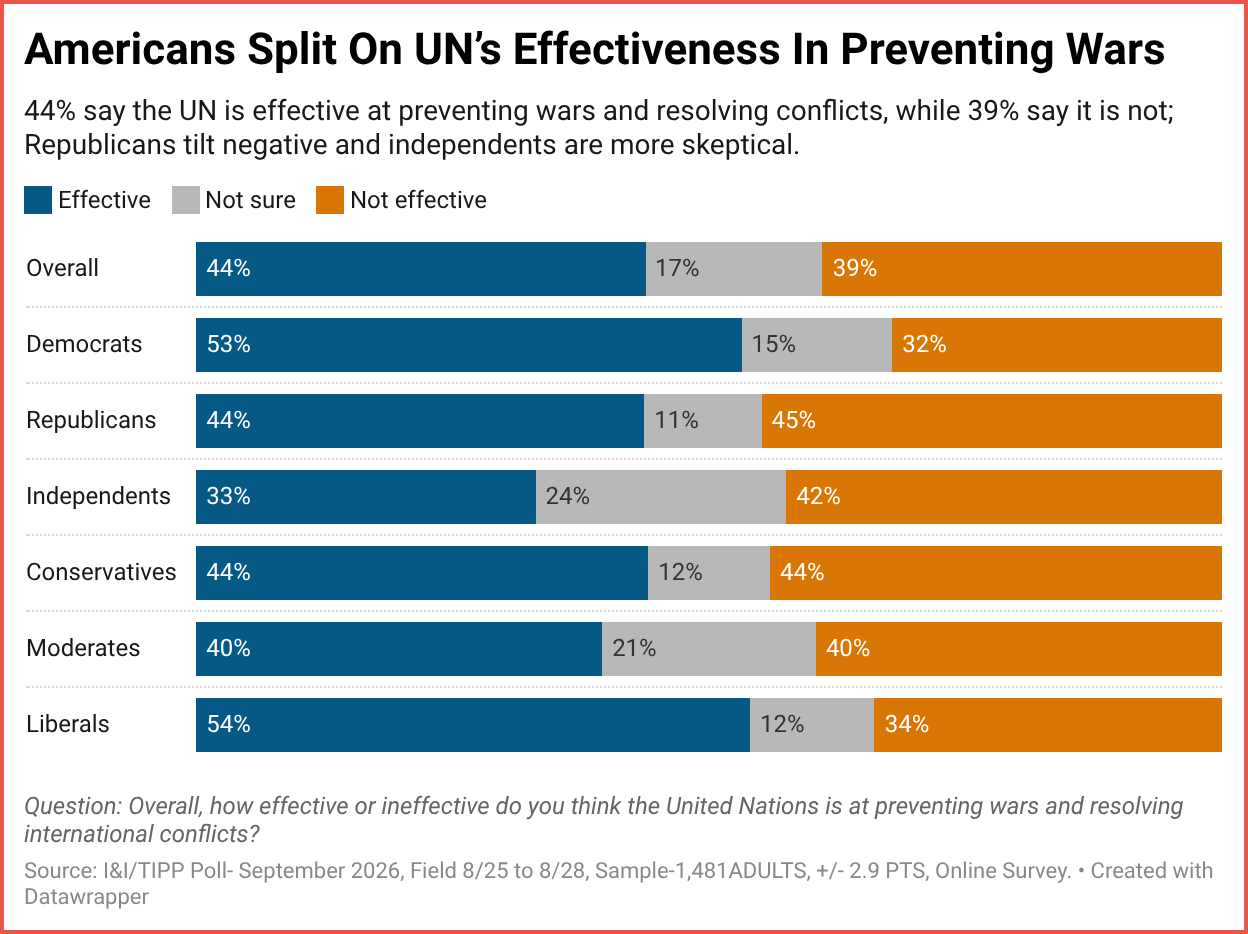
The data show that, once again, political party matters. Democrats (53% effective, 32% ineffective) were more likely to see the U.N. as effective in preventing wars and ending conflicts than either Republicans (44% effective, 45% ineffective) or independents (33% effective, 42% ineffective). Also, almost a quarter of indie voters said they weren't sure.
But there were interesting nonpolitical differences on this question, too.
Looking at the results by race, as an example, shows differences in how Americans perceive the U.N. Among white voters, for instance, those calling the U.N. effective (41%) were slightly below the share calling them ineffective (42%). Minority voters, meanwhile, were far more impressed than white voters: 52% effective, 30% ineffective.
Likewise, there's a gap between men and women. A slight majority of men (50% effective, 40% ineffective) were impressed with the U.N.'s efforts at stopping wars; that compares to women, who broke even on this question (38% effective, 38% ineffective).
But has the U.N. outlived its usefulness for the U.S.? Most Americans don't think so. I&I/TIPP asked: "Which comes closest to your view of the role the United States should play in the United Nations?"
Among all responses, as the chart below shows, 54% said they wanted the U.S. to keep its current level of involvement (29%) or become even more involved (25%). That compares with 27% who said they either wanted to reduce U.S. involvement (15%) or withdraw entirely from the organization (12%).
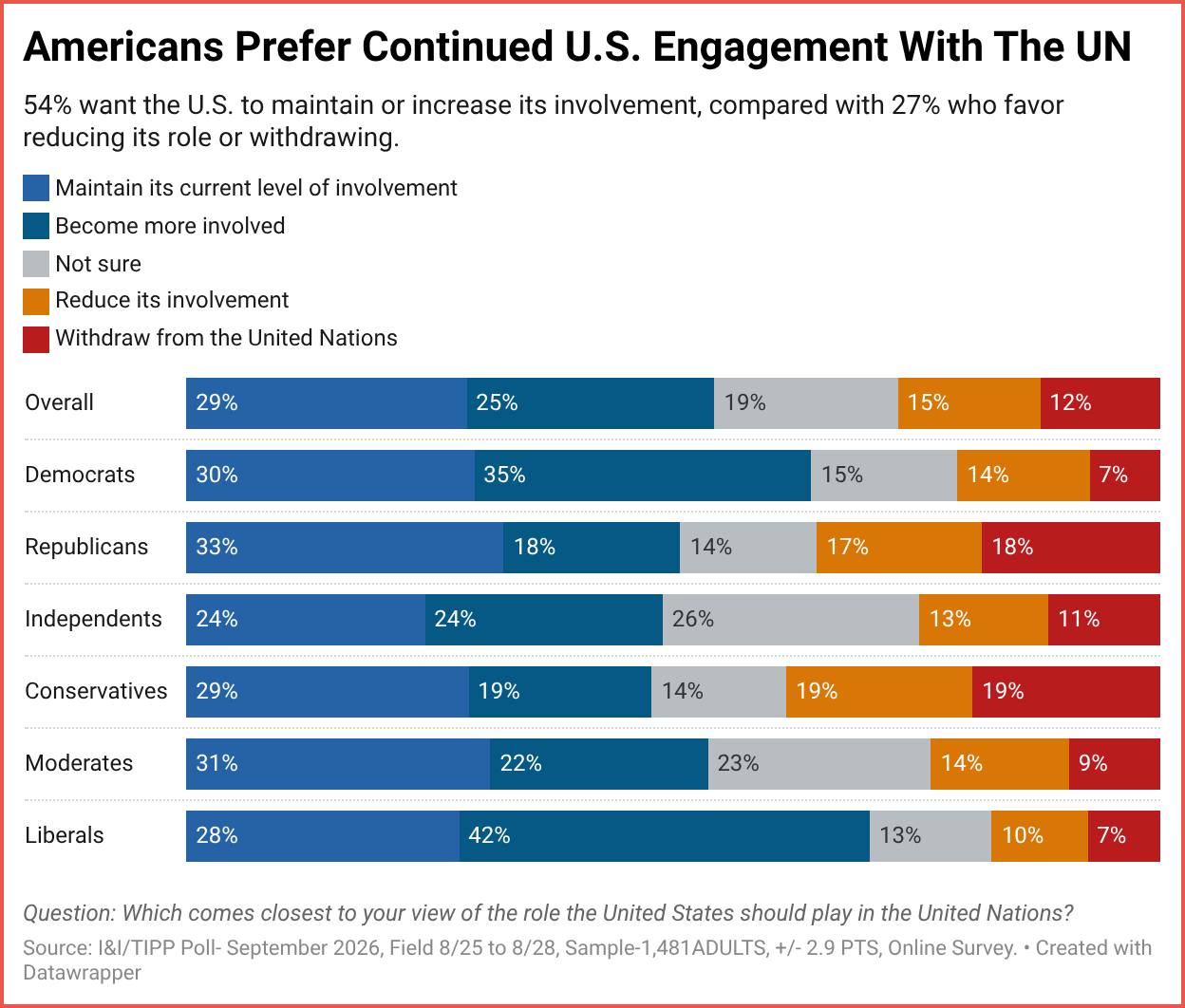
The chart above tells the tale: Democrats are far stronger in their support for the U.N. than either Republicans or independents.
This probably comes as no surprise to any observer of American politics. The Republican Party has had a rocky relationship with global organizations, and, in recent years, that has particularly meant the U.N. Same with independent voters.
This shows in Democrats' responses (65% would maintain or expand U.S. involvement in U.N.) when compared to both Republicans (51% would maintain or expand U.S. involvement in U.N.) and independents (48% would maintain or expand U.S. involvement in U.N.).
Even so, in the I&I/TIPP Poll for September Americans show broad support for the U.N., despite what some perceive as its anti-Americanism, corruption and political extremism.
Americans are not alone, however, in having issues with the U.N. A recent poll of 37 countries by the Pew Research Center, for instance, found that a median 55% of those polled had a "favorable opinion" of the U.N., while a median of 37% voiced an "unfavorable opinion."
Yet, that same multi-country poll also found that poll readings had "become more negative" in recent years, as a series of scandals and chronic financial mismanagement have roiled the global group. Reports of repeated sexual abuse by U.N. peacekeepers, in particular, have rankled many once-strong supporters.
"Corruption seems to be a real problem throughout the United Nations," noted the International Policy Digest in a 2019 report. "Cover-ups are being reported at all levels from an institution which seems hell-bent on not making itself accountable."
A recent Reddit timeline of U.N. scandals shows an alarming propensity for negligence and criminal behavior by U.N. agencies. Add to this, the U.N. is currently suffering a fiscal crisis that threatens the organization with "imminent financial collapse," and seeks billions of dollars in added contributions to erase the red ink.
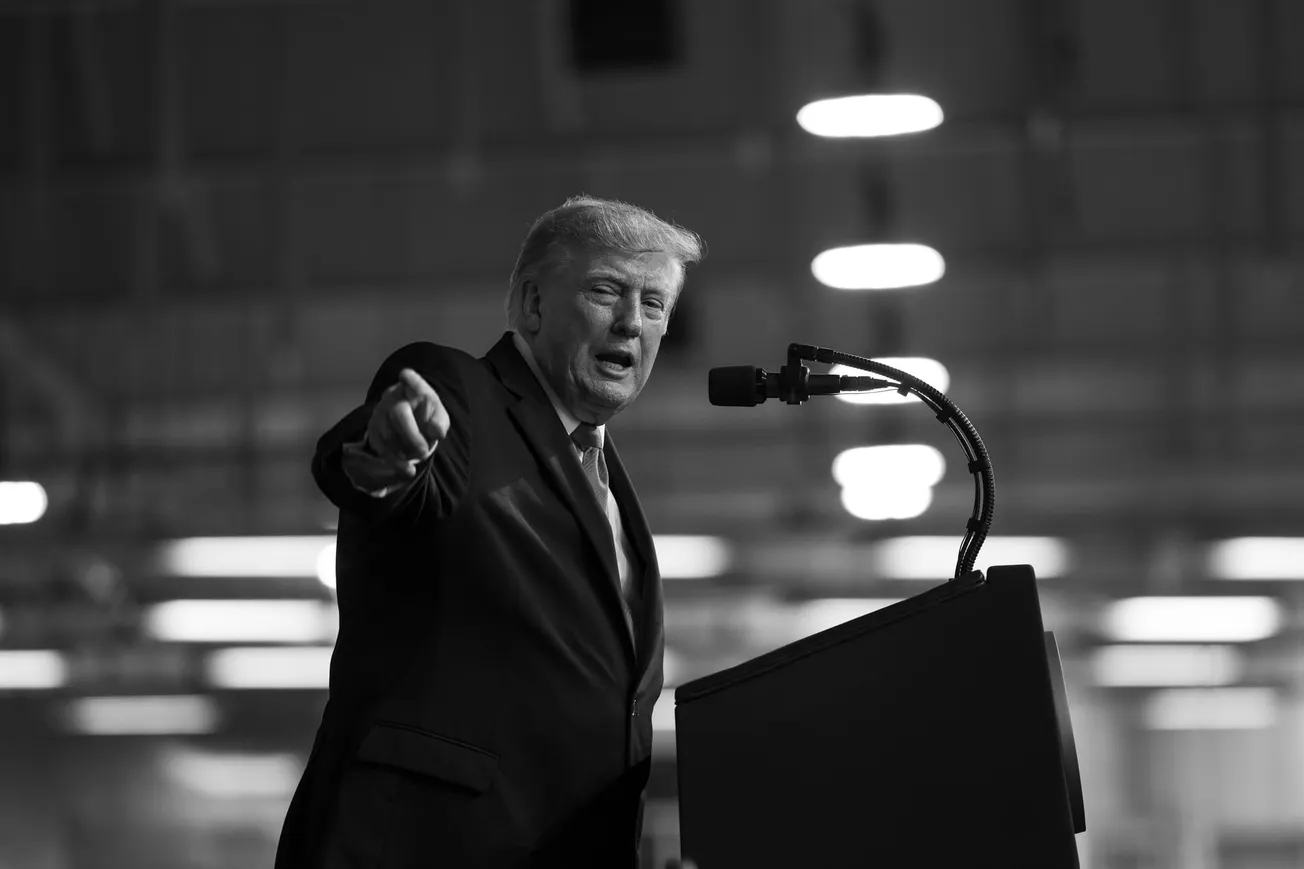
Amid all this, President Trump has had a rocky relationship with the U.N. in recent years. Even so, he is slated to appear before the U.N. General Assembly on Tuesday, Sept. 22, where, according to Reuters, he "will face a deeply skeptical audience increasingly rattled by six months of war between US forces and an emboldened Iran, growing regional instability and a nuclear threat that has not disappeared despite his claims."
Maybe so. But with the U.N. facing long-term issues over its fiscal viability, and its ongoing failures to end conflicts around the world, even former friends have trouble defending it.
"There have been bribery allegations over UN peacekeeping contracts in Africa, fraud in procurements, and sex abuse allegations against UN peacekeepers in the Central African Republic," writes Rahul Goswami, a long-time consultant with the U.N. "For all these, the UN’s internal oversight mechanisms were deemed to have competence and independence enough to adjudge."
And of course, they weren't.
Still, Americans have a special fondness for the U.N., despite its many failings, as the I&I/TIPP Poll shows. After all, the U.S. was responsible for the U.N.'s creation in a burst of post-war idealism, and has been its main funding source ever since. But if the U.N. doesn't reform itself and clean up its act, it might find that even idealistic, largely pro-U.N. Americans will lose their patience.
I&I/TIPP publishes timely, unique, and informative data each month on topics of public interest. TIPP’s reputation for polling excellence comes from being the most accurate pollster for the past six presidential elections.
Terry Jones is an editor of Issues & Insights. His four decades of journalism experience include serving as national issues editor, economics editor, and editorial page editor for Investor’s Business Daily.
Loved it, hated it, or somewhere in between — tell us. Grade this article here and help shape what lands in your inbox next.
📊 Market Mood · September 21, 2026
How the trading day is setting up.
🟩 Markets are starting the week on firmer footing. U.S. futures are higher, led by technology shares, as continued AI demand supports chipmakers and easing oil prices improve risk sentiment.
🟦 Oil is providing some welcome relief. Brent is down about 2% as Saudi exports recover and reports suggest more crude is moving out of the Gulf, although shipping through the Strait of Hormuz remains disrupted and difficult to measure.
🟧 Treasury yields are easing but remain historically high. The 10-year yield has slipped below 5% as lower oil prices reduce some inflation anxiety, following last week's Fed rate hike.
🟨 U.S.-China diplomacy moves into focus this week. President Trump is due to meet Chinese President Xi Jinping on Thursday, while investors will also watch a heavy slate of Fed speakers for clues about whether another rate increase is likely this year
🗓️ Key Economic Events
On today's U.S. data calendar.
No major U.S. economic reports are scheduled today.
Letters to the editor email: editor-tippinsights@technometrica.com
Subscribe Today And Make A Difference. Consider supporting Independent Journalism by upgrading to a paid subscription or making a donation. Your support helps tippinsights thrive as a reader-supported publication. Contact us to discuss your research or polling needs.
Reach our audience. For sponsorship and advertising opportunities, visit our Partner With Us page.