
By Desmond Lachman, Project Syndicate | Sep 30, 2026
At a time when the cost of servicing sovereign debt is rising globally, France stands out as an especially fragile case. Its public debt-to-GDP ratio is edging up toward that of Greece on the eve of its sovereign-debt crisis, and the French political system seems unable to do anything about it.
WASHINGTON, DC—In 2010, a Greek sovereign-debt crisis roiled world financial markets. Now, France threatens to do the same, but on a larger scale. Not only is its public debt-to-GDP ratio edging up toward that of Greece on the eve of its crisis, but the French political system seems unwilling or unable to address the country’s gaping fiscal deficit.
There is every reason to fear that a French sovereign-debt crisis would have global spillover effects. France is the European Union’s second-largest economy, with a debt many times the size of Greece’s circa 2010. Moreover, France’s debt problems are mounting at a time when bond yields in the United States, Japan, and the United Kingdom have all surged to multi-decade highs.
Not only has France’s public debt ballooned from a little over 80% of GDP in 2010 to 119% today, but budget deficits reaching 5% of GDP continue to add to the problem. Worse, remaining on this unsustainable trajectory has become even costlier now that the French ten-year government bond yield has shot up to 4.81%. With a sclerotic economy that is being buffeted by an energy-price shock and higher interest rates—and which is officially projected to grow by less than 1% next year—France cannot hope to grow its way out of its debt problem.
To date, France has shown little political will to consolidate its budget and cut public spending, which now amounts to a staggering 58% of GDP. Over the past five years, French President Emmanuel Macron’s administration has churned through six prime ministers, not one of whom has managed to reduce the budget deficit in any meaningful way. Deficit-reduction targets have repeatedly been softened, planned spending cuts and pension reforms have been diluted, and promised savings have fallen short of what was initially announced. So polarized is the National Assembly that reaching a consensus on how to achieve debt sustainability remains out of reach.
With a presidential election coming next April, little can be expected in terms of budget consolidation. All the candidates have an incentive to make lofty campaign promises, not to confront the electorate with painful economic-policy choices. Moreover, it is far from clear that any successor to Macron would be able to push through the economic reforms that the situation demands. For that to happen, the next president would need to win a working majority in the National Assembly, elections for which could take place several weeks after the presidential vote.
Even if France had the political will to address its public debt problem, doing so within the euro straitjacket would not be easy. France can neither pursue a currency depreciation nor cut interest rates to offset the contractionary effect of belt-tightening. Putting its fiscal house in order therefore comes with a high chance of recession (especially given the economy’s current weakness); and a recession, in turn, would limit the potential gains from belt-tightening, by requiring increased social spending alongside reduced government revenue.
Markets seem to have taken note of France’s unsustainable public finances and political dysfunction. The spread between French and German long-term interest rates has increased to 119 basis points, its highest level since the 2010 sovereign-debt crisis. The risk now is of a doom loop, where the French government’s rising debt and higher borrowing costs exacerbate each other.
The good news is that the European Central Bank is better equipped than it was in 2010 to support a eurozone member state that is coming under market pressure. Its Transmission Protection Instrument, for example, allows it to buy unlimited quantities of a member’s government bonds in the secondary market, provided that the country has a credible economic-adjustment program in place.
But France would be making a big mistake if it came to rely too much on an ECB safety net. Given the rise of Germany’s right-wing, nationalist Alternative für Deutschland party, there would probably be little to no German public support for another ECB-orchestrated bailout of a fiscally irresponsible neighbor.
Even if France’s mounting debt does not lead to the breakup of the euro, a new crisis for the common currency and tensions between the EU’s two largest economies is the last thing that the world economy and financial markets need right now.
Desmond Lachman, a senior fellow at the American Enterprise Institute, is a former deputy director of the International Monetary Fund’s Policy Development and Review Department and a former chief emerging-market economic strategist at Salomon Smith Barney.
Loved it, hated it, or somewhere in between — tell us. Grade this article here and help shape what lands in your inbox next.
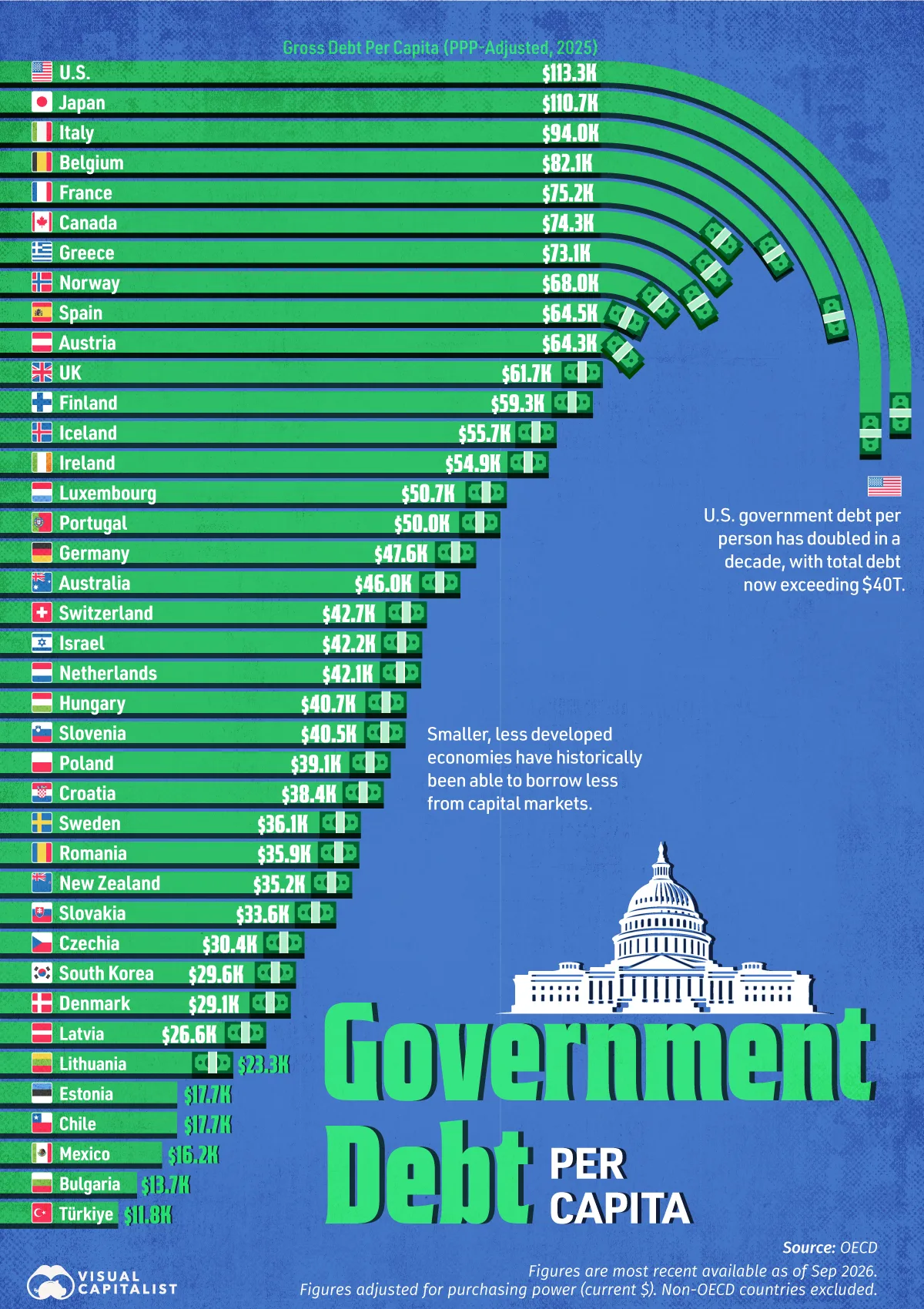
France Now Owes More Per Person Than Greece
France's government debt works out to $75,200 per person, above Greece's $73,100 and well ahead of Germany's $47,600, according to OECD data for 2025 adjusted for purchasing power. The U.S. tops the list at $113,300 per person, with Japan close behind at $110,700.
🧭 Power & Capital · October 1, 2026
Where state power meets the boardroom.
🔷 Federal Trade Commission Expands Probe Into AI Safety Concerns – Power & Capital Desk, TIPP Insights
🌍 Global Affairs
The world's flashpoints, in motion.
🟥 Russia Warns NATO Of Nuclear Response Over Kaliningrad – TIPP News
🟥 Netanyahu Vows To Investigate Motive Behind Foiled Flydubai Crash Attempt – TIPP News
🟥 Trump: Invading Cuba Will Be A ‘Great Honor’ – Kurt Nimmo, Ron Paul Institute for Peace and Prosperity
🏛️ National Affairs
The fights shaping America right now.
🟫 The Coming GOP Bloodbath? – Ron Paul, Ron Paul Institute for Peace and Prosperity
🟫 Alito Steps Aside In Supreme Court Climate Showdown After Left-Wing Groups Question His Energy Investments – Fred Lucas, The Daily Signal
🟫 Shocking Senate Report Details Billions In Health Care Fraud Lost To Russian Fraudsters, Medicare Scammers, Other Schemers – Fred Lucas, The Daily Signal
🟫 Trump Administration Begins Sending $500 ACA Refund Checks To 1 Million Americans – TIPP News
🟫 Senate Data Center Bill Falls Short Ahead Of Midterm Recess – TIPP News
🟫 Vance Says He And Trump ‘Aggressively Thought Through’ How To Pass SAVE America – Elizabeth Troutman Mitchell, The Daily Signal
🟫 Trans Organization’s ‘Unreliable’ Standards Don’t Justify Prison Medical Interventions, DOJ Tells Supreme Court – Tyler O’Neil, The Daily Signal
🟫 Parents Who Treat Boys As Boys And Girls As Girls Are Not Abusers, New Bill Declares – Tyler O’Neil, The Daily Signal
🟫 GOP Takes Aim At Sherrod Brown’s Radical Record On Transing Minors – Rebecca Downs, The Daily Signal
🟫 NY Rep Exposes Opponent For Living In Virginia And Doing ‘No-Show Jobs’ – Pedro Rodriguez, The Daily Signal
🟫 U.S. Reviews Border Project Through Texas’ Big Bend National Park – TIPP News
🟫 How Conflicting Interpretations Of Dred Scott Undermine State Sovereignty – Wanjiru Njoya, Mises Wire
🟫 The 1787 Constitution As Counterrevolution: America’s Thermidorean Reaction – Ryan McMaken, Mises Wire
🟫 Eisenhower And Washington Both Spoke Out Against War – Rep. John J. Duncan Jr., Ron Paul Institute for Peace and Prosperity
🟫 White House AI Agreement Draws Attention Over Spelling Error – TIPP News
🟫 What Is Diddy’s Life Like In Federal Prison? Report Details Perks And Routine – TIPP News
📈 Economy
Prices, policy, and the pressure on your wallet.
🟩 Reality Slaps College Graduates In The Face – Editorial Board, Issues & Insights
🟩 The Fed Chairman Has Raised Interest Rates, But Will It Slow Inflation? – Frank Shostak, Mises Wire
🟩 Beware Of George Soros Types In Government Finance – Mark Thornton, Mises Wire
🟩 The False Promises Of Democratic Socialism – Ruel Domi, Mises Wire
📊 Market Mood · October 1, 2026
How the trading day is setting up.
🟥 The bond selloff has intensified. The 10-year Treasury yield surged as high as 5.34%, its highest since 2002, as the fourth quarter begins with investors still uneasy about inflation, government borrowing and the path of interest rates.
🟩 Inflation offered some relief, but bonds barely responded. August PCE inflation came in softer than economists expected, reducing expectations for another Fed hike in October, yet long-term yields continued to climb.
🟦 AI demand remains a bright spot. Micron delivered strong results and said customer commitments under long-term AI memory-chip supply agreements have risen to $32 billion, reinforcing the strength of AI infrastructure spending.
🟨 Middle East uncertainty remains an inflation risk. U.S.-Iran ceasefire efforts remain unsettled, although the restart of Saudi Arabia's East-West Pipeline and tanker loadings from Yanbu are improving regional oil flows.
🗓️ Key Economic Events
On today's U.S. data calendar.
🟧 8:30 a.m. ET — Initial Jobless Claims
Forecast: 205K | Previous: 197K
Claims are expected to remain low, providing another check on labor-market conditions ahead of Friday's employment report. TradingCharts
🟧 10:00 a.m. ET — ISM Manufacturing PMI (September)
Forecast: 54.0 | Previous: 54.6
This is today's most important economic release, with markets watching both factory activity and the prices-paid component for signs of continuing inflation pressure.
Letters to the editor email: editor-tippinsights@technometrica.com
Subscribe Today And Make A Difference. Consider supporting Independent Journalism by upgrading to a paid subscription or making a donation. Your support helps tippinsights thrive as a reader-supported publication. Contact us to discuss your research or polling needs.
Reach our audience. For sponsorship and advertising opportunities, visit our Partner With Us page.