

By Daron Acemoglu, Project Syndicate | Jul 6, 2026
Genetic-engineering tools with which to design one's progeny already exist, and they are being made even more potent with AI—at least for those who can afford such services. In the absence of policy interventions, we will be hurtling toward a tiered society in which economic privileges become biological advantages.
BOSTON—Designer babies who are genetically engineered for desirable health, physical, and intellectual features are now within reach using existing technologies, a prospect that raises far-reaching societal and ethical questions not unlike those associated with advances in AI. One difference, though, is that the institutions needed to open an ethical path for gene editing—by treating the technology as a public-health measure that should be available to everyone—may be easier to conceive than in the case of AI.
The big breakthrough for gene editing is no longer so recent. The outlook changed fundamentally back in the 2000s, and especially the early 2010s, with the development of CRISPR-Cas9 technology, which enables high-precision genetic engineering. The technique uses a guide RNA to locate a specific sequence in the genome of a living organism, where the Cas9 enzyme makes a cut for disabling or editing a gene.
The applications are vast. The technique can be used to turn off a disease-inducing gene, modify seeds and agricultural products, or design custom-made medicines and vaccines. It holds the potential to tackle inherited genetic diseases such as sickle cell anemia, as well as later-in-life, disease-inducing somatic mutations like those involved in cancer. It also raises the possibility of adding or removing genes at the embryonic stage, in vivo or in vitro, which is where the issue of designer babies comes in. Human genetic engineering could be purely somatic (affecting individuals during their lifetimes) or it could take the form of germline editing, altering the genome in ways that would be passed on to offspring.
AI itself is technologically complementary to gene editing, because it can sift through massive amounts of data to find gene combinations capable of changing not just disease potential, but looks, physical strength, and various dimensions of cognitive ability. But this potential raises obvious ethical issues. As in Aldous Huxley’s Brave New World, designer babies could bring us closer to a genetically tiered society, where only the wealthy have the means to improve their and their progeny’s cognitive and physical performance and lifespans. In this scenario, those with the money today could grow even richer and more genetically superior with each generation.
This scenario is not merely hypothetical. Embryo-selection services based on polygenic screening are already sold commercially to IVF patients, and advances in AI have made them even more enticing to those who can afford them. If current trends continue, we could end up with a cadre of billionaires and trillionaires who are intent on cementing their economic privileges with biological ones; worse, this could happen just as many other people are facing the prospect of AI-driven job displacement.
To prevent such a future, most people’s first instinct is to ban germline editing and designer babies altogether. But this may not be the right response. After all, we already “design” our bodies and our children by means of vaccines and operations. Parents-to-be in the industrialized world (and increasingly in emerging economies) test for a variety of diseases, such as Down Syndrome, and can opt to terminate the pregnancy. The line between these interventions and genome editing is not hard and fast. Would editing genes to build natural immunity against smallpox be so different than injecting children with a vaccine?
The issue isn’t so much about “interfering with nature” as it is about two other considerations. First, the implications of germline editing are poorly understood. Living organisms are constantly attacked by pathogens, and some genetic changes, especially those passed from parents to offspring, can create unforeseen vulnerabilities.
For example, the Chinese scientist He Jiankui created the first designer babies by editing the CCR5 gene to confer HIV resistance. But the same edit appears to increase susceptibility to other infections, such as West Nile virus and influenza. We know what smallpox vaccines do, both because of their simplicity and because we have more than two centuries of experience. But the same cannot be said of the far more complex and intrusive process of genome editing.
Second, vaccines are a public-health intervention, whereas genome editing, at least in the foreseeable future, will be available only to the privileged, who will propagate their advantages in ways that we have not yet imagined.
These two issues point to a clear set of guidelines for how we should approach germline editing. First, we must make certain that unforeseen consequences are limited in number and scope. This requires not just research by individual scientists and labs, but also public infrastructure to provide a rigorous testing and permission process that is even more stringent than what the US Food and Drug Administration (FDA) requires for drugs and vaccines.
Second, we must legislate and enforce the norm that germline editing should be treated solely as a public-health measure. No germline editing services should be purchasable in the private market, and any well-tested, fully understood genome-engineering intervention that does prove beneficial should be made available to all.
Implementing such guidelines isn’t pie in the sky. We already have highly respected institutions with the relevant expertise, and norms within the scientific community are aligned with these bodies. The US National Academies of Sciences, Engineering, and Medicine and the FDA have both already published widely circulated reports and guidelines for research and practice in this area. Moreover, the 2015 International Summit on Human Gene Editing—which was convened by the US, British, and Chinese academies—adopted a hard line against germline engineering, especially the alteration of gametes and embryos that would generate heritable advantages for the privileged few. Subsequent summits in Hong Kong (2018), where the He case broke, and London (2023) then reaffirmed and refined that stance.
The fact that such bodies exist and have taken a proactive stand helps to explain why I see the challenge posed by designer babies as being somewhat more manageable than those associated with AI. The tragedy with AI is that we are on the cusp of similarly transformative developments, but with no equivalent bodies. Recently established AI safety institutes and European Union bodies lack the authority to influence the industry, and many individual scientists and labs remain oblivious to the societal effects that they may unleash.
We urgently need to build an ethical consensus on AI, not least because doing so could help us deal with the various symbiotic challenges that genetic engineering brings. Failing that, we will have traded future generations’ inheritance for a mess of pottage.
Daron Acemoglu, a 2024 Nobel laureate in economics and Institute Professor of Economics at MIT, is a co-author (with James A. Robinson) of Why Nations Fail: The Origins of Power, Prosperity and Poverty (Profile, 2019) and a co-author (with Simon Johnson) of Power and Progress: Our Thousand-Year Struggle Over Technology and Prosperity (PublicAffairs, 2023).
Loved it, hated it, or somewhere in between — tell us. Grade this article here and help shape what lands in your inbox next.
Copyright Project Syndicate
Ukraine Escalates Attacks On Russian Energy Infrastructure
Ukraine is striking Russian energy infrastructure at an unprecedented rate, exacerbating Russia's growing fuel crisis, according to Financial Times data analysis.

Data analyzed by the FT shows Ukrainian forces carried out a record 16 successful strikes on Russian refineries in June, the highest monthly total since the start of the war. The figures are based on data from Rochan Consulting, a Polish research group that tracks the conflict.
Analysts say Ukraine's growing success is driven by higher drone production, better coordination and U.S. intelligence support, allowing its forces to carry out more effective long-range attacks.
The increase in strikes comes as Ukrainian President Volodymyr Zelensky has signaled a renewed military push this summer aimed at increasing pressure on Moscow.
At the same time, both Ukraine and Russia have launched record numbers of drones and missiles this year, highlighting the growing importance of long-range attacks in the war.
France’s Far-Right Leader Marine Le Pen Awaits Court Verdict
French far-right leader Marine Le Pen awaits a crucial appeal ruling in Paris on Tuesday that will determine whether she can run in the 2027 presidential election.
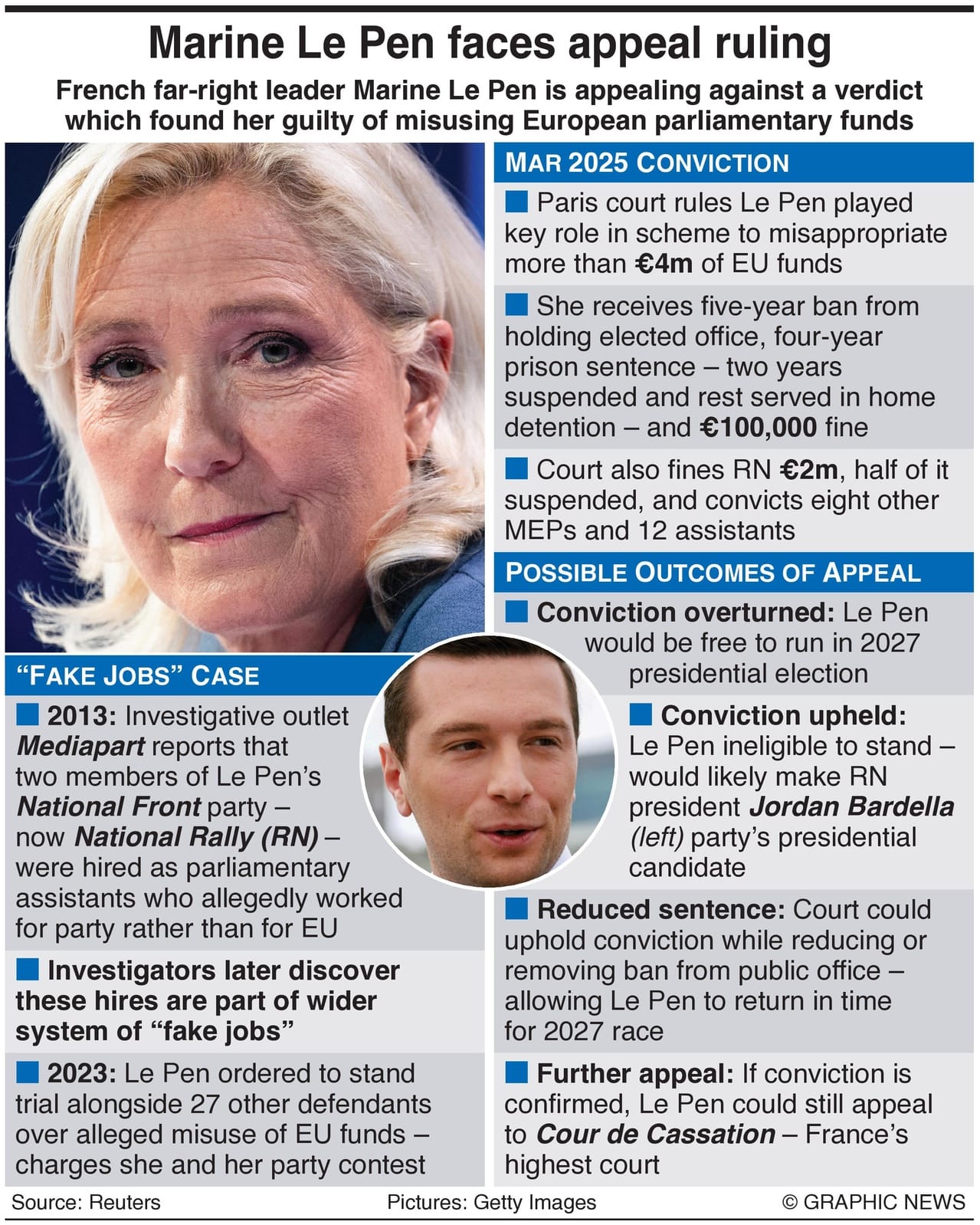
Le Pen is appealing a conviction for misusing European Parliament funds that resulted in a five-year ban from holding public office. The ruling could either revive her presidential ambitions or effectively end them, opening the door for National Rally president Jordan Bardella to become the party’s candidate.
The case centres on allegations that Le Pen and her party improperly used European Parliament funds intended to pay parliamentary assistants.
Le Pen, the 57-year-old leader of National Rally, has already run for president three times and came second to Emmanuel Macron in 2022 and 2017.
Letters to the editor email: editor-tippinsights@technometrica.com
Subscribe Today And Make A Difference. Consider supporting Independent Journalism by upgrading to a paid subscription or making a donation. Your support helps tippinsights thrive as a reader-supported publication. Contact us to discuss your research or polling needs.
Reach our audience. For sponsorship and advertising opportunities, visit our Partner With Us page.