

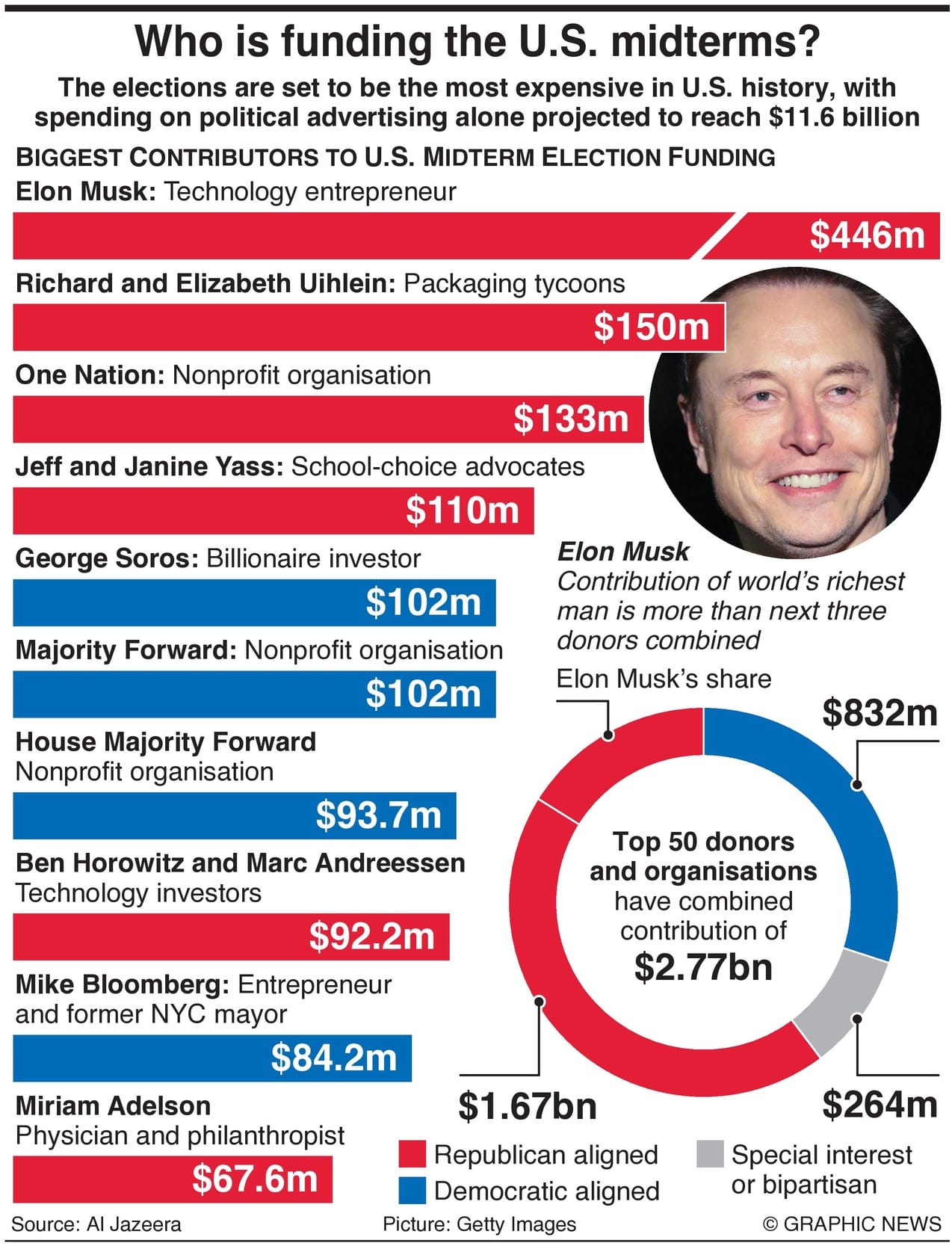
The 2026 U.S. midterms are on track to be the most expensive in the country’s history, with spending on political advertising alone projected to reach $11.6 billion./p>
Much of that money comes from wealthy donors, political nonprofits and businesses seeking to shape Washington’s priorities, and some of it passes through networks of organizations before it is spent.
The 50 largest donors and organizations have so far contributed a combined $2.77bn during the 2026 midterm election cycle.
Republican-aligned contributors accounted for $1.67bn, or about 60% of donations, double the $832m from Democratic-aligned contributors.
The remaining $264m came from contributors classified as bipartisan or special interest, including groups backing sports betting and cryptocurrency.
Elon Musk, the world’s richest man and head of Tesla and SpaceX, is the largest individual contributor of the cycle, with $446m, according to Federal Election Commission data.
No Clear Winner Emerges In Israel’s Election
Benjamin Netanyahu’s right-wing coalition holds a lead over a bloc of Jewish opposition parties centered on former general Gadi Eisenkot, but neither side has a parliamentary majority, partial results show.

With roughly 86 percent of ballots tallied by 14.32 local time (12:32GMT), Netanyahu’s alliance of Likud, two ultranationalist parties and two ultra-Orthodox parties was projected at 53 seats, seven short of the 61 needed in the 120-seat Knesset.
The Jewish opposition parties were projected at 48 seats, while Israel’s two Arab parties were heading for 19, helped by a surge in Arab turnout.
Many Israelis regard the vote, the first since Hamas’s attack of 7 October 2023, as the most consequential in the country’s history.
The outcome points to weeks of coalition haggling before a new prime minister can be named. Until then, Netanyahu remains caretaker premier.
Death Toll Rising In Spain Train Crash
At least 64 people have died after two high-speed trains collided south of Madrid, nine months after a crash on the same line involving the same two operators killed 46.
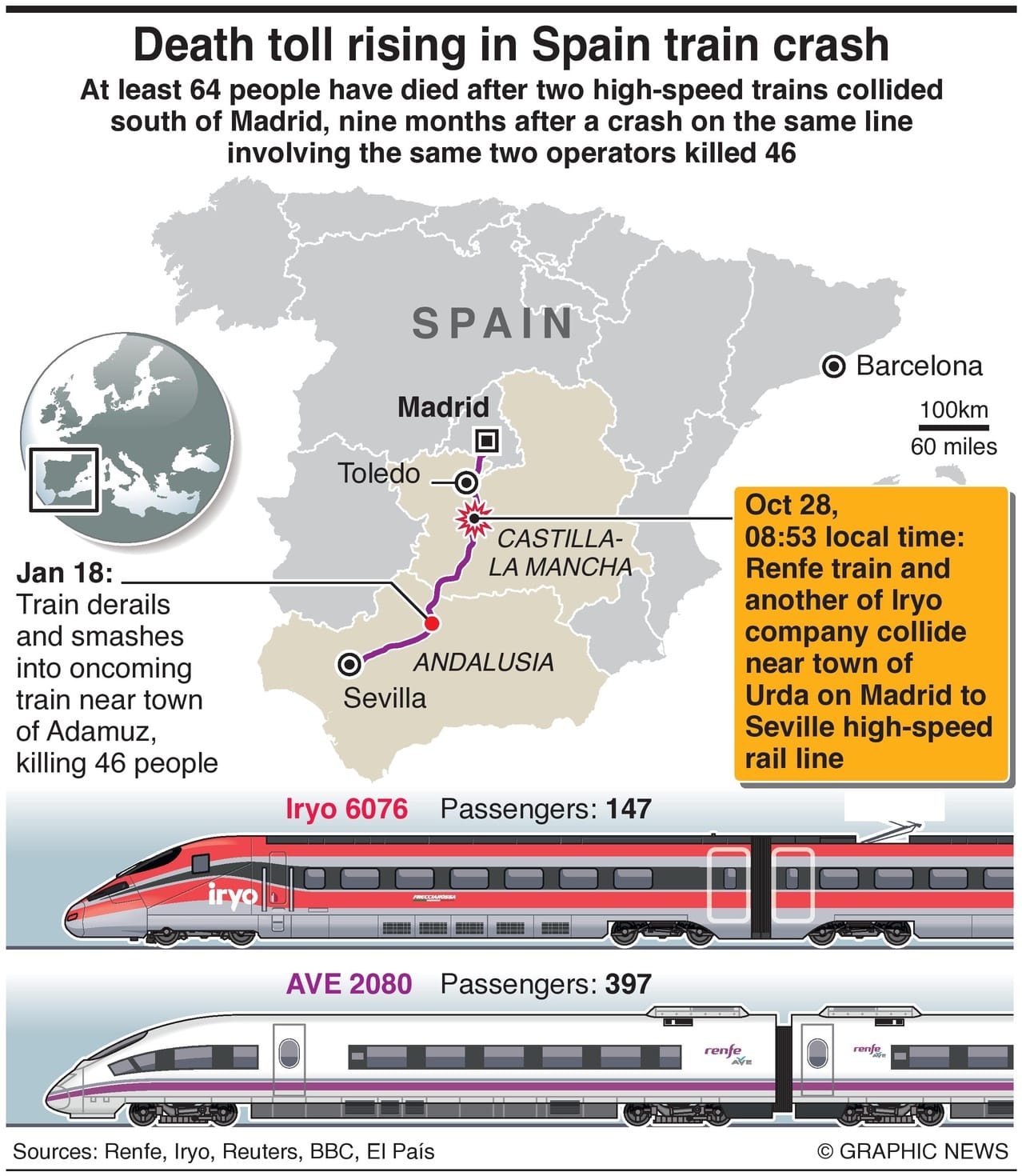
The collision occurred on Wednesday morning near Urda in Toledo province, between a Renfe AVE service bound for Seville and a train operated by the private operator Iryo. Two carriages fell down an embankment. Rail traffic between Madrid and Andalusia has been suspended.
Spain was already reeling from the Adamuz high-speed rail disaster outside Córdoba in January, in which 46 people died. It happened on the same high-speed route, but much further south.
Not since July 2013 has Spain seen such a devastating rail disaster. Eighty people died when a high-speed train derailed on a curve on the outskirts of Santiago de Compostela, in the north-west.
🧭 Power & Capital · October 29, 2026
Where state power meets the boardroom.
🔷 European Central Bank CB Chief Lagarde Steps Down Early Amid Inflation And Rising Borrowing Costs – Power & Capital Desk, TIPP Insights
🌍 Global Affairs
The world's flashpoints, in motion.
🟥 Russian Attack On Dnipro Railway Station Kills Civilians, Ukraine Says – TIPP News
🟥 Israel Election Deadlock Leaves Netanyahu Fighting To Stay In Power – TIPP News
🟥 Five Killed In Latest US Military Attack On Alleged Drug Traffickers – TIPP News
🟥 Watch: After Spain Train Crash, Tourist Recounts How Everything ‘Fell Apart’ – TIPP Video
🟥 Watch: King Charles Breaks Protocol To Dance In The Bahamas – TIPP Video
🏛️ National Affairs
The fights shaping America right now.
🟫 Why Hegseth Removed The Pentagon’s Top Planner As Trump Weighs Iran Strikes – TIPP News
🟫 US Intelligence Identifies Nvidia CEO’s Associate As Suspected Chinese Spy: NYT Report – TIPP News
🟫 Alaska Election Officials Defend State Authority As Senate Race Controversy Escalates – TIPP News
🟫 Ex-Peltola Aide Alleges Candidate Knew About Recruiting The ‘Other Dan Sullivan’ – Virginia Grace McKinnon, The Daily Signal
🟫 Pilot Fatigue Survey Raises Concerns Over Airline Schedules And Rest Periods – TIPP News
🟫 America Admits To TDS In Themselves And Others – Dr. Carole Lieberman, M.D., M.P.H
🟫 AMA Under Fire For ‘Replacing One Racial Preference With Another’ – Tyler O’Neil, The Daily Signal
🟫 Georgia GOP Launches Website Highlighting Ossoff’s ‘Failures,’ DSA Ties Ahead Of Obama Rally – Rebecca Buis, The Daily Signal
🟫 Former Rep. Tom Perriello Pledges To ‘End War,’ Remove Trump’s Tariff Authority If Elected – Rich Tucker, The Daily Signal
🟫 Watch: Democrats Will Decimate Ohio, Says Trump – TIPP Video
📈 Economy
Prices, policy, and the pressure on your wallet.
🟩 Strong US Economic Growth Beats Forecasts Despite Persistent Inflation – TIPP News
💼 Markets & Business
The deals and tickers making moves.
🟧 DoorDash Expands Grocery Business With Instacart Acquisition – TIPP News
🟧 Cybersecurity Firm Warns Hackers Could Manipulate AI Chatbots Through Hardware – TIPP News
🟧 Watch: Stranded In Asia - 200 Travelers Abandoned As Luxury Global Cruise Halts Operations – TIPP Video
🔬 Science & Tech
What's being discovered, built, and launched.
🟪 What Is 2026 ED138, The Possible New Dwarf Planet Beyond Pluto – TIPP News
🟪 Rising Temperatures Reveal Unexploded World War I Ammunition In Italy’s Mountains – TIPP News
Letters to the editor email: editor-tippinsights@technometrica.com
Subscribe Today And Make A Difference. Consider supporting Independent Journalism by upgrading to a paid subscription or making a donation. Your support helps tippinsights thrive as a reader-supported publication. Contact us to discuss your research or polling needs.
Reach our audience. For sponsorship and advertising opportunities, visit our Partner With Us page.