
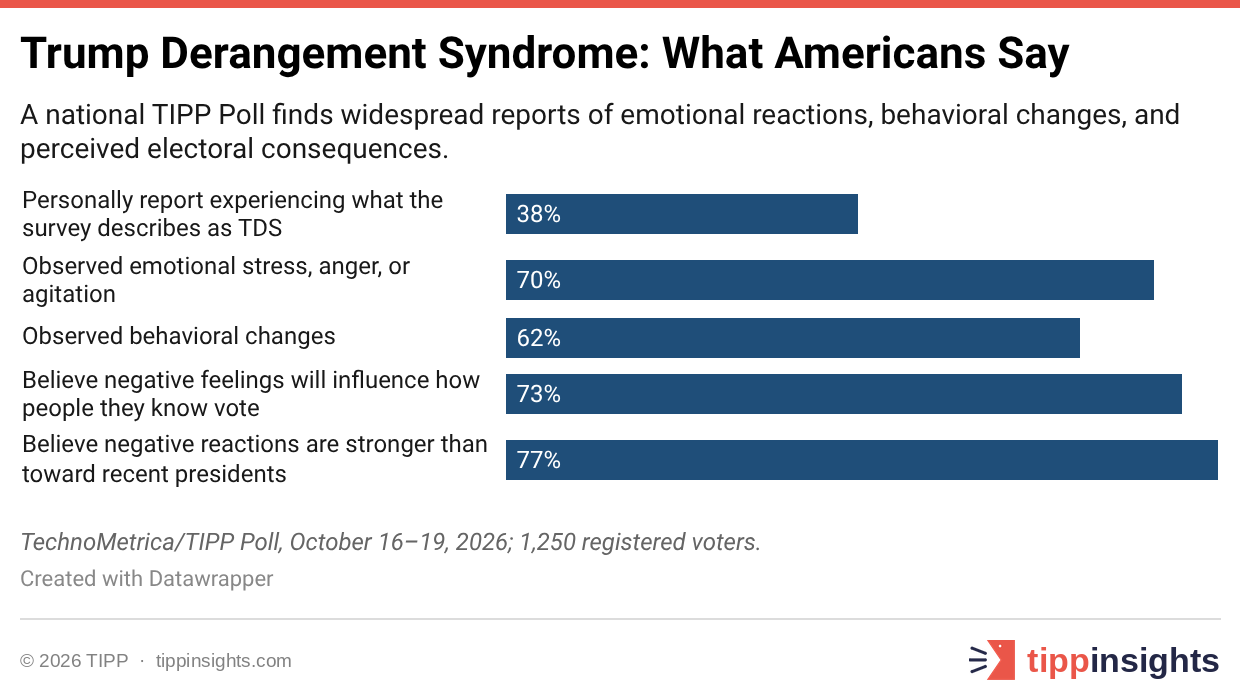
A national survey of 1,250 registered voters conducted by TechnoMetrica’s TIPP Poll from October 16–19, 2026, will surprise those who don’t believe Trump Derangement Syndrome (TDS) is real because 38% of those polled reported personally experiencing what the survey described as TDS, and 70% say that they have observed emotional stress, anger or agitation (some symptoms of TDS) in others, in response to appearances or events involving President Trump.
Why DSM Recognition Matters
As a board-certified psychiatrist, who has spent the past two years developing diagnostic criteria for Trump Derangement Syndrome for the purpose of advocating that it be added to the Diagnostic and Statistical Manual of Mental Disorders (DSM), the results of this poll strongly support such inclusion.
The DSM is published by the American Psychiatric Association (APA), the nation’s leading professional organization for psychiatrists. The APA represents more than 40,000 psychiatrists and establishes standards for psychiatric diagnosis and treatment in the United States. Because the DSM serves as the primary reference used by clinicians, hospitals, researchers, and insurers to identify and classify mental disorders, recognition of a condition in the DSM can encourage greater research, awareness, diagnosis, and access to treatment.
If TDS was an official diagnosis, more people would have access to treatment, since more mental health professionals would recognize the symptoms, understand the psychodynamics underneath the disorder, and recognize the urgency of treatment, since it can lead to serious consequences for friendships, marriages, families, businesses, and society as a whole.
TDS is due to an individual’s personal reaction to President Trump based upon their childhood or adulthood experiences. They project these past experiences and their general dissatisfaction with life onto Trump and blame him for them. This is elucidated in more detail in my proposal to the APA.
It has also contributed to an atmosphere in which extreme hostility toward President Trump can flourish. In the most extreme cases, it has emboldened people to attempt to assassinate President Trump, his family and cabinet.
Furthermore, our enemies have taken advantage of this “virus” to weaken our morale and democracy.
Additional Poll Findings
The survey revealed a number of other noteworthy findings. More than half of respondents (54%) said they had personally experienced negative emotional reactions to President Trump, with 18% describing those emotions as intense.
Seventy-seven percent said negative reactions toward President Trump are stronger than those directed toward recent presidents, including Bill Clinton, George W. Bush, Barack Obama, and Joe Biden. In fact, this proved to be the most lopsided finding in the survey.
Seventy-three percent believe negative feelings toward President Trump will influence how people they know vote in the upcoming election, while 74% believe media coverage contributes to negative reactions toward President Trump.
Impact on Relationships and Behavior
In a question asking about specific types of behavioral changes, 72% of respondents reported observing at least one of the listed behaviors among people with strong feelings against President Trump.
Looking at the types of behavior change, 41% said these people refused to socialize with friends or family who liked President Trump; 38% engaged in some activity to protest President Trump; and 37% were obsessed with Trump and had simmering anger toward those, even strangers, who might like him.
The Most Serious Manifestations
One of the most disturbing findings is that 22% of respondents reported observing threatening, aggressive, or violent behavior associated with strong negative reactions toward President Trump.
While many manifestations of TDS involve emotional distress, family conflict, social isolation, or political activism, this finding suggests that, in its most extreme forms, these reactions can escalate into conduct that threatens public safety. The most extreme manifestations of anti-Trump fixation have included assassination attempts against President Trump.
Understanding the psychological roots of these intense reactions is therefore not merely a political question, but a mental health and societal concern.
The poll also found that 50% of respondents acknowledged that they, themselves, had experienced behavior changes because of negative emotional reactions toward President Trump, including withdrawing from family members and friends, engaging in protest activities, or becoming preoccupied with President Trump and those who support him.
Treatment and Counseling
Another interesting finding is that 44% of respondents agreed that psychological counseling should be available to people who are experiencing intense negative emotional reactions toward President Trump. This would be facilitated if TDS was given an official place in the Diagnostic and Statistical Manual of Mental Disorders.
Looking Beyond Politics
In my proposal to the American Psychiatric Association, presented on October 28, 2026, I go into far greater depth regarding the symptoms, diagnostic criteria, and underlying psychological causes of TDS. The condition goes far beyond merely “liking” or “disliking” President Trump. This is a critical step in the recognition of the disorder and its treatment, not only for people across a broad spectrum of demographics today, but for future generations.
The survey findings suggest that we are witnessing a phenomenon that affects emotions, relationships, behavior, civic engagement, and even voting decisions. The roots of TDS are profound and deserve serious study by mental health professionals, researchers, policymakers, and the public alike.
As Americans continue debating the future of our nation, the findings of this first national survey suggest that understanding the emotional and psychological dimensions of our political climate may be more important than ever—not only for today’s society but for future Americans.
Dr. Carole Lieberman, M.D., M.P.H., is a board-certified psychiatrist. She has spent the past two years developing proposed diagnostic criteria for Trump Derangement Syndrome and advocating for its consideration by the American Psychiatric Association.
TIPP’s reputation for polling excellence comes from being the most accurate pollster for the past six presidential elections.
Download: Executive Summary and Survey Results
Proposal to the American Psychiatric Association
Loved it, hated it, or somewhere in between — tell us. Grade this article here and help shape what lands in your inbox next.
🧭 Power & Capital · October 29, 2026
Where state power meets the boardroom.
🔷 Trump To Announce New Rule To Lower Gas, Diesel Prices – Elizabeth Troutman Mitchell, The Daily Signal
🔷 Meta And Snap Face Landmark US Trial Over Youth Social Media Addiction – Power & Capital Desk, TIPP Insights
🌍 Global Affairs
The world's flashpoints, in motion.
🟥 Trump Weighs Iran Strikes As US Moves Missile Defenses And Prepares Warplanes – TIPP News
🟥 Trump Says Putin-Zelenskyy Meeting Could Happen ‘Very Soon’ – TIPP News
🟥 Iran War Costs Hit $47 Billion As Trump Insists Tehran Must Not Go Nuclear – TIPP News
🟥 UK Announces £13 Billion In Ukraine Support And Higher Defense Spending Targets – TIPP News
🟥 Netanyahu And Rival Eisenkot Fall Short Of Majority In Israel Election – TIPP News
🟥 Flavio Bolsonaro Arrives In Florida After Leaving Brazil – TIPP News
🟥 Why Trump Approved US Entry For Brazil’s Flávio Bolsonaro After His Election Loss – TIPP News
🟥 Watch: What Guilt Drove Bolsonaro To Escape Brazil, Asks Lula – TIPP Video
🟥 Watch: Russian Strike On Kharkiv Injures Five Including 4-Year-Old – TIPP Video
🟥 Watch: Belgrade Police Neutralize Attacker Outside Israeli Embassy; Officer Injured – TIPP Video
🟥 Watch: Wreckage Clip Of Deadly Train Collision In Spain – TIPP Video
🟥 How The Deadly Spain Train Crash Disrupted High-Speed Rail Services – TIPP News
🟥 Putin Calls Elon Musk A ‘Real Genius’ Amid SpaceX Rivalry – TIPP News
🟥 French Voters Are Waking Up To The Real Cause Of Their Country’s Riots, Experts Say – Malia Loock, The Daily Signal
🏛️ National Affairs
The fights shaping America right now.
🟫 Emergency Declared At South Carolina Nuclear Site After Laboratory Fire – TIPP News
🟫 Democrat-Run Cities Tried To Salvage A Biden Anti-Deportation Policy. SCOTUS Says No. – Fred Lucas, The Daily Signal
🟫 Maryland Child Protective Services Treated Christian Beliefs As Evidence Of Parental Unfitness, Black Baptist Parents Allege – Tyler O’Neil, The Daily Signal
🟫 Undercover Camera Catches Newsom Predicting DSA’s Rise In Democratic Party – Angelina Delfin, The Daily Signal
🟫 Former Heritage Foundation Intern Breaks The Sen. Slotkin Intimidate Young Conservatives Story – Olivia Burdo, The Daily Signal
🟫 West Texas City To Vote On ‘Sanctuary For The Unborn’ Ordinance – Emily Medeiros, The Daily Signal
🟫 Out Of Office But Not Off The Trail: Glenn Youngkin Stumps In Virginia’s 5th – Rich Tucker, The Daily Signal
🟫 What I Saw On Trump’s Trip To Mississippi – Elizabeth Troutman Mitchell, The Daily Signal
🟫 Collins Rails Against Ossoff At Georgia Rally, Speaks On Increasing Momentum Of Senate Race – Rebecca Buis, The Daily Signal
🟫 Dolores Huerta, Farmworker Rights Pioneer And Civil Rights Icon, Dies At 96 – TIPP News
🟫 Historic Mason-Dixon Line Map Heads To Auction For Up To $1.2 Million – TIPP News
🟫 Great White Shark Lunges At Woman During Georgia Tagging Expedition – TIPP News
📈 Economy
Prices, policy, and the pressure on your wallet.
🟩 World Bank Warns Global Commodity Prices Could Surge 23% In 2026 – TIPP News
🟩 Oil Markets Brace For Wider Middle East Conflict After Saudi Refinery Attack – TIPP News
🟩 Another Crash Landing For Brazil’s Economy? – Project Syndicate
💼 Markets & Business
The deals and tickers making moves.
🟧 European Satellite Firms Challenge Musk’s Starlink After Ukraine Disruption – TIPP News
🟧 China’s Auto Industry Faces Falling Sales And Shrinking Profits – TIPP News
🟧 Stellantis Shares Rebound Despite $4.5 Billion Quarterly Cash Shortfall – TIPP News
🟧 Traders Place Million-Dollar Bets On Chipotle Stock Falling Further – TIPP News
🟧 Iran War Disruptions Push Round-The-World Residential Cruise Into Financial Crisis – TIPP News
📊 Market Mood · October 29, 2026
How the trading day is setting up.
🟥 Alphabet's earnings miss is rattling technology stocks. Google’s parent plunged about 10% in after-hours trading as disappointing profits and heavy AI spending raised concerns about the returns on massive technology investments.
🟩 Microsoft is providing a counterweight to AI worries. Its shares gained nearly 3% after strong cash flow demonstrated its ability to finance AI expansion without relying heavily on borrowing.
🟦 Treasury yields are easing after the Fed held rates steady. Chair Kevin Warsh's comments were interpreted as less hawkish than expected, although investors still anticipate another rate increase in December.
🟨 GDP and inflation data face a critical test today. Third-quarter economic growth and September PCE inflation figures could reshape expectations for interest rates, while Amazon's earnings will provide another test of AI investment.
🗓️ Key Economic Events
On today's U.S. data calendar.
🟧 8:30 a.m. ET — GDP, Advance Estimate (Q3)
Forecast: +3.2% annualized | Previous: +2.2%
Economic growth is expected to accelerate, suggesting continued resilience despite elevated interest rates and inflation.
🟧 8:30 a.m. ET — Core PCE Price Index (September)
Forecast: +0.3% m/m, +3.1% y/y | Prev: +0.2% m/m, +3.0% y/y
The Fed's preferred underlying inflation measure is expected to accelerate, potentially reinforcing expectations for another rate hike in December.
Letters to the editor email: editor-tippinsights@technometrica.com
Subscribe Today And Make A Difference. Consider supporting Independent Journalism by upgrading to a paid subscription or making a donation. Your support helps tippinsights thrive as a reader-supported publication. Contact us to discuss your research or polling needs.
Reach our audience. For sponsorship and advertising opportunities, visit our Partner With Us page.