Third of three this weekend on China. Friday: what Beijing tells itself. Saturday: what its army cannot do. Today: why Xi is staging both at once.
Friday’s editorial argued that Beijing has talked itself into a fantasy about American decline. Saturday’s argued that the army Xi would need to act on the fantasy was born during the one-child policy that guaranteed there would not be enough of them. This editorial answers the question that follows: Why is Xi running a propaganda campaign that promises a victory his military cannot deliver, at the same time, in public, with so much visible effort?
Xi was not staging the campaign for Washington, Taipei, or Manila. He was choreographing it for the nearly 100-million-member Communist Party.
In eighteen months, Xi Jinping will have completed three five-year terms and will ask his own party to give him a fourth term as general secretary at the 21st National Congress. No Chinese leader has attempted what he is about to attempt since Mao. He needs the record to justify it, and the record is not cooperating. The Chinese economy is slowing. The Chinese military has failed in every kinetic engagement it has been given. The Chinese propaganda machinery has produced a public that expects a finishing blow the army cannot deliver. The two Beijing summits in May, one with Trump and the other with Putin in the same week, were staged to project Beijing as the third pole between Washington and Moscow. They were also the showpiece events of Xi’s reelection campaign, with two world leaders walking the Temple of Heaven as guest stars who did not know they were in someone else’s commercial.
Two senior China-watchers called this months before it happened. The Nikkei’s Katsuji Nakazawa wrote in March that Xi needed Trump’s spring visit specifically to clear his political runway toward the 2027 Congress. The China scholar Minxin Pei wrote the day before the summit that even a strongman needs to burnish his record to justify staying in power, and that this was how summitry with Trump was factoring into Xi’s political calculus. Both predicted the same motive, two months apart. The Trump summit played out exactly as their thesis required. The Putin summit a week later was the same play with a different visiting head of state.
Rewind to October 2025. Xi flew to a US-South Korean air force base in Busan to meet Trump on the sidelines of an Asia-Pacific summit. The location was extraordinary, the stronghold of an alliance directed against China. Xi accepted a temporary trade truce on terms tilted toward Washington, and in return, he secured Trump’s promise to visit China in the spring of 2026. That marked the start of a campaign that would run until the 21st Party Congress in the fall of 2027.
Fast forward to January 2026. Xi destroyed the career of his most trusted general, the senior uniformed officer of the People’s Liberation Army, a man he had personally elevated. The purge followed an October plenum at which two other handpicked Xi loyalists in the military leadership were stripped of party membership along with seven other former senior officers. Xi was conducting an unprecedented purge of his own military command while projecting external calm. The trip Trump had promised in Busan had become a domestic political necessity.
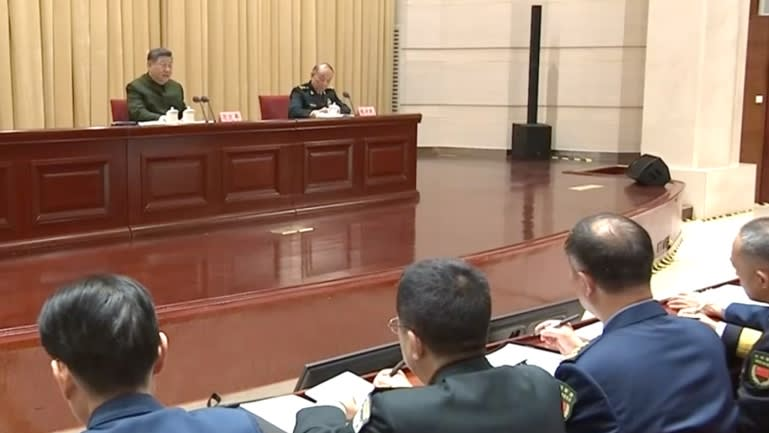
Three weeks later, on February 10, Xi's isolation became visible. Instead of his customary Lunar New Year inspection tour to a theater command, he stayed inside the Bayi Building, the headquarters of China's Central Military Commission in central Beijing, and addressed nine PLA units through a video link. State television footage showed three people in a vast red-carpeted hall. Xi sat between two of them, addressing soldiers on a giant split-screen monitor, the hall around him nearly empty. He praised the rank and file, "especially those at the grassroots level," and asked for their loyalty. Nakazawa drew the obvious parallel to Mao's tactic. When senior leaders cannot be trusted, the supreme leader goes over their heads and appeals directly to the soldiers. Xi did not leave Beijing because he could not be certain his own theater commands would receive him properly. The Central Military Commission, the body he chairs, had been reduced from seven members to two. The two would still be sitting alone at the head table during senior officer ceremonies two months later, in April. The other member was the discipline commissar. No one on the CMC, besides Xi, currently specializes in commanding the armed forces.
Eighteen days later, at the end of February, the war in Iran broke out. Trump used the China visit as leverage to push Xi toward helping protect Strait of Hormuz shipping, and postponed the trip to May. Xi did not retaliate but decided to wait it out. Nakazawa’s line from March captures the desperation exactly: for Xi to save face, Trump must visit China.
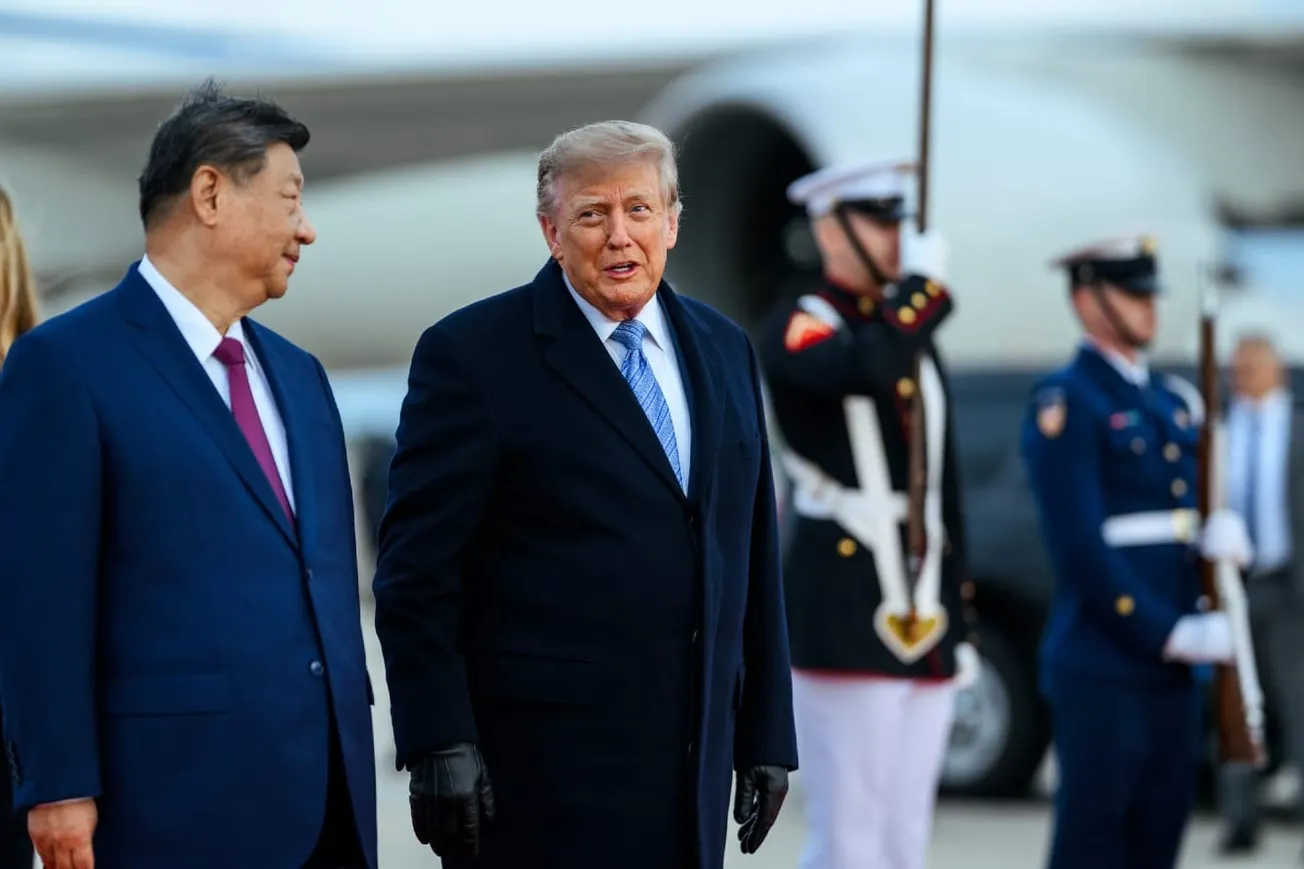
The Trump state banquet at the Great Hall of the People in May was the first time in months that Xi had appeared in public outside the Bayi Building with another world leader. The Temple of Heaven photograph was a reassurance, broadcast to his own party, that the man at the top was still functioning, still meeting foreign leaders, still in control of the apparatus he had spent the winter hollowing out from inside.
Inside the bilateral itself, Xi asked the question Beijing has wanted answered for forty-seven years. He opened with a lecture on the Thucydides Trap, Graham Allison's framing of rising-power confrontation, which Xinhua flagged as the philosophical centerpiece of the meeting. Western analysts treated it as Xi's erudition. It was the elite version of the same propaganda Friday's editorial described, the kill line for an American president instead of for a Chinese commuter.
The American readout did not mention Taiwan. The Chinese readout led with it. Xinhua quoted Xi telling Trump that Taiwan is “the most important issue in China-U.S. relations” and that mishandling it would put the relationship “in great jeopardy.” Trump told reporters on Air Force One that Xi had asked him directly whether the United States would defend Taiwan, and that he had declined to answer. The American fact sheet, released two days later, made no mention of Taiwan. The silence let Wang Yi, the Chinese foreign minister, tell Chinese audiences the day after the summit that the United States “understands China’s position.” Trump made no such commitment, as he told reporters on the way home. Beijing had built its messaging around the assumption that Taiwan would be absent from the American account. The arrangement suited both leaders. Xi got the boost he needed without Trump having to put anything in writing.
The performance of China’s military hardware is a persistent embarrassment against the propaganda. Beijing has marketed its air defense systems for years as fourth-generation, capable of tracking American stealth aircraft from hundreds of miles away. China’s HQ-9B systems failed in Pakistani hands during Operation Sindoor in May 2025. Chinese-built radar in Venezuela failed to detect US aircraft during the January 2026 raid that captured Maduro. By the time Michael Sobolik of the Hudson Institute spoke to the Indo-Pacific Defense Forum in late January, he was saying what every Asian defense ministry was already saying privately: “Any nation around the world with Chinese defense equipment is checking their air defenses and wondering how safe they actually are.”
A month later, the HQ-9B network in Iran was destroyed in the opening hours of the February 28 US and Israeli strike that killed Khamenei. A regime running a campaign on the claim that America is in decline cannot also be losing every advertised showdown its own equipment has been in.
Putin arrived in Beijing the same week as Trump and left without the Power of Siberia 2 gas deal he had come for. Two state banquets at the Great Hall of the People in one week, with two readouts that bore little resemblance to the conversations that produced them, gave Xi exactly what the campaign required: the volume of foreign attention without the obligation of foreign substance.
Xi will visit Washington on September 24. By the time the 21st Party Congress meets in the fall of 2027, his propaganda apparatus will have a year of footage from two summits in Beijing and one in Washington to run as evidence that Xi alone manages the relationship that matters most.
The campaign that began in Busan is now on the calendar through the fall of 2027. Until then, a leader who could not be certain his own theater commands would receive him properly will be the face of a country whose propaganda has told it the great rival is already finished.
Trilogy complete.
The complete trilogy is available as a single audio edition. Approximately thirty-five minutes. Listen here.
Letters to the editor email: editor-tippinsights@technometrica.com
Subscribe Today And Make A Difference. Consider supporting Independent Journalism by upgrading to a paid subscription or making a donation. Your support helps tippinsights thrive as a reader-supported publication. Contact us to discuss your research or polling needs.
Reach our audience. For sponsorship and advertising opportunities, visit our Partner With Us page.