
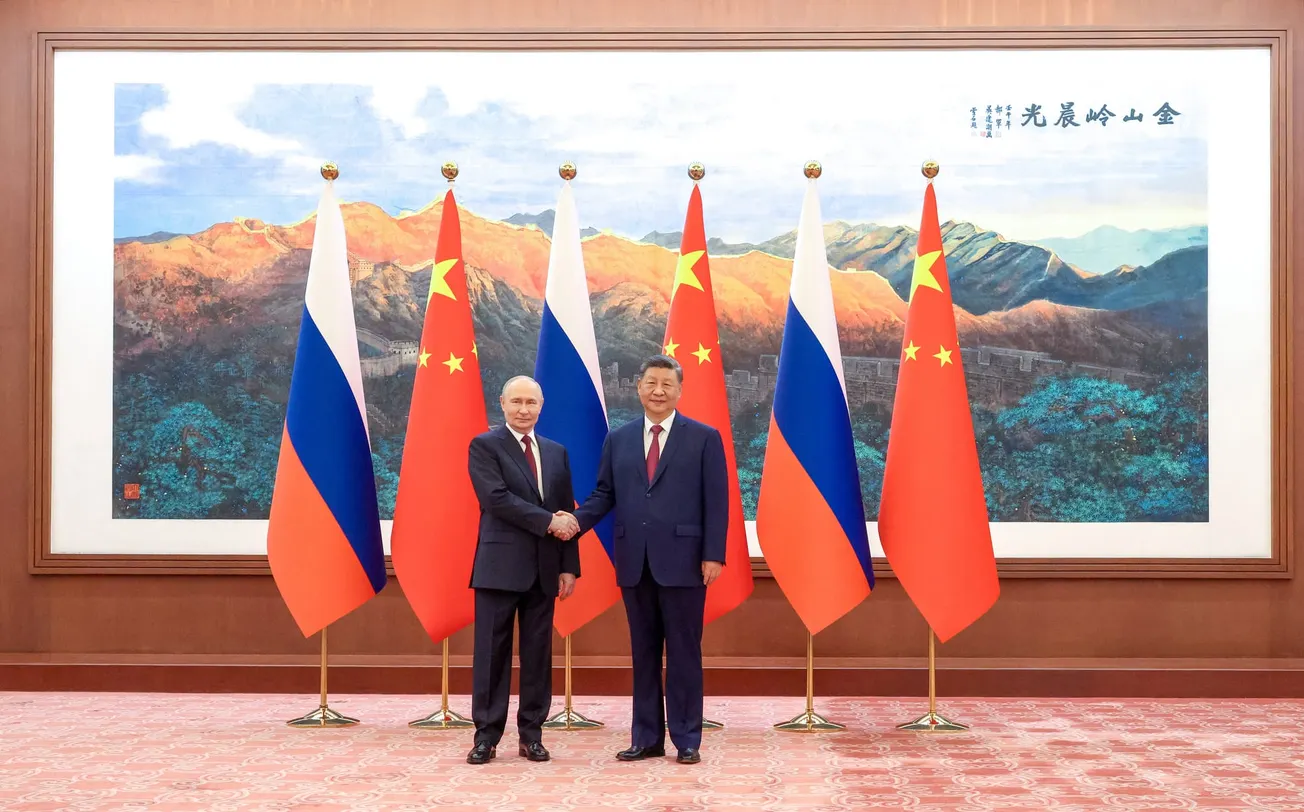
President Vladimir Putin landed in Beijing on Tuesday for his 25th visit to China. No foreign leader has made the same pilgrimage twenty-five times.
What he came for is the same thing he has been asking for over the better part of a decade: a signed contract for Power of Siberia 2, a 2,600-kilometer pipeline that would carry 50 billion cubic meters of natural gas a year from the Yamal Peninsula in West Siberia, through eastern Mongolia, into northern China. Gazprom’s feasibility study began in 2020, with a target operational date of 2030. The price China is willing to pay has still not been agreed upon. One would expect a project this large to have been signed years ago if the partners were equals, and the fact that it has not been is the first measurement of who needs whom.
Russia needs the deal because Europe, which absorbed roughly 150 billion cubic meters a year before the invasion, is no longer there, with the pipelines that once carried Russian gas to Germany lying in pieces under the Baltic. The Yamal fields that fed those buyers sit full, with nowhere to send their gas. Only one country on the planet is large enough to take that volume, and Putin is currently inside it. That is not the position of a senior partner; it is the position of a seller with one buyer and no walk-away.
China is under no symmetric pressure. It already imports gas from Turkmenistan, Uzbekistan, Kazakhstan, and Myanmar through dedicated pipelines, and it takes liquefied natural gas by sea from more than twenty countries, with Qatar and Australia at the top of the list. The original Power of Siberia pipeline is not yet running at full capacity. A second Russian line, the China-Russia Far East Pipeline, began construction earlier this year. If all three Russian lines eventually run at full flow, Russia alone would account for roughly a quarter of Chinese gas consumption, precisely the single-source dependence Beijing has spent two decades engineering away from.
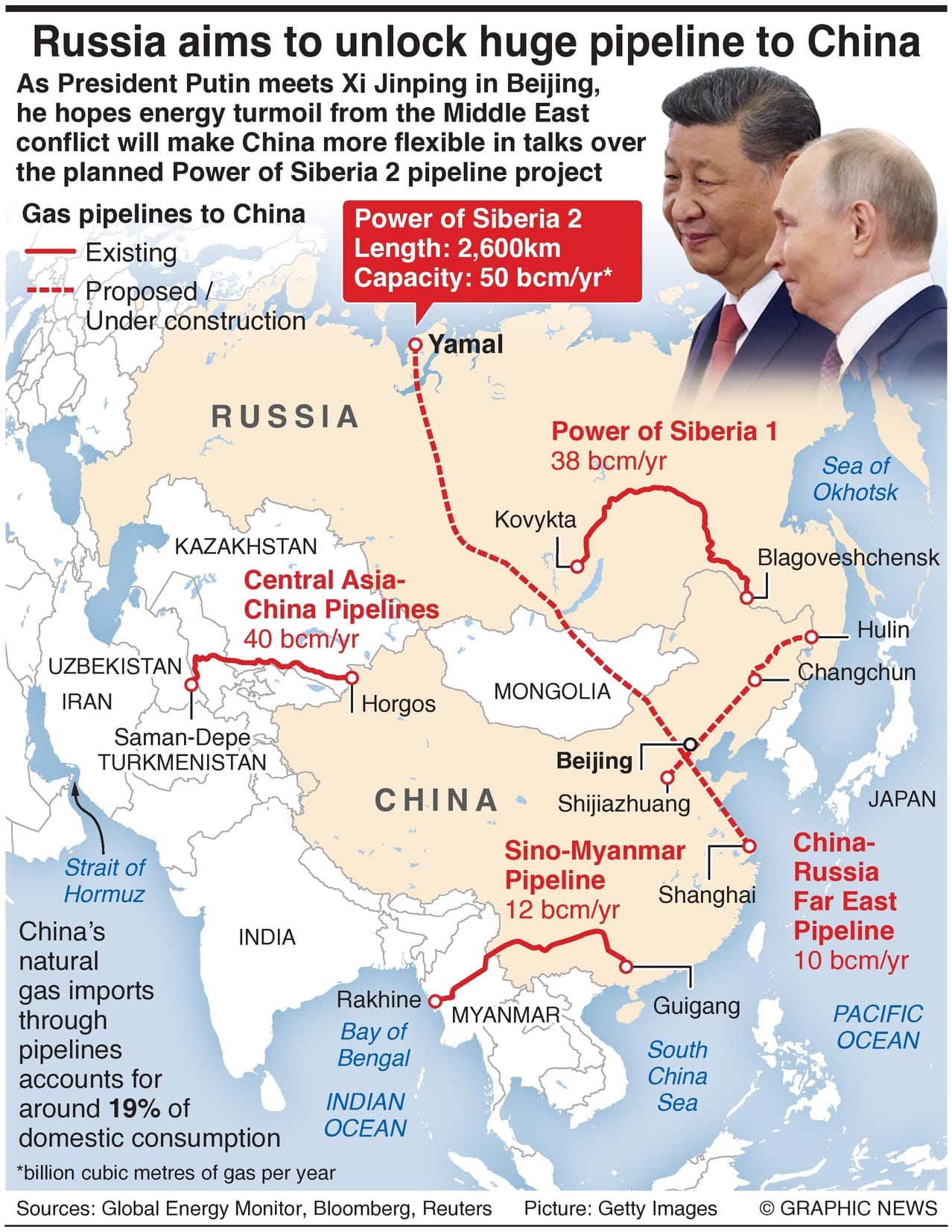
The economics of the new pipeline make the case worse, not better. The Bohai Economic Rim around Beijing and Tianjin, where the gas would land, is already oversupplied by domestic Shaanxi gas, offshore Bohai Sea gas, and a fast-growing cluster of coastal LNG terminals. Roughly half of northern China’s gas demand is seasonal winter heating, which does not align well with a year-round baseload pipeline. China’s 2030 carbon peak target arrives the same year the pipeline would begin operations. Xi has read the spreadsheet correctly. Saying no to Putin costs him nothing. Saying yes to Putin would run counter to the diversification strategy that defines Chinese energy security.
What Putin hoped to bring to the table this week was the war with Iran. Israeli and American strikes on Iranian nuclear and military targets have rattled global energy markets. The Strait of Hormuz is still unresolved and oil prices are surging. Qatar, which supplies roughly 20% of global LNG, has declared force majeure on shipments through mid-June after Iranian strikes on Ras Laffan. Moscow figures that energy security anxiety in Beijing would translate into urgency over Power of Siberia 2. Putin himself said on May 9 that he hoped to “finalize” the deal during the visit. A man arriving with a signed contract does not say he hopes to finalize it. The hopeful phrasing is itself the tell.
The Iran lever has not moved Xi. Bloomberg and Reuters reporting this week converge on the same outcome. Beijing will likely agree to a broad framework covering annual volumes, seasonality, and flexibility terms, and leave the price column blank. Price negotiations, the same sources say, could take years. In September 2025, Gazprom signed a memorandum on building the pipeline without locking in a price. Eight months later, he is back asking for the same signature, and Xi is preparing to send him home with the same partial answer. Xi has found the formula: keep the door open, sign the press release, never sign the price. He will keep using it as long as it works. It will keep working as long as Putin keeps coming.
The terms Russia insists on expose the asymmetry. Moscow has refused Chinese investment on the Russian side of the border on previous pipelines, and Gazprom is expected to demand the same arrangement for Power of Siberia 2: China writes the checks for the gas, Russia builds and owns the pipeline, the wells, and everything upstream. The Russian phrase for this is “you pay, I deliver.”
Beyond ownership and structure, the unsigned variable is price. Russia wants terms similar to its existing Power of Siberia 1 contract, around $265 per 1,000 cubic meters. China is offering something close to Russia’s heavily subsidized domestic rate, around $120 to $130. The gap is roughly two-to-one. Russia needs the higher number to justify the capital cost of a 2,600-kilometer pipeline across difficult terrain. China sees no reason to offer it. That gap is the contract that has not been written. Payment runs in yuan, not dollars. For Russia, yuan settlement is a sanctions workaround, while for China, it is a long-term project to internationalize the renminbi at the expense of the dollar. The price Russia is being asked to accept is what Putin keeps returning to Beijing to discuss.
Visit 25 lands in a year when, as Nina Khrushcheva has catalogued, Russia’s other partnerships are fraying. Kazakhstan signed military cooperation with NATO member Turkey. Bashar al-Assad is gone in Damascus, and with him the Russian naval base at Tartus that took a decade to secure. Alexander Lukashenko in Belarus, Putin’s most reliable client, has been talking directly to Donald Trump. The line at Russia’s door is one customer long, and Xi knows it.
Nina Khrushcheva is the great-granddaughter of Nikita Khrushchev and was recently designated a “foreign agent” by the Kremlin for opposing the war in Ukraine. She describes the current Russia-China relationship as a “lopsided marriage of convenience” rather than an alliance of equals. When the Kremlin formally brands Khrushchev’s own great-granddaughter an enemy of the state for telling the truth about Russia’s position, the truth she is telling has weight. Russia is not the partner China celebrates in joint communiqués; it is the only partner Russia has left.
The oil trade looks different. China is the largest buyer of Russian crude, with most of it settled in yuan, and independent Chinese refiners buy openly through sanctions while state refiners just resumed purchases after a brief U.S. waiver. An additional 2.5 million metric tons per year now move through Kazakhstan under a 2025 agreement. Oil works because oil has a world market price, and Russia gets paid relative to the price floor set in London and New York, not in Beijing. Pipeline gas has no such reference price. Whatever Russia gets for Power of Siberia 2 is whatever China decides to pay. That is the difference between selling a commodity and being a captive supplier, and Putin is on the wrong side of it.
Four days before Putin arrived, Donald Trump made a high-profile state visit to Beijing. The trip produced concrete deliverables: Chinese commitments to buy 200 Boeing aircraft, $17 billion a year in U.S. agricultural goods through 2028, and movement on rare earths. It also produced the framing Xi wanted. Both sides agreed to a “constructive relationship of strategic stability,” language Beijing pressed into the joint readout, consciously displacing the “strategic competition” framing of the Biden era. Hosting Putin one week later allowed Beijing to project the message both visits were staged to deliver: China is the stable hub of a multipolar world, capable of receiving both the American president and the Russian president in the same week, with strategic partnerships that bend to no one.
This is the part Washington should read carefully. The choreography says China is the adult in the room. The substance says China is extracting better terms from a weakened Russia than from a confident United States. The lesson for American policy is not that the Sino-Russian axis is strong. It is that one of its two members has been reduced to a client, and the other is using that fact to demonstrate to a watching world what alignment with Beijing now means.
Putin will board the plane home with another framework document, another communiqué about all-weather partnership, and a fresh round of oil deals. The pipeline he came for will remain a memorandum. Twenty-five visits to ask for the same signature is not diplomacy or negotiation, but petition. Beijing knows the difference. So should Washington.
Visit 26 is already on the calendar, Putin will draw up on the flight home. The DO loop continues.
The TIPP Off
What you should be reading right now
Global Affairs
Russia's Grind, Iran's Clock—Mark Pfeifle, TIPP Insights
The Blood Libel—Daniel Pomerantz, TIPP Insights
The World Economy After the Trump-Xi Summit—Shang-Jin Wei, Project Syndicate
Rape Dogs Claim Lands NYT In Defamation Lawsuit—Pedro Rodriguez, The Daily Signal
Trump’s Failed Mission To China—Larry C. Johnson, Ron Paul Institute for Peace and Prosperity
Xi Tells Trump That Mishandling Of Taiwan Could Spark Conflict—Trevor Hunnicutt & Mei Mei Chu, The Daily Signal
SPY WARS: Former CIA Covert Operations Officer Explains How Intelligence Is Influencing The Iran War—Bradley Devlin, The Daily Signal
Super Power To Spare: How Battery Tech Illuminates Competition Between U.S. & China—James Varney, RealClearInvestigations
National Affairs
Victor Davis Hanson: ‘It’s All According To Plan’ As Protesters Target Jewish Area In Mamdani’s NYC—Victor Davis Hanson, The Daily Signal
Voters Back Federal Student Loans, But Want Parents, Schools To Focus On Degrees That Pay: I&I/TIPP Poll—Terry Jones, TIPP Insights
Tensions Between CIA And Congress Flare—George Caldwell, The Daily Signal
GOP Attorneys General Tout Crime Crackdown As Democrats Push Bail Reforms—Fred Lucas, The Daily Signal
Voters Overwhelmingly Support White House Draft Executive Order To Protect Americans From Cyber Threats—Elizabeth Troutman Mitchell, The Daily Signal
Lewd Anti-ICE Protester Says She Wants To Prevent Children From Coming To St Paul Church—Tyler O’Neil, The Daily Signal
Top Dems Call Islamic Terrorism In US A ‘Conspiracy Theory’—Pedro Rodriguez, The Daily Signal
📊 Market Mood — Wednesday, May 20, 2026
🟩 Markets stayed cautious Wednesday as investors balanced hopes for an Iran ceasefire against lingering fears about inflation, bond yields, and global growth.
🟧 President Donald Trump said the Iran war could end “very quickly,” while signs of oil tankers moving again through the Strait of Hormuz eased some concerns about prolonged supply disruptions.
🟦 Nvidia earnings became the market’s main focus, with investors looking for confirmation that the AI spending boom still has momentum despite rising competition and soaring infrastructure costs.
🟨 Rising Treasury yields and Fed uncertainty continued to pressure sentiment as markets prepared for minutes from the Federal Reserve’s April meeting.
🗓️ Key Economic Events — Wednesday, May 20, 2026
🟧 10:30 a.m. ET — Crude Oil Inventories
Forecast: -2.5M barrels vs. -4.306M previous. Markets remain highly sensitive to oil supply data as tensions around the Strait of Hormuz continue driving energy volatility.
🟧 2:00 p.m. ET — FOMC Meeting Minutes
Investors will closely parse the Fed minutes for clues on how policymakers are balancing inflation risks, rising oil prices, and the outlook for future interest rates.
Letters to the editor email: editor-tippinsights@technometrica.com
Subscribe Today And Make A Difference. Consider supporting Independent Journalism by upgrading to a paid subscription or making a donation. Your support helps tippinsights thrive as a reader-supported publication. Contact us to discuss your research or polling needs.
Reach our audience. For sponsorship and advertising opportunities, visit our Partner With Us page.