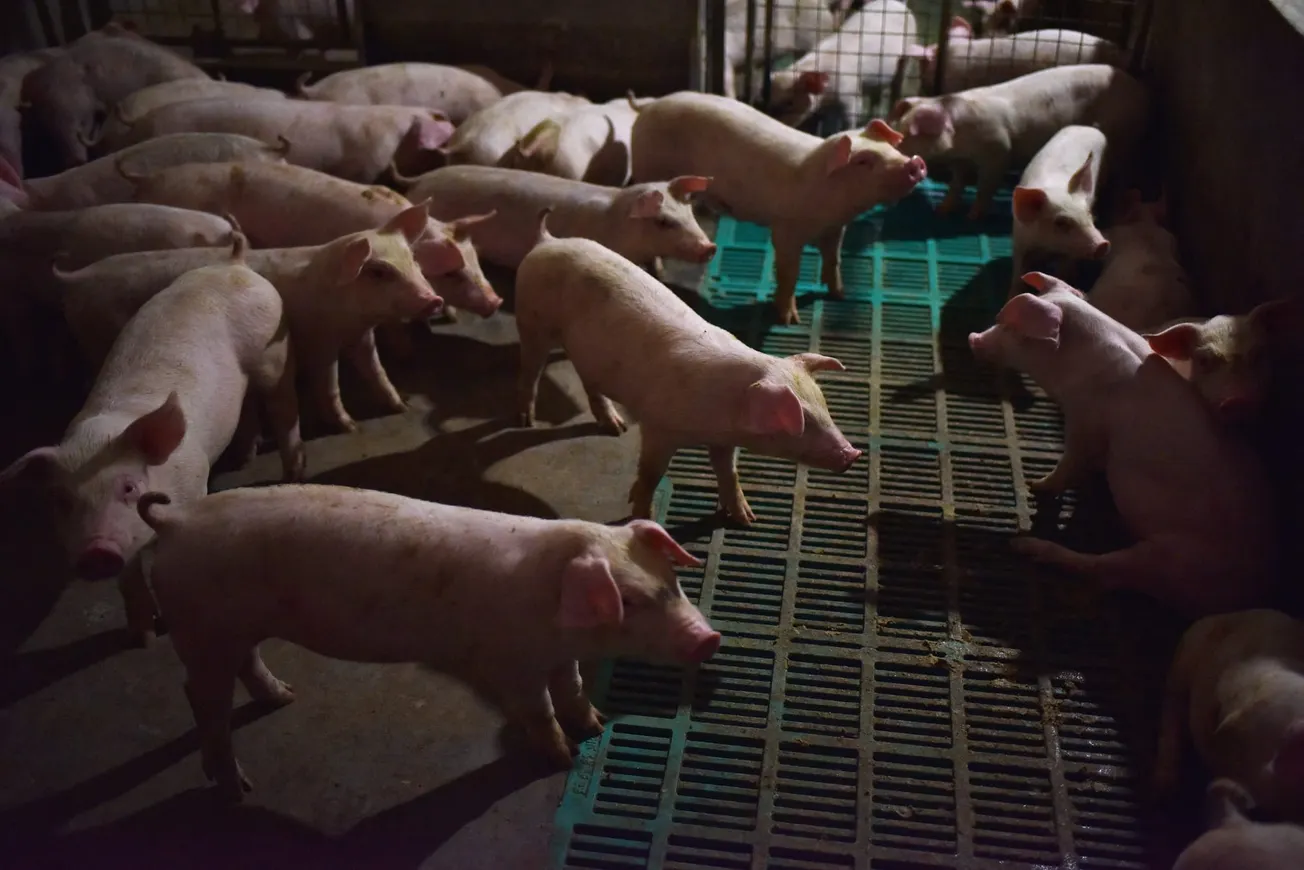
In China today, a pig sells for less than it costs to raise. After feed, housing, labor, and the trip to market, a farmer loses between 280 and 350 yuan on the animal. That figure is the most honest available reading of the Chinese economy, and it is one Xi Jinping has no power to change.
Growth targets are met on schedule, but economists outside China have long suspected that the official books are massaged. Before he became premier, Li Keqiang privately dismissed the country’s own growth figures as “man-made” and unreliable. For a time, Chinese officials even avoided saying the word for falling prices out loud.
Pork, however, is much harder to manage. Its price is determined by millions of farmers and millions of households making everyday decisions at the dinner table, and right now it is falling sharply. It is the one verdict on China’s economy that Xi cannot fake.
For Xi, feeding China without relying on the outside world is a matter of national security. Since 2013, he has vowed that the country’s “rice bowl” will remain firmly in Chinese hands. At the center of that promise is pork, the meat China runs on and so woven into its diet that the Chinese word for “meat” commonly means pork itself.
Rewind to 2019. African swine fever, a disease deadly to pigs, swept through China’s herds and wiped out a large share of the national stock. Pork prices roughly doubled, climbing above 50 yuan a kilogram from a long-established level of about 20. Alarmed by the shortage, Beijing poured subsidies and cheap credit into rebuilding the herd and championed a new model of production: multistory hog farms, some rising more than 20 floors, designed to ensure the country would never face such a shortage again.
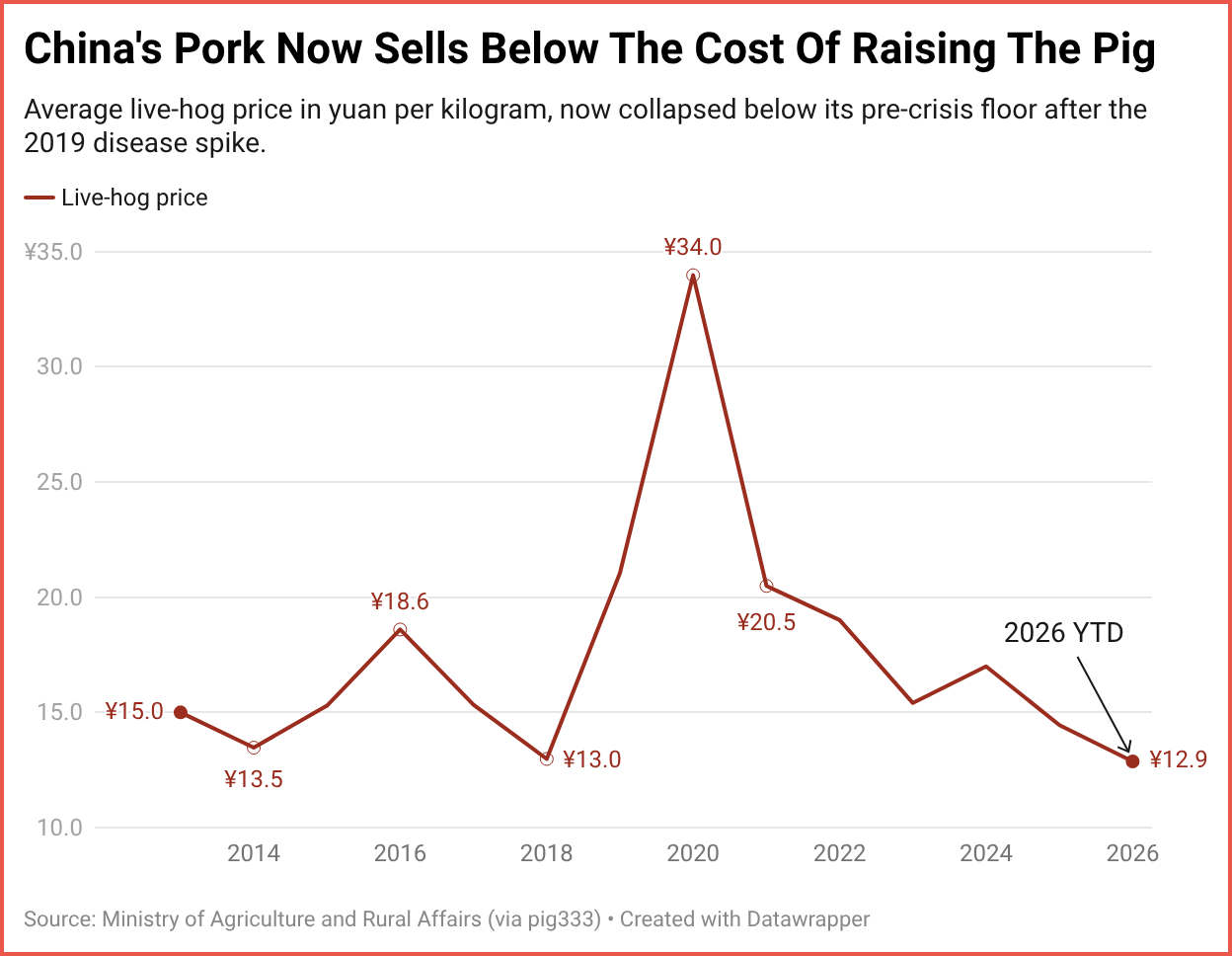
The strategy perhaps worked too well. The herd recovered in full, but by then household demand was already weakening. Four years later, pork sells for about 15 yuan a kilogram, an eight-year low, beneath where it sat before the crisis.
A few years earlier, the government had followed the same playbook with milk, pushing dairy production ever higher until supply outpaced demand and prices slid for two straight years through 2024. When output is driven by command rather than consumption, gluts are almost inevitable. Pork is the same story on a much larger scale.
China created a strategic pork reserve in 2007, an emergency stockpile of frozen meat designed mainly to protect consumers from soaring prices. When pork became expensive, the state released supplies from the reserve to push prices back down. Keeping pork affordable was a promise the Communist Party made to the public, and the reserve was one of its main instruments.
When pork prices spiked in 2019, a Communist Party newspaper ran an article urging people to eat less of it, for their health. Readers mocked it as a modern version of “let them eat cake.” Today, the strategic reserve is being used in the opposite direction, with the government buying pork to prop up prices. It is also pressing local governments to absorb the surplus and ordering farmers to cull breeding sows. The reserve that was created to protect consumers from pork that cost too much is now being used to protect producers from pork that has become too cheap to raise.
Chinese consumers are eating less of their national staple because they feel poorer. Some of pork’s long decline reflects a richer country diversifying its plate, trading toward beef, poultry, and seafood. But taste shifts unfold over decades, not in a single year, and they cannot explain a fall this sudden. Pork production, long maintained near a ceiling of about 57 million tonnes a year, declined in 2024 for the first time in four years. Yet demand is falling even faster: the amount of pork eaten per person dropped by nearly 8 percent in a single year. The U.S. Department of Agriculture expects Chinese pork consumption to continue declining, citing the country’s weak economy.
Economists inside and outside China have urged the same remedy for years: put more money into people’s hands and build a social safety net strong enough that families feel confident enough to spend it. The International Monetary Fund, in its latest assessment of China, argued that fiscal policy should prioritize strengthening social protection “to give people the confidence and security they need to spend more and save less,” estimating that such a shift could raise consumption by as much as 3 percentage points of national output. Studies surveyed by the Peterson Institute reach the same conclusion, recommending greater spending on pensions, health care, and unemployment benefits so households, less fearful of what lies ahead, spend more freely. Xi has taken only modest steps. He doubled subsidies for trading in old cars and household appliances but has stopped short of putting cash directly into people’s pockets.
The reluctance runs deeper than the pork crisis. In 2021, with the economy still climbing, Xi revived an old Party slogan, "common prosperity," and pledged to narrow the gulf between rich and poor. As growth faltered, the phrase slipped out of his speeches, and the promise was quietly shelved.
"The economy is in such a bad shape that common prosperity is no longer a high priority. There is no prosperity, what is there to be common now?" —Minxin Pei, professor of government at Claremont McKenna College
Xi has long believed that direct handouts breed sloth and dependency. He has warned that “it is unsustainable to pursue welfarism,” convinced that handouts encourage people to “lie flat,” and has pointed to places like Latin America as cautionary tales where, in his view, welfare breeds idleness. Falling prices appear to trouble him less than they trouble his economists. When advisers warned that China risked a deflationary spiral, he brushed it off. “What’s so bad about deflation?” he asked them, according to the Wall Street Journal. “Don’t people like it when things are cheaper?”
The instinct behind all of it is the same. Xi trusts production, discipline, and self-reliance, and is wary of policies that might make people too comfortable. So he reaches for the levers he believes in, ordering farmers to cull breeding sows and pressing factories to end their price wars, while the one remedy that would actually clear the glut, stronger consumer demand, goes largely unaddressed.
The price of a pig ultimately points to the three pressures that now define Xi’s economy: heavy debt, prices that keep sagging because no one will spend, and a population that is aging and shrinking at the same time. The first two run directly into China’s property crash, the subject of the next piece in this series, where close to 70 percent of household wealth is tied up in homes that are losing value. The reluctance visible at the meat counter has its roots in those falling home values.
A leader this hemmed in at home has reason to look abroad, to act tough beyond his borders and unite his people against an outside rival while the problems at home go unsolved. That is the thread connecting this piece to the ones that follow. A weaker China may prove more dangerous, not less.
Xi built up these herds to prove how strong China had become. They now sell for less than the feed they eat, and nothing he can order will lift them.
📉 THE CHINA FILES · June 13, 2026
Xi's China is contracting at home and overreaching abroad. The TIPP editorial board tracks the decline, one front at a time.
THE SUMMIT THEATER
🔹 Mr. President, Don't Go to China: Beijing is funding a regime that is killing American troops. A state visit now rewards the patron.
🔹 The Handshake in Beijing: The summit is just a photograph, unless Trump forces Xi to move on Iran.
🔹 The 25th Visit: The price column is still blank.
🔹 To Be Continued: Trump asked Xi for the only thing that mattered. Xi said no.
🔹 Xi's Reelection Theater: Every concession since Busan was for one photograph. The photograph was for his fourth term.
BANKROLLING THE AXIS
🔹 The Quartermaster: The drone that downed an American helicopter is Iranian. Its supply chain is not.
🔹 The Denuclearization Surrender: China's demand that North Korea disarm was also its leverage. Xi gave up both, just as Kim turns to confront Washington.
TAIWAN AND A HOLLOW ARMY
🔹 The Boxed-In Giant: On the map that decides a war over Taiwan, China is the trapped one, and Xi tightened the trap himself.
🔹 Xi's Question: Taiwan?
🔹 Ambiguity Top and Bottom: Xi asked whether America would defend Taiwan. The President preserves the ambiguity by design; the public, by indecision.
🔹 The Death Sentence: Xi is purging the men he handpicked. The army he is left with cannot fight the war he keeps threatening.
🔹 One Child, One Soldier: The demographic curse haunting Xi.
THE JAPAN MISFIRE
🔹 The Home Front: Xi staged a year of pressure on Japan for an audience at home, and lost the one abroad.
🔹 The Backfire: A year of Chinese pressure left Japan's new prime minister stronger than it found her.
THE PENETRATION OF AMERICA
🔹 The American Kill Line: The viral Chinese meme that explains everything wrong with Beijing's reading of America.
🔹 Inside the Wire: Americans want China out of the land, the supply chain, and the phone. The agreement is broad, and it is defensive.
👉 The full China dossier, with new dispatches as the story breaks. Subscribe to TIPP Insights →
🌍 Global Affairs
The world's flashpoints, in motion.
Why Did Trump Pause A Proposed Mission To Seize Iran’s Uranium? – TIPP News
Trump Says U.S. Strike Killed Tren de Aragua Leader – TIPP News
EU Countries Preserve Flight Delay Compensation Rules – TIPP News
🏛️ National Affairs
The fights shaping America right now.
Texas Shooting Leaves One Dead, Nine Injured Before Suspect Dies – TIPP News
Judge Allows UFC Event On White House South Lawn To Proceed – TIPP News
Court Upholds Removal Of Trump-Kennedy Center Branding – TIPP News
Why Are Renewable Energy Groups Suing The Pentagon? – TIPP News
💼 Markets & Business
The deals and tickers making moves.
Record IPO Sends SpaceX Market Value Above $2 Trillion – TIPP News
Canadian Mother Sues OpenAI Over Daughter’s Death – TIPP News
Google Takes Legal Action Against Cybercrime Group – TIPP News
Letters to the editor email: editor-tippinsights@technometrica.com
Subscribe Today And Make A Difference. Consider supporting Independent Journalism by upgrading to a paid subscription or making a donation. Your support helps tippinsights thrive as a reader-supported publication. Contact us to discuss your research or polling needs.
Reach our audience. For sponsorship and advertising opportunities, visit our Partner With Us page.