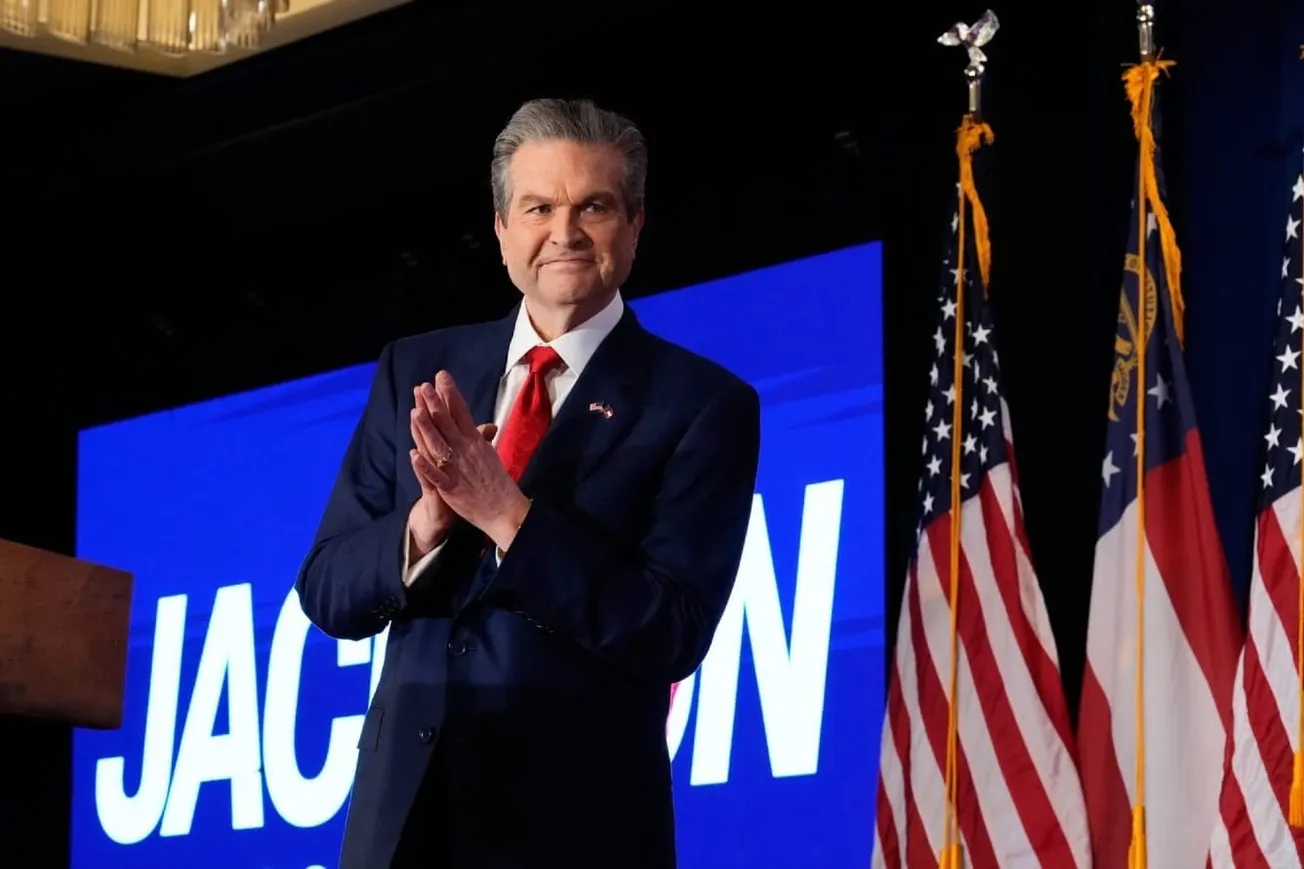

Americans like free enterprise considerably more than capitalism. A new TIPP Poll shows just how wide the difference is.
Two-thirds of Americans (67%) hold a favorable opinion of free enterprise, compared with 51% who say the same of capitalism, while socialism trails at 39%. The 16-point gap between the first two terms suggests that some Americans who support the principles of a market economy are uneasy with the label most often attached to it.
The Capitalism Paradox
Free enterprise and capitalism are closely related ideas, both resting on private ownership and market competition, yet many Americans see a difference between them. The October TIPP Poll asked 1,488 adults whether they held favorable or unfavorable views of free enterprise, capitalism, and socialism, and free enterprise came out well ahead.
The results suggest that Americans are more comfortable with the language of economic freedom than with the system most closely associated with it. One possible reason is that capitalism carries mixed associations, including innovation and prosperity but also corporate concentration and inequality, whereas free enterprise is more likely to suggest small businesses and individual entrepreneurs. The poll did not ask respondents why they distinguish between the terms.
A Rare Point of Bipartisan Agreement
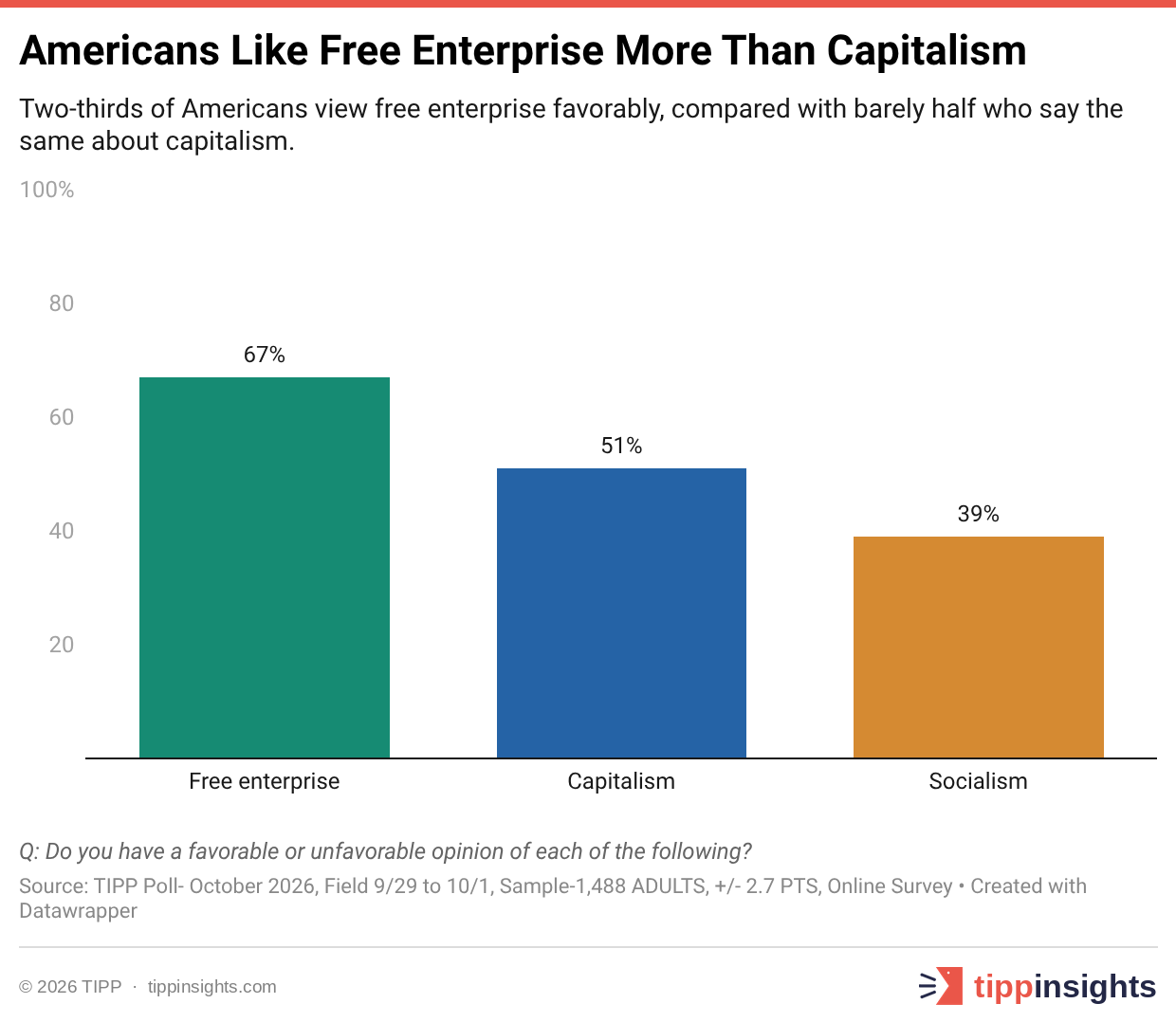
Support for free enterprise extends across party lines. Among Republicans, 76% view free enterprise favorably, compared with 69% who favor capitalism and 38% who favor socialism.
The contrast is sharper among Democrats. Nearly two-thirds (65%) hold a favorable opinion of free enterprise, while only 42% view capitalism favorably, and socialism, at 48%, fares better than capitalism with this group. Among Democrats, free enterprise is 23 points more popular than capitalism and 17 points more popular than socialism. Independents show a similar preference, with 63% viewing free enterprise favorably, compared with 44% for capitalism and 31% for socialism.
Republicans are 27 points more favorable toward capitalism than Democrats, but only 11 points more favorable toward free enterprise.
The two parties still disagree over taxes, regulation, and the role of government, and a shared regard for free enterprise does not settle those questions. The results do show that the idea has support well beyond traditional conservative voters.
Even Liberals Favor Free Enterprise
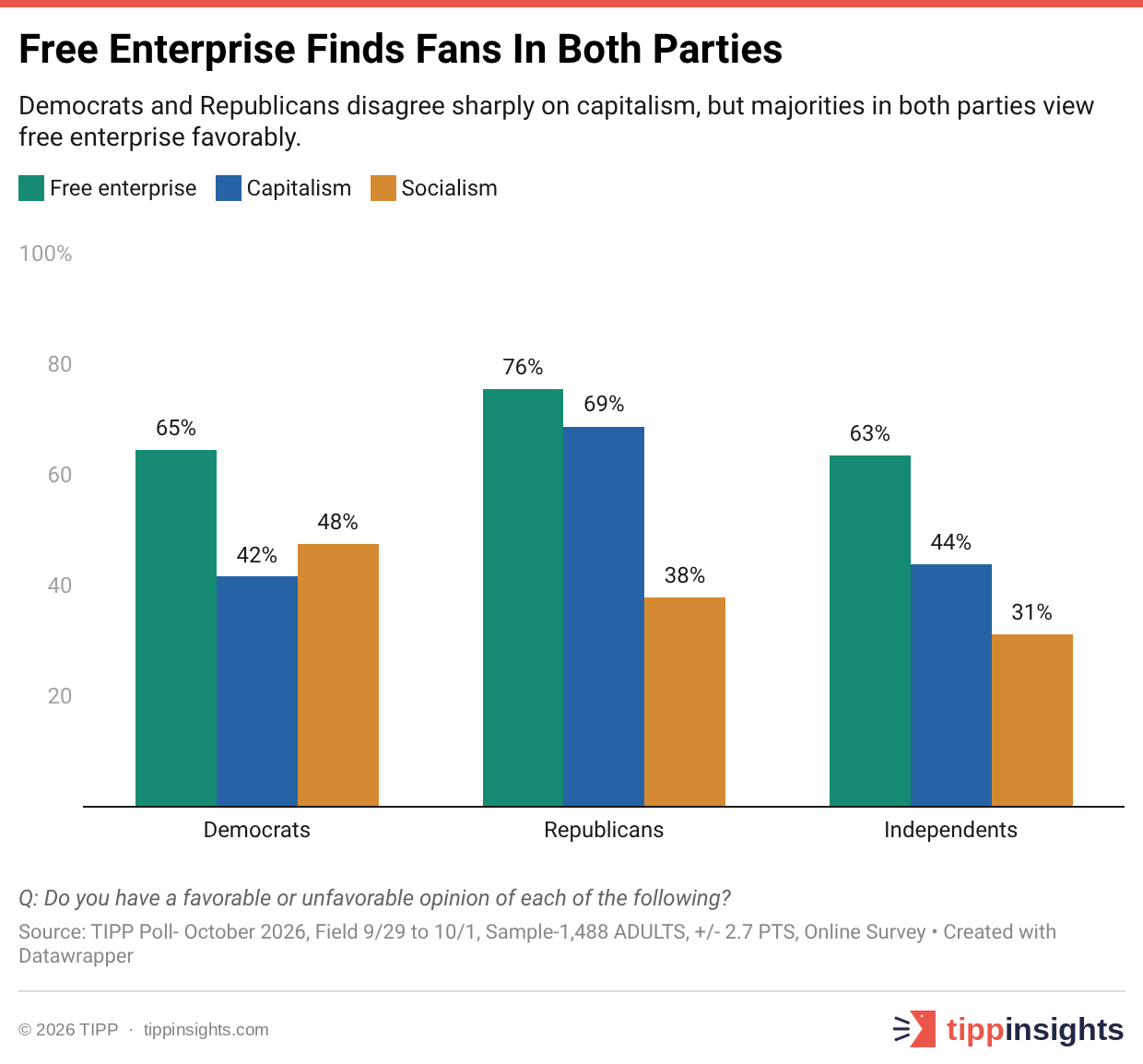
The ideological breakdown shows the same pattern. Among conservatives, 78% view free enterprise favorably, compared with 71% for capitalism and 39% for socialism.
Among liberals, 58% view socialism favorably and 44% favor capitalism, while 67% favor free enterprise, making it the most popular of the three concepts with this group.
Moderates also distinguish clearly among the three, giving free enterprise 62% favorability, compared with 42% for capitalism and 31% for socialism.
These findings suggest that Americans do not divide neatly into capitalist and socialist camps. A person can view free enterprise favorably while supporting a large government role in the economy, and a favorable view of socialism need not mean opposition to private business. The survey measured attitudes toward economic concepts rather than specific policies, so it cannot say how these views translate into policy preferences.
A Generational Twist
Views of capitalism and free enterprise also vary by age. Among Americans aged 18 to 24, the two receive nearly identical favorability ratings, 57% for capitalism and 56% for free enterprise, with socialism at 48%.
Among Americans aged 65 and older, 73% favor free enterprise, while 50% favor capitalism and 19% view socialism favorably.
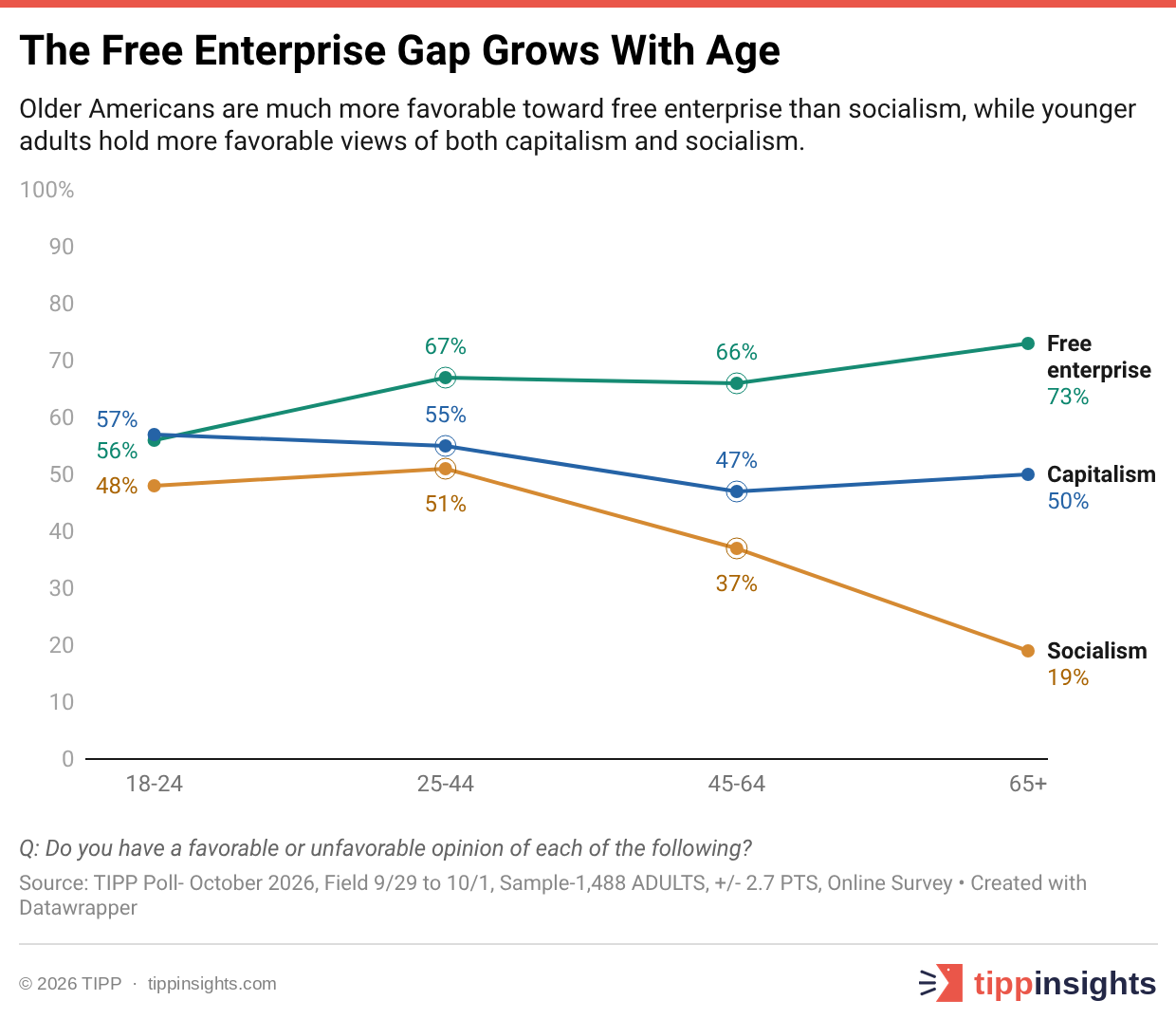
The gap between free enterprise and capitalism is essentially absent among the youngest adults and reaches 23 points among seniors. Support for socialism also declines with age, although not evenly across every age group.
Americans of different ages appear to react differently to these economic labels. Older Americans view free enterprise much more favorably than capitalism, while younger Americans rate all three concepts relatively favorably. As younger Americans make up a growing share of voters, their views on these questions are likely to carry more weight.
The Enduring Appeal of Economic Freedom
A narrow majority of Americans still views capitalism favorably, and support for free enterprise does not imply agreement on how the economy should be organized. The poll does show clear differences in how Americans regard three ideas that are central to the country's economic debates.
Capitalism divides Americans along partisan and ideological lines, and socialism even more so. Free enterprise, by comparison, is viewed favorably by majorities of Democrats, Republicans, independents, conservatives, moderates, and liberals.
These results suggest that some of the disagreement over economic systems may involve the labels themselves. Americans disagree about capitalism and socialism, but free enterprise remains common ground across the political spectrum.
Methodology: The TIPP Poll was conducted online September 29 to October 1, 2026, among 1,488 U.S. adults. The margin of error for the full sample is ±2.7 percentage points. Favorability figures combine “very favorable” and “somewhat favorable” responses. Subgroup results have larger margins of error.
Loved it, hated it, or somewhere in between — tell us. Grade this article here and help shape what lands in your inbox next.
🧭 Power & Capital · October 17, 2026
Where state power meets the boardroom.
🔷 Trump Waives Key Russia Sanctions And Tariffs Ahead Of Implementation – Power & Capital Desk, TIPP Insights
🏛️ National Affairs
The fights shaping America right now.
🟫 Trump Tells Press Secretary Katie Zacharia To “Reconsider” Her Role – TIPP News
🟫 What Happened In The Deadly Shooting At Silver Rail Elementary School In Oregon – TIPP News
🟫 Armed Community Hero Stops Shooting Spree At Oregon Elementary School – Reuters, The Daily Signal
🟫 New Documents Question Key Claims From Trump’s 2019 Impeachment – Fred Lucas, The Daily Signal
🟫 Trump Says Those Who Leak Military Plans Deserve Death Penalty – Elizabeth Troutman Mitchell, The Daily Signal
🟫 DOJ Sues California After State Refuses To Act On Suspected Noncitizen Voters – Angelina Delfin, The Daily Signal
🟫 ‘Should Have Acted Sooner’: Kamala Harris Takes Aim At Biden Over Israel In Potential 2028 Preview – Fred Lucas, The Daily Signal
🟫 Supreme Court Ruling Could Impact The Closing Weeks Of High-Stakes Midterm Advertising Battle – Rich Tucker, The Daily Signal
🟫 Vivek Ramaswamy And Amy Acton: A Contrast Of Events – Rebecca Downs, The Daily Signal
🟫 Washington High School Girls Refuse To Race Against Male Cross-Country Runner – Tyler O’Neil, The Daily Signal
🟫 Poll Suggests How TikTok Shapes Voter Views On Foreign Policy – Caroline Berkness, The Daily Signal
🟫 Poll Shows Tight Race In Virginia’s 2nd Congressional District – Rich Tucker, The Daily Signal
🟫 Rick Jackson For Governor? Opinions From Peach State Voters – Rebecca Buis, The Daily Signal
🟫 Trump Gives Content Creators Economic Boon – Elizabeth Troutman Mitchell, The Daily Signal
🟫 US Measles Cases Surge Past 4,400 As Outbreaks Spread Across 45 States – TIPP News
🟫 Diddy Transferred To Pennsylvania Prison After Reports Of Luxury Life Behind Bars – TIPP News
🟫 Art Installation Connects A Henrico County High School To Germany – Rich Tucker, The Daily Signal
📈 Economy
Prices, policy, and the pressure on your wallet.
🟩 Oil Prices Surge Above $109 As Middle East Conflict Fuels Supply Fears – TIPP News
Letters to the editor email: editor-tippinsights@technometrica.com
Subscribe Today And Make A Difference. Consider supporting Independent Journalism by upgrading to a paid subscription or making a donation. Your support helps tippinsights thrive as a reader-supported publication. Contact us to discuss your research or polling needs.
Reach our audience. For sponsorship and advertising opportunities, visit our Partner With Us page.