Columbus Day falls this year shortly after the United States marked its 250th anniversary, a milestone that invites Americans to consider both where the country has been and where it is headed.
For generations, America has rested on the proposition that freedom, hard work, and determination can lead to a better life. Millions of immigrants came in pursuit of that promise, and millions of native-born Americans assumed their children would achieve more than they had. That assumption became the foundation of the American Dream, and the nation's entry into its next quarter-millennium is a fitting moment to ask whether Americans still hold it.
A new national TIPP Poll suggests that they largely do, with one significant exception. Americans remain overwhelmingly proud of their country, and a clear majority believe the American Dream is still achievable. Yet when asked whether today's children will enjoy a better standard of living than their parents, far fewer express confidence. That divergence may be the most consequential finding of the survey.
American Pride Remains Strong
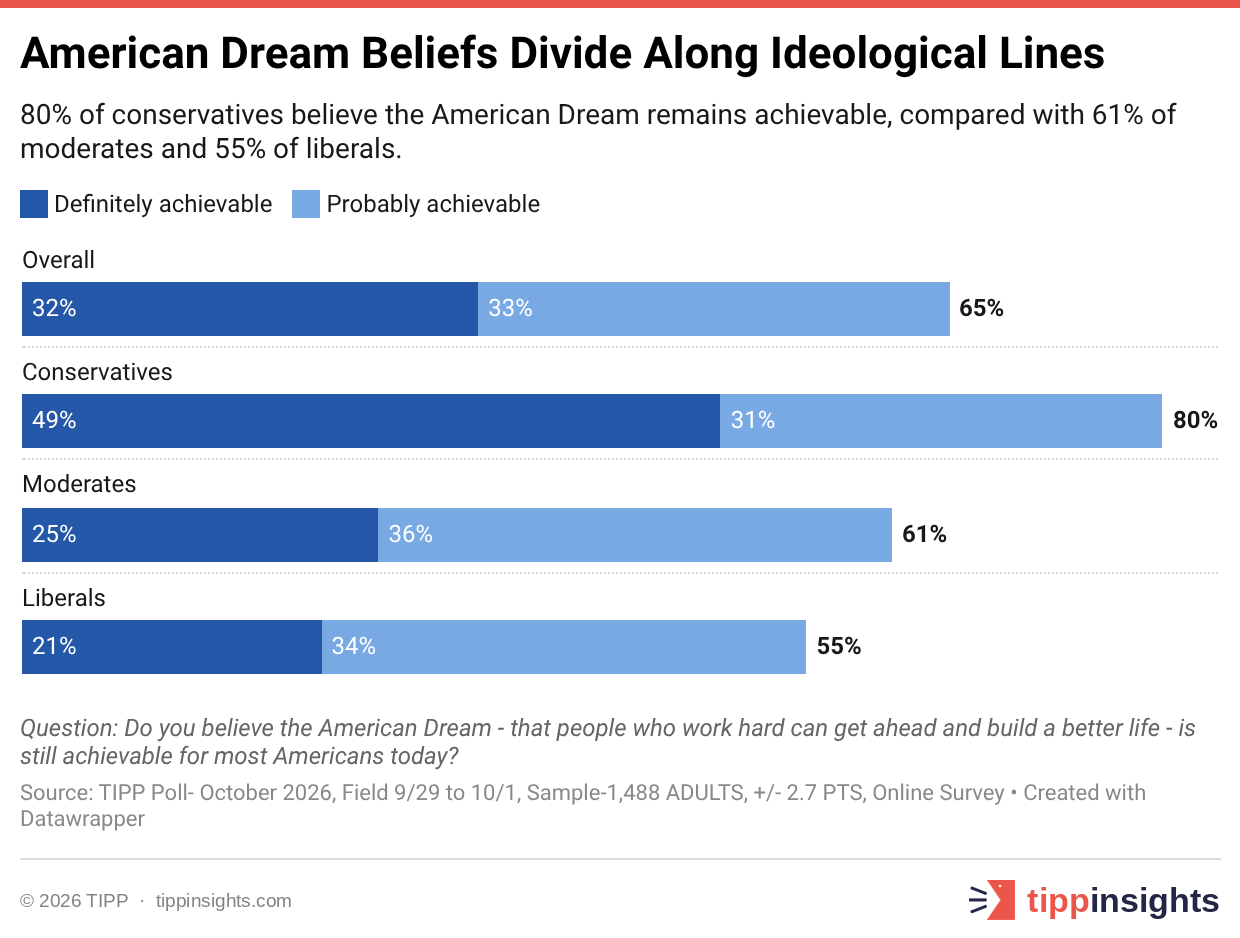
Years of political polarization have not eroded national pride. Two-thirds of Americans (67%) say they are extremely proud (43%) or very proud (24%) to be American.
That sentiment extends across party lines, although its intensity varies considerably. Among Republicans, 86% express strong pride, including 60% who say they are extremely proud. The figure drops to 60% among Democrats and 52% among independents. The 27-point gap between Republicans and Democrats shows how closely patriotism has become tied to political identity.
Still, majorities in all three groups say they are proud of their country. Whatever divides Americans politically, a shared sense of national belonging remains intact.
The American Dream Is Still Alive
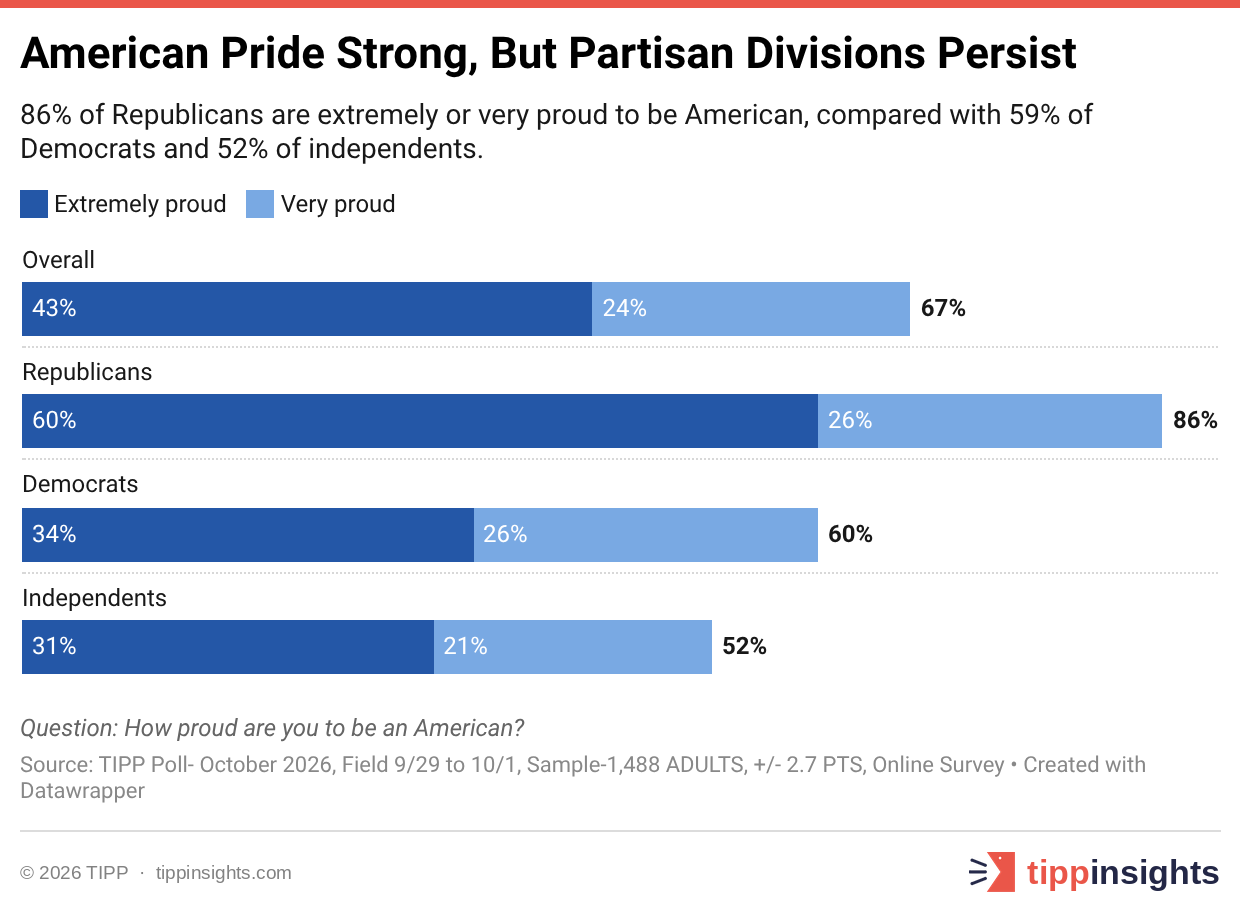
Belief in the American Dream offers a measure of how Americans view the country's promise. The TIPP Poll asked whether the American Dream, defined as the idea that people who work hard can get ahead and build a better life, remains achievable for most Americans today. About two-thirds (65%) said it does, a notable result at a time of high housing costs, household financial strain, and widespread concern about economic opportunity.
The ideological differences are substantial. Eight in ten conservatives (80%) believe the Dream remains achievable, compared with 61% of moderates and 55% of liberals. The gap widens when it comes to conviction, with 49% of conservatives saying the Dream is definitely achievable, compared with 21% of liberals. Americans clearly assess the country's economic promise through different ideological lenses.
Even so, majorities of liberals and moderates still believe that hard work can lead to a better life. The idea retains a strong hold on the national imagination.
But Will the Next Generation Do Better?
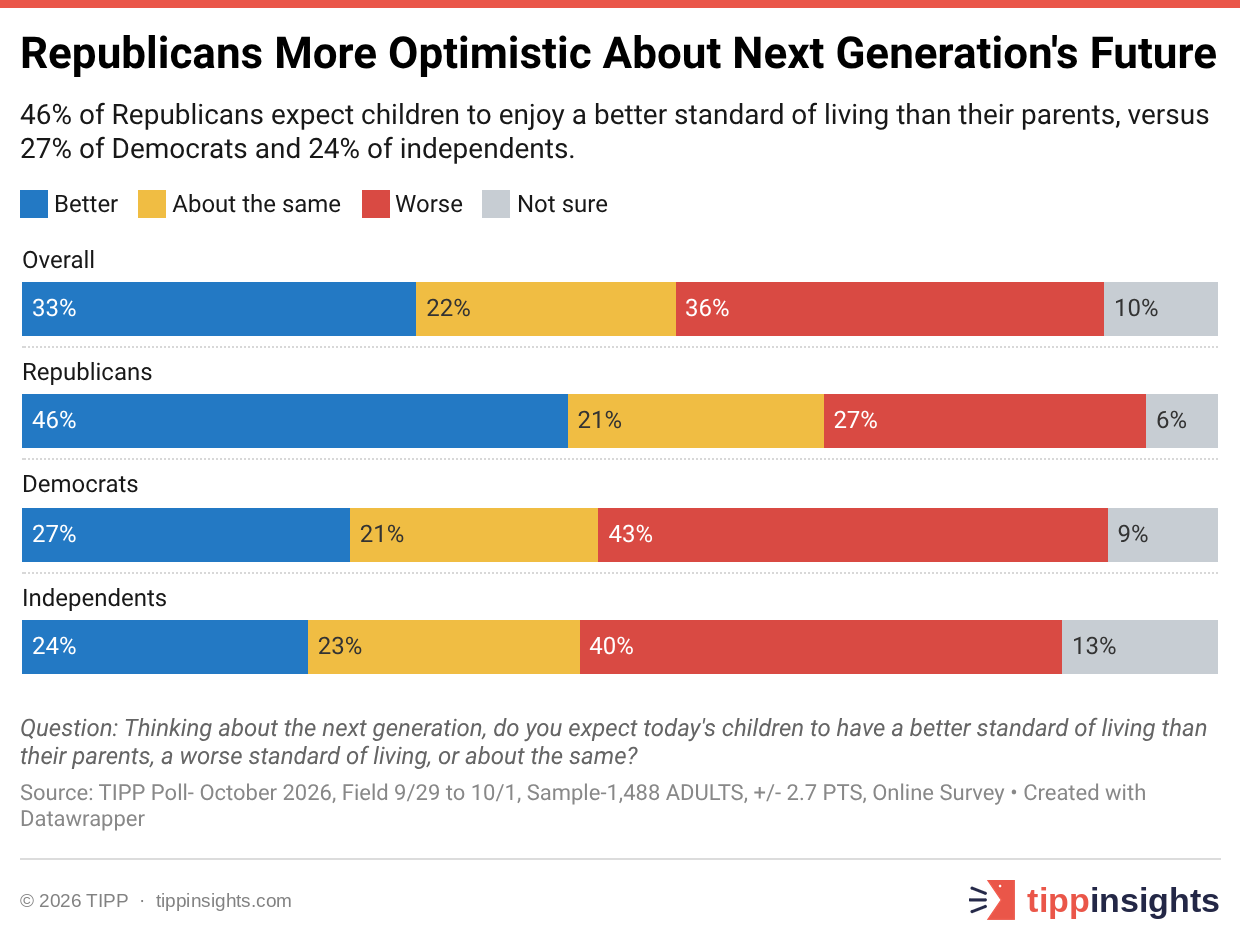
Expectations for the next generation are considerably darker. Asked whether today's children will enjoy a better standard of living than their parents, only 33% of Americans said they will. A slightly larger share (36%) expect them to do worse, 22% expect about the same, and 10% are unsure.
This is the central tension in the survey. Most Americans believe the Dream is still within reach, yet relatively few expect the next generation to be more prosperous than the current one. The two views can coexist, since a person may believe hard work still pays while doubting that economic conditions will allow most children to surpass their parents.
Partisan differences are pronounced here as well. Republicans are the most optimistic, with 46% expecting today's children to have a better standard of living. Just 27% of Democrats share that view, while 43% expect the next generation to be worse off. Independents are similarly pessimistic, with 24% expecting improvement and 40% expecting decline.
Beyond these divisions lies a broader concern. Only about one in three Americans expects the next generation to be better off, and for a country whose identity has long been tied to upward mobility, that finding deserves serious attention.
An Unexpected Generational Divide
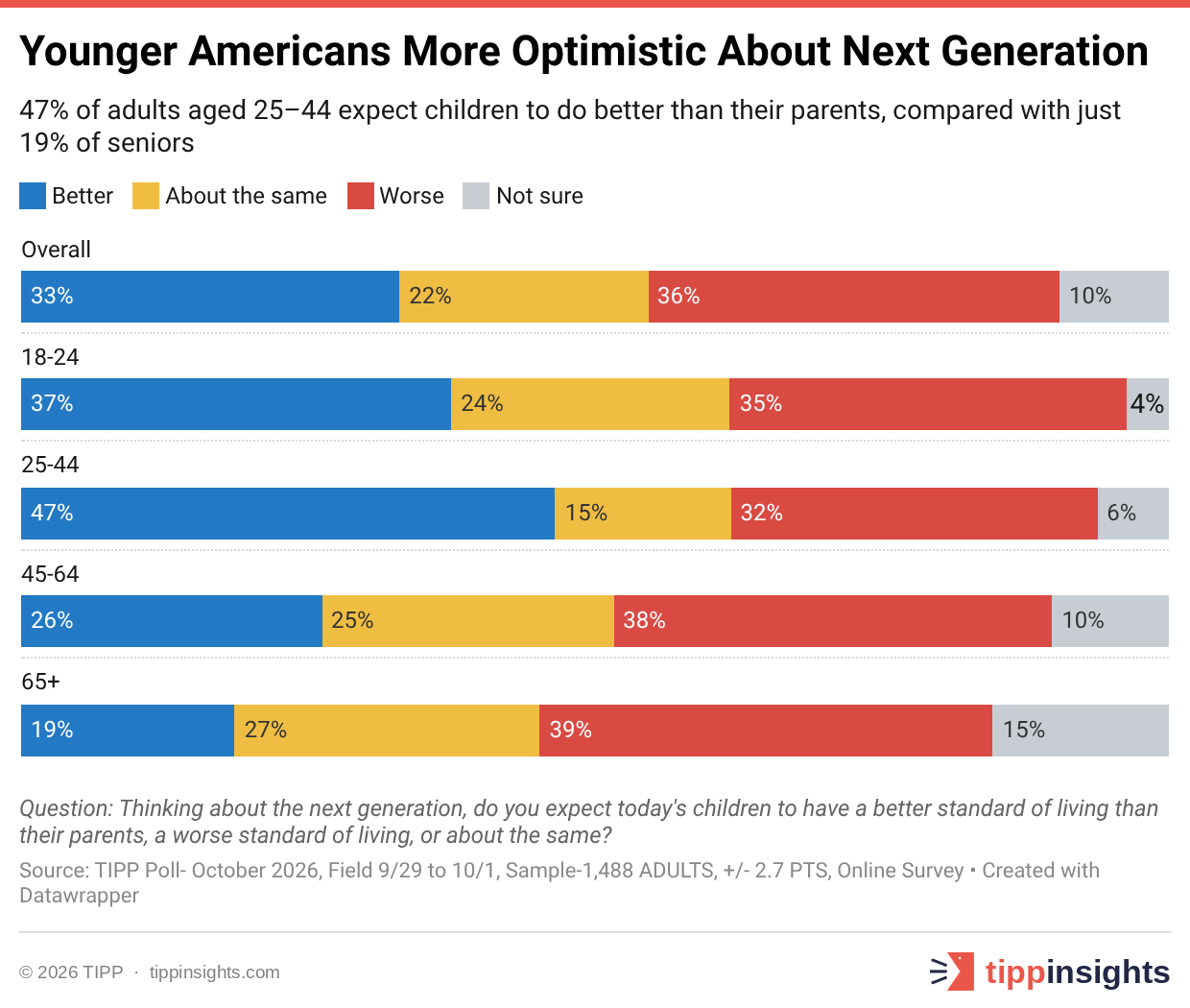
The results by age are especially interesting. Adults aged 25 to 44 are the most optimistic about the next generation, with 47% expecting today's children to have a better standard of living than their parents. Among those aged 18 to 24, the figure is 37%.
Optimism declines with age after that. Only 26% of Americans aged 45 to 64 expect the next generation to do better, and the share falls to 19% among those 65 and older, a 28-point gap between seniors and adults aged 25 to 44.
The survey does not explain these differences, but there are plausible reasons. Older Americans may be comparing today's economy with the opportunities they had earlier in life, when buying a home, paying for an education, and starting a family may have seemed more attainable. Younger adults may see promise in technological innovation, entrepreneurship, and a changing economy.
The most optimistic group is adults aged 25 to 44 rather than the youngest respondents. Because this cohort is managing careers, homeownership, and family responsibilities, its relatively positive outlook is particularly noteworthy.
America's Promise for the Next 250 Years
Columbus Day has long been an occasion to reflect on the voyages that connected continents and shaped the modern world. America's 250th anniversary invites a wider assessment of the nation's achievements, shortcomings, and aspirations.
The October TIPP Poll describes a country that is neither despairing nor uniformly optimistic. Americans remain proud of their country, and most still believe they can get ahead through hard work. Those convictions have sustained the United States through wars, economic depressions, political upheaval, and profound social change.
The survey also reveals real uncertainty about the future. The American Dream has always meant more than individual success. At its core is an intergenerational promise that parents can build a foundation on which their children will achieve more, and many Americans now doubt that promise will hold.
As the country enters its next 250 years, national pride and faith in opportunity will both matter. The larger challenge may be giving the next generation good reason to believe its best days are still ahead.
The national TIPP Poll was conducted online from September 29 to October 1, 2026, among 1,488 U.S. adults. The survey has a credibility interval of ±2.7 percentage points. Results may not total 100% due to rounding. Subgroup results have greater sampling variability. TIPP’s reputation for polling excellence comes from being the most accurate pollster for the past six presidential elections.
Loved it, hated it, or somewhere in between — tell us. Grade this article here and help shape what lands in your inbox next.
Letters to the editor email: editor-tippinsights@technometrica.com
Subscribe Today And Make A Difference. Consider supporting Independent Journalism by upgrading to a paid subscription or making a donation. Your support helps tippinsights thrive as a reader-supported publication. Contact us to discuss your research or polling needs.
Reach our audience. For sponsorship and advertising opportunities, visit our Partner With Us page.