
The media often spin a tale of despondent American voters sitting at home, unengaged and unwilling or unmotivated to vote. But the latest I&I/TIPP Poll suggests that’s not quite right. In fact, a solid majority of voters are quite interested in the outcome of the 2026 midterm congressional elections.
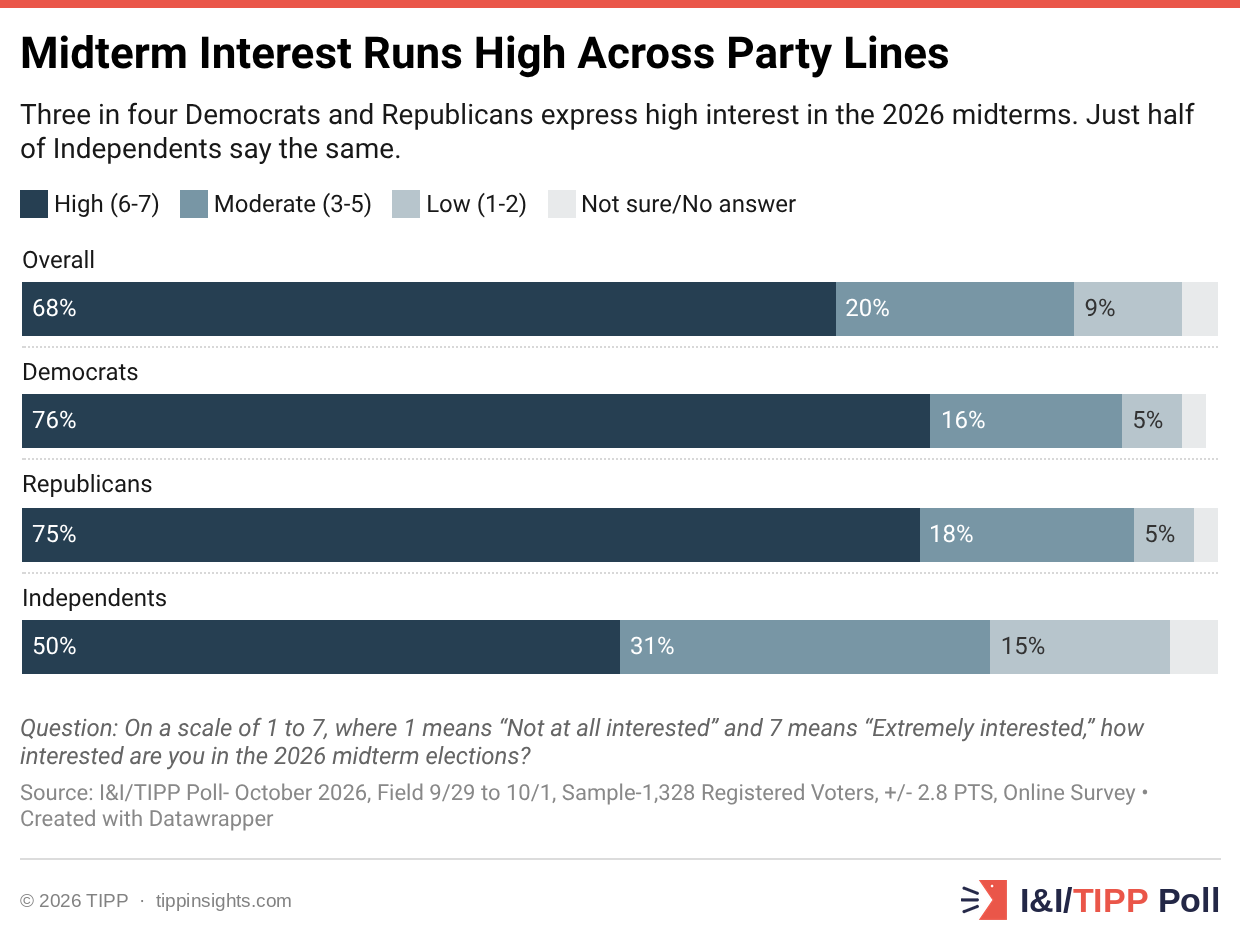
As the elections draw near, I&I/TIPP asked 1,328 registered voters: “On a scale of 1 to 7, where 1 means ‘Not at all interested’ and 7 means ‘Extremely interested,’ how interested are you in the 2026 midterm elections?”
Among those taking the poll, roughly two-thirds — 68% — expressed high interest, with 53% selecting answer 7 and 15% picking just one step below that at 6, the two highest possible answers for interest in the election.
That compares to those with more lukewarm opinions (20% expressing “moderate” interest, with answers of 3-5) or an even smaller percentage picking “low” interest answers (9% picking lowest-ranked answers of just 1 or 2).
What’s more, the two major parties are nearly identical: it’s Democrats (76% “high” interest and 16% “moderate”) and Republicans (75% “high” interest and 18% “moderate”).
The outliers are the swing-vote independents: Just 50% express “high” interest, well below the two major parties, but 31% selecting “moderate” interest answers, much higher than either the Dems or GOP respondents.
The national online poll, taken from Sept. 28 through Oct. 1, has a margin of error of +/-2.8 percentage points.
Plainly, voters are engaged in the coming elections, with 88% total expressing either “high” or “moderate” interest in the outcome. But indie voters, who tend to sit between the two major parties ideologically, may need more coaxing to go to the polls than diehard Democrats and Republicans.
That’s the main issue in nearly every election: Who will vote, who will sit it out?
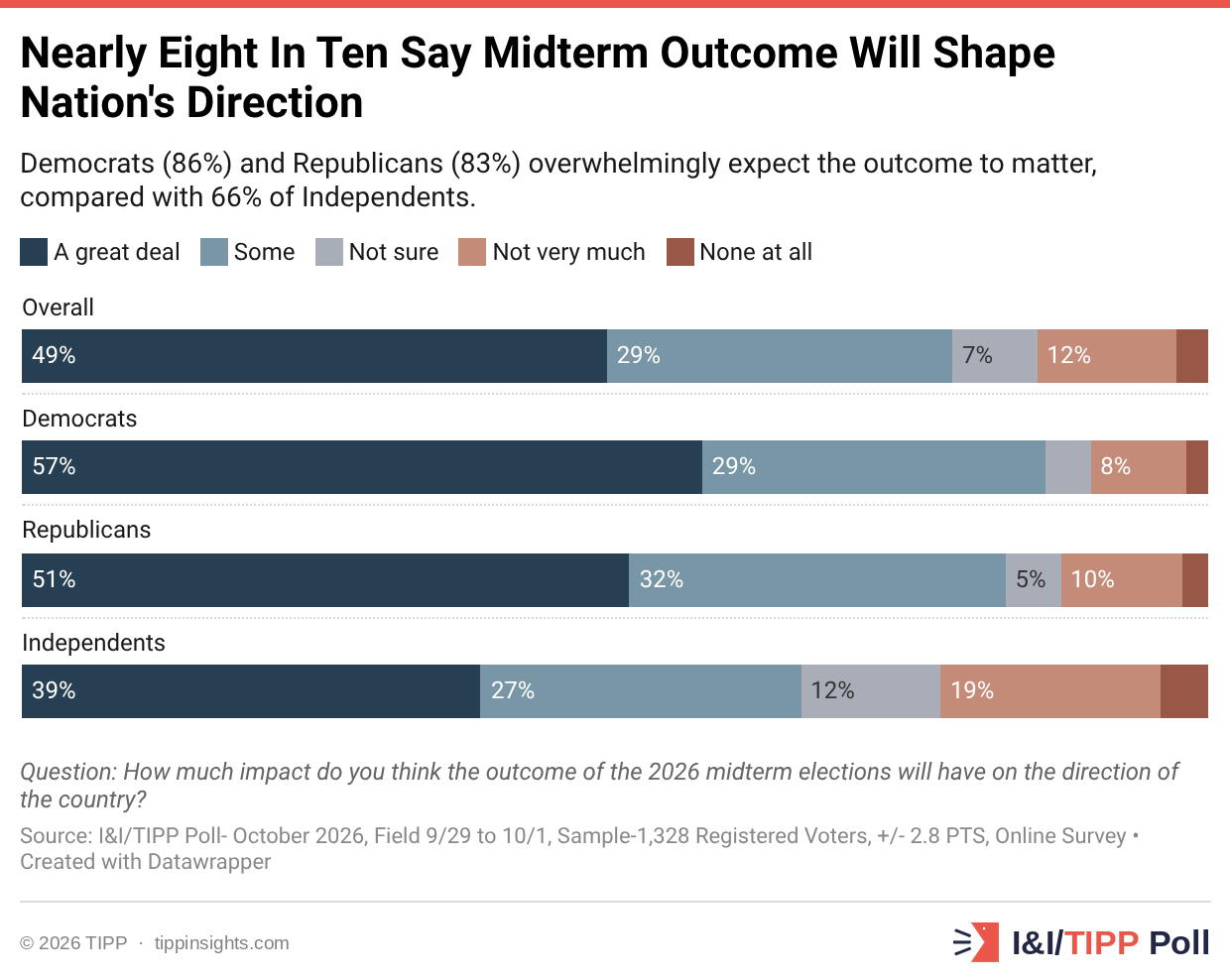
To get at that question another way, I&I/TIPP asked voters the following: “How much impact do you think the outcome of the 2026 midterm elections will have on the direction of the country?”
Once again, voters seem to feel this election will be important, with 78% saying it would either have a “great deal” of impact (49%) or “some” impact (29%). Just 14% thought it would have “not very much” impact (12%) or “none at all” (3%).
This is another case where the two major parties, for their own partisan reasons, see virtually eye to eye on this question. For Democrats, 86% predict a “great deal” or “some” impact, and just 10% say “not much” or “none at all.” For Republicans, it’s 83% “great deal” or “some,” and 12% “not much or none.” Statistically, the same.
Independents show why they got their name. They see things a bit differently, with 66% in the “great deal” or “some” impact group, and nearly a quarter — 23% — in the “not much” or “none at all” group.
So with independents seeing a bit less at stake in this midterm election, both Republicans and Democrats will have their work cut out for them in getting independents to vote for their candidates.
Finally, I&I/TIPP asked: “How confident are you that votes in the November 2026 elections will be counted accurately?”
Overall, 74% responded that they felt “very confident” (37%) or “somewhat confident” (37%), versus just 20% who said they were “not very confident” (13%) or “not confident at all” (7%). While that latter number is low, it still represents one out of five voters in this survey.
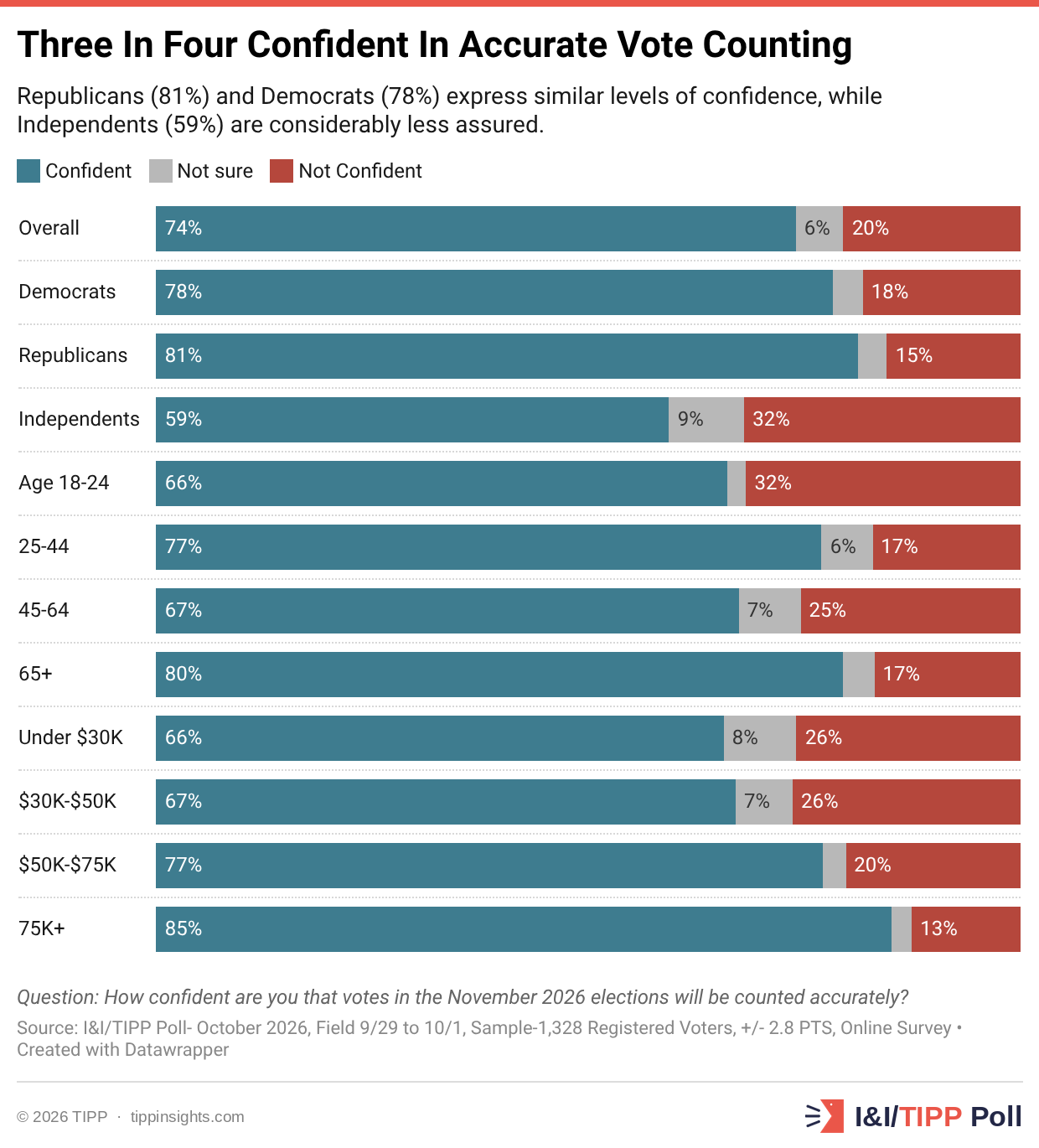
But the two major parties, who generally do the most complaining about vote counting, are most confident that it will all be on the up and up. Among Democrats, 78% were in the “confident” camp, while just 18% said they were not confident. Similarly, 81% of Republicans expressed confidence their votes would be counted accurately, while just 15% were not confident.
Once again, indie voters are most wary about the balloting: Just 59% were confident in the vote-counting process, while 32% (one in three) were not confident.
Also, a significant share of the independent vote again expresses a certain amount of cynicism about the election counting mechanics, and, as a result, will possibly be hard to motivate to vote for either Dem or GOP candidates or issues.
As the numbers above suggest, the two major parties’ focus on independent “swing” voters in the final two weeks of campaigning will be crucial.
“Regardless of the outcome of the 2026 midterm elections, any party that wins the majority will have done so because of the independent vote. For the past several elections, this cohort has been the crucial swing vote that ultimately decides the election,” noted Fox News recently. “Independents are the kingmakers.”
How can indies be kingmakers? They are now the largest share of registered voters, outweighing in number both the Democratic Party and the Republican Party.
How do they lean? Right now, it’s toward the Democrats.
“Democrats have a narrow advantage over Republicans in partisan affiliation among U.S. adults: 47% identify with or lean toward the Democratic Party, and 43% identify with or lean toward the Republican Party,” notes Pew Research.
But 10% of the electorate has not committed to either party and has no expressed opinion. That’s the largest share of uncommitted voters in nearly a decade. That’s the battleground for both parties over the next two weeks.
Much has been made of the GOP’s fundraising campaign. But, according to Federal Election Commission numbers, spending by Democrats has nearly doubled the amount spent by GOP candidates in this year’s Senate races, and exceeds it by 29% for 2026 House races.
Yet, the margin between the parties remains close. While most voters are interested in this year’s midterm election outcome, a sizable chunk of 10% remain pretty much up for grabs. That means that once again this year’s election will come down to the final two weeks, as I&I/TIPP’s own data suggest.
I&I/TIPP publishes timely, unique, and informative data each month on topics of public interest. TIPP’s reputation for polling excellence comes from being the most accurate pollster for the past six presidential elections.
Terry Jones is an editor of Issues & Insights. His four decades of journalism experience include serving as national issues editor, economics editor, and editorial page editor for Investor’s Business Daily.
Loved it, hated it, or somewhere in between — tell us. Grade this article here and help shape what lands in your inbox next.
🧭 Power & Capital · October 30, 2026
Where state power meets the boardroom.
🔷 Why Is Carney Choosing China Over America? – Victor Davis Hanson, The Daily Signal
🌍 Global Affairs
The world's flashpoints, in motion.
🟥 Trump Says Vance’s Outreach To Iran Focused On Medical Supplies – TIPP News
🟥 US Proposes 2027 Venezuela Elections, Opposition Leader Says – TIPP News
🟥 The American Government’s Shameful Economic Warfare Against Cuba – Birsen Filip, Mises Wire
🟥 Kurdistan’s Liberty: A Consequence Of Its Pre-State Condition? – Soleyman Abdi, Mises Wire
🟥 The Polish “Golden Liberty” And The Myth Of Multicultural Equality – Jeremy E. Powell, Mises Wire
🏛️ National Affairs
The fights shaping America right now.
🟫 Raffensperger Assures Of Election Integrity Amid DOJ’s Deployment Of Election Watchers – Rebecca Buis, The Daily Signal
🟫 ‘Systemic Marginalization’ Of ‘Transgender Women’: Inside The Woke NIH Grants Trump Slashed – Elizabeth Troutman Mitchell, The Daily Signal
🟫 Tim Moore Questions Democrat Opponent’s Fitness For Congress After Felony Summons – Virginia Grace McKinnon, The Daily Signal
🟫 Millions Spent Against Him. Can This California Republican Win The 48th Congressional District? – Angelina Delfin, The Daily Signal
🟫 New Poll Shows Wisconsin Governor’s Race Is Up For Grabs – Olivia Burdo, The Daily Signal
🟫 6 Days Before Election Day, Michele Tafoya Issues Call To Action To Minnesota Republicans: Show Up And Vote – Caroline Berkness, The Daily Signal
🟫 The Midterms, JD Vance, And The Working-Class Realignment – Frank DeVito, The Daily Signal
🟫 Iran, The Midterms, And The Myth Of Government By The People – Connor O’Keeffe, Mises Wire
🟫 Texas Law Enforcement Miscast As Villains In Immigration Debate – Lauren Washburn, The Daily Signal
🟫 Revisiting Black Labor In Confederate Virginia – Wanjiru Njoya, Mises Wire
🟫 The Politician Under Troy Jackson’s Logging Jacket – Michael Freund, The Daily Signal
🟫 National First Responders Day And The People Who Saved My Son – Bridget E. Bean, The Daily Signal
🟫 Senate Hesitates On Permanent Daylight Saving Time Despite Trump’s Push – TIPP News
🟫 Watch: Obama Laughs Off Trump’s Outrage Over Renovation Joke – TIPP Video
🟫 Patrick Stewart, Star Trek And X-Men Icon, Dies At 86 – TIPP News
🟫 Why Modern Car Headlights Are Blinding Drivers More Than Ever – TIPP News
📈 Economy
Prices, policy, and the pressure on your wallet.
🟩 Economists Who Support Statism At The Expense Of Freedom – Finn Andreen, Mises Wire
💼 Markets & Business
The deals and tickers making moves.
🟧 Microsoft Turns To Bond Market To Fund Expanding AI Infrastructure – TIPP News
🟧 Polymarket Probes Suspicious Bets On Israel’s Election – TIPP News
📊 Market Mood · October 30, 2026
How the trading day is setting up.
🟥 AI spending fears are triggering another technology selloff. Nasdaq futures are down more than 2% after disappointing results from Amazon and Intel, as investors question the mounting costs and returns of AI investments.
🟧 Oil is surging amid fresh Middle East attacks. Brent has climbed above $116 a barrel following another tanker attack in the Strait of Hormuz, renewing concerns about energy supplies and inflation.
🟦 Treasury yields are falling as investors seek safety. The 10-year yield has slipped toward 4.91%, putting bonds on track for their strongest monthly performance in nearly three years.
🟨 Strong economic growth is complicating the Fed's outlook. Third-quarter GDP expanded 3.4%, exceeding expectations, while persistent inflation and Wednesday's decision to hold rates steady leave another December hike in focus.
🗓️ Key Economic Events
On today's U.S. data calendar.
🟧 8:30 a.m. ET — Employment Cost Index (Q3)
Forecast: +0.8% q/q | Previous: +0.9% q/q
Labor costs are expected to moderate slightly, providing an important indication of wage-driven inflation pressures.
🟧 9:45 a.m. ET — Chicago PMI (October)
Forecast: 55.8 | Previous: 58.8
Business activity in the Chicago region is expected to slow but remain in expansion territory, offering an early indication of manufacturing conditions ahead of Monday's ISM report.
Letters to the editor email: editor-tippinsights@technometrica.com
Subscribe Today And Make A Difference. Consider supporting Independent Journalism by upgrading to a paid subscription or making a donation. Your support helps tippinsights thrive as a reader-supported publication. Contact us to discuss your research or polling needs.
Reach our audience. For sponsorship and advertising opportunities, visit our Partner With Us page.