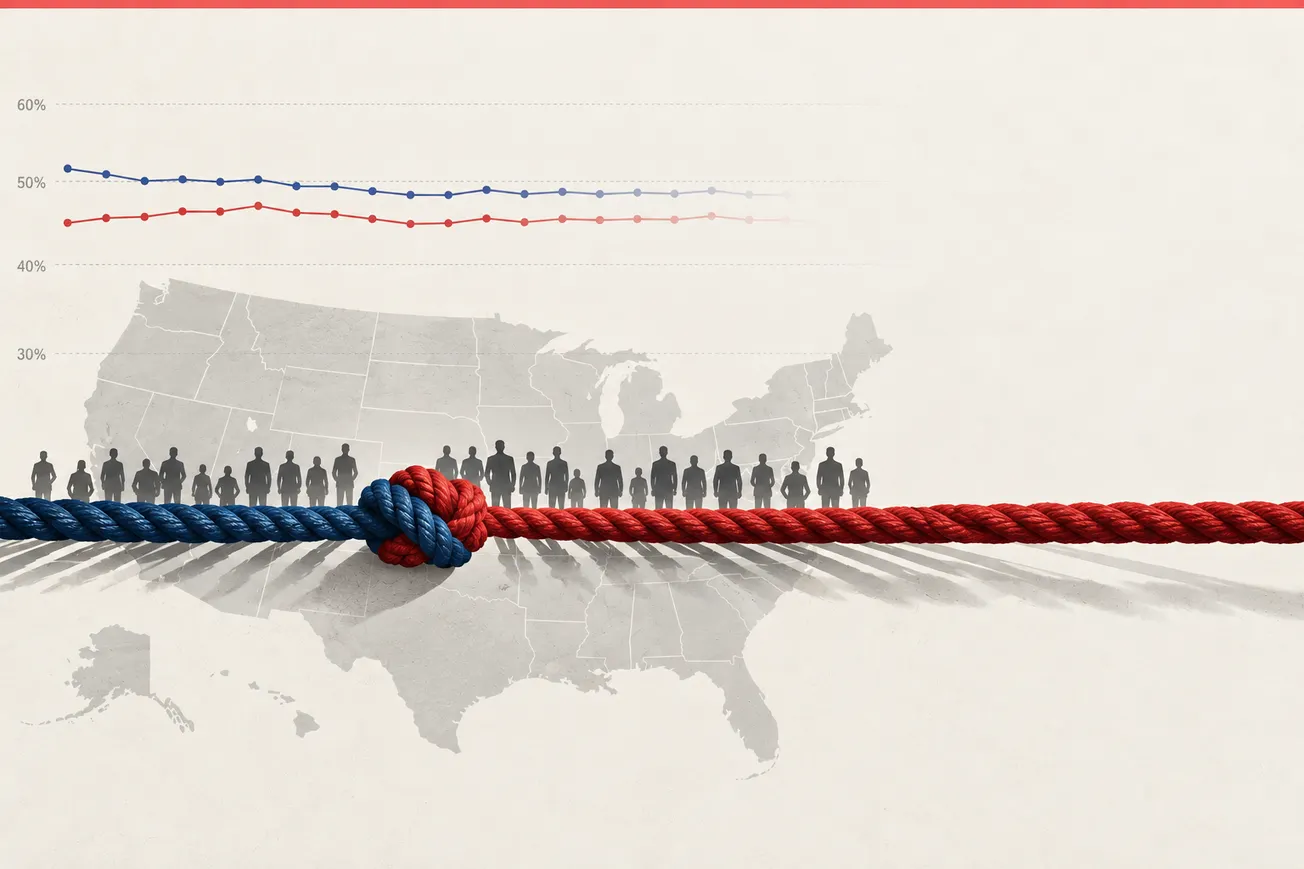
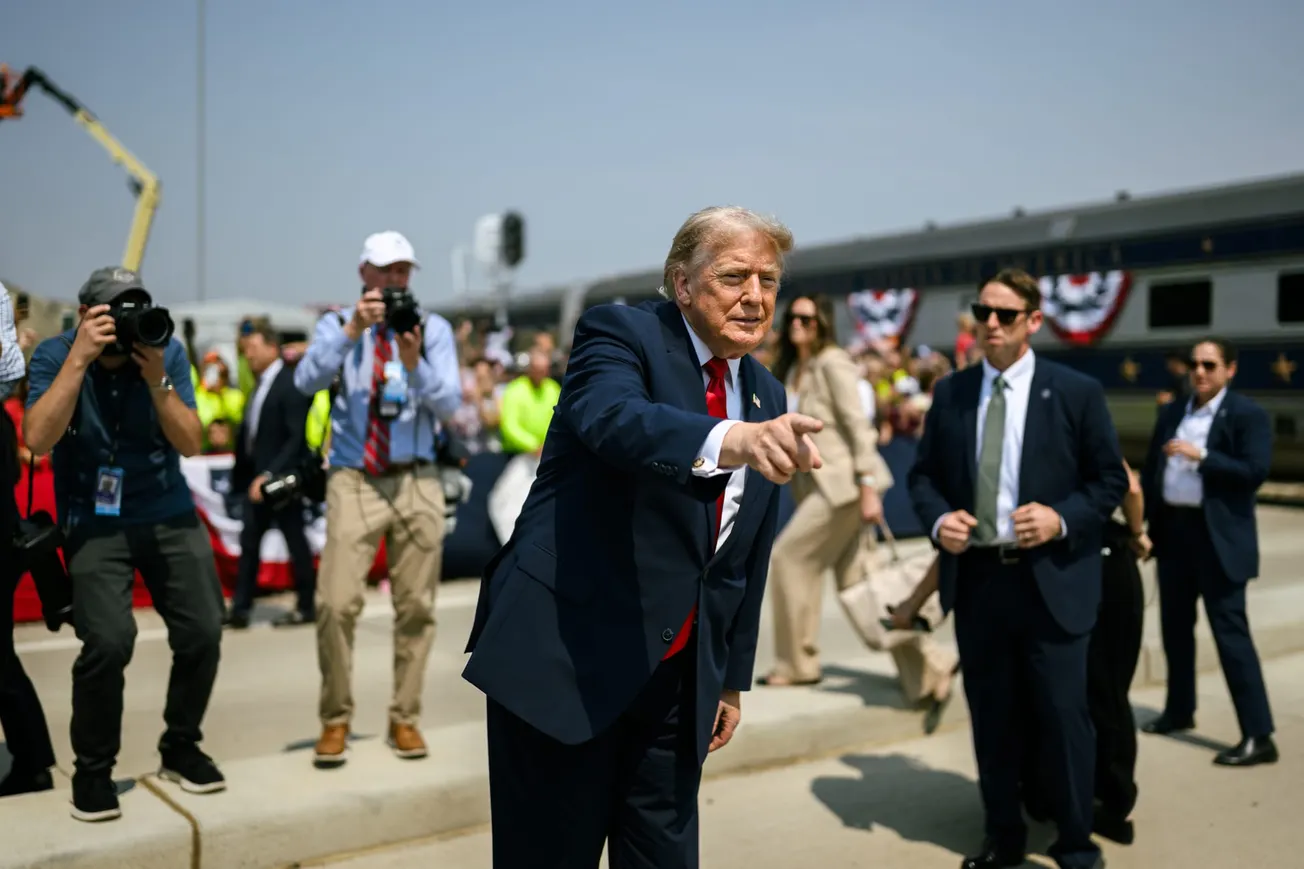
President Donald Trump's favorability ratings have suffered this year as higher oil prices and a persistent armed conflict with Iran have upset many voters. But with energy prices down in recent weeks, and ongoing talks with Iran, Trump may be turning a corner in public opinion, the latest I&I/TIPP Poll suggests.
The national online I&I/TIPP Poll each month asks voters to grade the president's performance. Voters are asked four questions, starting with: "Overall, is your opinion of Donald Trump generally favorable, generally unfavorable, or are you not familiar enough to to say one way or the other?"
In July, there appears to be some overall improvement for Trump, with 40% giving him a "favorable" score, and 52% giving him an "unfavorable" score, a negative 12 percentage point difference. That compares to just 37% favorable, 53% unfavorable in June, for a 16 percentage point gap. Another 5% said they were "not familiar enough to say," while 4% called themselves "unsure."
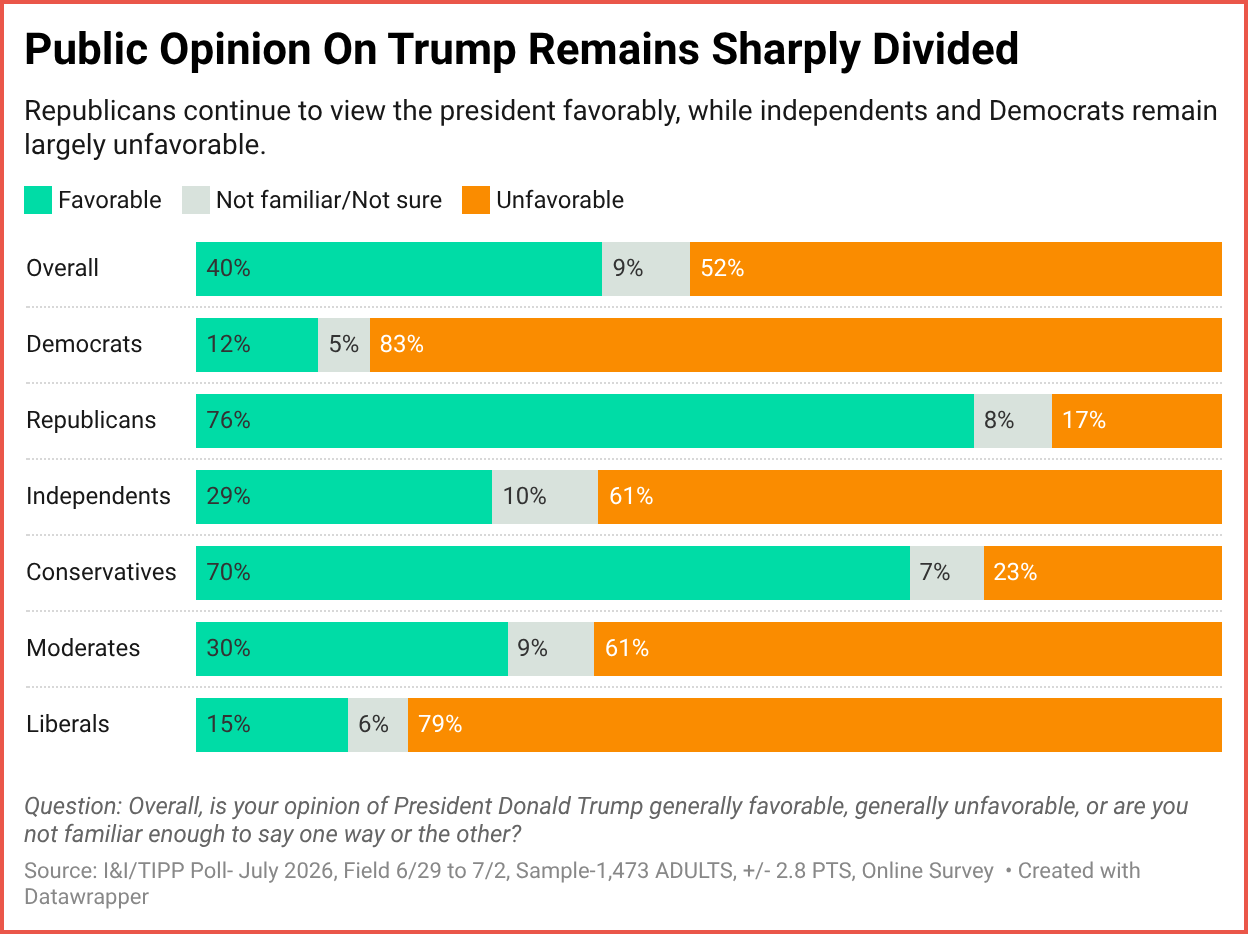
July's poll, taken from June 29 through July 2, included a sample of 1,473 adults, with a margin of error of +/-2.8 percentage points.
How did this turnabout occur? Trump shored up his Republican base and gained ground with independent voters, while Trump's esteem among Democrats continued to evaporate.
In July, registered Republican voters gave Trump a 76% favorability, up from 72% in June, while his unfavorable ratings dipped to 17%, down from 20% in June. At the same time, independents' favorability ratings for Trump edged up to 29% in July from 25% in June.
That leaves Democrats. Their favorable ratings for Trump continued to edge downward, to 12% in July from 13% the month earlier, while the unfavorable ratings rose to July's 83% from 81% in June.
The second question each month asks: "In general, do you approve or disapprove of the way Donald Trump is handling his job as president, or are you not familiar enough to say one way or the other?"
Overall there was little change in July, with 54% saying they disapprove, and 38% saying they approve, for a gap of negative16 percentage points. June's job-performance data were nearly identical, with the only difference being a 37% "approve" response, one point less than in July.
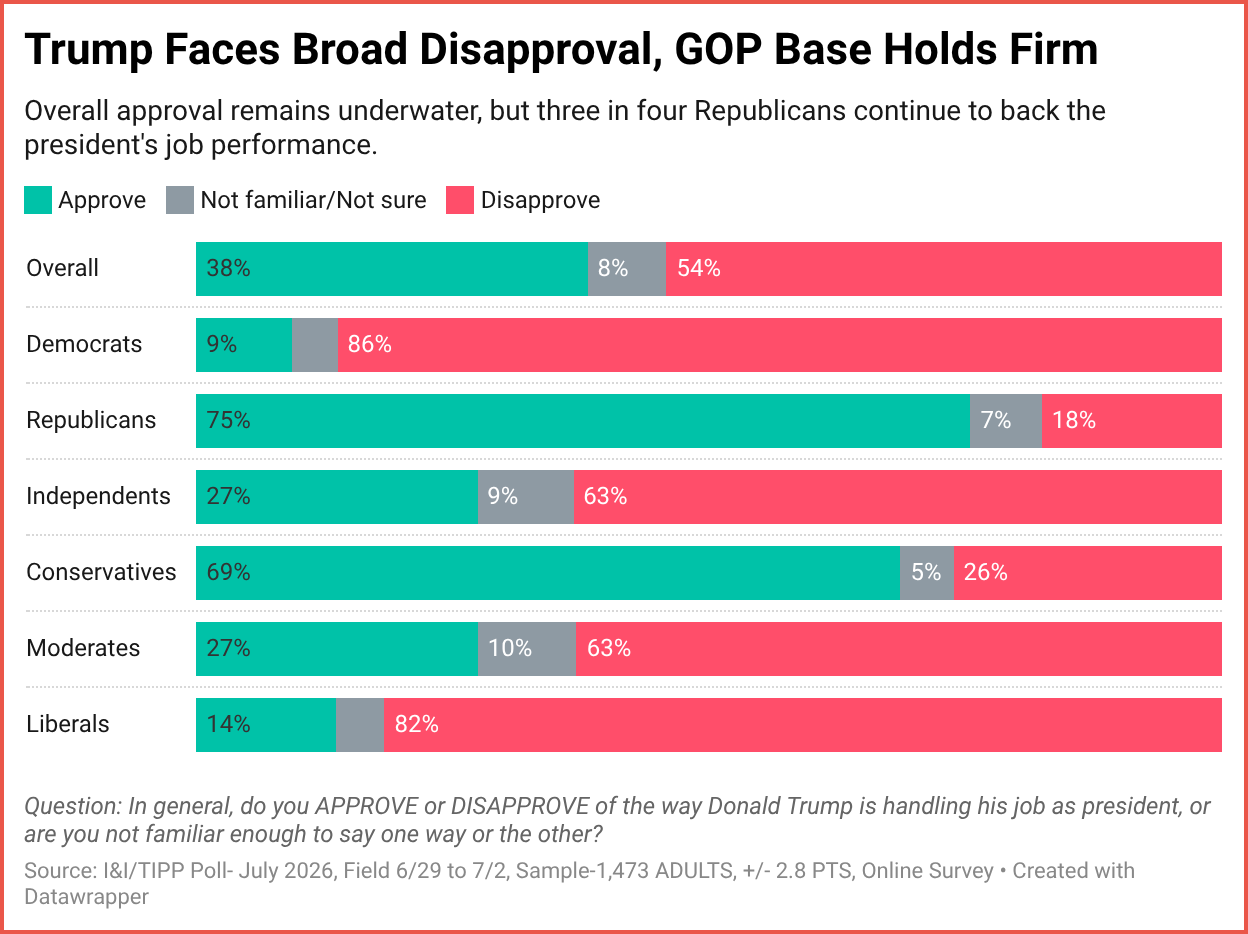
Once again, political affiliation was key in understanding the larger movement in Trump's ratings.
Democrats in July (86% disapprove, 9% approve) were again gloomier than they were in June (83% disapprove, 13% approve), as that party's voters selected a spate of candidates for public office that leaned sharply toward the socialist left.
Among independent voters, Trump's job approval rose slightly in July (63% disapprove, 27% approve) from June's reading (62% disapprove, 24% approve).
But Trump also regained some lost approval within his own party in July (18% disapprove, 75% approve) a clear improvement after June's readings (21% disapprove, 71% approve).
A third question asked voters: "How would you describe the leadership that President Trump is providing for the country?"
Of these responses in July, 37% said either "very strong" (22%) or "strong" (15%), while 46% responded "weak" (11%) or "very weak" (35%). Another 14% called Trump's leadership "moderate." In June, meanwhile, 36% described Trump's leadership as either "very strong" (20%) or "strong" (16%), while 45% responded "weak" (11%) or "very weak" (34%). And 16% called Trump's leadership "moderate."
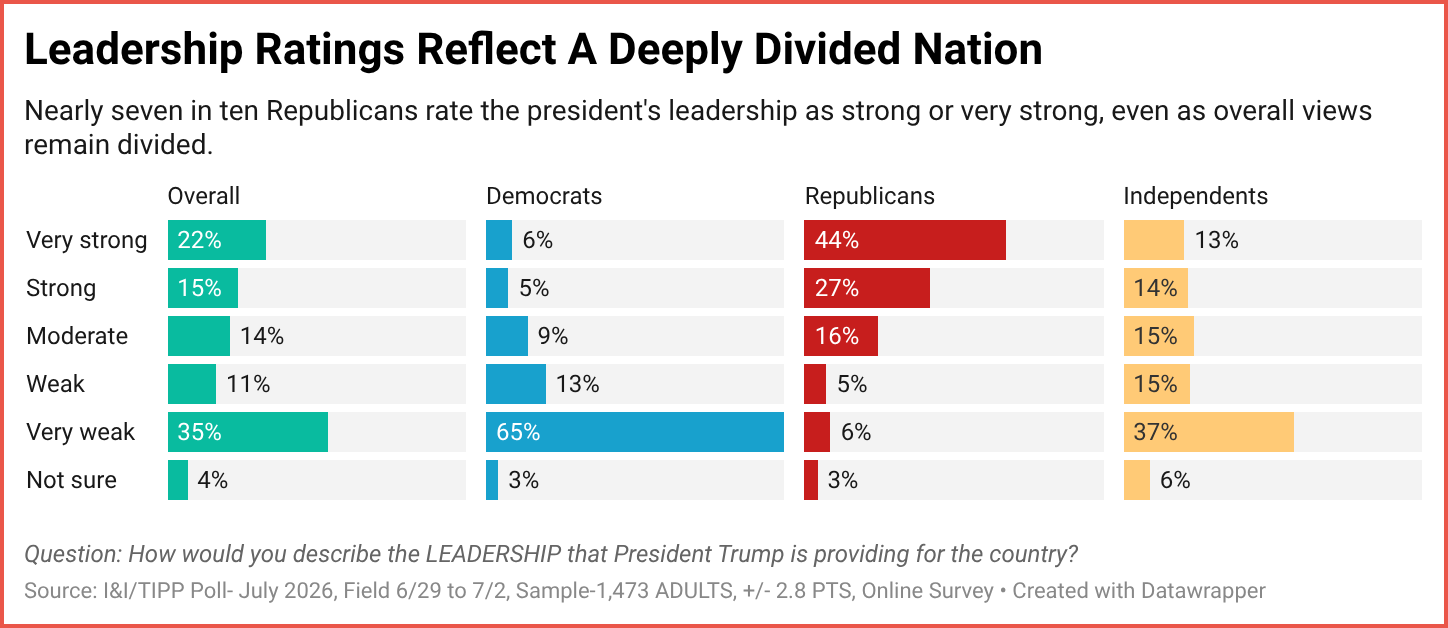
Once again, partisanship drives the leadership numbers in different directions.
In July, among Democrats, Trump gets a net "weak" rating of 78%, while he nets just 11% for "strong" and 9% for moderate. Indie voters give a net 52% "weak" score, a 27% "strong" score, and 15% for "moderate."
Republicans? They see a very different president: Net weak: 11%. Net strong: 71%. Net moderate: 16%.
So even by strength of leadership measures, President Trump proves to be a politically divisive figure, especially among Democrats.
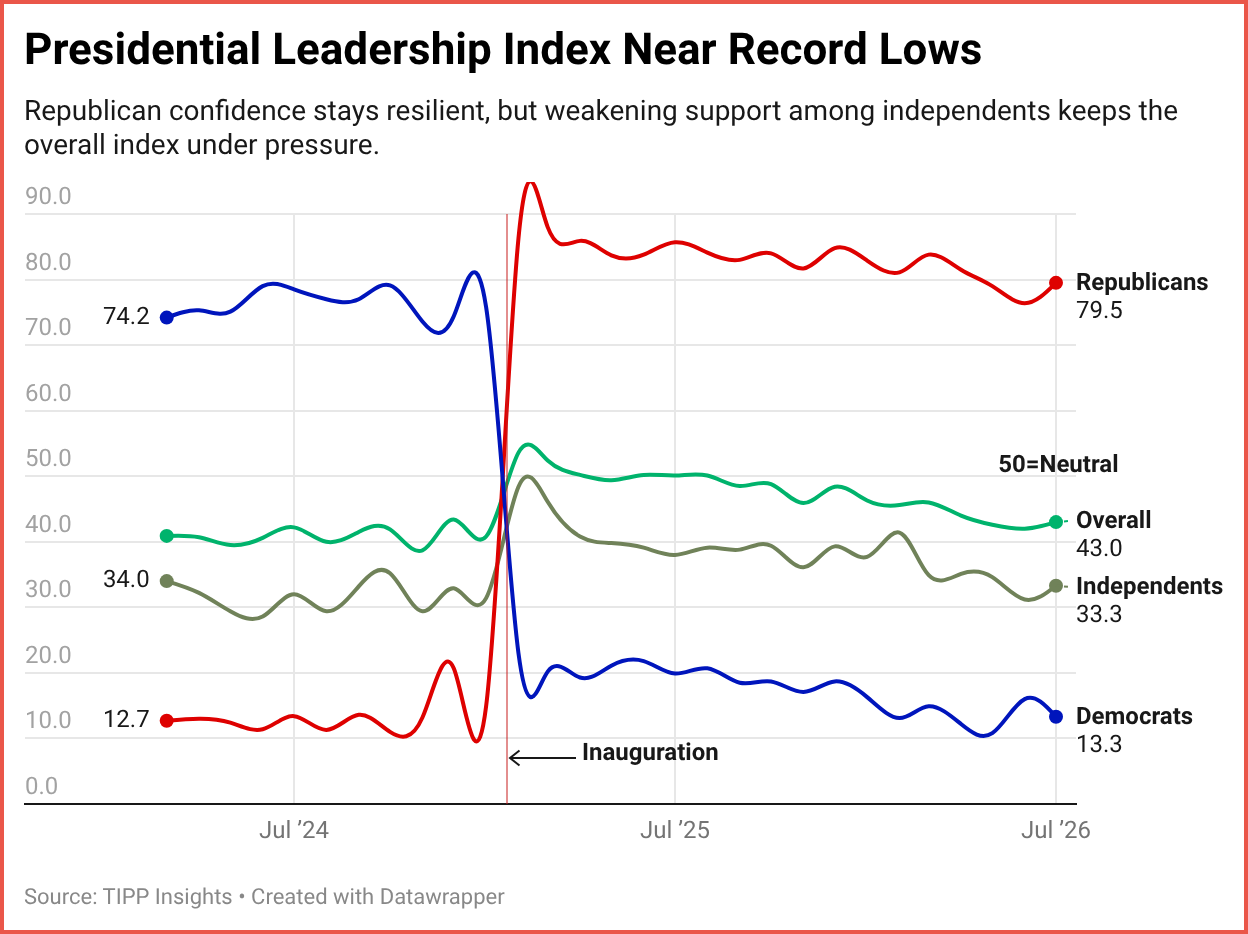
Each month, I&I/TIPP Poll also produces its proprietary Leadership Index, giving the president an overall score based on all the data.
What does July's I&I/TIPP Leadership Index, below, show? Trump again remains fairly solid within his own party, but is weakening noticeably among others. That has pulled the overall index down from close to 50 late last year to 43.0. And the trend isn't favorable.

I&I/TIPP also asks voters to give school-style grades — A (excellent), B (good), C (average), D (poor) and F (unacceptable) — for overall presidential performance and for individual policy issues.
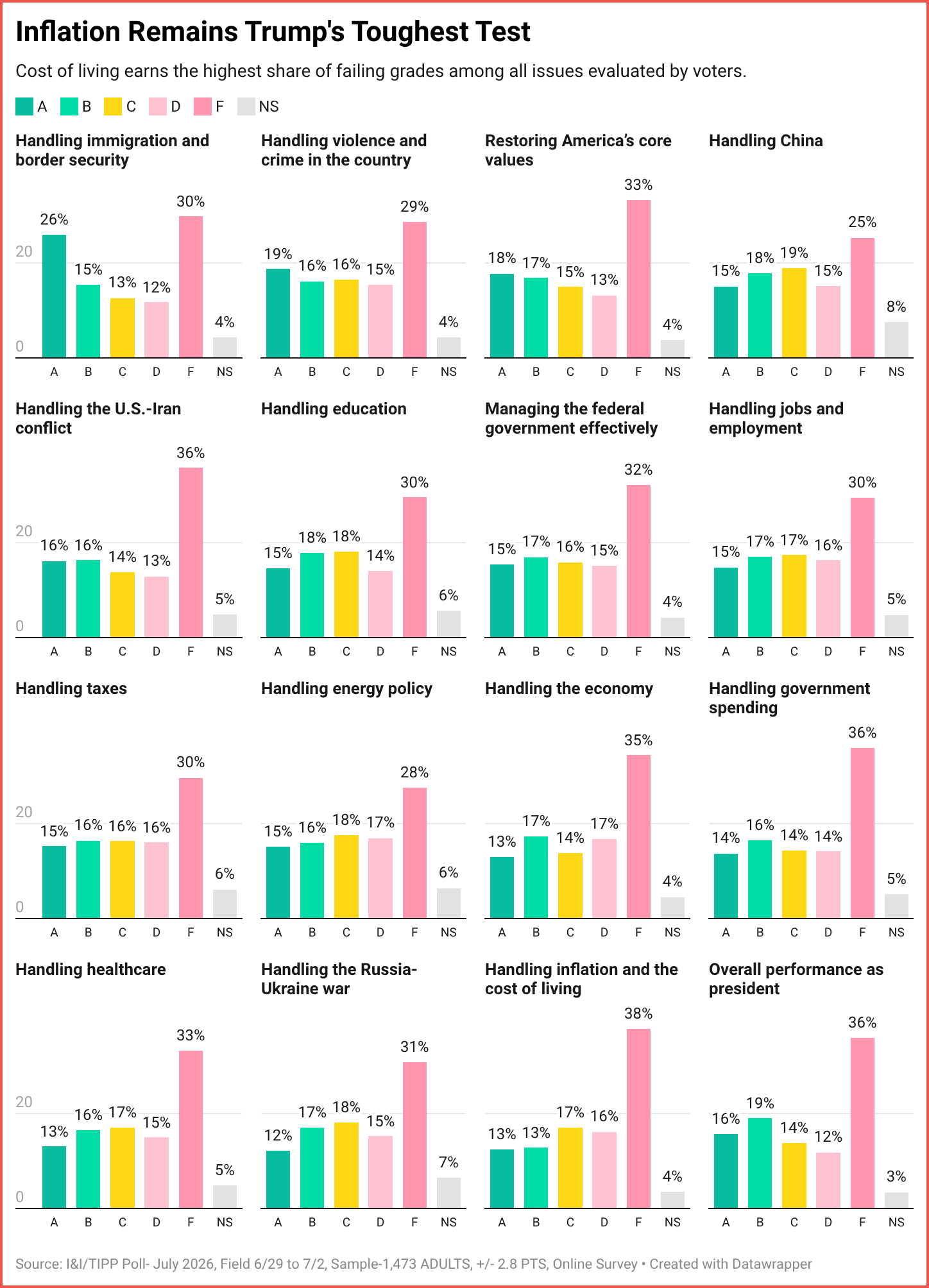
In July, Trump received overall 35% As and Bs for his policy performance, the first increase in four months. In June, voters assigned Trump 34% As and Bs for his presidential policies. That was down from May’s 36%, April’s 37% and March’s 38%.
Trump's grades fell among Democrats in July, declining to 9% As and Bs after getting 12% As and Bs in June. His share of As and Bs from Republicans rose to 68% in July from 64% in June, while his share of the top two grades from independents rose slightly to 25% in July from 24% in June.
I&I/TIPP also asks voters to give specific grades for 15 separate policies.
Trump’s top grades (that is, share of A and B grades from voters) were given for “Handling immigration and border security” (45%), “Handling violence and crime in the country” (37%), and “Restoring America’s core values” (36%).
His lowest percentage of A and B grades came from “Handling inflation and the cost of living” (26%), “Handling healthcare” (30%), and “Handling government spending” and “Handling the Russia-Ukraine war” (both at 31%).
The remaining eight policy areas all received 33% or 34% As and Bs.
June's grades represent a rebound of sorts for Trump on most issues. As noted last month, five issues received scores below 30% in June. This month, only one did: Inflation and the cost of living.
And voters appear to be quite happy about stepped up enforcement of the U.S. border: That issue's 45% score was five points higher than in June.
Last month's I&I/TIPP poll story wondered: "Can President Trump reverse the slump?" The answer appears to be yes. With the U.S.-Iran war now mostly at the talking stage, and oil prices down sharply, Americans' outlook appears to have brightened a bit.
But the immediate future holds major challenges for President Trump's leadership.
The midterm election for Congress is tight by most measures. The Real Clear Politics average of recent party-preference polls for the 2026 election shows Democrats having a 5.6 percentage point edge over the Republicans in the upcoming election.
Five percentage points may seem large, but past "blue wave" elections for Democrats have shown leads in June of 11% in 2006 and 10% in 2018. As CNN's poll maven Harry Enten recently reminded viewers, "Now the Democratic lead is on a single hand, one, two, three, four, five points. And it's this type of lead, you know, that you say Democrats are ahead, but don't count your chickens just quite yet."
Do Trump and Republicans in Congress have enough time to reshape and recapture the debate over the future? Will they win the battle for control of Congress, and spare Trump another impeachment by the Democrats? If Trump continues his winning run of policy successes, the latest I&I/TIPP Poll suggests the answer could be yes.
I&I/TIPP publishes timely, unique, and informative data each month on topics of public interest. TIPP’s reputation for polling excellence comes from being the most accurate pollster for the past six presidential elections.
Terry Jones is an editor of Issues & Insights. His four decades of journalism experience include serving as national issues editor, economics editor, and editorial page editor for Investor’s Business Daily.
Loved it, hated it, or somewhere in between — tell us. Grade this article here and help shape what lands in your inbox next.
📊 Market Mood · July 6, 2026
How the trading day is setting up.
🟩 Markets begin the week with a constructive tone as easing oil prices and expectations of a steady Fed support risk appetite ahead of earnings season.
🟧 Investors remain selective in technology shares after June's volatility, with upcoming earnings expected to test whether AI spending can continue to justify lofty valuations.
🟦 Oil prices are hovering near four-month lows after OPEC+ agreed to raise production again and shipping through the Strait of Hormuz continued to recover, helping ease inflation concerns.
🟨 Attention now shifts to Wednesday's Fed minutes and the unofficial start of earnings season, two events that could set the market's direction for the rest of July.
🗓️ Key Economic Events
On today's U.S. data calendar.
🟧 9:45 a.m. ET — S&P Global Services PMI (Final, June)
Forecast: 51.3 | Previous: 51.3
The final reading on June services activity will confirm whether the largest segment of the U.S. economy maintained its recent pace of expansion.
🟧 10:00 a.m. ET — ISM Services PMI (June)
Forecast: 54.2 | Previous: 54.5
The day's most important economic report. A reading above 50 signals expansion, and investors will be watching for signs that the services sector remains resilient while gauging implications for Fed policy.
🟧 Fed Speakers Throughout the Day
Markets will listen for any comments on inflation, interest rates, and the economic outlook ahead of Wednesday's release of the June FOMC minutes.
Letters to the editor email: editor-tippinsights@technometrica.com
Subscribe Today And Make A Difference. Consider supporting Independent Journalism by upgrading to a paid subscription or making a donation. Your support helps tippinsights thrive as a reader-supported publication. Contact us to discuss your research or polling needs.
Reach our audience. For sponsorship and advertising opportunities, visit our Partner With Us page.