
President Donald Trump has played tough with Iran, using the U.S. military to punish that nation’s Islamist regime when it stops talking, and calling off hostile actions when Iran returns to the negotiating table. After five months of this pattern, Americans’ support for U.S. attacks on Iran is lukewarm at best, the latest I&I/TIPP Poll shows.
For the August online national I&I/TIPP Poll, taken from July 28 to Aug. 1, 1,463 adults were asked: “Do you support or oppose U.S. military action against Iran?” The poll’s margin of error is +/-2.9 percentage points.
A total of 42% said they supported military action either “strongly” (22%) or “somewhat,” while a 44% plurality said they opposed it “strongly” (28%) or “somewhat” (16%). Another 14% said they were not sure.
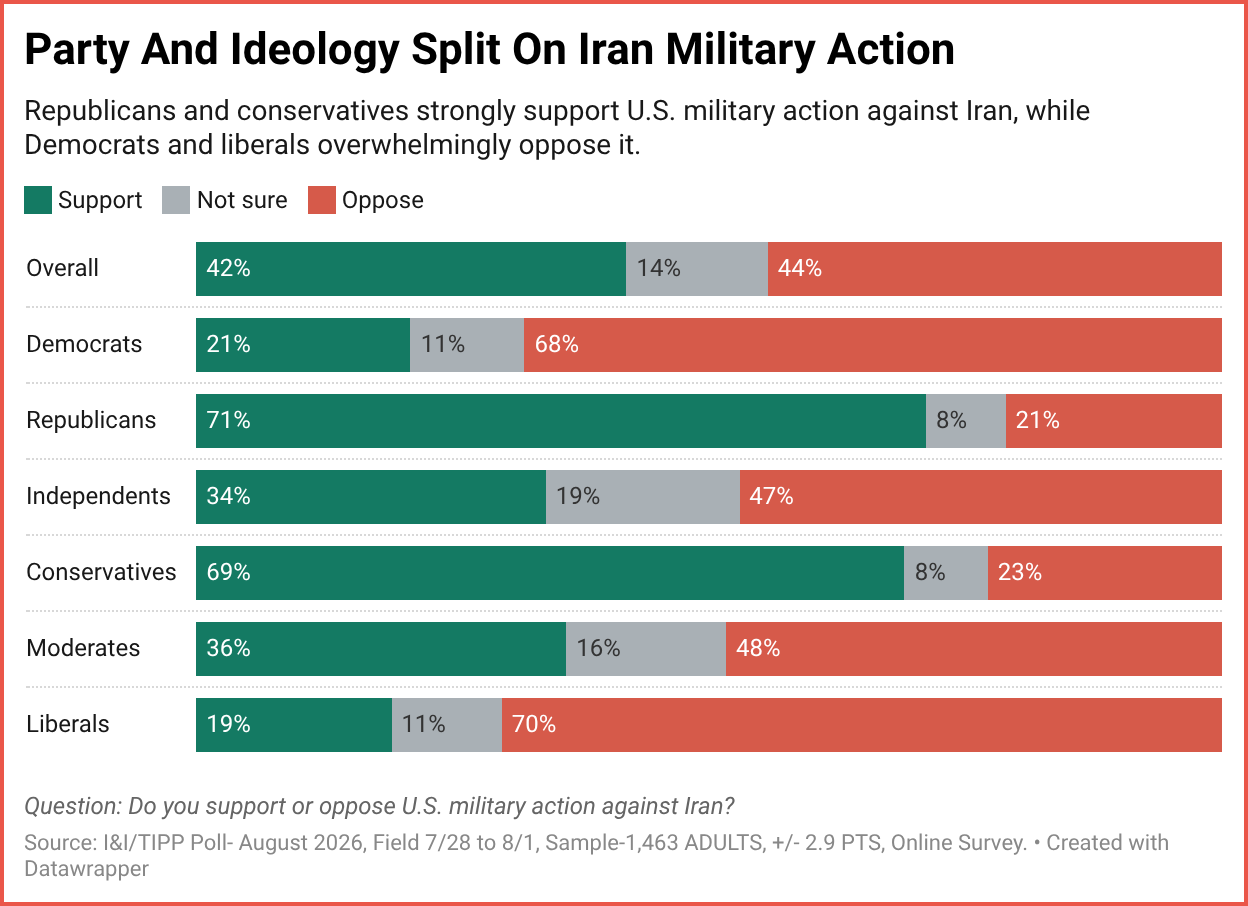
As usual, responses by political affiliation show a gap in how the main political parties and independents view the Iran conflict. A big majority of Democrats were against the U.S. attacks on Iran (68% oppose, 21% support), while a smaller plurality of independents (47% oppose, 34% support) also reject it.
Republicans reverse-flip the Dems’ response: A large GOP majority (71% support, 21% oppose) back Trump’s military action against Iran. Indeed, among all 36 demographic groups in the I&I/TIPP Poll, the Republicans’ 71% support is the largest of all.
Notable differences also emerge when looking at responses by gender and income.
Men largely back the Iran war (52% support, 40% oppose), while a significant plurality of women oppose it (32% support, 48% oppose).
Meanwhile, among I&I/TIPP’s four general income categories, the bottom three income levels average just 39% support for the Iran conflict vs. 47% opposition, but a majority in the highest income bracket solidly back the Iran war effort (52% support, 39% oppose).
I&I/TIPP’s second question asks: “If Iran refuses to negotiate over its nuclear program, would you support or oppose expanding U.S. military operations against Iran?”
On this question, Iranian refusal to negotiate its nuclear program increases support for enlarging the military response against Iran. Overall, 47% said they’d either “strongly support” (25%) or “somewhat support” (22%) increased military action, compared to just 36% who “strongly oppose” (23%) or “somewhat oppose” (13%) that. Another 17% weren’t sure.
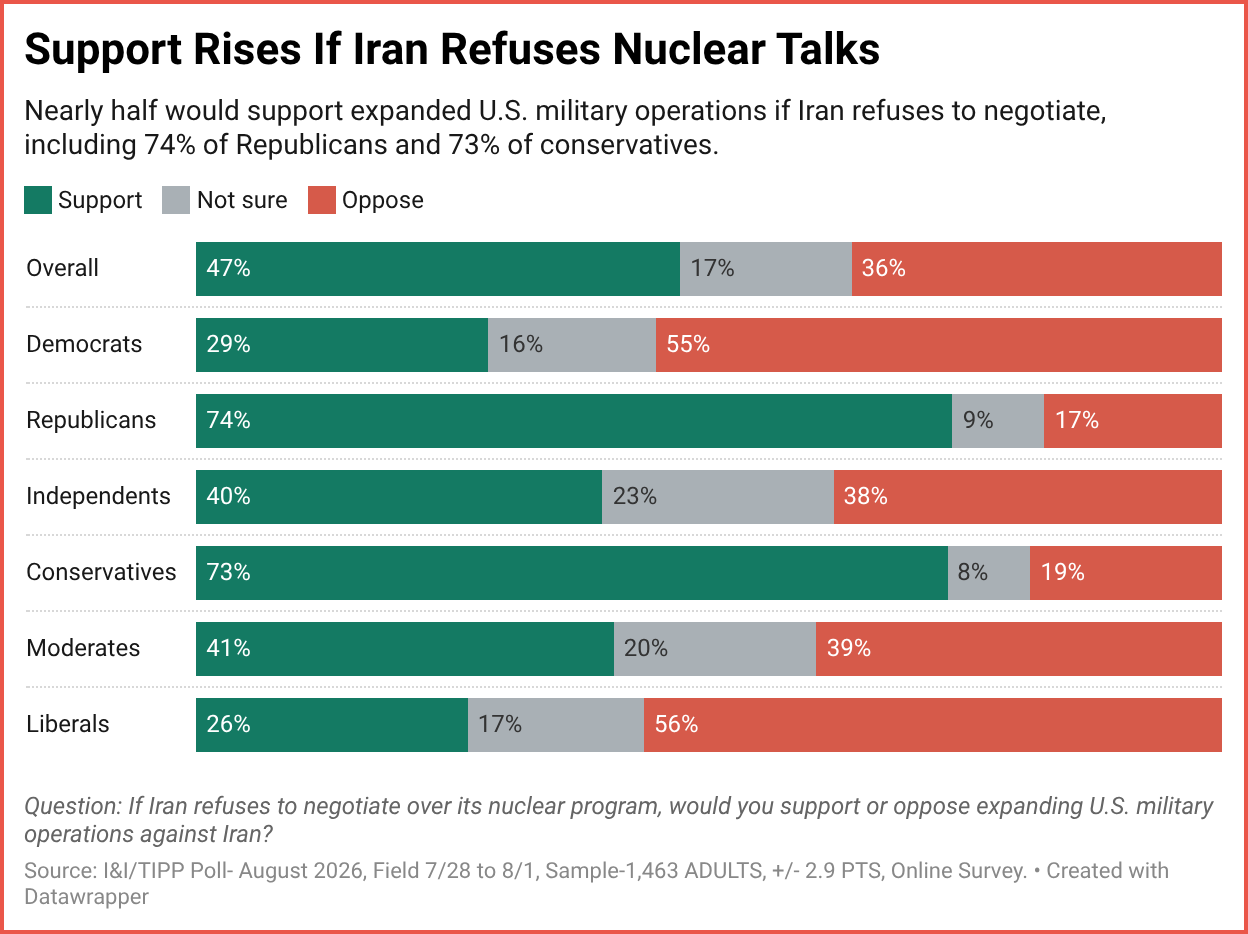
Political party membership is once again a defining factor. Only the Democrats outright oppose expanding the U.S. military response (29% support, 55% oppose). Independents are slightly in favor (40% support, 38% oppose). But Republicans are all in on ratcheting up military action if nuke talks fail: 74% support, just 17% oppose.
A third and final question asks: “If Iran refuses to negotiate over its nuclear program, which approach would you prefer?” Respondents were asked to choose one of five possible answers.
Of the five, both “Continue diplomatic efforts without expanding military operations” and “Withdraw U.S. military forces from the conflict” were each picked by 22% of participants, while “Continue air and missile strikes, but do not send U.S. ground troops” won 19% backing. Least popular answer, at 17%, was “Expand military operations, including ground troops if necessary.”
Meanwhile, a hefty 20% said they weren’t sure.
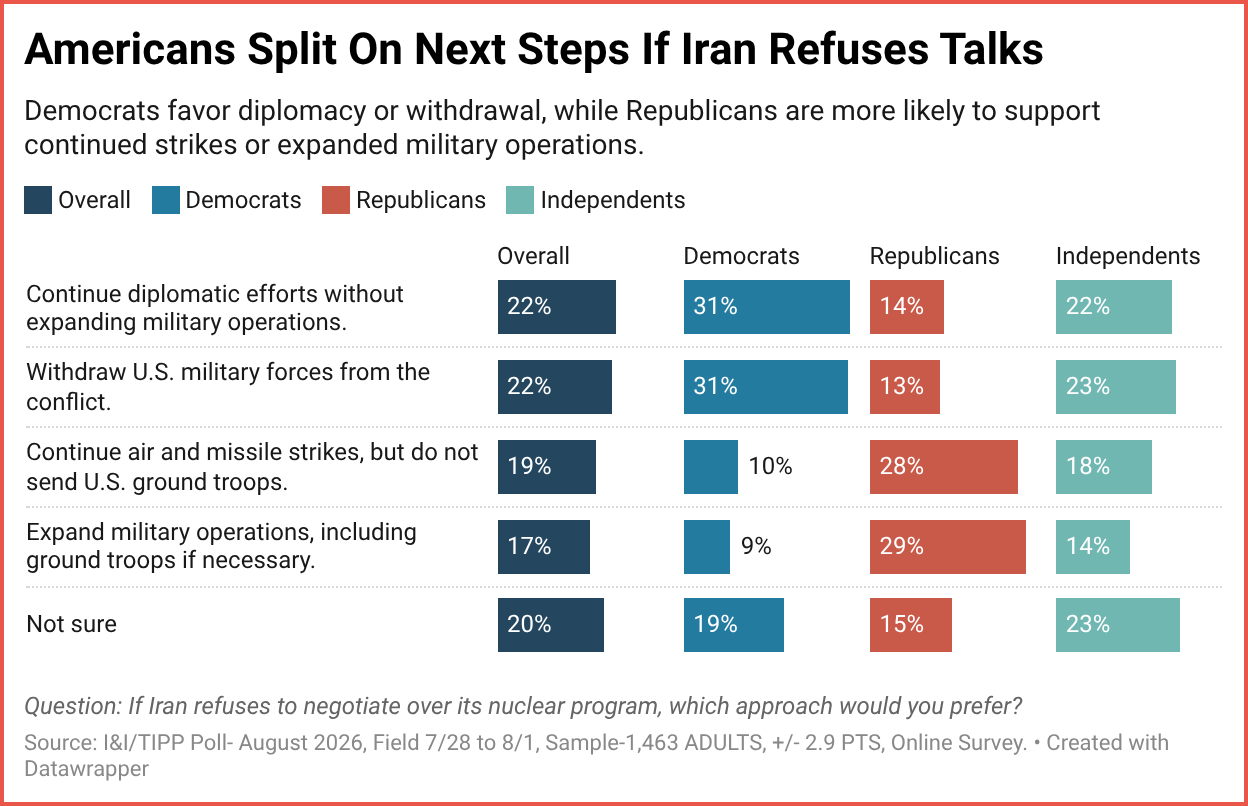
Among Democrats, 62% favored responses including either continuing diplomacy (31%) or withdrawal of forces (also 31%). Republicans, on the other hand, 57% backed either missile strikes but no more ground troops (28%) or expanded operations with ground troops (29%).
Independents 45% supported either more diplomacy (22%) or withdrawal (23%), but 23% also said they were “not sure.”
All in all, politically speaking, there’s not a large amount of backing specifically for either missile strikes or more ground troops in the region. Still, when asked separately whether they would support expanding U.S. military operations if Iran refuses to negotiate over its nuclear program, 47% said yes, compared with 36% who opposed doing so.
Right now, talks with Iran over control of the Strait of Hormuz and its nuclear program are at an impasse.
Iran has threatened to close the Strait of Hormuz to commercial shipping unless the U.S. meets what the New York Times described as a “sweeping set of demands.”
Specifically, Iran called for the U.S. “to lift its naval blockade and sanctions on Iran, withdraw the U.S. military from around Iran, pay war reparations and release frozen Iranian assets, as well as end attacks on Iran’s allies in the region and threats against the country,” the Times reported.
For the U.S., in addition to ending Iran’s control of Hormuz, a linchpin for a final deal includes Iran giving up its stores of highly enriched uranium, which can be used to make a bomb.
There’s little doubt that the destabilizing effects of an Iranian nuclear weapon would be enormous.
“The regional implications of a nuclear Iran extend well beyond the immediate threat of weapons use,” according to a recent analysis by Political.org, which notes that Saudi Arabia has vowed to pursue a nuclear weapon if Iran gets one.
That, in turn, “could trigger a cascade of nuclear proliferation across the Middle East involving Turkey, Egypt, and the United Arab Emirates.”
That’s a nuclear nightmare that President Trump hopes to avoid.
Meanwhile, Israel is thought to have anywhere from 100 to 400 nuclear warheads already. It has stated repeatedly that it won’t let Iran get a nuclear weapon, seeing a nuke in the hands of a radical Islamist regime as an existential threat.
American voters also aren’t happy about Iran’s nuclear ambitions, but they are also not keen on further military action, especially involving ground troops. The memories of the Iraq War and the 20-year Afghanistan war, not to mention the terrorist 9-11 attacks, still weigh heavily on public opinion, as this I&I/TIPP Poll suggests.
I&I/TIPP publishes timely, unique, and informative data each month on topics of public interest. TIPP’s reputation for polling excellence comes from being the most accurate pollster for the past six presidential elections.
Terry Jones is an editor of Issues & Insights. His four decades of journalism experience include serving as national issues editor, economics editor, and editorial page editor for Investor’s Business Daily.
Loved it, hated it, or somewhere in between — tell us. Grade this article here and help shape what lands in your inbox next.
🧭 Power & Capital · August 12, 2026
Where state power meets the boardroom.
🔷 FDA Issues New Guidance To Reduce Contamination In Fresh-Cut Produce – Power & Capital Desk, TIPP Insights
🔷 The Hamiltonian AI Curse: How American Tech Learned To Make Its Losses Everyone Else’s Problem – Hamoon Soleimani, Mises Wire
🌍 Global Affairs
The world's flashpoints, in motion.
🟥 Pakistan Says US And Iran Near Possible Deal On Strait Of Hormuz – TIPP News
🏛️ National Affairs
The fights shaping America right now.
🟫 Two School Custodians Fatally Shot At Chicago Elementary School – TIPP News
🟫 Human Rights Groups Sue Trump Administration Over ICC Sanctions – TIPP News
🟫 Jury In Luigi Mangione Murder Trial To Remain Anonymous – TIPP News
🟫 US Hires More Than 2,000 Air Traffic Controllers In Gamer-Focused Drive – TIPP News
🟫 Diversity, Equity, And Confabulation – Daniel McCarthy, The Daily Signal
🟫 The Declaration And Dinesh D’Souza’s “Revisionist History” – Joshua Mawhorter, Mises Wire
🟫 When Progress Turns Against Itself: The Rise Of Anti-Progress – Luc Lelièvre, Mises Wire
🟫 What Did You Expect? – David Gordon, Mises Wire
🟫 Time For A Renaissance Of American Public Service – Michael Freund, The Daily Signal
🟫 Shark Drags Maine Lifeguard Underwater In Close Encounter – TIPP News
🟫 How Did A Teenager’s 911 Call Lead To An Animal Cruelty Arrest – TIPP News
🔬 Science & Tech
What's being discovered, built, and launched.
🟪 James Webb Telescope Captures Cosmic 'Treasure Chest' Of Young Stars – TIPP News
🟪 Perseid Meteor Shower Set To Light Up Skies On Aug. 12 And 13 – TIPP News
📈 Economy
Prices, policy, and the pressure on your wallet.
🟩 US Existing Home Sales Fall As Prices And Mortgage Rates Rise – TIPP News
🟩 Why A BRICS Gold Standard Is A Fiction – Jeremy E. Powell, Mises Wire
🟩 The Barbarous Relic’s Revenge – George Ford Smith, Mises Wire
🟩 The Value And Virtues Of Free Enterprise – Stefan Padfield, The Daily Signal
💼 Markets & Business
The deals and tickers making moves.
🟧 Why Is Toyota Recalling More Than 650,000 Camrys – TIPP News
📊 Market Mood · August 12, 2026
How the trading day is setting up.
🟧 Markets are cautious ahead of this morning’s crucial U.S. inflation report, with stocks holding near recent highs as investors wait for CPI to clarify the Fed’s next move. U.S. futures are edging higher rather than making a decisive move.
🟦 Oil is adding to the uncertainty. Brent has climbed to around $89 a barrel, its highest since July, as renewed shipping attacks and the continuing U.S.-Iran impasse raise concerns about supplies through the Strait of Hormuz.
🟩 AI remains a source of support, with strength in Asian technology shares and upbeat sentiment around AI infrastructure helping offset geopolitical worries.
🟨 CPI is the pivot today. A cooler reading could reinforce hopes that the Fed can remain on hold, while an upside surprise would revive the possibility of a September rate hike, particularly with energy prices climbing again
🗓️ Key Economic Events
On today's U.S. data calendar.
🟧 8:30 a.m. ET — Consumer Price Index (July)
Forecast: +0.1% m/m | 3.4% y/y
Previous: −0.4% m/m | 3.5% y/y
Today’s most important report and a potentially significant driver of Fed expectations.
🟧 8:30 a.m. ET — Core CPI (July)
Forecast: +0.2% m/m | 2.5% y/y
Previous: 0.0% m/m | 2.6% y/y
The core reading will be especially important for assessing whether underlying inflation pressures continue to ease.
Letters to the editor email: editor-tippinsights@technometrica.com
Subscribe Today And Make A Difference. Consider supporting Independent Journalism by upgrading to a paid subscription or making a donation. Your support helps tippinsights thrive as a reader-supported publication. Contact us to discuss your research or polling needs.
Reach our audience. For sponsorship and advertising opportunities, visit our Partner With Us page.