It’s been a little over two weeks since Spain defeated defending champions Argentina 1-0 in the 2026 FIFA World Cup Final, held in East Rutherford, New Jersey. By all accounts, the tournament, held across the US, Canada, and Mexico, was a massive success, boasting record attendances and being the first World Cup to have 48 teams participating. Despite the success of the sporting event, soccer has never quite reached the heights of popularity or fanaticism in the US compared to other countries around the globe.
So, how did Americans feel about the 2026 FIFA World Cup? We polled around 1,500 American adults to find the answers. The result: soccer has a long way to go in terms of mainstream popularity, but those who watched the event enjoyed it greatly and are eager for more.
Polling indicates that the percentage of Americans who would call themselves soccer “fans” is still quite low. Only around 23% of respondents indicated that they watch the sport very/somewhat often, while 45% of respondents indicated that they never watch soccer.
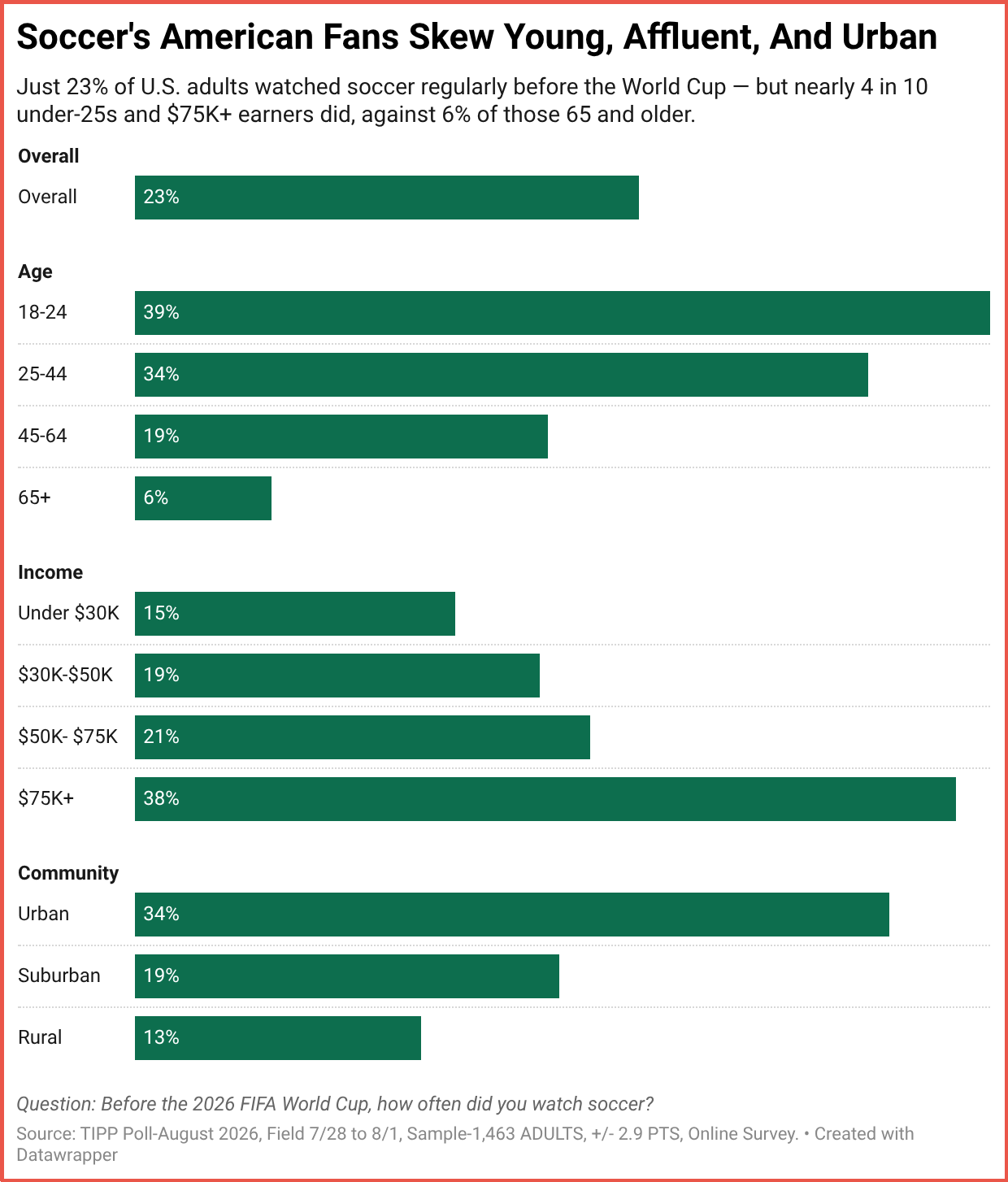
However, soccer seems to be vastly more popular among younger Americans. In fact, a clear generational divide has emerged regarding Americans’ fondness for the world’s most-watched game. Among 18-24-year-olds, 39% indicated that they watched soccer very/somewhat often, while among the 65+ age group, only 6% did so. Meanwhile, 67% of 45-64-year-olds and 83% of seniors said they rarely/never watched soccer.
The higher interest in the sport among young Americans could be attributed to various reasons. The establishment of Major League Soccer in the 90s, along with the US hosting the World Cup for the first time in 1994, could have made soccer more accessible in the United States. Another possible reason is the spread of the internet, making international sporting competitions, such as the English Premier League, and football superstars, like Lionel Messi, more familiar to American audiences. It is also possible that more young people are immigrants, or children of immigrants, from soccer-loving countries around the globe, driving up the game’s popularity.
Another interesting tidbit: wealthier Americans tend to watch soccer more. When looking at income, the trend is quite clear, though not as strong as with age. Americans with a household income over $75,000 watch soccer more than Americans in the smaller income brackets.
This is likely strongly correlated with the game’s popularity among urban/rural Americans, where the numbers present a similar strong trend.
Again, there are many possible reasons for this. One strong factor is likely to be the greater presence of immigrant communities in urban regions, where people bring their love of the game to America. Regardless, the game still has not quite reached America’s rural communities. It seems fans of the game tend to overwhelmingly skew younger, wealthier, and more urban.
Next, we wanted to see how people who had actually watched the World Cup felt about it. A little over 54% of the 1,463 adults polled said they watched the tournament. That’s roughly similar to the percentage of Americans who indicated that they, at least rarely, watched soccer.
However, the response among those who watched the World Cup was overwhelmingly positive. Across all demographics, Americans of all walks of life had an enjoyable World Cup summer: 87% of watchers said they enjoyed it, and enjoyment stayed above 80% in every age and income group, rising to 92% among those in households earning $75,000 or more. Adults aged 25 to 44 were the most enthusiastic, with 48% saying they enjoyed the tournament a great deal.
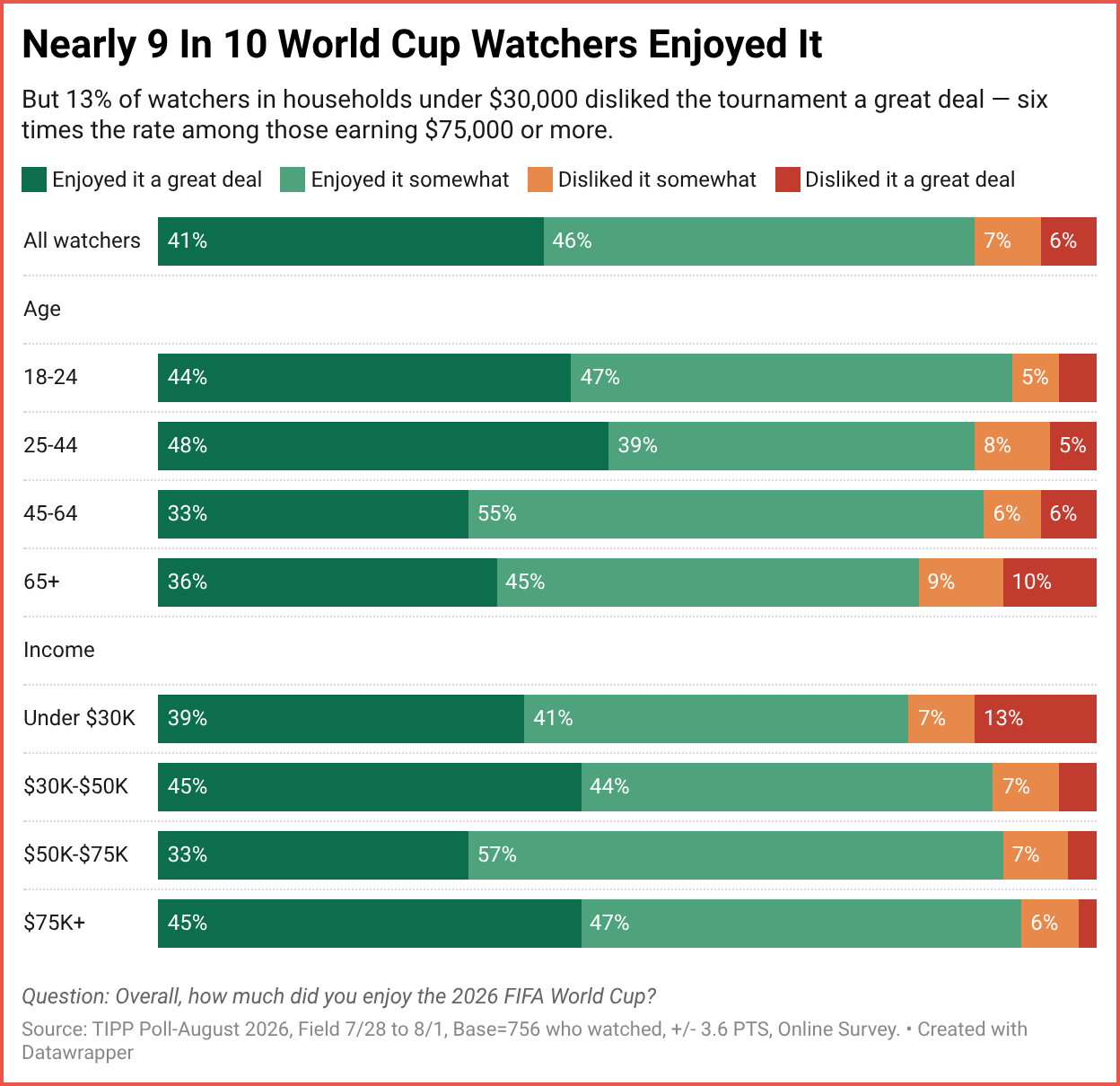
Interestingly, the percentage of respondents who indicated that they disliked the event “a great deal” ticks up noticeably for those who earn less than $30,000 a year. This may be due to disappointment or anger over expensive tickets, meaning that many people were priced out of watching the World Cup in the stadium.
Respondents were also asked if they’d like to see the United States host more international sporting events, including the World Cup and competitions such as the Olympics. Across all demographics, including over political affiliations, Americans want to see more events coming to the US. Two-thirds of adults — 67% — agree the country should host more, against 15% who disagree and 18% who are unsure. Agreement ranges from 59% among women to 74% among men, and stays above 60% in every age and party group.
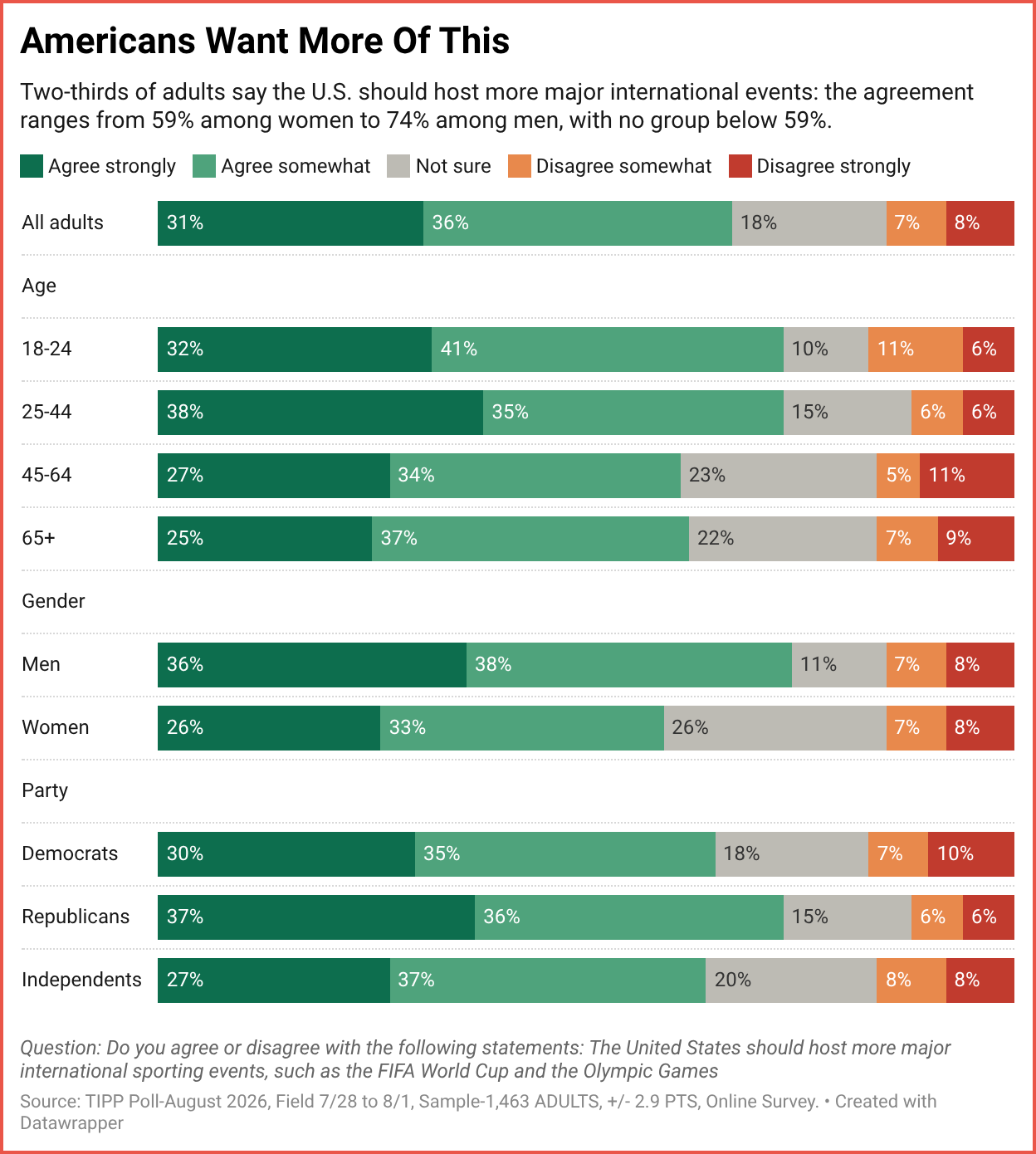
This data indicates not only approval of world events by Americans, but an eagerness to host more. This contrasts with many other countries, where hosts face backlash from their constituents over hosting such events (notably, Brazil hosting the 2014 World Cup and the 2016 Rio Summer Olympics). Americans, in the aftermath of the World Cup and in the buildup to the 2028 LA Summer Olympics, seem to have a much more favorable outlook. One potential reason is that the US already has plenty of state-of-the-art stadiums ready to use, meaning that hosting such large-scale events would not lead to an additional financial burden.
Finally, Americans were asked if they thought that the World Cup helped to unite Americans. In general, the answer is positive. A clear majority — 58% — said the tournament was a unifying factor culturally, against 18% who disagreed and 24% who were unsure. Republicans were the most likely to agree, at 66%, as were 25-to-44-year-olds at 66%, while independents were the most doubtful at 50%.
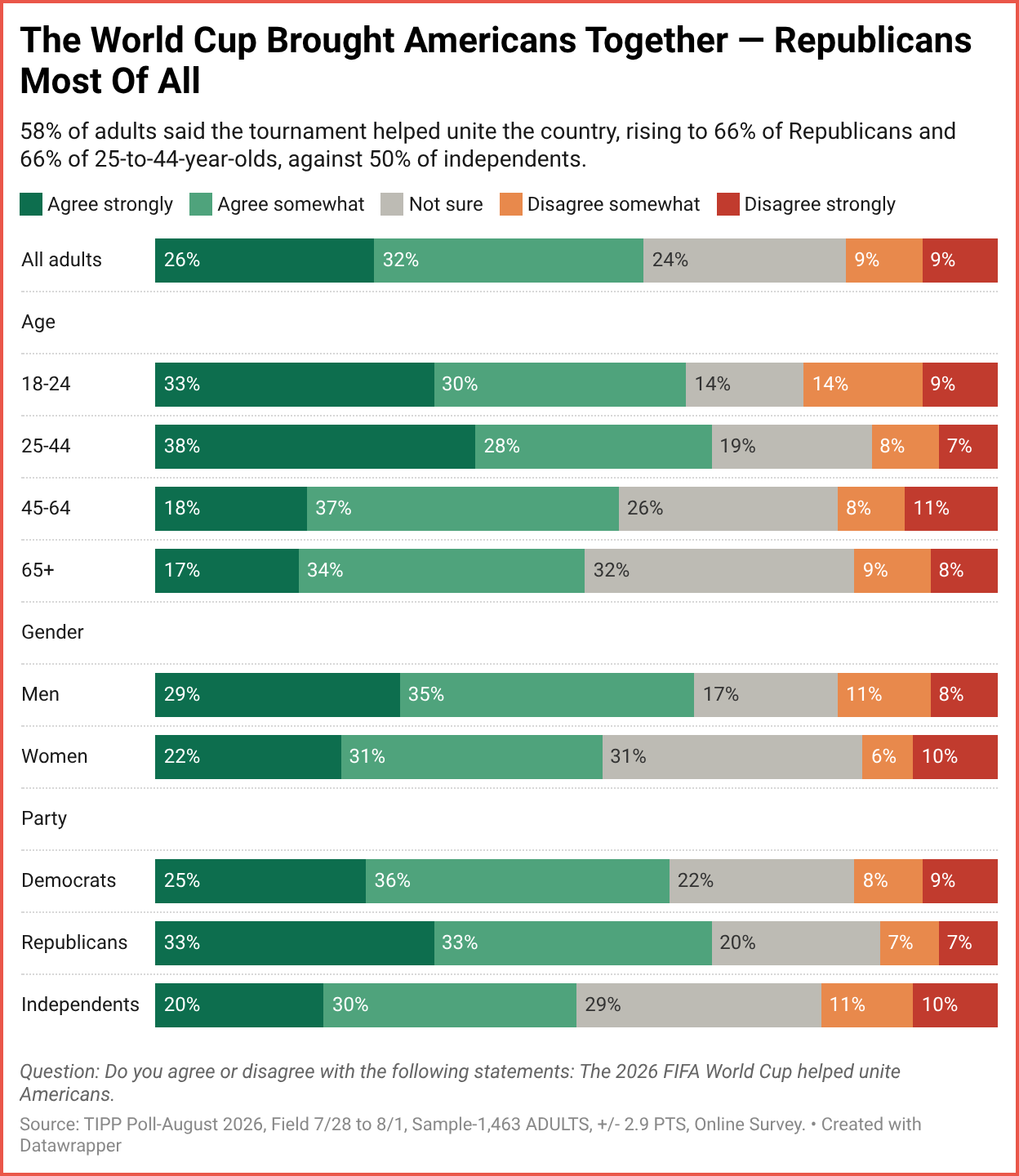
Regardless of politics, most Americans likely felt a sense of pride when the US won in its opening game against Paraguay (4-1), and gutting disappointment at the defeat against Belgium. Neighborhood watch parties likely brought together people with different views to simply enjoy the game. The event wasn’t perfect and had its fair share of controversies, including over pricing, officiating, and other issues, but these didn’t mar the enjoyment of the tournament for the average fan.
Overall, the 2026 FIFA World Cup cannot be termed anything but a success. America still isn’t quite a soccer country, but the sport is clearly growing in popularity, especially among youngsters, and a significant majority of Americans watched the World Cup. In fact, Americans were overwhelmingly positive about it and are eager to host it more often. Finally, most Americans agree that the event was a unifying force culturally, during a time of extreme political polarization. Sometimes, a game can be enough to bring the whole country, and indeed, the whole world, together.
Loved it, hated it, or somewhere in between — tell us. Grade this article here and help shape what lands in your inbox next.
🧭 Power & Capital · August 4, 2026
Where state power meets the boardroom.
🔷 Elizabeth Warren Calls Trump’s Memecoin An ‘Illegal Scam’
🔷 New Truth Social Service Gives Traders Millisecond Edge
🌍 Global Affairs
The world's flashpoints, in motion.
🟥 Trump Calls Iran Talks ‘Last Chance’ To End War – TIPP News
🟥 Watch: Last Chance For Iran To Sign A Good Document, Says Trump – TIPP Video
🟥 Iran President Denies Reports Of Stepping Down – TIPP News
🟥 Bessent Says Hormuz Deal Could Come This Week – TIPP News
🟥 What Happened To The Cargo Ship Struck In The Strait Of Hormuz – TIPP News
🟥 Watch: Stop Illegal Immigration In Europe, Says Trump – TIPP Video
🟥 Don’t Be Fooled, What’s Going On Is An Invasion Of Spain – Rebecca Downs, The Daily Signal
🟥 What A Sino-American G2 Would Mean For Asian Security – Brahma Chellaney, Project Syndicate
🏛️ National Affairs
The fights shaping America right now.
🟫 Todd Blanche Clears Key Senate Hurdle For Attorney General – TIPP News
🟫 Acting Attorney General Blanche Rescinds ‘Anti-Weaponization’ Fund Before Confirmation Vote – Reuters, The Daily Signal
🟫 Arson Suspect Arrested As Spokane Wildfires Rage – TIPP News
🟫 Watch: First Two Deaths Related To Cyclospora Reported In USA – TIPP Video
🟫 Moreno Says Ex-Son-In-Law Is A ‘Danger’ Who Should Not Serve In Congress – Reuters, The Daily Signal
🟫 Jackson Launches Massive $87 Million Ad Blitz Against Keisha Lance Bottoms In Governor’s Race – Rebecca Buis, The Daily Signal
🟫 Did James Talarico Meet Texas’ Residency Requirements? New Report Raises Questions – Emily Medeiros, The Daily Signal
🟫 PragerU Created Exhibit For White House With The Help Of Production AI – Francesca Cella, The Daily Signal
📈 Economy
Prices, policy, and the pressure on your wallet.
🟩 What Do The Latest U.S. Hiring Data Reveal – TIPP News
🟩 Watch: Stable Yen Important For U.S., Entire Region, Says Sec. Bessent – TIPP Video
💼 Markets & Business
The deals and tickers making moves.
🟧 McDonald’s Earnings Beat Estimates Despite Slower U.S. Sales – TIPP News
🟧 Saudi Aramco Reports Strong Q2 Earnings – TIPP News
🟧 What Will SpaceX’s First Earnings Report Reveal – TIPP News
🟧 Polymarket Targets $20 Billion Valuation Amid Market Expansion – TIPP News
Letters to the editor email: editor-tippinsights@technometrica.com
Subscribe Today And Make A Difference. Consider supporting Independent Journalism by upgrading to a paid subscription or making a donation. Your support helps tippinsights thrive as a reader-supported publication. Contact us to discuss your research or polling needs.
Reach our audience. For sponsorship and advertising opportunities, visit our Partner With Us page.