By Carl Bildt, Project Syndicate
Recent developments in the Balkans ought to be a wake-up call for Europe, given the potential for nationalist provocations in one country to spill over within the region. Multiple elections coming next month raise the risk of a dangerous descent into political instability.
STOCKHOLM—Benighted politics are once again haunting the Balkans. This month’s semi-official funeral in Belgrade for the convicted war criminal Ratko Mladić, whom many Bosnian Serbs still honor, has dredged up past traumas and reignited nationalist tensions. Diplomatic relations between Serbia and Bosnia are deteriorating, casting further doubt on Serbia’s already semi-stalled accession to the European Union.
Worse, while Europe and the United States used to be mostly aligned in their support for the tenuous political process in Bosnia, that is no longer the case. Whereas previous US presidents might have been accused of being overly interventionist, Donald Trump’s administration has shown no interest in the region’s delicate political processes whatsoever. Its sole concern is to advance narrow economic interests, and this has meant tolerating or even supporting hardline Serbian nationalists in Bosnia.
For example, the Trump administration has thrown its support behind a gas pipeline that would connect the Croatian coast to Sarajevo (the Bosnian capital). At first glance, such a project makes sense, given its potential to alleviate the region’s dependence on Russian gas. But when contracts may suspiciously be awarded to a previously unknown company whose leaders have “personal connections to Donald Trump,” warning lights start flashing.
Warning lights are flashing on the political front, too. Bosnia will hold elections this October, and depending on the outcome, hardline Serb forces may join with hardline Croats to change the country’s governance framework. The timing for such a gambit is ideal because the US obviously would look the other way. But should it succeed, the Bosniak (Muslim) community is bound to feel threatened and will respond accordingly. That would increase the risk of a downward spiral that could profoundly destabilize the country.
Moreover, Serbia will also hold elections in October. After years of mass student protests, the government is facing a broad grassroots opposition movement, which is now organized under the banner of the “Student List.” With the outcome still far from certain, one can easily imagine a scenario in which President Aleksandar Vučić’s populist regime simply declares victory, triggering even more instability.
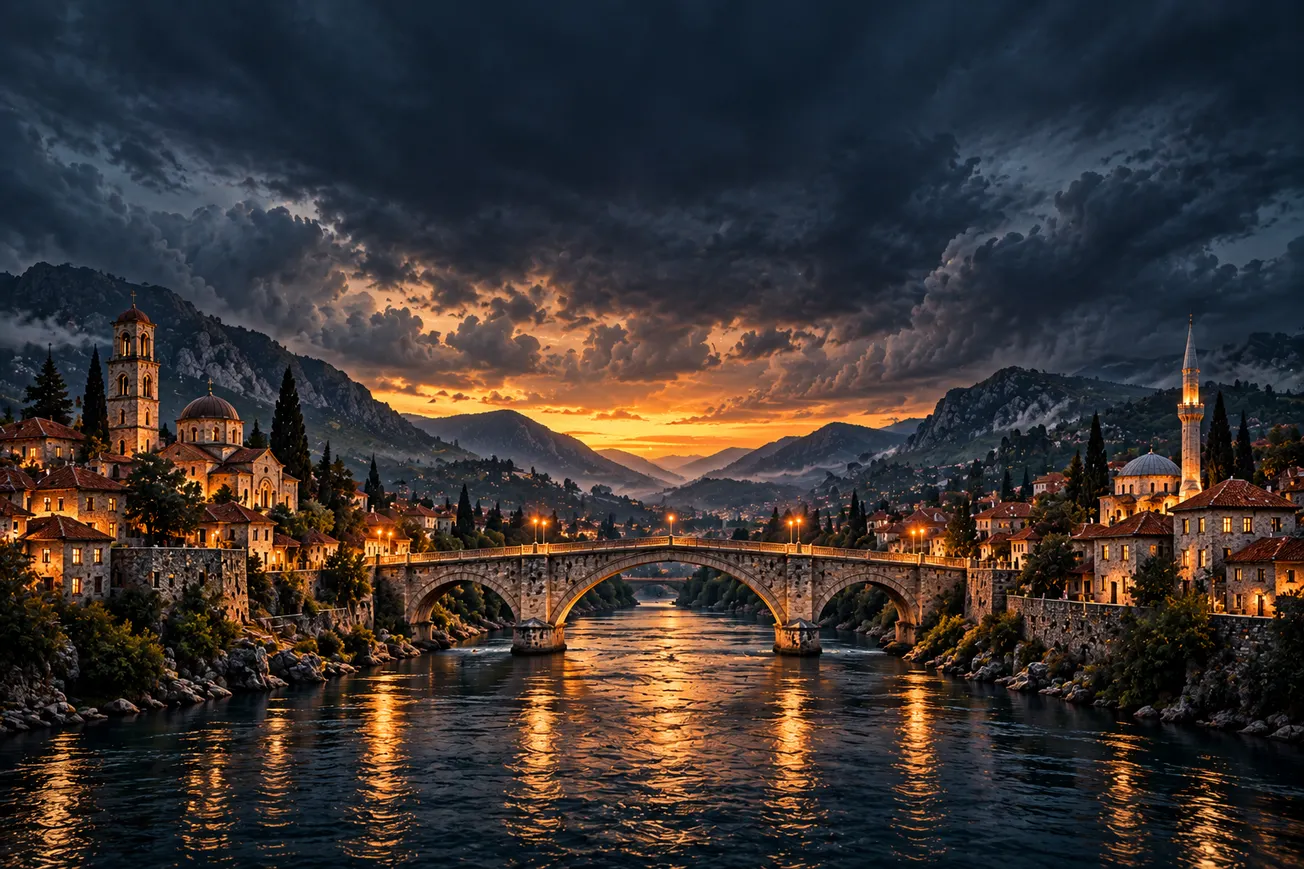
The situation in Kosovo is no calmer. Reconciliation talks between Serbia and Kosovo have stalled, and local authorities in the divided town of Mitrovica have yet to be given responsibility for the bridge linking the Serbian and Albanian districts, owing to fears of what might follow.
More broadly, the country’s political system is deadlocked, and anger over the Kosovo Specialist Chambers’ recent conviction of Hashim Thaci, a former military leader who served as president of Kosovo from 2016 to 2020, has further alienated the country from its previous international partners.
None of these developments would necessarily be destabilizing on its own. But taken together, they risk creating a critical mass of nationalist sentiment. The central idea behind the peace processes a quarter-century ago was that a combination of EU accession talks and reconciliation facilitated by various international tribunals would gradually bring stability and cooperation to the region. But that hope has not been vindicated.
With the exception of Montenegro, and possibly Albania, integration into the EU has stalled and lost much of its power as a motivating force. Equally disappointing, the proceedings led by international tribunals at The Hague have been so grotesquely drawn out as to have no chance of promoting reconciliation. They may even be making the situation worse.
Tiny Montenegro is still on a promising trajectory, but whether its EU accession bid could survive a new whirlwind of regional turmoil is far from certain. If Serbia has an interest in destabilizing its neighbor, it can easily do so.
As is always the case in the Balkans, there are no easy solutions to address the rising tensions. Each country has its own political processes, but the risk of mutually reinforcing spillovers is high. With the US focused solely on private economic interests, and with the EU distracted by Russian aggression and US unpredictability, the prospects for coherent international policies to restore stability, promote reconciliation, and support integration are bleak.
This doesn’t mean we are heading toward a new round of Balkan wars. But even limited skirmishes could be sufficient to push the entire region onto a more uncertain and dangerous path. Political leaders, particularly in Europe, must heed the alarm. The Balkans brought major wars to Europe twice in the previous century, and they could easily create instability in this century, too.
Carl Bildt is a former prime minister and foreign minister of Sweden.
Loved it, hated it, or somewhere in between — tell us. Grade this article here and help shape what lands in your inbox next.
🧭 Power & Capital · September 25, 2026
Where state power meets the boardroom.
🔷 Gov. Kemp Announces $1.2B Pirelli Investment In The Peach State – Rebecca Buis, The Daily Signal
🌍 Global Affairs
The world's flashpoints, in motion.
🟥 Iran Says US Must Decide Whether To End Seven-Month War – TIPP News
🟥 Iran Uses Chinese Intelligence To Track Ships And Strike US Bases – TIPP News
🟥 Watch: Iranian President Dismisses U.S. Sanctions, Keep Dreaming, He Says – TIPP Video
🟥 US, Israel And Arab Allies Revive Abraham Accords Talks – TIPP News
🟥 Watch: President Trump Hosts Xi Jinping For White House State Dinner – TIPP Video
🟥 Danish Report Warns Of Russian Strikes On NATO Infrastructure – TIPP News
🟥 Ukraine Seeks Patriot Missile Production As Russian Strikes Intensify – TIPP News
🟥 North Korean Hackers Linked To Massive Bitget Crypto Breach – TIPP News
🟥 Watch: After Hurricane Polo, Mexican Coastal Communities Begin Cleanup – TIPP Video
🏛️ National Affairs
The fights shaping America right now.
🟫 Federal Courts Deliver Setbacks To Trump In Free Speech Cases – TIPP News
🟫 Supreme Court Revives Citizenship Data Tool For Voter Audits – TIPP News
🟫 Republicans Enter Midterm Stretch With House Control At Risk – TIPP News
🟫 Government Watchdog Flags Waste In ICE Detention Spending – TIPP News
🟫 Karoline Leavitt Opens Up About What President Trump Taught Her – Malia Loock, The Daily Signal
📈 Economy
Prices, policy, and the pressure on your wallet.
🟩 Will AI Take Asian Young People’s Jobs? – Lee Jong-Wha, Project Syndicate
Letters to the editor email: editor-tippinsights@technometrica.com
Subscribe Today And Make A Difference. Consider supporting Independent Journalism by upgrading to a paid subscription or making a donation. Your support helps tippinsights thrive as a reader-supported publication. Contact us to discuss your research or polling needs.
Reach our audience. For sponsorship and advertising opportunities, visit our Partner With Us page.