

No place outside the United States matters more to America's November 3 elections than the Strait of Hormuz.
Most Americans couldn't find it on a map, but they know what they pay to fill their cars.
Since the Iran war began, gasoline has risen about $1.30 a gallon and diesel about $2.60, so filling a 15-gallon tank now costs nearly $20 more. The war has restricted shipping through the Strait of Hormuz, which normally carries 20% of the world's oil supply.
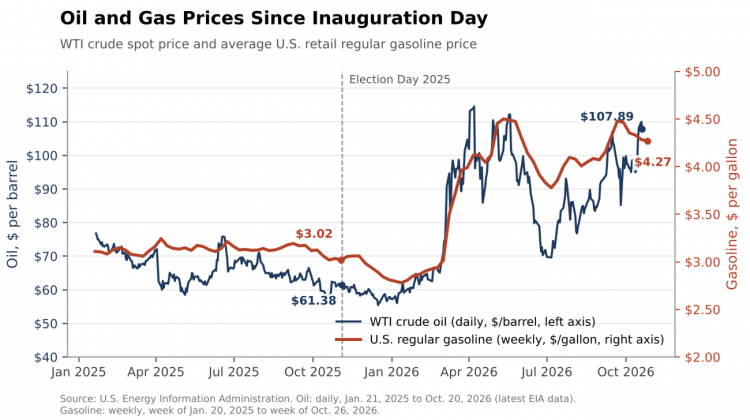
At the Big Iron farm show in West Fargo, North Dakota, Chris McDonald, president of the North Dakota Soybean Growers Association, told the North Dakota Monitor that diesel for his harvest cost roughly twice what he paid last year.
"That can erase your profit," he said.
McDonald didn't tell the reporter how he would vote, and politicians won't know what diesel costs them until the polls close.
A national TechnoMetrica/TIPP survey found that 70% of respondents believe international conflicts contribute to negative reactions to President Donald Trump. The survey of 1,250 registered voters was conducted October 16–19 and released October 28 at the National Press Club.
Without the Hormuz crisis, Trump and congressional Republicans would be barnstorming the country talking about a reasonably good economy, steady inflation and lower prices at the grocery store and gas pump.
They'd be campaigning on the One Big Beautiful Bill, which lets service workers deduct qualified tips from their federal taxable income, gives seniors an additional tax deduction and lets overtime workers keep more of their paychecks.
On November 7, 2006, I was a Bush administration political appointee at the Pentagon when a war swung a midterm, and election night was rough. Republicans lost 30 House seats and six Senate seats.
Bush called it a "thumping," and the next day he announced that Defense Secretary Donald Rumsfeld would be replaced by Robert Gates.
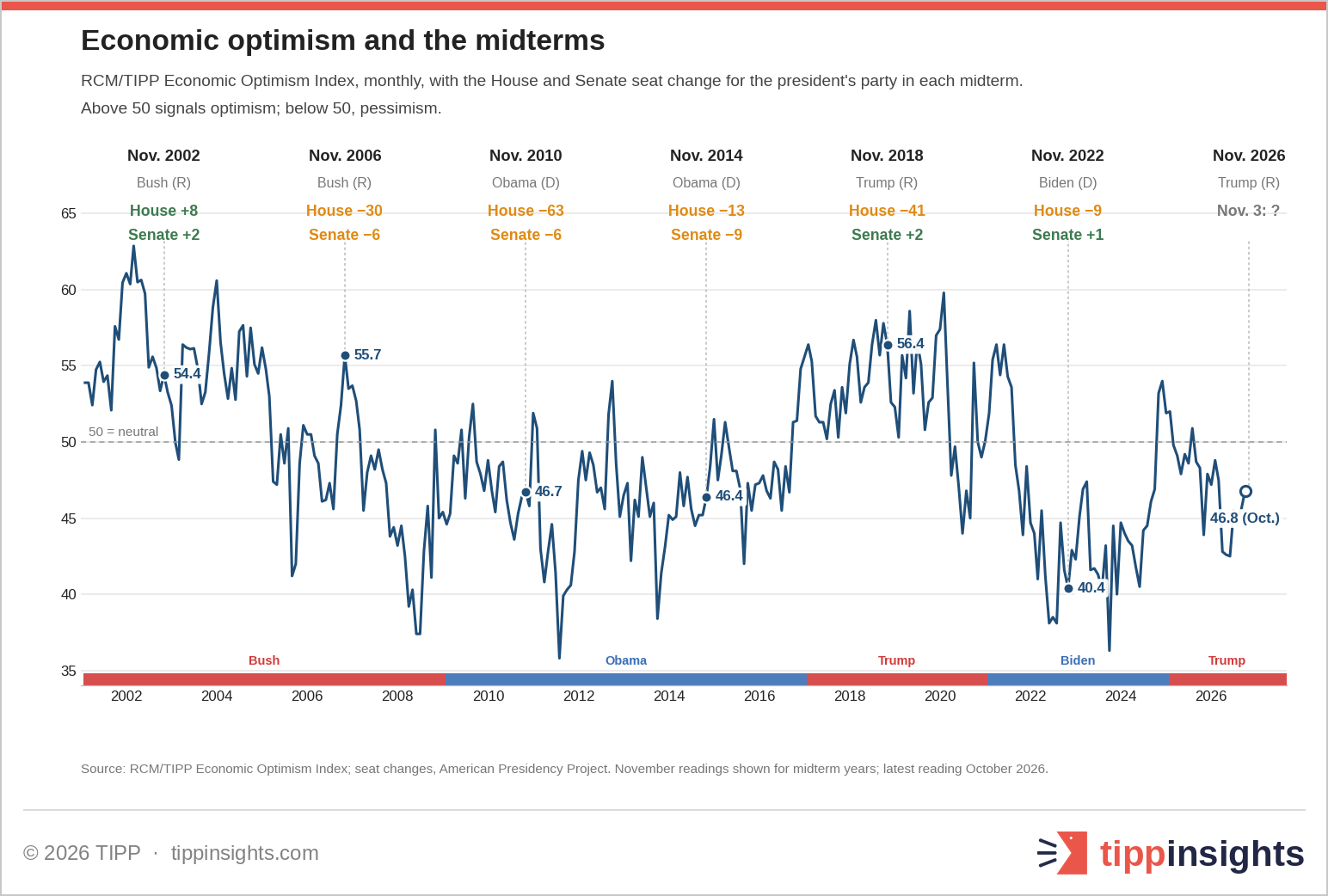
In 2006, the place that mattered most was Iraq's Al Anbar province. Voters watched television reports of American casualties and escalating violence, and Operation Together Forward, the effort to secure Baghdad, wasn't working.
In Anbar, Sunni tribal leaders began turning against al-Qaeda in 2006, and American forces partnered with them, later expanding the effort through the Sons of Iraq program. Monthly attacks in Anbar fell from approximately 1,350 in October 2006 to just over 200 in August 2007.
In January 2007, Bush announced the New Way Forward, better known as the Surge, with General David Petraeus and Ambassador Ryan Crocker leading the new strategy in Iraq.
The Surge also expanded Provincial Reconstruction Teams across Iraq. Diplomats, agricultural experts and engineers worked alongside American troops to rebuild local government and give Iraqis something worth defending.
Americans watched the Iraq war on television. Twenty years later, they follow this one by swiping through videos on their phones.
In a 2026 analysis of 464 million TikTok video views donated by 16,981 users, half the videos were swiped away within six seconds and one-third within three.
That leaves room for outrage but not for explaining how to lower grocery prices, fix the border or end a war.
Fabricated videos targeting Democratic Senate candidates Sherrod Brown in Ohio and James Talarico in Texas were built for that kind of quick viewing.
One video used the identity and photographs of Haya Akbik, a former Brown campaign intern, to spread false accusations. Akbik told the Associated Press the allegations were completely fabricated.
Clemson professor Darren Linvill found that the videos bore the hallmarks of Storm-1516, a Russian disinformation network that targeted Kamala Harris and Tim Walz during the 2024 election. Accounts circulating the new videos had previously shared material from the same network.
The TechnoMetrica/TIPP survey also found that 70% of respondents have observed Trump-related anger or stress among people they know, 74% believe media coverage contributes to negative reactions to Trump, and 77% say those negative reactions are stronger than reactions to previous presidents.
Over the past year, Democrats’ lead on the generic ballot grew from 3.6 to 8.3 points, while Trump’s approval fell from 43.4% to 38.4%.
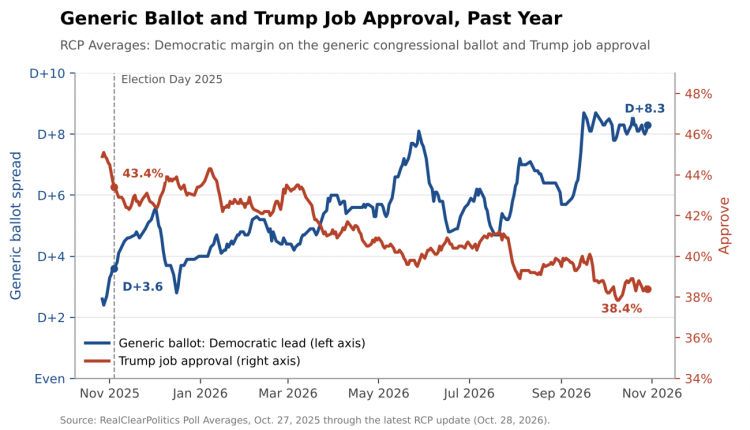
Still, the RealClearPolitics favorability average puts Democrats at only 40% and Republicans at 38%, which makes both parties about as popular as skinny jeans at a Gen Z fashion show.
Anger at Trump won't elect Democrats by itself. In 1994, Newt Gingrich helped Republicans win 54 House seats. In 2006, Rahm Emanuel recruited Democratic candidates, raised money and kept them focused on issues that mattered to voters, and Democrats captured control of Congress.
Four years later, the Tea Party galvanized Republicans against President Barack Obama, federal spending and the expansion of government.
Obama's approval rating was 45% at the time of the November 2010 election, and Republicans gained 63 House seats and six Senate seats. John Boehner became House speaker, and Mitch McConnell remained Senate Republican leader.
Obama called it a "shellacking."
No Kings protests have filled the streets, but unlike the Tea Party, they haven't yet turned into seats in Congress.
Democrats also lack a quarterback. Hakeem Jeffries is more Kirk Cousins than Josh Allen.
Trump, meanwhile, has worked the attention economy better than any modern-day politician.
Whether November 3 brings a thumping, a shellacking or something smaller may depend less on campaign ads than on what voters pay at the pump. If Republicans take a thumping, Trump may have to rethink his Iran policy, just as Bush changed course in Iraq after 2006.
Mark Pfeifle, a member of the TIPP Insights Editorial Board, served as deputy national security adviser for strategic communications and global outreach at the White House from 2007 to 2009. He runs the crisis management firm Off the Record Strategies.
Loved it, hated it, or somewhere in between — tell us. Grade this article here and help shape what lands in your inbox next.
🔗 Further Reading
Deeper on what you just read.
🟨 Democrats Poised for Largest Generic Ballot Win Since Obama’s 2008 Blowout – John McIntyre, RealClearPolitics
🟨 I&I/TIPP Poll Finds Surprising Level Of Apathy Among Swing Voters As Midterms Approach – Terry Jones, TIPP Insights
🟨 The Great Inversion: Trump’s Support Has Shifted – Editorial Board, TIPP Insights
🟨 Statistically Speaking, Don’t Count Republicans Out of the Midterms – Jonathan Draeger, RealClearPolitics
🧭 Power & Capital · October 31, 2026
Where state power meets the boardroom.
🔷 Trump Administration Offers Audi Tariff Relief After $4 Billion Georgia Plant Deal – Power & Capital Desk, TIPP Insights
🔷 Treasury Announces Higher I Bond Rates Amid Renewed Inflation – Power & Capital Desk, TIPP Insights
🌍 Global Affairs
The world's flashpoints, in motion.
🟥 Strait Of Hormuz Tensions Rise As Iran Challenges US Mine-Clearing Claims – TIPP News
🟥 Oman Navy Evacuates 25 Sailors After Ship Attack Near Hormuz – TIPP News
🟥 Ukraine Blackout Deepens As Russia Intensifies Energy Attacks – TIPP News
🟥 US Cancels G20 Group Photo After European Objections Over Russia – TIPP News
🟥 Russia Loses Its Last Major Independent Newspaper Amid Media Crackdown – TIPP News
🟥 Thousands Rally Against Meloni Government In Nationwide Italian Protests – TIPP News
🟥 Watch: EU Military Helicopter Crash In Bosnia Leaves 3 Dead And 12 Injured – TIPP Video
🟥 Watch: Spain's King Arrives Near Toledo To Support Train Collision Victims – TIPP Video
🟥 Watch: Kim Jong Un Orders Mass Acceleration Of North Korea's Military Drone Program – TIPP Video
🟥 The Iran War And The ‘Terrible Power Of The Purse’ – Alastair Crooke, Ron Paul Institute for Peace and Prosperity
🟥 Lies, Damn Lies, And Ukraine News – William Dunkerley, Ron Paul Institute for Peace and Prosperity
🟥 Ron Paul’s 2001 Alternative: What Could Have Been – Joshua Mawhorter, Mises Wire
🟥 Five Franciscan Friars Killed In 1597 Move One Step Closer To Sainthood – TIPP News
🏛️ National Affairs
The fights shaping America right now.
🟫 Trump And Vance Cancel Campaign Events Days Before Midterm Elections – TIPP News
🟫 California’s ‘Likely Noncitizen’ List Just Got A Court Decision – Hailey Gomez, The Daily Signal
🟫 Alaska Democrats Defend Peltola Despite Allegations Of Election Gamesmanship – TIPP News
🟫 Judge To Hear Bid To Block Trump’s Proposed 250-Foot Arch In Washington – TIPP News
🟫 First American Pope Casts Ballot In US Midterm Elections – TIPP News
🟫 The Doomsday Government: Preparing For The End Of The World, Not The End Of Power – John W. & Nisha Whitehead, Ron Paul Institute for Peace and Prosperity
🟫 America’s Deadly Addiction To War – Andrew P. Napolitano, Ron Paul Institute for Peace and Prosperity
🟫 Legitimate Care Or A Tax-Fed Racket? Mental Health Care For Adolescent Girls – Jeffery L. Degner, Mises Wire
🟫 Prosecutors Drop Felony Strangulation Charge Against Rapper Rick Ross – TIPP News
🟫 Watch: Trump Hits Campaign Trail To Defend Endangered Republican Senate Seats – TIPP Video
📈 Economy
Prices, policy, and the pressure on your wallet.
🟩 What Leads To Violent Populism? – Mark Thornton, Mises Wire
🟩 Nobel Prize For Keynesian Economics – Frank Shostak, Mises Wire
💼 Markets & Business
The deals and tickers making moves.
🟧 Meta, Amazon And Alphabet Face Cash Flow Challenges Amid AI Boom – TIPP News
🟧 Chevron, Exxon Beat Earnings Estimates On Strong Refining Profits – TIPP News
🟧 Bayer Wins Roundup Cancer Trial as $7.25 Billion Settlement Remains Pending – TIPP News
🟧 How Did Hackers Steal More Than $6 Billion From Binance – TIPP News
🔬 Science & Tech
What's being discovered, built, and launched.
🟪 35-Year Study Challenges Belief That Cannabis Improves Sleep – TIPP News
🟪 Pennsylvania Measles Outbreak Reaches 35-Year High As Vaccine Interest Grows – TIPP News
🟪 Watch: Pennsylvania Amish Community Battles Worst Measles Outbreak In Decades – TIPP Video
🟪 Even Birds Experience Jet Lag During Long-Distance Flights, Study Finds – TIPP News
🟪 4.1-Billion-Year-Old Martian Meteorite Reveals Evidence Of Ancient Water – TIPP News
Letters to the editor email: editor-tippinsights@technometrica.com
Subscribe Today And Make A Difference. Consider supporting Independent Journalism by upgrading to a paid subscription or making a donation. Your support helps tippinsights thrive as a reader-supported publication. Contact us to discuss your research or polling needs.
Reach our audience. For sponsorship and advertising opportunities, visit our Partner With Us page.