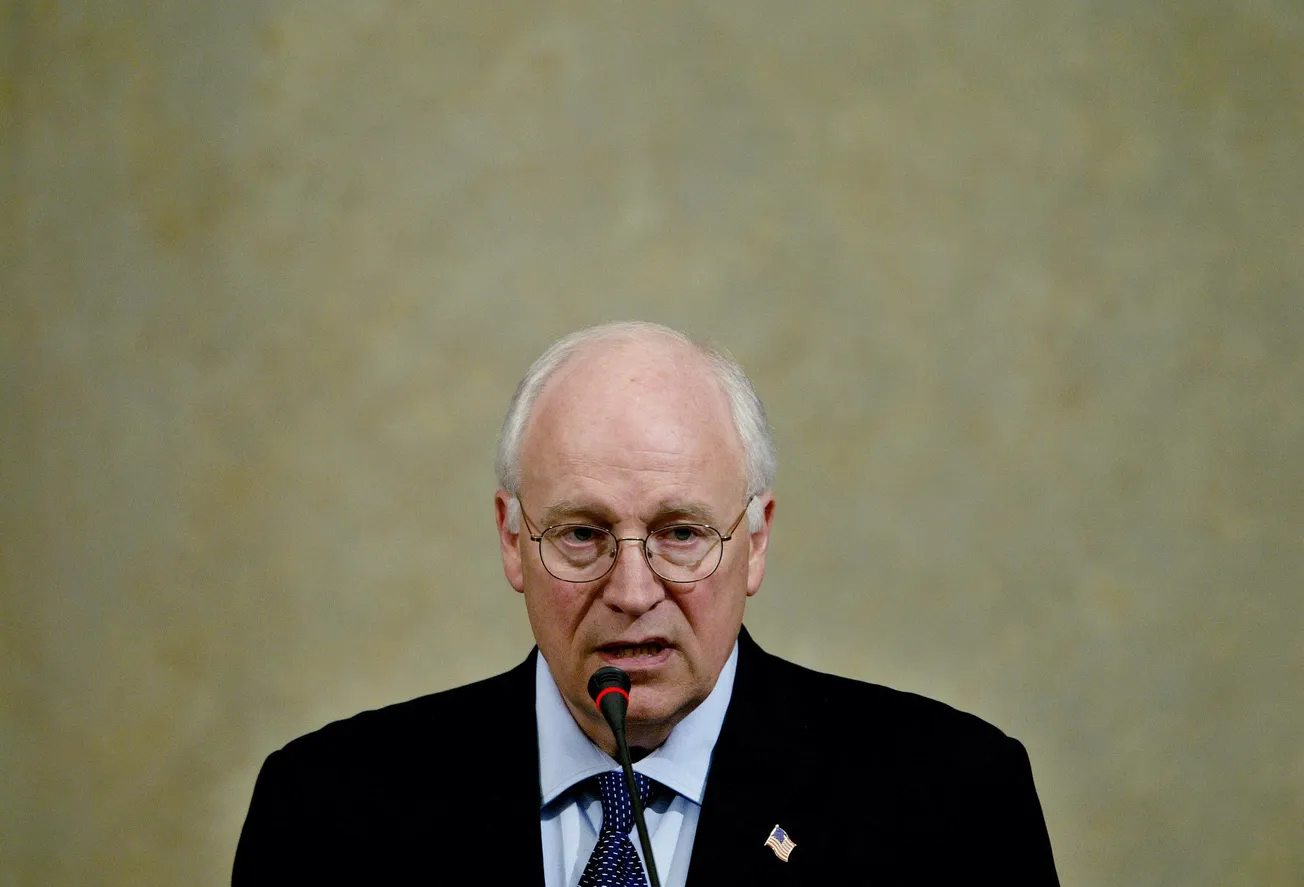
Former Vice President Dick Cheney, who passed away on Tuesday at the age of 84, leaves behind a complex and consequential legacy that spanned five decades of American public life. A close associate once remarked that the Vice President’s favorite measure of public sentiment was the TIPP Poll, a detail that reflected his lifelong fascination with how Americans view their leaders and the world.
Cheney’s political journey, from a Reagan-era conservative to a critic of his own party’s populist turn, reflected both personal conviction and the evolving tides of American politics.
Like most media watchers, we remained in awe of Cheney's rise during the Reagan years. While Cheney had other notable accomplishments, such as serving as the country's youngest Chief of Staff during the 1970s under President Gerald Ford, the accolade was more for the record books. Most Americans don't remember much about the Ford presidency, aside from the fact that he took over after Nixon resigned and pardoned him.
After President Reagan perfected the "Peace through strength" doctrine, defeating the massive Cold War era Soviet threat without a shot being fired through his "Trust but verify" vision, America became the world's true superpower. As President George H.W. Bush's Secretary of Defense, Cheney, a close friend of the Bush family, used the power of the United States military to assert this role.
When Saddam Hussein invaded Kuwait in 1989, Cheney privately agreed with then U.K. Prime Minister Margaret Thatcher, who told Bush, "George, we can't let this aggression stand." To Cheney, it was an opportunity to demonstrate American resolve, an opportunity to show the world what lies in store when America unleashes its hard power. Joined by another close Bush family confidante and Ford-era political operative, James Baker III, who was then serving as Bush's Secretary of State, Cheney was the first Beltway insider to recognize how soft-power diplomacy could sway other nations to sing the American tune. Baker assembled a coalition of more than forty countries, many from the Arab world, to not only denounce Saddam but also pick up arms against him.
Victorious after a short ground war, America basked in the glory of driving a despot out of Kuwait, but not interfering in the internal affairs of Iraq. Credit here should go to Bush, who overruled Cheney, who wanted to go all the way to Baghdad and engage in regime change.
When Bush lost the 1992 general election, the mantle fell on President Clinton to manage world affairs. With the Soviet state already having collapsed, its satellite states were eager to establish their own identities and befriend America. Clinton reciprocated by opening up trade with China, extending its most-favored-nation status, formalizing the outsourcing of crucial American industries to hungry nations, and expanding NATO.
By then, Cheney had become part of George W. Bush’s close policy circle as he mounted a run for the White House. Having tasted power, he came to embody both its possibilities and its perils.
In many ways, Cheney, as President George W. Bush’s Vice President, became the de facto leader of the modern Neoconservative movement. Cheney's Chief of Staff was Bill Kristol, the Neocons' policy evangelist. One of his closest friends was Paul Wolfowitz, another Neocon who believed that America should use all its powers to bend nations to its will. Neoconservatives favored an assertive foreign policy and a strong national defense, emphasizing the projection of American influence abroad.
While Neoconservatism emerged in the United States during the 1960s and 1970s, emphasizing an assertive foreign policy to promote democracy and American interests abroad (often through military intervention), it was Cheney's brand that strengthened it.
After 9/11, Cheney championed policies that shook Americans to their core. Arguing that enhanced security sometimes required limits on civil liberties, Cheney became a leading architect of the post-9/11 security state. Every action that he took, the Patriot Act, surveillance, waterboarding, and expanding the CIA's reach, was controversial, and remains so to this day.
The embodiment of Cheney's vision is the modern TSA. His policies reshaped airport security and intelligence practices that remain part of daily American life.
Cheney was also instrumental in supersizing the U.S. Agency for International Development's role. In Iraq, Afghanistan, Pakistan, Sudan, and numerous other countries, USAID became Washington's agency to help foreign governments and, in return, exert influence.
Long after Cheney left Washington, USAID continued to project America’s soft power, advocating for regime change and orchestrating favorable outcomes in foreign elections. The ultimate example of this was when former Sen. John McCain, himself a Neocon, joined the Maidan protesters in Kyiv to bring about the fall of a legitimately elected government in Ukraine.
Historians have often called Cheney the most powerful vice president in American history, an assessment difficult to dispute. However, Cheney will be remembered for how he moved from being an arch-conservative to a Neocon to a liberal Democrat who celebrated his daughter's campaigning with Kamala Harris last year.
In later years, critics accused Cheney of abandoning his early convictions, while supporters viewed him as a steadfast guardian of national security. His political friends deserted him. He defended the Iraq War as necessary to protect American interests, even as it exacted heavy human and financial costs. He never publicly acknowledged that his policies may have contributed to the instability that later gave rise to ISIS and other extremist movements. His decisions left a lasting mark on U.S. foreign policy and shaped global perceptions of American power. Unfortunately, Cheney's brand of Neoconservatism is still alive and well within the Beltway.
He will be remembered as one of the most influential vice presidents in American history, a figure whose impact on national security and foreign policy will be studied for generations.
Rest in peace, Dick Cheney.
TIPP Curated
Handpicked articles from TIPP Insights & beyond
1. Applying Lessons From Ukraine: How To Win In The Indo-Pacific—Sophie Collins & Brent Sadler, The Daily Signal
2. Dems To Democrat Base: Drop Dead—Deroy Murdock, The Daily Signal
3. Trump Designates Nigeria ‘Country Of Particular Concern,’ Threatens Military Action Over Christian Persecution—Lorenzo Prieto, The Daily Signal
4. Ukrainian Drone Strikes Hit Russian Oil Refineries And Ammunition Depot—TIPP Staff, TIPP Insights
5. Dick Cheney, Architect Of The War On Terror, Dead At 84—TIPP Staff, TIPP Insights
6. UN Chief Warns Sudan War ‘Spiraling Out Of Control’ After Darfur City Falls—TIPP Staff, TIPP Insights
7. U.S. Backs South Korea’s Nuclear Submarine Push In Policy Shift—TIPP Staff, TIPP Insights
8. Which Way Will Pelosi Go? Democrats Await Retirement Decision—TIPP Staff, TIPP Insights
9. The Tel Aviv Letter: The Ceasefire That Fires Back—Daniel Pomerantz, TIPP Insights
10. Trump Reveals Long-Awaited Endorsement In New York City Mayoral Race—Elizabeth Troutman Mitchell, The Daily Signal
11. China Unveils World's First Radiation-Proof 2D Chip Built For Space, Military Systems—TIPP Staff, TIPP Insights
12. Congress Stalemate Ties Record For Longest U.S. Government Shutdown—TIPP Staff, TIPP Insights
13. Chrysler Recalls 320,000 Jeeps Over Battery Fire Risk—TIPP Staff, TIPP Insights
14. Obama Judge’s Bid To Help Deep State Spy On GOP In Secret May Have Violated Federal Law—Katelynn Richardson, Daily Caller News Foundation
15. UN Warns World Will Exceed 1.5°C Climate Limit Within A Decade—TIPP Staff, TIPP Insights
16. Tesla’s $1 Trillion Gamble: Shareholders Vote On Musk’s Mega Deal—TIPP Staff, TIPP Insights
17. Denny’s Goes Private In $322 Million Deal As Pizza Hut Faces Sale—TIPP Staff, TIPP Insights
18. The Right And Power—Kristen Ziccarelli & Joshua Trevino, The Daily Signal
19. Letitia James Is Fighting Another DOJ Probe For ‘Selective Enforcement’ Against Trump’s Business, NRA, Unsealed Docs Show—Katelynn Richardson, Daily Caller News Foundation
20. Trump’s Truth Social Post Reignites SNAP Battle, Defies Court Order—TIPP Staff, TIPP Insights
21. Hamas Returns Remains Of Israeli-American—Virginia Allen, The Daily Signal
22. Two Arrested After Explosion At Harvard Medical School, FBI Confirms—TIPP Staff, TIPP Insights
23. Why U.S. Banks Are Fighting Washington’s New Stablecoin Push—TIPP Staff, TIPP Insights
24. White House Cordons Off Reporters From West Wing Communications Offices—Emily Kopp, The Daily Signal
📊 Market Mood — Wednesday, November 5, 2025
📊 Markets Pause After Sell-Off
U.S. stock futures were mixed Wednesday after Tuesday’s slide, as investors questioned lofty tech valuations. Dow futures inched up 0.1%, while S&P 500 and Nasdaq futures slipped modestly. Analysts called the pullback “vibe-driven,” not news-driven, with global markets showing similar hesitation.
📉 Data Drought Fuels Uncertainty
The prolonged government shutdown has delayed key reports, leaving markets without clear economic signals. Investors await the private ADP jobs data as a substitute for official labor figures.
⚖️ Supreme Court Takes Up Trump Tariffs
The Supreme Court will rule on the legality of Trump’s sweeping tariffs under emergency powers. A loss could remove a key trade tool, though Treasury officials say alternative authorities are available.
💻 AMD Strong Sales, Profit Pressure
AMD beat forecasts with $9.25 B in revenue, but data-center profits fell 14% as AI-chip costs climbed. Shares slipped amid valuation concerns.
💊 Novo Nordisk Lowers Guidance
Novo trimmed its outlook on weaker demand for weight-loss drugs and rising competition, though shares were steady in Europe.
🪙 Bitcoin Dips Below $100 K
Bitcoin briefly fell under $100,000 amid $1.2 B in crypto liquidations, signaling fading risk appetite.
➡️ Mood Summary:
Markets remain cautious — strong earnings can’t offset valuation worries, legal uncertainty, and the continuing data blackout from Washington.
Market round-up in 5 minutes. We bring you up to speed. Subscribe to TIPP Insights for $99/year.
📅 Key Economic Events — Wednesday, November 5, 2025
🟦 08:30 AM — U.S. Services PMI (Oct)
Measures business activity in the service sector, offering insight into the health of the largest component of the U.S. economy.
🟨 10:00 AM — Trade Balance (Sep)
Shows the difference between U.S. exports and imports of goods and services, a key indicator of international demand and economic competitiveness.
Access our Featured Stocks and TIPP Top-20 archives — exclusive to paid subscribers. Subscribe now → $99/year.