
Are Americans better off today than two years ago? By a number of objective measures, the answer is yes. But if you ask people whether they're worse off or better off, the answer is more negative than anything else, as the latest I&I/TIPP Poll indicates.
Taken from Aug. 25 through Aug. 28 by 1,481 likely adult voters, I&I/TIPP asked: "Thinking about your personal financial situation, are you better off or worse off today than you were two years ago?"
Overall, 39% of those responding said they were "worse off," while just 26% responded "better off." Another 32% called their financial situation "about the same." So, on net, 58% are either better off or the same. The poll's margin of error is +/-2.9 percentage points.
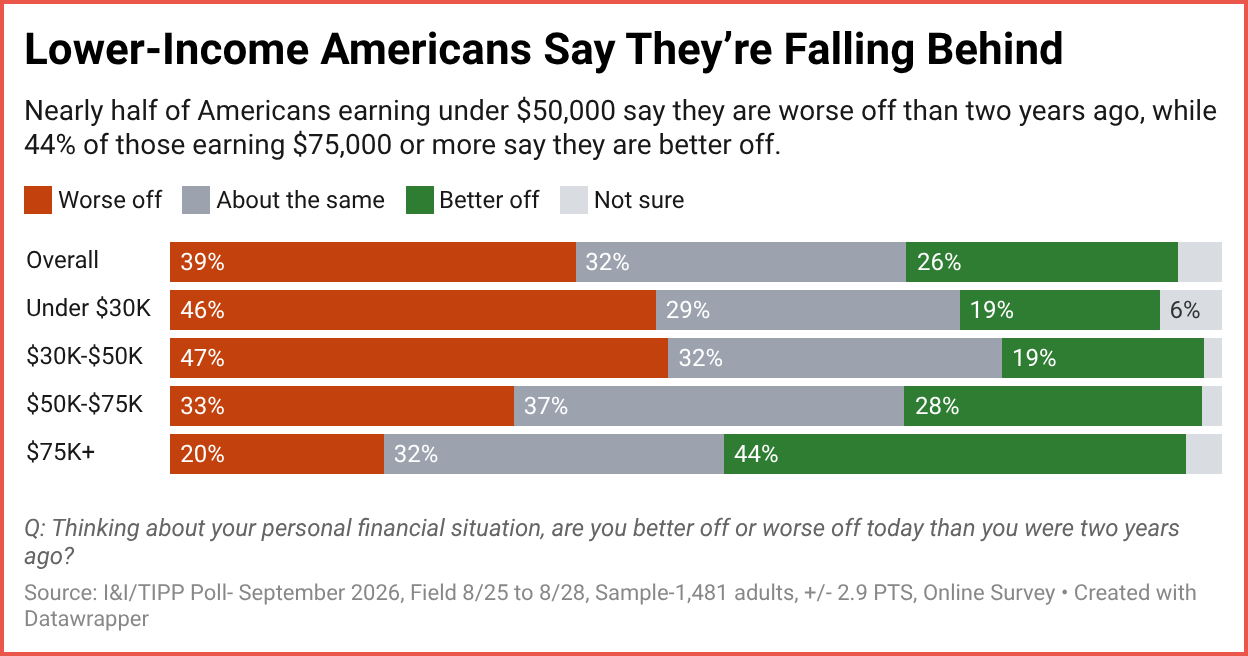
It perhaps comes as no shock, as the chart shows, that those at the bottom rungs of the income ladder are most likely — just under half — to say they're worse off, and least likely — just under 20% — to be better off. Just under a third said they were doing about the same.
And responses showed sharp differences based on political orientation. Conservatives were far more likely to describe themselves as better off (36%) than worse off (28%), when compared to both moderates (42% worse off, 22% better off) and liberals (49% worse off, 19% better off).
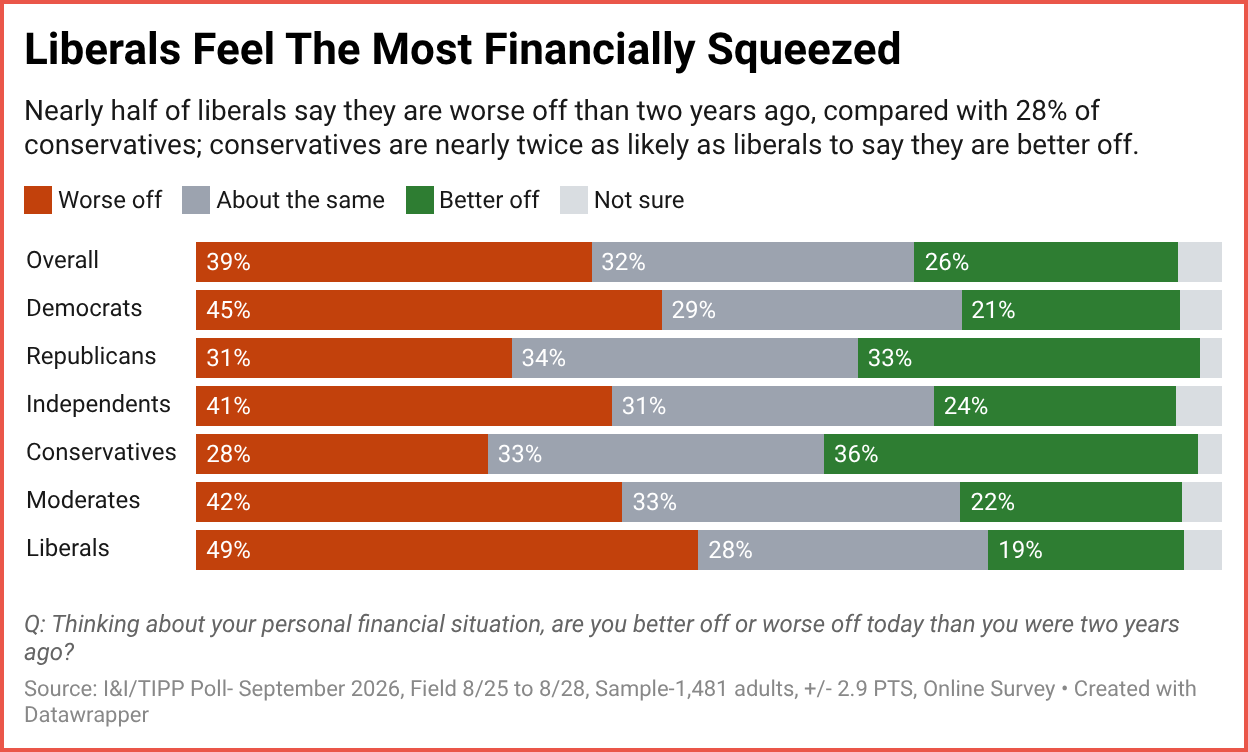
Still, the number saying they're either "better off" or "the same" as two years ago remains above 50% for both conservatives (69% combined score) and moderates (55% combined score) when compared to liberals (47% combined score).
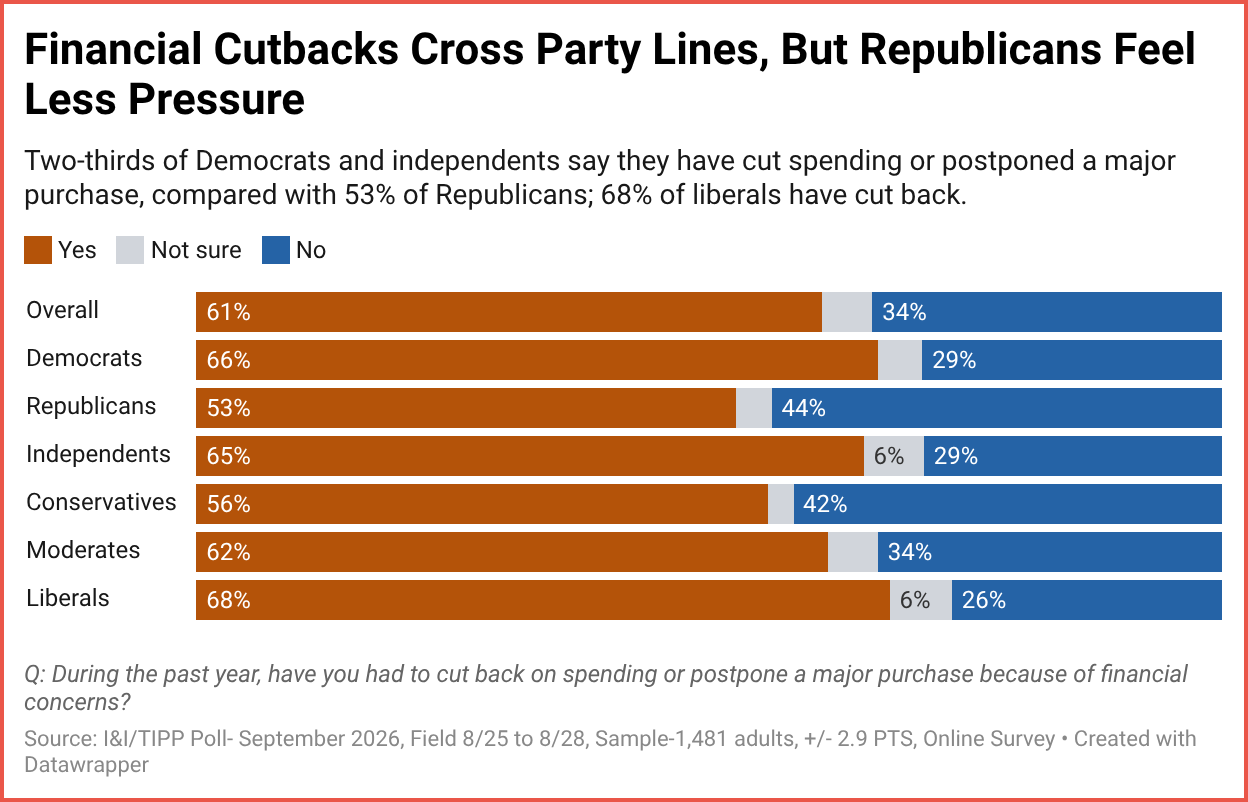
But that doesn't mean Americans aren't worried about finances. They are. Overall, as the chart indicates, 61% of all those answering the poll said they've either cut personal spending or put off a major purchase over the past year.
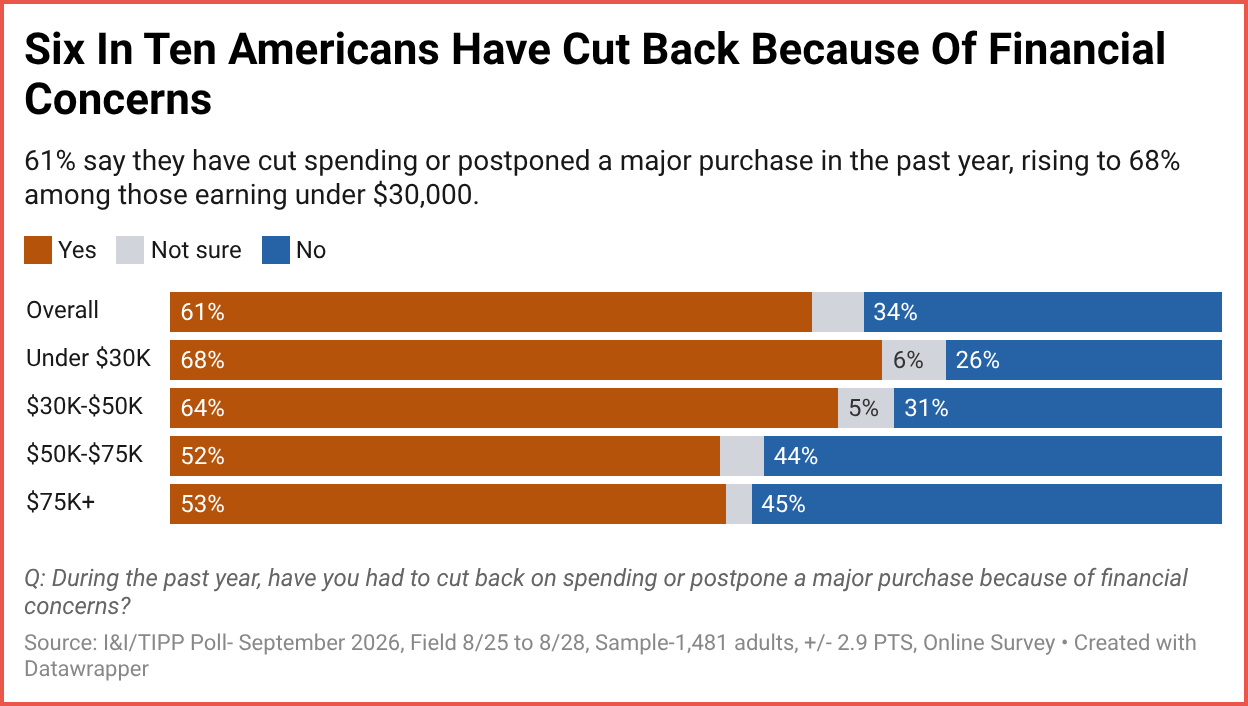
Again, not surprisingly, nearly two-thirds of those below $50K a year in income report putting off purchases, compared to just over 50% of those over $50K a year.
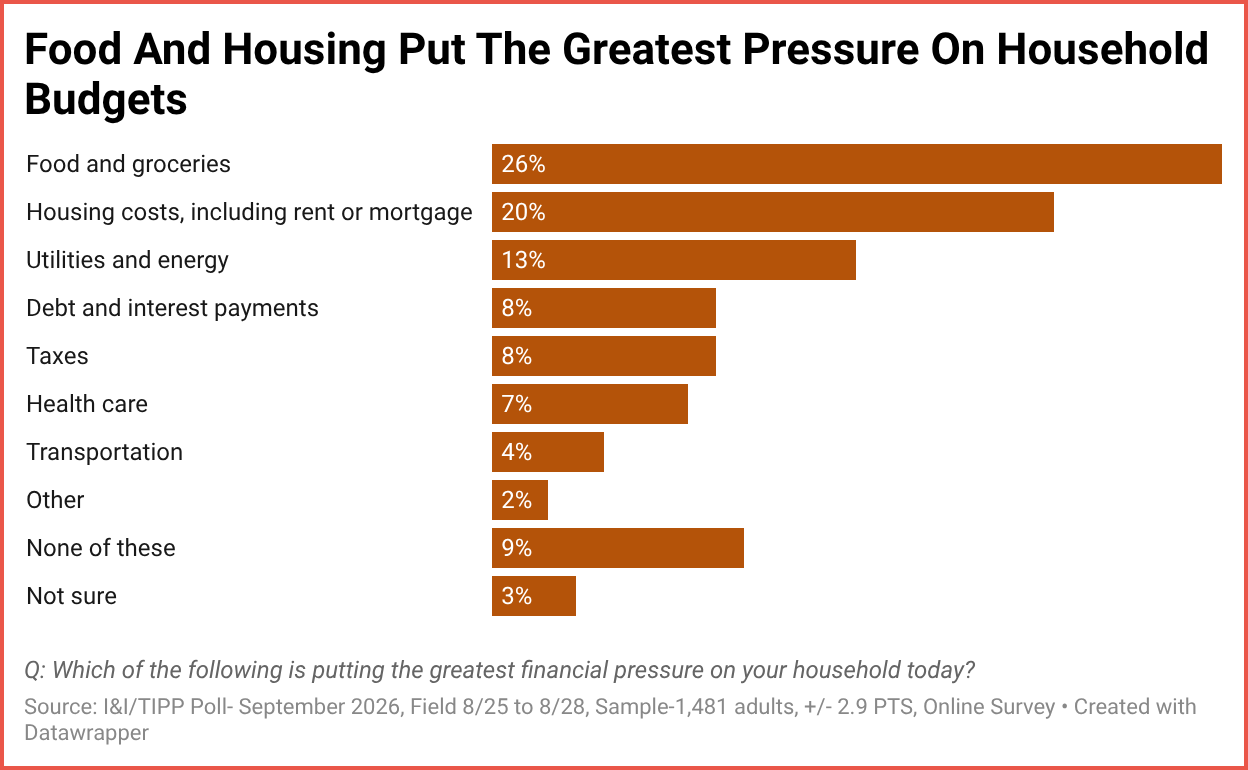
So what is causing all the financial stress?
Over a quarter of those responding said "food and groceries," while a fifth said "housing costs, including rent or mortgage" and another 13% cited "utilities and energy." Meanwhile, "debt and interest payments," "taxes," "health care," and "transportation" all garnered single-digit responses, as did "none of those" at 9%, making it the fourth largest category.
While food gets the most blame, it should be noted that official data for the food component of consumer prices show a 2.7% gain over the past year, below the 10-year average of 3.2%. Is this a case of data lagging reality, or vice-versa? Also, as far as housing is concerned, mortgage rates have surged recently as Congress' borrowing binge has sucked trillions of dollars out of the productive private sector of the economy to fund record growth in government spending.
The spending cutbacks and postponements also have a partisan tinge.
Democrats and independents are about 12 to 13 percentage points more likely than Republicans to say they have had to cut or postpone spending, a statistically significant difference.
So a question arises: Do the differences among the various political leanings, either defined as party affiliation or ideology, indicate what pollsters call "confirmation bias," in which people respond to questions based on their pre-existing beliefs, not actual experience?
Or are the differences due to underlying demographic differences, such as age, race, gender, and income?
And what about the role the media play in crafting perceptions about the economy?
Let's start with age. Those 18-to-24 years of age (33% "better off") and 25-to-44 years (37% "better off") are more likely to feel they've improved than those 45-to-64 (20%) and 65-plus (14%).
And the difference between men and women is stark. Among men, 36% say they're better off; just 16% of women say the same thing. Do they live in the same household?
Another surprising outcome: Black and Hispanic Americans are significantly more likely to say their lot improved over the past two years (31%) than white Americans (24%). A not so surprising outcome: Those with less education (high school only, 20% "better off"; some college, 21% "better off") than those with college degrees or higher (36% "better off").
And yet another unexpectedly big gap exists between parents (44% "better off") and non-parents (19% "better off").
People certainly understand their very own personal struggles within the economy, especially given current high gasoline prices nationwide. But they sometimes might not fully comprehend the bigger picture, which suggests that overall the economy appears to be improving from the COVID years.
Which raises a question: Do people underestimate how well they're doing because of the media's reluctance to report positive recent economic news? No doubt, President Trump hasn't done himself any favors with his ongoing war against large mainstream media outlets, which has led to jaundiced coverage of anything having to do with Trump's second-term as president.
"Today, Americans across the political spectrum say the relationship between the president and the press is in a bad place," a recent Pew Research report found.
Nor do Americans like watching nationwide gasoline prices surge by nearly 30% from $3.22 a gallon in January to $4.15 a gallon in early September. They feel the pinch, and that goes a long way to explaining why so many now feel "worse off."
Even so, in recent weeks and months, data have emerged that show a thriving economy, with few exceptions. And yet, as recent polls by I&I/TIPP and others show, people seem unaware of this.
Consider this collection of recent news items, many of which got little or only cursory media coverage:
- The U.S. poverty rate fell a half percentage point to 10.2% in 2025, its lowest level ever.
- Real median household income surged 2.6% to $87,460, the highest level ever, even as after-tax income jumped 3.1% to $76,060, also a record high, after President Trump's tax cuts.
- All the major stock market indexes are at or near record highs, good news for the millions of working Americans who own stocks in their 401(k) and IRA retirement plans.
- The Atlanta Federal Reserve's "GDPNow" forecast predicts a searing 5.0% growth rate in the third quarter, set to end this week.
- The U.S. standard of living, commonly measured as per capita GDP, has risen 9.6% since Trump entered office to $94,430, its highest ever.
- While energy inflation remains high due to the U.S.-Iran conflict, food inflation remains below the 20-year average.
- Just last week, U.S. weekly jobless claims plunged to 197,000, close to 57-year lows.
The big question is: How many Americans ever saw or heard of these developments, which suggest major positive shifts in the U.S. economy? No doubt knowing these trends are in place might lead at least some to see things differently.
Still, as the I&I/TIPP Poll shows, nearly 40% of Americans think they're worse off now than they were two years ago. Does that now set up an election-year tug-of-war with the 58% majority that believe they're either better off or at least the same as two years ago? We'll soon see.
I&I/TIPP publishes timely, unique, and informative data each month on topics of public interest. TIPP’s reputation for polling excellence comes from being the most accurate pollster for the past six presidential elections.
Terry Jones is an editor of Issues & Insights. His four decades of journalism experience include serving as national issues editor, economics editor, and editorial page editor for Investor’s Business Daily.
Loved it, hated it, or somewhere in between — tell us. Grade this article here and help shape what lands in your inbox next.
🔗 Further Reading
Deeper on what you just read.
🟨 The Unsold Boom – Larry Kudlow, Fox Business
🟨 The Pessimism Machine – Larry Kudlow, Fox Business
🟨 American Household Income Reaches Highest Level On Record – TIPP News
🟨 The Boom They Never Saw Coming – Larry Kudlow, Fox Business
🟨 WATCH: August Jobs Report ‘Crushed Expectations’ As Economy Adds 162,000 Jobs — CNN – TIPP Videos
🟨 US Factory Orders Rise More Than Expected In July – TIPP News
🟨 The American Engine Revs – Larry Kudlow, Fox Business
🟨 Why Is No One Talking About the Manufacturing Boom? – Steve Cortes, The Daily Signal
📊 Market Mood · September 28, 2026
How the trading day is setting up.
🟧 Oil is back in the driver’s seat. Brent has jumped about 2% to around $107 a barrel after President Trump rejected Iran’s latest proposal for reopening the Strait of Hormuz, reviving concerns about energy supplies and inflation.
🟦 Treasury yields are climbing again as higher oil prices reinforce inflation concerns and expectations that the Fed may need to tighten further. Bond-market pressure remains a significant headwind for stocks.
🟨 Stocks are starting the week cautiously. Asian markets are mostly lower and U.S. futures have slipped as investors weigh higher oil and yields against continued strength in AI-related shares.
🟩 A data-heavy week lies ahead. Investors will be watching inflation, GDP and labor-market readings, culminating in Friday’s September jobs report, for clues on how much further the Fed may need to raise rates.
🗓️ Key Economic Events
On today's U.S. data calendar.
No major U.S. economic reports are scheduled today.
Letters to the editor email: editor-tippinsights@technometrica.com
Subscribe Today And Make A Difference. Consider supporting Independent Journalism by upgrading to a paid subscription or making a donation. Your support helps tippinsights thrive as a reader-supported publication. Contact us to discuss your research or polling needs.
Reach our audience. For sponsorship and advertising opportunities, visit our Partner With Us page.