
Despite the many bright promises made by experts that the coming artificial intelligence Golden Age will leave us all better off both financially and personally, Americans aren’t buying it. A majority fears being blindsided by a wave of layoffs and higher costs from AI’s seemingly inevitable presence in our lives, the latest I&I/TIPP Poll shows.
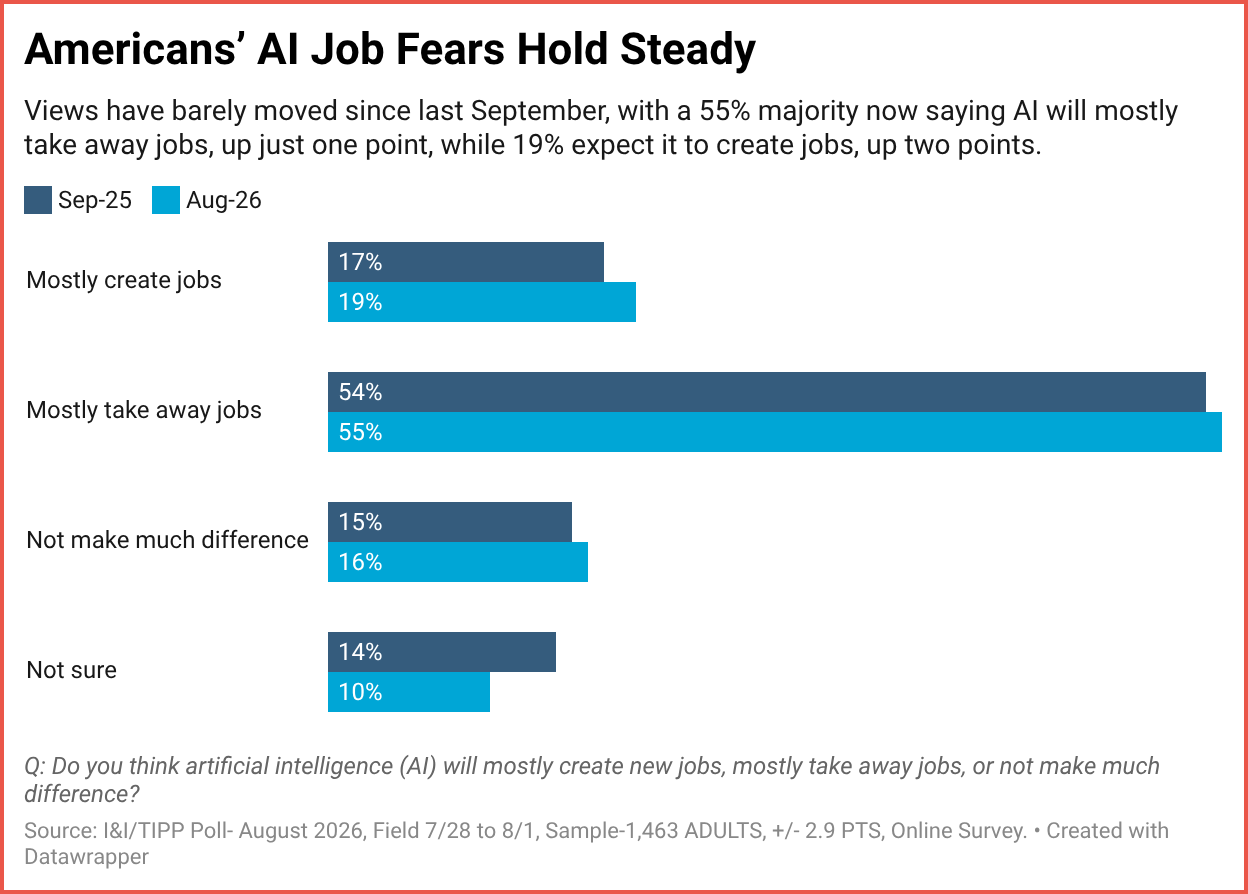
In this month’s national online poll, taken from July 28 through Aug. 1, 1,463 adults were asked three questions about AI, starting with: “Do you think artificial intelligence (AI) will mostly create new jobs, mostly take away jobs, or not make much difference?”
Of those responding, just 19% said AI will “mostly create new jobs,” while a whopping 55% said it would “mostly take away jobs.” Only 16% answered it would “not make much difference,” while 10% weren’t sure.
Those numbers are slightly higher than September 2025’s identical I&I/TIPP Poll, when 54% said AI’s advent would take away jobs, while 17% believed it would create them. The share saying they were “not sure” dropped four percentage points, to just 10% this year. So public opinion seems to be solidifying.
If you expected major differences by political party, as is often the case with questions about economic impacts, you would be disappointed.
There was near-unanimity among Democrats, Republicans and independent voters that AI will be a job-killer, not a job-creator. Most Democrats (18% create, 58% take away), a plurality of Republicans (26% create, 48% take away) and a large majority of independents (12% create, 64% take away) all believe jobs will be lost, not gained.
Indeed, in rare unanimity among the 36 demographic groups tracked by I&I/TIPP, none thought AI would create more jobs than it would destroy. None.
There was more bad news for AI backers in I&I/TIPP’s second question: “Some reports suggest that AI consumes substantial amounts of electricity and could lead to increased power costs. Do you see this as a serious problem, a minor issue, or not a problem at all?”
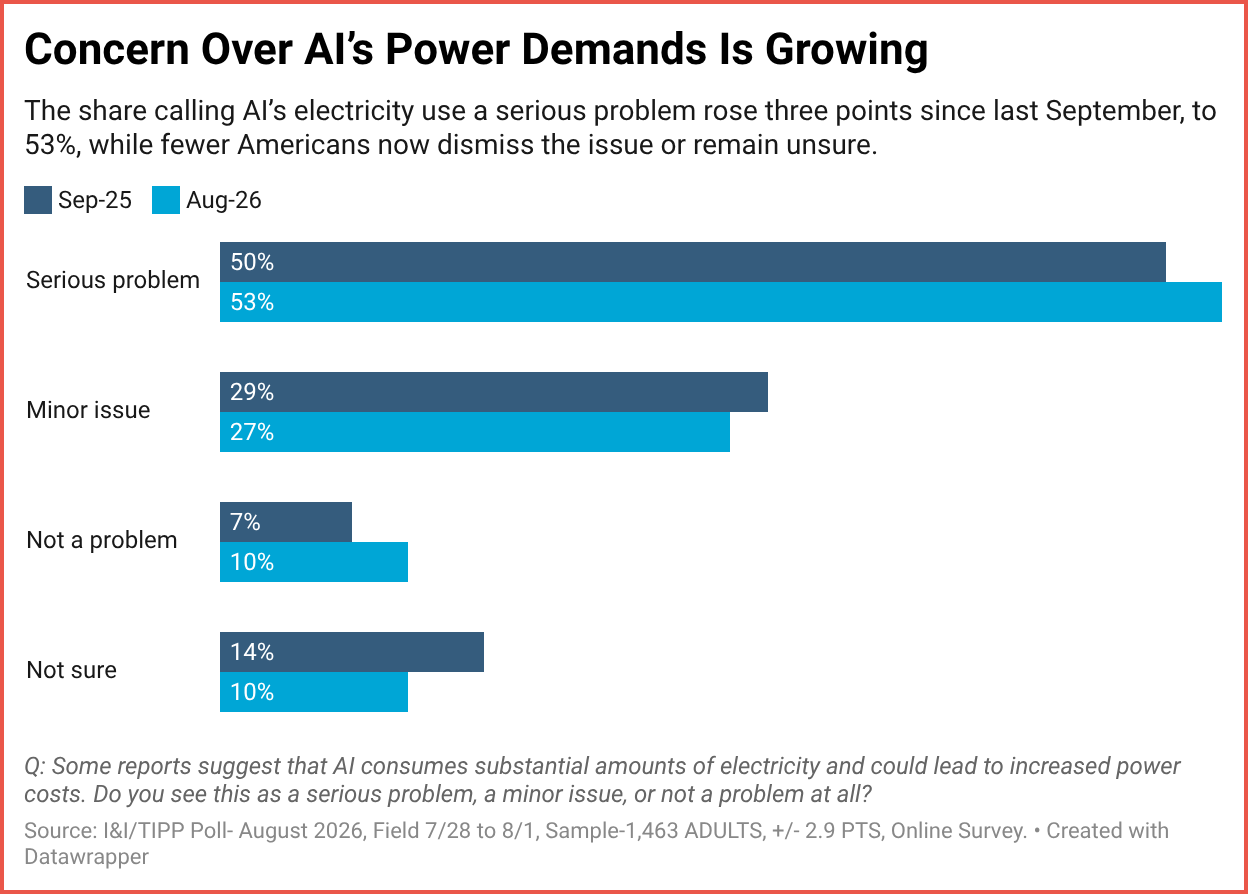
Overall, 53% called power costs associated with AI a serious problem, while (27%) said it would be a minor issue. Just 10% termed it “not a problem at all,” while 10% weren’t sure. Meanwhile, the share saying it would not be a problem increased over the year, by three percentage points.
Compared to the I&I/TIPP survey of September 2025, concern that AI’s power demands are a “serious problem” is up three percentage points, while those calling it a minor issue dipped two percentage points (see chart, above).
Once again, by political party, there was broad agreement that power costs for AI would be a problem: Democrats (59% serious problem, 25% minor issue), Republicans (47% serious problem, 30% minor issue) and independents (55% serious problem, 27% minor issue) held a broad consensus on the energy cost issue.
But not everyone agreed. Age turns out to be a big differentiator for AI. The older the potential voter, the more problems they expect for energy prices.
Indeed, among those age 18 to 24, the responses broke even: 42% said power costs would be a serious problem, an equal 42% said it would be a minor issue, and 10% called it no problem.
But the older the voter, the bigger the problem: For those 25 through 44 years (44% serious problem, 31% minor issue, 16% not an issue), 45 through 64 years (52% serious problem, 26% minor issue, 8% not an issue) and, finally, 65 years and over (71% serious problem, 15% minor issue, 4% not an issue), electricity costs are a major issue.
A final question asks voters: “Which comes closer to your view of AI right now?” Four possible responses were provided.
Overall, 20% selected “It’s overhyped and won’t live up to its promises,” while more than twice that level (42%) answered “It’s dangerous and its risks are being downplayed.” Just 26% said “It will bring big benefits worth the risks,” while 13% weren’t sure.
How does that compare with the September, 2025 poll? Those calling AI “overhyped” is the same, while those calling it “dangerous” has actually fallen three percentage points. And those seeing “big benefits worth the risks” has increased five percentage points, a statistically significant swing.
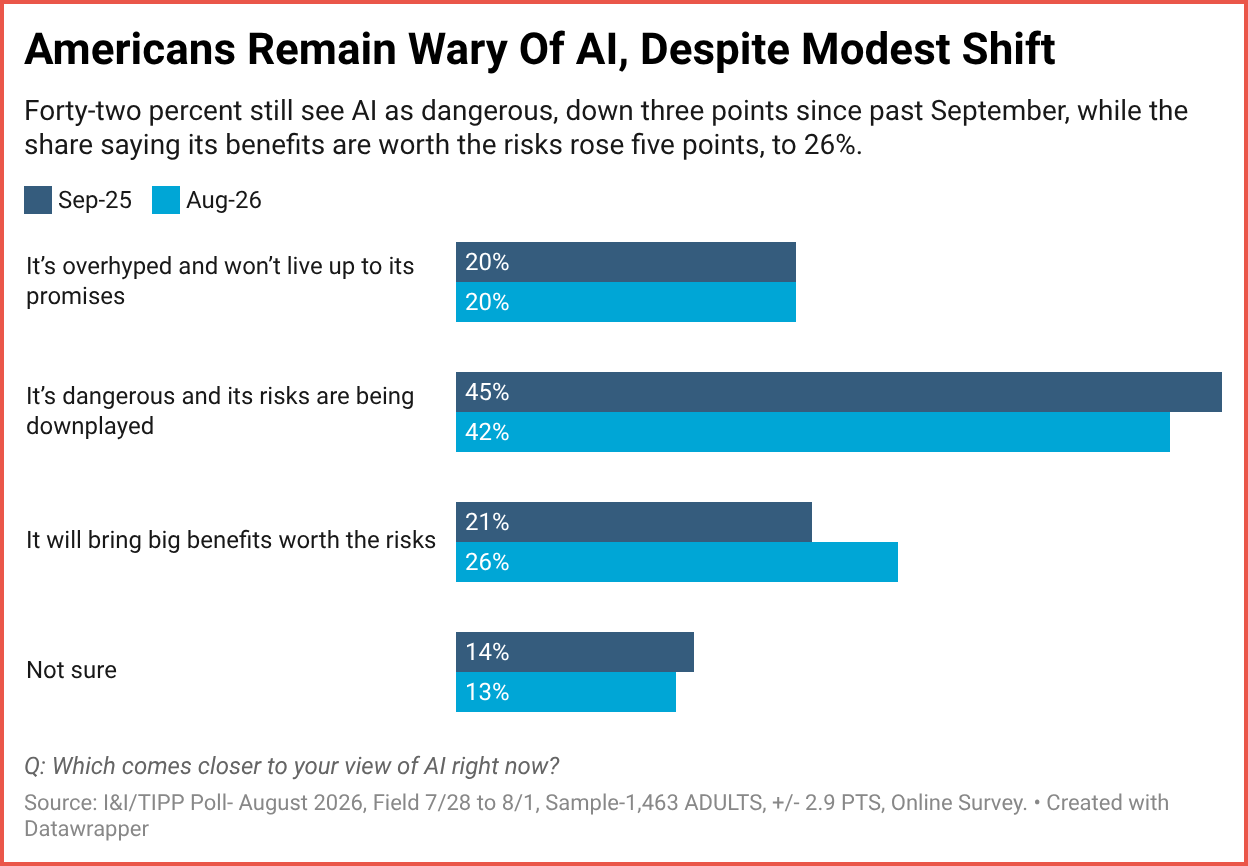
There were minor differences by political affiliation. One in five of Dems, Republicans and independents agreed AI was “overhyped” and won’t “live up to its promises.” But 44% of Dems, 37% of GOP voters and 47% of independents called AI “dangerous” and its risks “downplayed.”
Republicans were most optimistic, with 34% agreeing that AI will bring “benefits worth the risks,” while just 23% of Democrats and 20% of independents agreed.
As we noted higher up, it’s hard to think of another current issue where there’s such a wide gap between the optimistic expert class and the common people who will supposedly benefit from the advent of the AI age.
But then again, public opinion has changed substantially since earlier in the year.
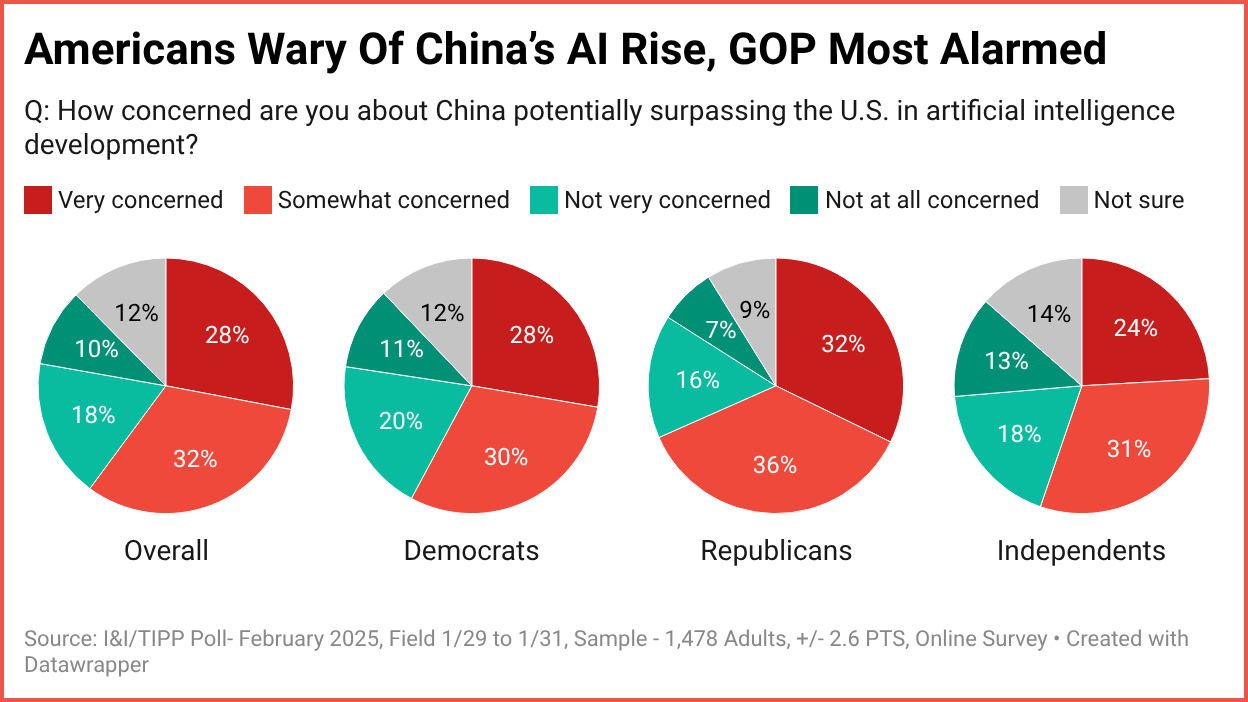
Recall that, as TIPP Insights reported in February, the stock market sold off sharply on news that “China’s ‘DeepSeek’ R1 AI software had leapfrogged other global AI versions and that it did so with an unbelievably parsimonious development cost of only $6 million.”
As the chart below shows, that report shocked Americans, with more than half saying they were concerned about China having an AI edge over the U.S. and expressing a desire for more government investment.
As Bob Dylan once sang, “Things have changed.” Today, there’s growing concern among a majority of Americans about AI’s impact on jobs and energy costs, with 62% describing it as either “overhyped” or “dangerous.”
The near-insatiable demand for more energy to fuel the AI boom has become a feature of the modern economy. And the AI boom is not going away.
As George Mason University economist Tyler Cowen recently noted, “Market sentiments rise and fall, but in the grand scheme of things, the market will not doom the AI revolution. Instead, if you think in terms of the broad sweep of history, you will see that everything is on track, and we are putting more and more of the transition costs behind us.”
In short, the AI revolution is here, whether we like it or not.
Knowing this, should Americans be more worried about ensuring that ever-more-powerful AI doesn’t become a political tool for any one ideology or party? That, unfortunately, might be tough.
A meticulous recent study by Just The Facts asked major AI chatbots, including ChatGPT, Google Gemini, Grok, and Claude, 100 questions each to uncover the degree of bias in their answers, either intentional or non-intentional.
The result: “When tested with the full battery of 100 questions, all of the AIs but Grok answered with more falsehoods from the political left than from the political right, while Grok did the opposite.” At least seven other studies (here, here, here, here, here, here, and here) have made similar findings.
As AI continues to expand in the coming years, Americans may well become more used to its presence. But as the I&I/TIPP Poll shows, many remain skeptical of claims made about AI and its impact on the economy, energy, family, and society.
I&I/TIPP publishes timely, unique, and informative data each month on topics of public interest. TIPP’s reputation for polling excellence comes from being the most accurate pollster for the past six presidential elections.
Terry Jones is an editor of Issues & Insights. His four decades of journalism experience include serving as national issues editor, economics editor, and editorial page editor for Investor’s Business Daily.
Loved it, hated it, or somewhere in between — tell us. Grade this article here and help shape what lands in your inbox next.
🧭 Power & Capital · August 19, 2026
Where state power meets the boardroom.
🔷 Defund The U.N. Green Climate Fund – Editorial Board, Issues & Insights
🔷 The Estate Tax Rewards The Wealthy For Funding Progressive Foundations – Glenn Farley, The Daily Signal
🌍 Global Affairs
The world's flashpoints, in motion.
🟥 Two Missiles Fired From Iran Toward UAE Land In Waters Off Coast – TIPP News
🟥 Switching Presidential Planes In Ankara – Philip Giraldi, Ron Paul Institute for Peace and Prosperity
🟥 Marching Into Colombia – Adam Dick, Ron Paul Institute for Peace and Prosperity
🟥 Liberia Agrees To Accept Up To 1,200 Deportees From US – TIPP News
🏛️ National Affairs
The fights shaping America right now.
🟫 Hospitals ‘Got Rich’ And Were ‘Mutilating’ Children—Vance, HHS Officials Announce Report – Pedro Rodriguez, The Daily Signal
🟫 Wolves In White Coats: HHS Exposes The Racket Behind ‘Gender-Affirming Care’ – Jay Richards, The Daily Signal
🟫 Texas Opens Nation’s 1st Detransition Clinic. Other States Should Follow. – Lauren Washburn, The Daily Signal
🟫 Trump Asks Supreme Court To Allow White House Ballroom Construction To Continue – Reuters, The Daily Signal
🟫 DOJ Plans To Deploy 1,000 Monitors For US Midterm Elections – TIPP News
🟫 The Posse Comitatus Presidency: Trump’s Standing Army On American Streets – John W. & Nisha Whitehead, Ron Paul Institute for Peace and Prosperity
🟫 The Illegal Constitutional Amendment – David Gordon, Mises Wire
🟫 Tucker Carlson Is Playing A Dangerous Game – Victor Davis Hanson, The Daily Signal
🟫 Fauci Called Them ‘Three Stooges’—Now His COVID-19 Critics Are Looking Vindicated – Victor Davis Hanson, The Daily Signal
🟫 You’re Not A Socialist—You Just Chose A $200K Degree Over A Trade – Victor Davis Hanson, The Daily Signal
🟫 Born From The DSA – Joe Thomas, The Daily Signal
🟫 No Distinction Between Socialism And Communism, Survivors Say – Pedro Rodriguez, The Daily Signal
🟫 The Humiliating Fall Of An ‘Expert’ On The Far Right
🟫 ‘Established Insurgent’: Newsom Tests New Political Identity Ahead Of 2028 – Angelina Delfin, The Daily Signal
🟫 Nithya Raman Axed From Homelessness Committee Leadership, Alleges Political Payback From Bass Allies – Angelina Delfin, The Daily Signal
🟫 The State Department’s DEI Reckoning Exposes The Global Reach Of Wokeness – Jarrett Stepman, The Daily Signal
🟫 Massachusetts’ New Abortion Law Is A Tragedy – Melanie Israel, The Daily Signal
🟫 Why Do Flock Cameras Need To Be About Abortion? – Rebecca Downs, The Daily Signal
🟫 Artificial Ignorance: The Political Falsehoods Of Leading AIs – James D. Agresti, Issues & Insights
🟫 Trump Makes Appearance In Ohio As Patriot Games Conclude – Rebecca Downs, The Daily Signal
🟫 Florida Set To Carry Out 13th Execution Of 2026 – TIPP News
🟫 Why Older Adults Face Greater Risks From Rising Heat – TIPP News
📈 Economy
Prices, policy, and the pressure on your wallet.
🟩 The Liberalization Of Holidays And The Ownership Of Time – Farzin Rahimi Zonouz, Mises Wire
🟩 Ahoy! Ahoy! The Telephone, Entrepreneurship, And Cronyism – Joshua Mawhorter, Mises Wire
📊 Market Mood · August 19, 2026
How the trading day is setting up.
🟧 Markets remain cautious after Tuesday’s selloff in technology and semiconductor shares. Futures are only modestly higher this morning as investors wait for the Fed minutes and assess whether the recent surge in bond yields has further to run.
🟦 Pressure from the bond market has eased somewhat, with the 10-year Treasury yield slipping to around 4.69%, providing some relief to rate-sensitive growth stocks after yields recently reached multi-year highs.
🟧 Oil is rising for a fourth consecutive session, with Brent around $91.50 a barrel, as uncertainty over the Strait of Hormuz and U.S.-Iran tensions keeps a geopolitical risk premium embedded in energy prices.
🟨 Today's Fed minutes are the main event. Investors will be looking for the depth of concern about inflation and clues about how divided policymakers are over whether another rate hike will be necessary.
🗓️ Key Economic Events
On today's U.S. data calendar.
🟧 2:00 p.m. ET — FOMC Meeting Minutes
July 28–29 Meeting
The minutes should provide a more detailed look at the Fed's debate over inflation, economic growth and the path for interest rates following its decision to leave rates unchanged.
Letters to the editor email: editor-tippinsights@technometrica.com
Subscribe Today And Make A Difference. Consider supporting Independent Journalism by upgrading to a paid subscription or making a donation. Your support helps tippinsights thrive as a reader-supported publication. Contact us to discuss your research or polling needs.
Reach our audience. For sponsorship and advertising opportunities, visit our Partner With Us page.