

Editor's note, July 12, 2026: Shortly before publication, Senator Lindsey Graham, Republican of South Carolina, died at 71 following a brief and sudden illness. Graham had won his June primary and was on November's ballot for a fifth term. His death opens the seat, but it does not alter the analysis below. South Carolina remains reliably Republican, Governor Henry McMaster is expected to appoint a Republican to serve in the interim, and the state party will name a replacement nominee for November. The path to a majority still runs through the nine states described here.
Before diving into any single race, it's worth taking the temperature of the country, since that mood tends to shape how a midterm plays out. Right now, most Americans are not happy with where things are headed. In the latest I&I/TIPP poll, 56 percent say they are not satisfied with the direction of the country, while just 41 percent say they are. Generally speaking, a sour mood is a warning sign for whichever party holds power, and at the moment, that's the Republicans, who control both the White House and the Senate. Perhaps the most revealing number is among independents, the voters who so often decide midterms: they're unsatisfied by roughly two to one, 64 percent to 32.
That discontent will get its first big national test on Tuesday, November 3, when the 2026 midterm elections kick off, and it's perhaps the Senate races that carry the most weight. By the usual logic of a midterm, an unhappy electorate spells a hard year for the party in charge. However, the Senate doesn't always follow that logic. Many of the seats in play this year sit in states that Donald Trump carried in 2024, which could let Republicans hold the chamber even against a national headwind. As we'll see, control may well come down to just nine states.
It helps to start with where things currently stand. Recall that the Senate today consists of 53 Republicans, 45 Democrats, and 2 Independents who caucus with the Democrats, which effectively gives the Democratic side 47. A majority is 51. Of the 35 seats on the ballot this year, Republicans are actually defending far more than the Democrats are, 22 to 13. At first glance, that might look like a Republican weakness, but most of those 22 seats sit on safe, reliably red ground, so the raw count can be misleading. For Democrats to take control, they'd need to gain a net of four seats. A 50-50 split wouldn't be enough, since the tiebreaker belongs to Vice President JD Vance, so they'd have to get all the way to 51. Republicans, for their part, only need to hold the line. Win three of the five tossups, or flip a single Democratic-held seat, and they keep their majority.
A Map Cracked Open
As a sign of the changing times, this year's map features an unusually large number of open seats, that is, seats with no sitting incumbent running, whether because of a retirement or a primary defeat. In fact, a wave of retirements and one notable primary loss have left roughly ten seats without an incumbent on the ballot, the most in over a decade. Perhaps most famously, Kentucky is open thanks to the retirement of former Majority Leader Mitch McConnell, and Texas is open on the Republican side after longtime Senator John Cornyn lost his primary runoff to state Attorney General Ken Paxton. Several of the battlegrounds we'll discuss below, including North Carolina, New Hampshire, Iowa, Michigan, and Montana, opened up the same way. Regardless of the cause, a seat with no incumbent to defend is genuinely in play.
To make sense of the map, we'll lean on the race ratings from RealClearPolitics, a nonpartisan outlet that aggregates public polling and rates each contest. Their scale runs from “safe,” meaning a race that isn't really competitive, through “likely” and “lean,” which tilt toward one party without being settled, down to “tossup,” which is essentially a coin flip. Of the 35 seats up this year, RealClearPolitics does not rate 14 of them as safe for either party. Nine of those will decide control of the chamber, while the other five are worth keeping an eye on even though they fall outside the Democrats' path. We'll come back to those.
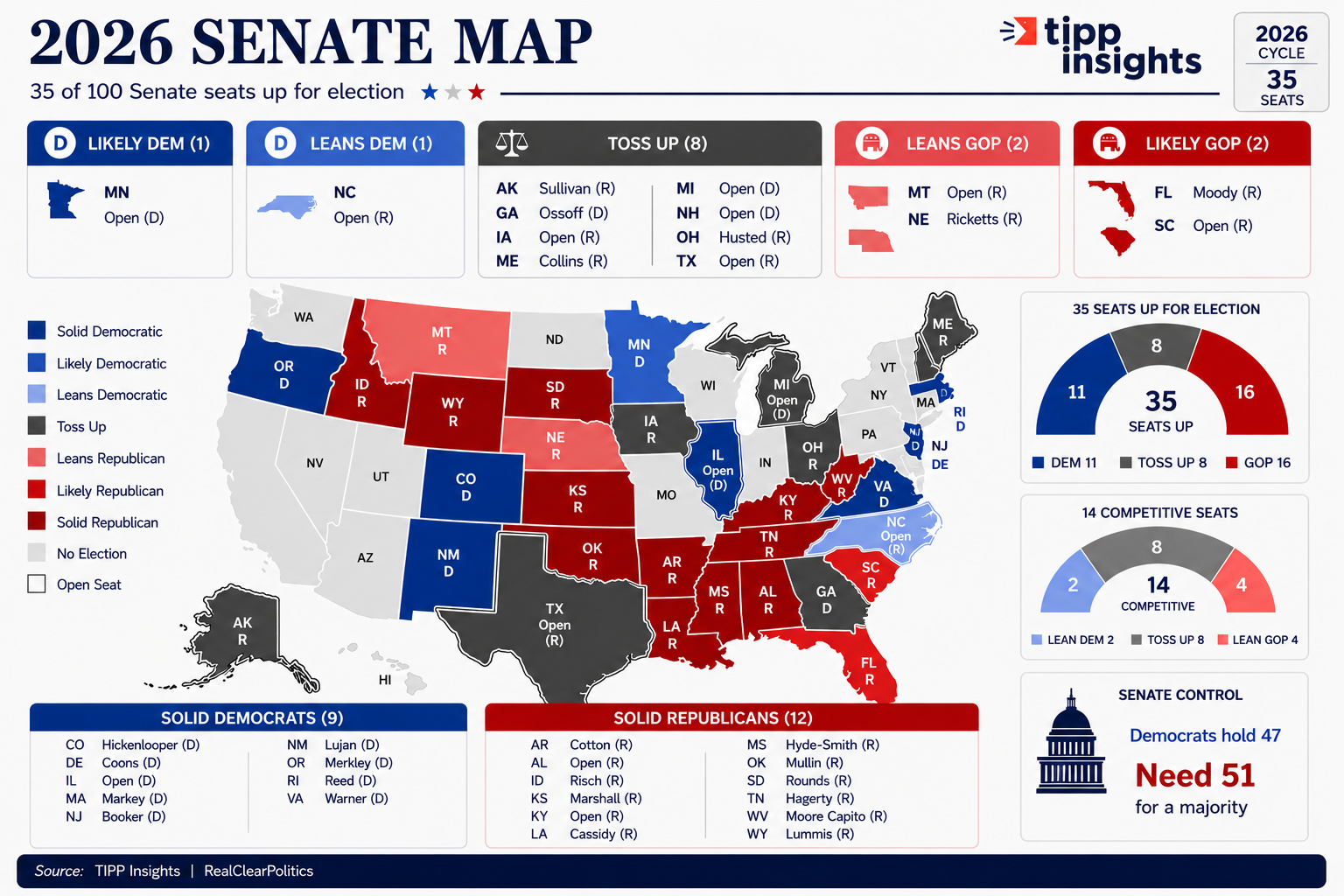
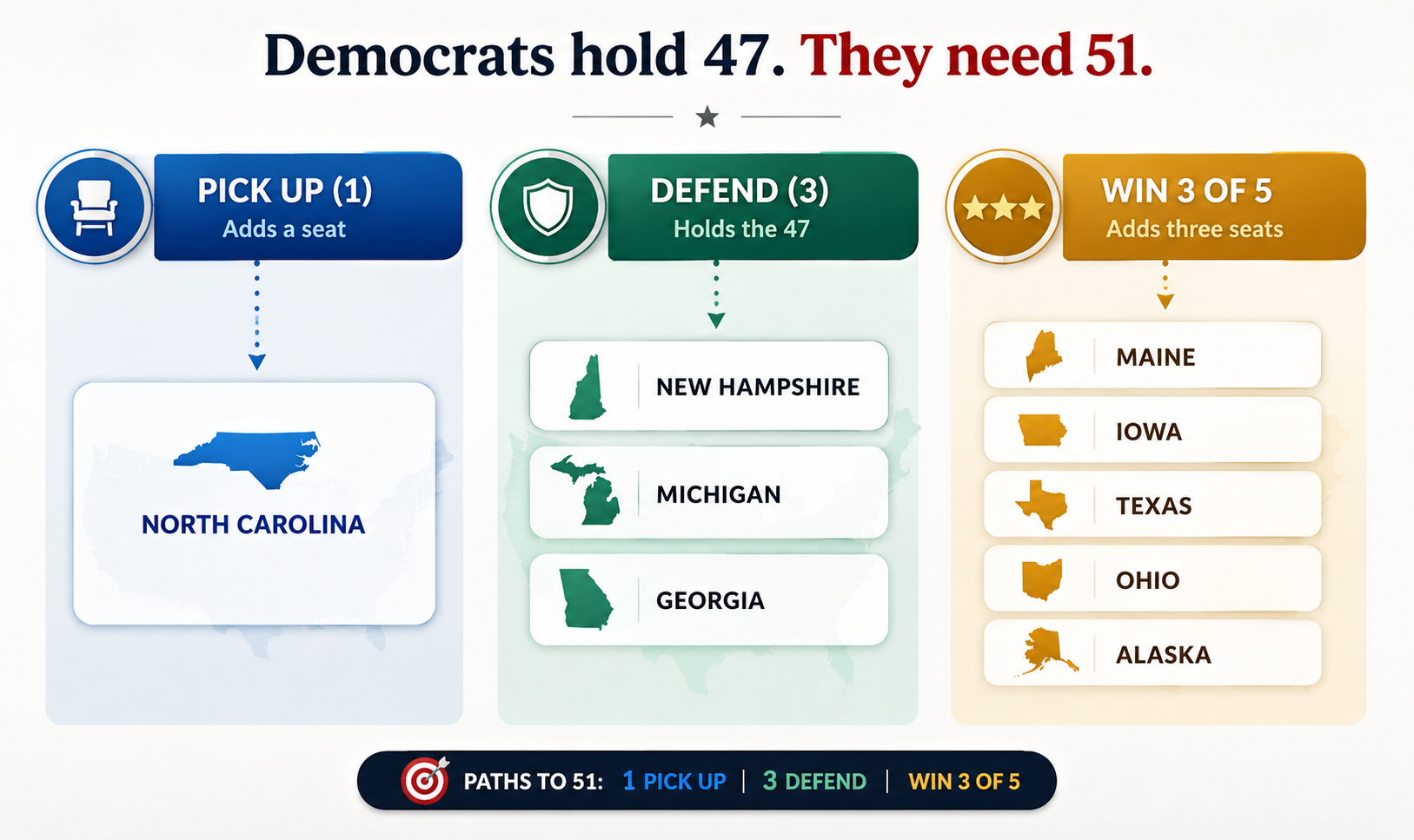
So how do those nine break down? Essentially, the Democrats have one pickup opportunity where they're already favored, three of their own seats to defend, and five Republican-held tossups, of which they'll need to win three. If they can hold serve on the first four and take three of those five, they flip the chamber. If they slip anywhere along the way, and there really isn't much room to spare, they fall short.
The pickup: North Carolina
Many Democrats feel that North Carolina is their best shot at a pickup, even though, remarkably, no Democratic Senate candidate has actually won there since 2008. This year, with Republican Senator Thom Tillis retiring, the seat is an open one that both sides will fight over. The Republican nominee is former RNC Chairman Michael Whatley, while the Democratic nominee is popular former Governor Roy Cooper. Current polling has generally shown Cooper enjoying a comfortable lead over Whatley, which is why North Carolina is the one seat currently leaning Democratic and the likeliest of the four pickups they need.
The Three They Must Defend: New Hampshire, Michigan, And Georgia
New Hampshire. Incumbent Democratic Senator Jeanne Shaheen has decided not to seek reelection, which makes this yet another open seat. The likely matchup is between current Democratic Representative Chris Pappas and former Republican Senator John E. Sununu, who represented New Hampshire from 2003 to 2009. However, the primaries won't be held until September 8. So far, Pappas has held a small but steady edge, roughly 47 to 44 in the most recent University of New Hampshire poll, and independent handicappers currently rate the seat as leaning Democratic. It does tilt blue, but in a state known for razor-thin finishes and a large pool of undecided independents, it's a hold the Democrats can't afford to take for granted.
Michigan. As with so many of this year's close races, Michigan is another open seat, since incumbent Democratic Senator Gary Peters declined to run again. Republicans, who are hoping to win their first Senate seat here in 32 years, are set to back former Representative Mike Rogers, who's running unopposed in his primary. The Democratic primary, held in early August, is more competitive, featuring a tight race between progressive doctor Abdul El-Sayed and the more moderate Representative Haley Stevens. Hypothetical polling suggests either Democrat could hold a slight edge in the general election, but for now it's a genuine toss-up.
Georgia. This is one of the most quintessentially purple states on the board, with a Republican governor, two Democratic senators, and a track record of backing Joe Biden in 2020 and Donald Trump in 2024. Incumbent Democratic Senator Jon Ossoff, who at just 39 remains the youngest senator currently in office, is the one defending here. His opponent is Republican Mike Collins, who represents Georgia's 10th congressional district. Ossoff has led in most polling so far, though Republicans clearly view him as one of their better chances to knock off a sitting Democrat.
The Five Tossups: Win Three
Maine. Republican Senator Susan Collins has long been a thorn in the side of Maine Democrats, winning comfortably in a state that leans blue at the presidential level; in 2020, for instance, she carried Maine by over 8 points even as Joe Biden won it. This cycle looked like the Democrats' best opening in years, right up until it fell apart. Their nominee, oyster farmer and veteran Graham Platner, had led Collins in several polls, but his campaign was steadily engulfed in controversy, culminating in a sexual assault allegation first reported by Politico on July 6. Platner announced he would suspend his campaign on July 8 and then formally withdrew on July 10. Maine Democrats will now pick a replacement at a nominating convention, with candidates declaring in mid-July and a new nominee due by July 27. Collins certainly remains vulnerable as the only Republican senator running in a state Kamala Harris won in 2024, but with no nominee yet in place and the calendar tight, Maine is really only back in play in theory until the Democrats settle on someone.
Ohio. Like Iowa below, Ohio is an old battleground that has shifted considerably to the right in recent years. However, its Senate race looks more competitive than that rightward drift might suggest. This one is a special election to fill the seat that JD Vance gave up when he became Vice President. Governor Mike DeWine appointed Jon Husted to hold it, and because Husted has only been in the seat a short time, he may not feel much of the usual incumbency advantage. His opponent, meanwhile, is a formidable one: longtime former Senator Sherrod Brown. Though Brown lost his own seat in 2024, he significantly outperformed Kamala Harris in Ohio that year, and he has proven his statewide electability many times before. Current polling gives Brown an extremely narrow lead, but one that is far too small to draw any early conclusions from.
Iowa. Iowa is another old battleground that has drifted rightward in recent years, and it too is an open seat, with Republican incumbent Joni Ernst deciding not to run for a third term. The race is now between Republican Representative Ashley Hinson, who won her primary comfortably with President Trump's endorsement, and Democratic State Representative Josh Turek. Iowa has trended red, and Trump carried it by double digits in 2024, so any Democrat starts at a disadvantage. Still, with no incumbent in the race and some polling showing Turek within striking distance, Democrats would certainly welcome a pickup here.
Texas. Texas has been a tantalizing target for Democrats for decades, though so far none of that promise has materialized; no Democrat has won a statewide race there since 1994. This year saw competitive primaries on both sides. Democrats nominated State Representative James Talarico, who triumphed outright over Representative Jasmine Crockett. Republicans went to a runoff, where longtime Senator John Cornyn faced Attorney General Ken Paxton. Paxton had weathered years of legal and political controversy, including a 2023 impeachment that ended in his acquittal, and emerged as a strong candidate. President Trump, who had been reluctant to weigh in, ultimately endorsed Paxton late in the runoff, and Paxton went on to win comfortably in May. Polling shows a close general election with a slight edge to Paxton, and both parties see Texas as a must-win.
Alaska. The last state to keep a close eye on is Alaska, which will conduct its election under ranked-choice voting. Incumbent Republican Senator Dan Sullivan faces his main challenger, former Representative Mary Peltola, the first Alaska Native to serve in Congress, who continues to draw strong support from the state's substantial Native population. Alaska has long been reliably Republican, but Peltola has won statewide before, since the state elects a single at-large House member. Current polling points to an extremely tight race, with perhaps the slightest edge to Peltola.
Off The Path, Worth Watching
Two other seats are competitive but don't really factor into the Democrats' path to a majority. In Nebraska, Republican Senator Pete Ricketts, who won a special election in 2024 and is now seeking his first full term, faces an unusually strong independent in former union leader Dan Osborn, who came within about 7 points of the state's other Republican senator in 2024. The state Democratic Party declined to field its own candidate, and its primary winner, Cindy Burbank, has pledged to drop out by August 3 to give Osborn a clean one-on-one shot at Ricketts. Notably, Osborn hasn't said which party he'd caucus with, which is why even a Ricketts loss wouldn't automatically help Democrats toward a majority. In Montana, meanwhile, retiring Senator Steve Daines has thrown his support behind his handpicked successor, former U.S. Attorney Kurt Alme, who faces Democrat Alani Bankhead and independent Seth Bodnar, the latter backed by former Democratic Senator Jon Tester. With Bodnar and Bankhead effectively splitting the opposition, Alme appears favored to win. Two further seats, in Minnesota and Florida, lean toward the party that currently holds them. South Carolina, following Senator Graham's death, is now an unexpectedly open seat, but in a state this reliably Republican it is very likely to stay in the party's hands once a new nominee is chosen.
The Tally
So, what would it actually take? As we said, the Democrats currently sit at an effective 47 and need to reach 51, a net gain of four seats. That will be difficult, and the math leaves very little margin for error. They'd want to bank North Carolina, where they're currently ahead. They'd then need to hold all three of their own contested seats, in New Hampshire, Michigan, and Georgia, none of which is safe. And on top of that, they'd have to win three of the five Republican-held tossups: Maine, Ohio, Iowa, Texas, and Alaska. Take the pickup, hold the three defenses, and win three of five, and they'd arrive at exactly 51.
The tricky part is that holding those three defenses doesn't add anything to the total; it just keeps it at 47. If they were to lose even one of them, “win three of five” would quickly become “win four of five,” and with Maine now in serious doubt after Platner's exit, that margin would all but disappear. It's also worth remembering that most of these tossups are in states Donald Trump carried in 2024, so a sour national mood is no guarantee the Senate will follow suit.
Still, the opportunities are clearly there. If current polling holds, a Democratic majority is genuinely possible, even if it remains the less likely outcome. Of course, election day is still a few months away, several states have yet to hold their primaries, and Maine's replacement nominee is weeks from being chosen, so plenty can still change between now and then. It is worth remembering that the burden sits with the Democrats. Because most of the decisive states are ones Trump carried in 2024, Republicans start with the friendlier map, and simply holding what they have keeps them in charge. What the map tells us today is that we should expect a very close fight for control, one that may well be decided by a handful of states and, quite possibly, by a single seat.
Loved it, hated it, or somewhere in between — tell us. Grade this article here and help shape what lands in your inbox next.
⭐ BEST OF TIPP INSIGHTS · July 12, 2026
The stories worth your time.
🔷 Victor’s Letter To Mamdani: You’re A Product Of Privilege, At Least Act Grateful – Victor Davis Hanson, The Daily Signal
🔷 China’s Erasure of Tibet Is Accelerating — Brahma Chellaney, Project Syndicate
🔷 Trump Gets A July Bounce In Voter Favorability, But Will It Help GOP Candidates In Midterms? I&I/TIPP Poll — Terry Jones, TIPP Insights
🔷 The Putin Escalation Risk — Ian Bremmer, Project Syndicate
🔷 Make Junk Mail Pay For The Post Office — Editorial Board, TIPP Insights
🔷 The Tax Rule Keeping Millions Of Homes Off the Market — Larry Kudlow, Fox News
🔷 Mythbuster: U.S. Much Safer Than Many Peer Nations — John R. Lott Jr., RealClearInvestigations
🔷 War Threatens Russian Banking Crisis — TIPP Staff, TIPP Insights
🔷 Just Say No To Remote Work — Michael R. Strain, Project Syndicate
🔷 Where Have All Our Manners Gone? — Deb Bright, TIPP Insights
🔷 Twenty-One Out Of Twenty-One — Editorial Board, TIPP Insights
Letters to the editor email: editor-tippinsights@technometrica.com
Subscribe Today And Make A Difference. Consider supporting Independent Journalism by upgrading to a paid subscription or making a donation. Your support helps tippinsights thrive as a reader-supported publication. Contact us to discuss your research or polling needs.
Reach our audience. For sponsorship and advertising opportunities, visit our Partner With Us page.