
By John R. Lott Jr., RealClearInvestigations | July 9, 2026
Conventional wisdom holds that the United States is the most violent and dangerous nation in the developed world. This dark view is frequently invoked by conservatives to demand stronger penalties for crimes and by progressives to argue for stronger gun laws.
At the same time, other nations point to crime as an Achilles heel of the American system. These include two peer nations with some of the most restrictive gun laws in the world – Australia and Canada. In 2025, the Australian Broadcasting Corporation reported that “the U.S. generally sees higher violent crime rates than many other countries.” Last year, the Canadian Press similarly reported that “the number of police-reported violent crimes for every 100,000 people continue to be higher in the United States than in Canada.”
The data, however, undercuts this narrative. While the United States still leads in some categories, on the whole it has significantly less violent crime per capita than those two nations.
Regarding homicide, the most heinous crime of all, it’s true that in 2025, the U.S. murder rate was about four per 100,000 people – roughly twice Australia’s and Canada’s 2024 homicide rate. Yet it’s also true that homicides account for only a tiny fraction of violent crime. In 2024, homicides represented just 0.21% of violent crimes in the U.S., based on National Crime Victimization Survey (NCVS) estimates of rape/sexual assault, robbery, aggravated assault, and simple assault. Murder comprises an even smaller fraction of crimes in Australia and Canada.
Murders in the U.S. are usually highly concentrated geographically, often connected to street gang activity, and threaten only a tiny fraction of Americans. Just 2% of counties account for approximately 54% of all murders, and within those counties roughly two-thirds of killings occur within areas covering only about ten city blocks. By contrast, 53% of U.S. counties report no murders in a typical year, while another 16% report only one.
Moreover, when analyzing the incidence of a broader set of crimes, the U.S. is nowhere near the most dangerous developed country.
Ignoring Police
Because police statistics capture only a fraction of actual crime, the U.S., Canada, and Australia all conduct large-scale victimization surveys that estimate total crime, including incidents never reported to police. The Bureau of Justice Statistics has conducted the National Crime Victimization Survey (NCVS), which interviews roughly 240,000 Americans annually, for more than 50 years. Australia relies on a comparable survey conducted by the Australian Bureau of Statistics, while Statistics Canada conducts the General Social Survey (GSS) on Safety and Victimization.
“Anyone who wants to understand the seriousness of crime in Canada needs to recognize that victimization surveys paint a more complete picture than police-reported crime,” said Gary Mauser, who has extensively studied crime at Simon Fraser University in Canada.
The gap between police statistics and actual victimization is substantial. In Canada, the police-reported violent-crime rate is 885 per 100,000 people. The GSS reported a violent victimization rate almost 10 times that – 8,300 per 100,000.
Australia shows a similar pattern. Although the state of Victoria did not provide assault data to the ABS, only about 37% of robberies and sexual assaults were reported to police in 2024.
The U.S. data tell a very different story. Although the FBI does not collect national counts of simple assault, it recorded 1,203,808 violent crimes in 2019. During the same year, the NCVS estimated 2,013,220 felonious violent crimes – rape or sexual assault, robbery, and aggravated assault, excluding simple assault. Police reports therefore captured 59.8% of the NCVS estimate.
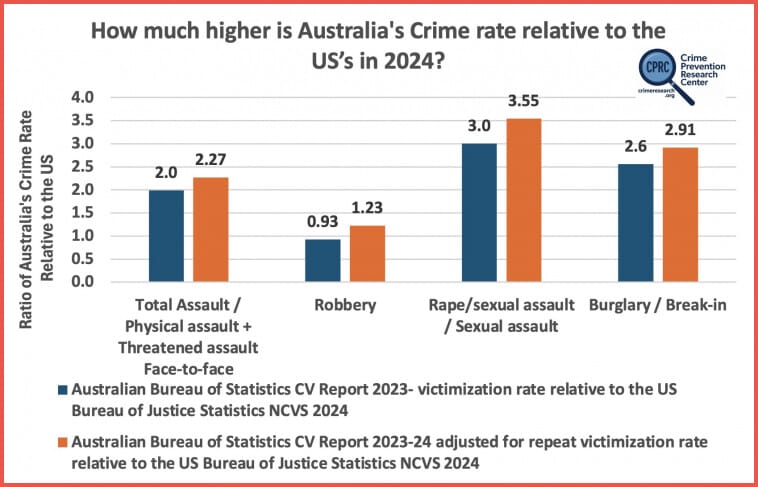
Using these broad estimates, Australia’s rape and sexual assault rate is roughly three times higher than that of the United States. Australia’s assault rate is about twice as high, and its burglary rate is about 2.5 times higher. Robbery is the only category where the two countries report similar rates.
But even this Australian data significantly understates the extent of violent crime because it counts victims rather than the number of crimes, unlike the U.S. data. If someone is robbed or sexually assaulted twice, the Australian survey records only one victimization, while the U.S. counts two separate crimes. As a result, Australia’s survey misses repeat victimizations and understates the total amount of violent crime. Even modest adjustments suggest that Australia’s violent crime rate is 15% higher than already discussed.
“For decades, researchers have documented that people report crimes more often when law enforcement is more likely to catch and punish the offenders,” said David Mustard, a professor and crime expert at the University of Georgia. “The extremely low reporting rates in Australia and Canada therefore raise serious doubts about public confidence in their criminal justice systems.”
Normalizing Rape
For example, in Canada in 2019, about 8.1% of total violent crimes resulted in the person being arrested and charged with the crime (210,000 arrested and charged out of 2.59 million victimizations), which is quite low even compared to the 20% rate in the U.S.
In Australia, there are numerous complaints that “Rape is effectively decriminalized.” In New South Wales, of the 9,138 sexual assaults reported to police in 2022, there were only 1,016 convictions – just an 11% conviction rate. Indeed, during a recent lecture that I gave to college students in New South Wales in February, several women said there was no reason to report rapes and sexual assaults to the police because they believed nothing would happen to the criminal and it was personally embarrassing to come forward publicly.
As a result, an analysis based solely on police statistics can be misleading when comparing countries. Victimization surveys tell a different story. Although direct comparisons require some caution because the Canadian GSS and the U.S. NCVS define certain crimes like sexual assault differently, those differences generally favor Canada and make the U.S. appear relatively more violent.
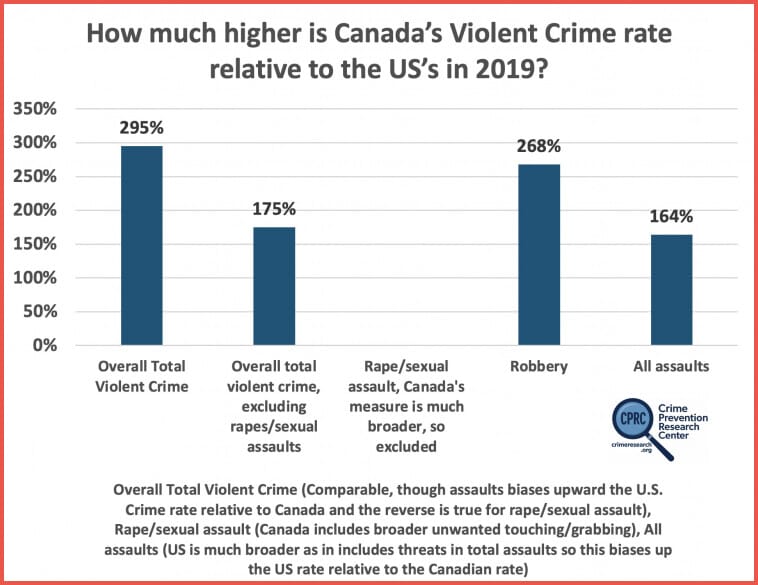
Still, the results remain striking. In 2019, Canada’s overall violent-crime victimization rate was at least 175% higher than the U.S. after adjusting for different methods. “Anyone who wants to understand just how serious crime is in Canada needs to recognize that crime rates are higher in Canada than in the U.S., according to victimization surveys,” Mauser said.
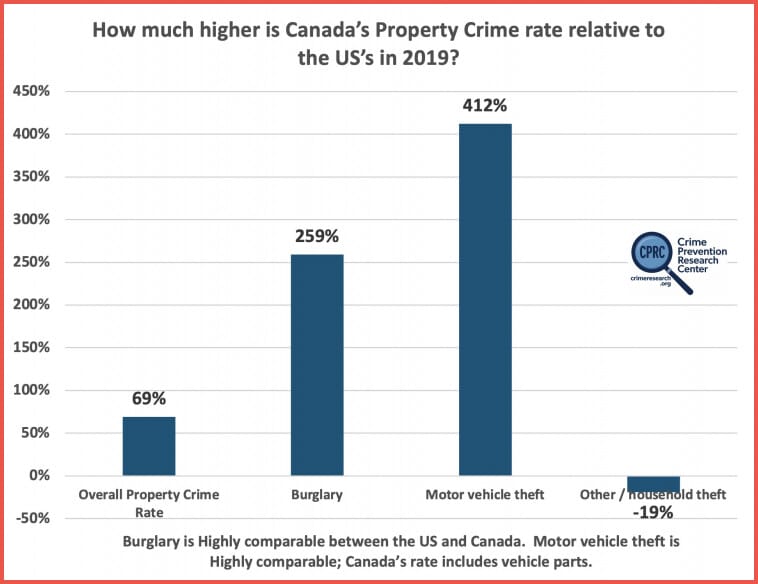
Robbery offers an especially useful comparison because both surveys define it similarly. Canada’s robbery victimization rate was 268% higher than the U.S. rate. Property crime follows a similar pattern. Canada’s burglary rate was 259% higher than the U.S. rate.
Nor is this pattern unique to recent years. The International Crime Victimization Survey (ICVS), which used identical questions and definitions across participating countries before the United Nations assumed responsibility for the survey and later discontinued it, reached similar conclusions. In 2000, Australia’s violent-crime victimization rate – including robbery, sexual incidents, assaults, and threats – was 104% higher than the U.S. rate. Robbery was 150% higher and sexual assaults 167.9% higher. The survey also found Canada’s violent-crime victimization rate to be 40% higher than the U.S.
Few countries conduct victimization surveys, but the historical evidence from older ICVS data paints a similar picture. The ICVS found that England and Wales and Scotland had violent crime rates about 40% higher than the United States, while Finland’s rate was about 20% higher. France, the Netherlands, and Sweden recorded rates roughly equal to the U.S., whereas Belgium and Poland experienced violent crime rates about 20% lower.
“The media’s emphasis on reported crime badly underestimates how bad the violent crime situation in Australia is compared to the U.S.,” Dr. Kesten C. Green, who has studied crime and is a researcher at the University of Adelaide Business School, tells RealClearInvestigations.
“Only victimization surveys capture both reported and unreported crimes, providing a far more complete picture of public safety, said Professor Carl Moody, a crime researcher at the College of William & Mary. “Unfortunately, much of the media ignores this distinction and relies on police statistics to make cross-country comparisons that can seriously mislead the public.”
🧭 Power & Capital · July 9, 2026
Where state power meets the boardroom.
🔷 US Federal Judge Presses Indian Billionaire Adani On Dismissed Bribery Charges – Power & Capital Desk, TIPP Insights
🔷 Russia's Diesel Export Ban Raises Global Supply Concerns – Power & Capital Desk, TIPP Insights
🔷 Which Supreme Court Rulings Does Trump Want Reversed – Power & Capital Desk, TIPP Insights
🔷 What Makes SK Hynix A $1 Trillion Chipmaker – Power & Capital Desk, TIPP Insights
🌍 Global Affairs
The world's flashpoints, in motion.
🟥 Trump Claims Iran Seeking Talks After Military Response – TIPP News
🟥 Former U.S. Adviser Warns Iran Conflict Is Far From Over – TIPP News
🟥 NATO: How Did European Leaders Respond To Trump's Remarks – TIPP News
🏛️ National Affairs
The fights shaping America right now.
🟫 Make Junk Mail Pay For The Post Office – Editorial Board, TIPP Insights
🟫 Why Did Graham Platner Suspend His Maine Senate Campaign – TIPP News
🟫 Olympian Faces Felony Over Lincoln Memorial Reflecting Pool – TIPP News
📈 Economy
Prices, policy, and the pressure on your wallet.
🟩 Treasury Yields Steady Despite Iran Tensions – TIPP News
🟩 Strait Of Hormuz Traffic Falls As US-Iran Tensions Rise Again – TIPP News
🟩 Weekly U.S. Unemployment Claims Dip Slightly – TIPP News
💼 Markets & Business
The deals and tickers making moves.
🟧 Meta Launches AI Coding Model To Challenge OpenAI – TIPP News
🟧 PepsiCo Reports Mixed Quarterly Results – TIPP News
Letters to the editor email: editor-tippinsights@technometrica.com
Subscribe Today And Make A Difference. Consider supporting Independent Journalism by upgrading to a paid subscription or making a donation. Your support helps tippinsights thrive as a reader-supported publication. Contact us to discuss your research or polling needs.
Reach our audience. For sponsorship and advertising opportunities, visit our Partner With Us page.