

Here's a great conversation starter: a recent national TIPP Poll found that a majority, or 61%, of Americans think that public behavior has become worse since the pandemic.
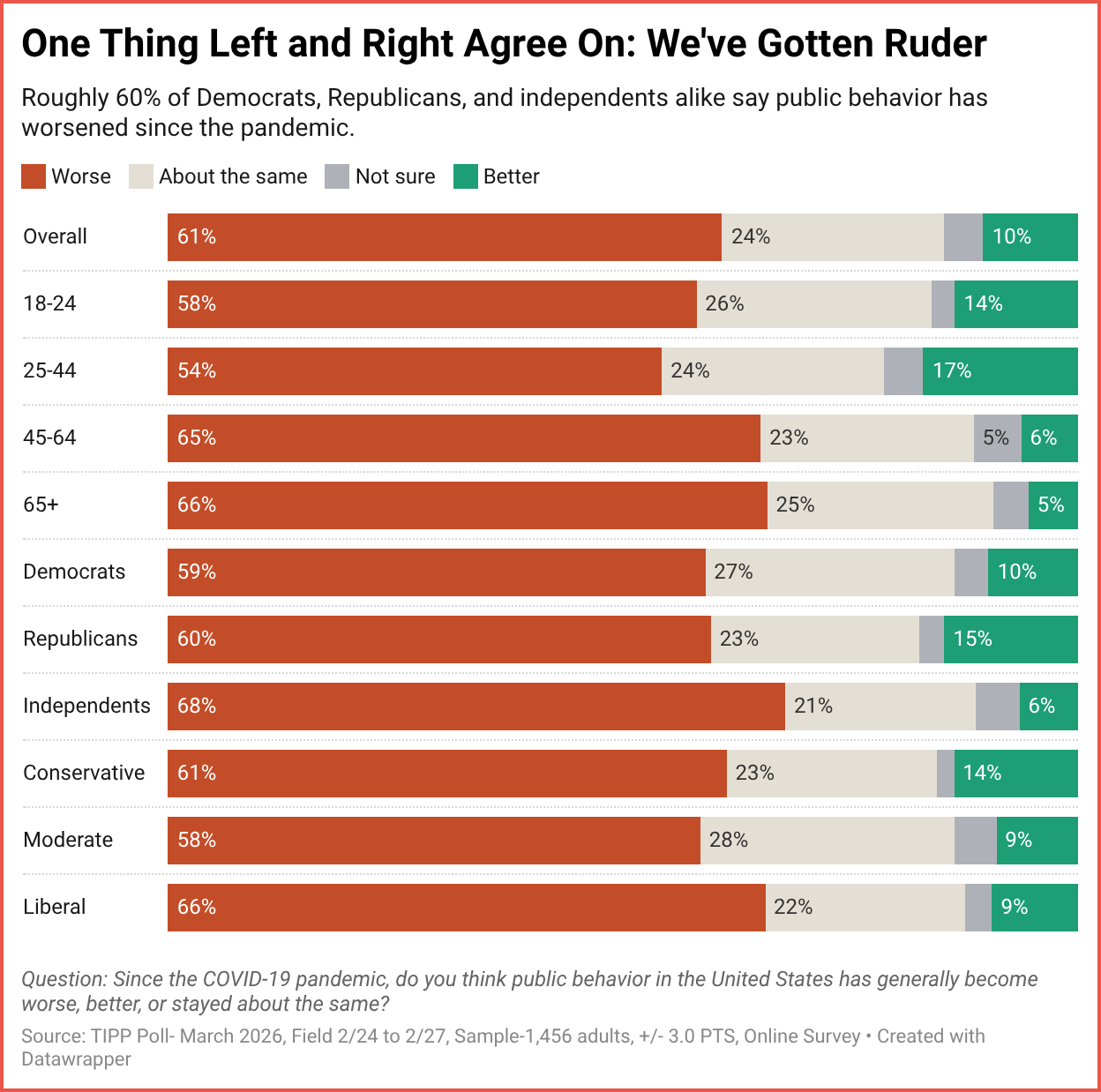
It’s not just a perception, either. 41% of Americans in the same poll reported having observed the worsening behavior firsthand. The poll also showed that, between men and women, women see poor behavior more often than men.
For many of you, these findings may bring a sigh of relief because they confirm what you and many of your friends are already experiencing.
The despicable behavior that we’re talking about isn't what we see from people living on the streets. Rather, we’re talking about people like you and me.
Take, for example, swearing in public. Look at our politicians and how they so freely use the “F word” when trying to impress the public. How does that kind of language set an example for our youth? Whatever happened to the importance of role models? What’s happened to what was once called “public decency?”
Take a look at what now seems “normal” in our everyday life. Passengers used to “dress up” when traveling by air. Today, it seems as if anything goes, even no shoes! It’s not uncommon to be seated next to a passenger who takes off their flip-flops to further expose their bare feet. Or finding customers dressed like they just got out of bed or just came back from the beach while trying to enjoy an evening out at a nice restaurant. It’s slovenly. What does that kind of dress do to the ambiance and special feeling that restaurant owners are trying to create for the rest of us? Going out to a decent restaurant isn't supposed to resemble what we look like when we’re at home watching television stretched out on a couch.
Are we saying goodbye to the common courtesy many of us once took for granted? “Please,” “thank you,” and “you're welcome” have too often been replaced by quiet demands. Beyond the absence of a genuine “please,” customers rarely offer a “thank you” after receiving help. In restaurants, people may grab the salt or pepper from across the table instead of politely asking. Or they may tell a waiter to “get me more water” rather than asking courteously. These examples may seem minor, but together they reshape the tone of public propriety.
And, heaven forbid, on the road or highway, if you mistakenly cut someone off when changing lanes, or if you take too long to accelerate after the light changes, it’s now common to see a middle finger flipping up while the person passing you is mouthing “F you.” Years ago, you’d never see a woman doing that. Today, it’s considered a “right of free speech”.
Public bathroom these days? Is there no job title like “attendees” anymore? If you’ve been to Europe recently, you were probably surprised to discover how bathrooms tend to be clean and tidy. Not sure they have any more bathroom attendants than we do!
These behaviors that once stood out as rude exceptions now feel commonplace, cutting across age, background, and geography. Data from the TIPP Poll seem to reflect these trends: respondents aged 18 to 24 years, as well as those 45 to 64, observed rude behavior more often than those aged 65 years or older. This difference may reflect exposure as much as perception. Younger and middle-aged individuals tend to spend more time in high-density, high-interaction settings: on the road or on airplanes, in workplaces, or online, where these behaviors are more likely to surface.
All of this is unfolding against the backdrop of far larger concerns. Globally, we have tensions involving Iran, Israel, Lebanon, and the other oil-rich nations, as well as the ongoing war in Ukraine and Russia. Closer to home, we are dealing with a strong political divide, national debt, rising energy costs, and the rapid integration of Artificial Intelligence into our daily lives.
While many of these issues occupy our thoughts and cause us to worry, most of them are largely out of our control. Something that does remain within our control, however, is how we, as individuals, contribute to our immediate social environment. Civility, consideration, and respect are not dictated by policy. They are expressed through individual choices, moment by moment. They are part of what is meant by “common culture”. It’s up to each of us to accept and exercise that control by saying and doing something if we see something.
It may take a little guts, such as calmly and respectfully asking someone to lower their voice on a cell phone in an open space or doing simple acts such as holding a door, acknowledging good service, or offering to let someone in the grocery line get ahead because they only have a few items in their basket. Businesses can establish subtle dress codes and encourage their staff to model polite behavior so that customers can once again experience being treated with respect, in the hope that they will do the same.
What's important is that none of these everyday examples cost you or those in your community a dime. They are solely within our control, no matter where you live, your education level, your sex, or your age. It’s just being aware of what we do and say, and having the courage to encourage others to be more polite and considerate.
The data suggests a decline. Whether that decline continues, however, will not be determined by sweeping reforms or large-scale interventions, but by the ordinary decisions we make every day! We create our social atmosphere. Let’s not let our hectic pace, complex lives, and concern about our future cause us to overlook basic manners. By being a little more considerate, we not only lift others but, in the process, lift ourselves.
Deborah Bright is the founder and president of Bright Enterprises, Inc., an executive coaching and training organization, and the author of six books, including The Truth Doesn’t Have to Hurt: How to Use Criticism to Strengthen Relationships, Improve Performance, and Promote Change (AMACOM, 2014).
Loved it, hated it, or somewhere in between — tell us. Grade this article here and help shape what lands in your inbox next.
🧭 Power & Capital · July 7, 2026
Where state power meets the boardroom.
🔷 DOGE Officially Ends Operations After Federal Cost-Cutting Drive
🔷 Why Is Lockheed Martin Acquiring Ultra Maritime
🔷 WHY Is NATO Demanding New Defense Spending Plans
🔷 House Committee Announces Fraud Investigation Into Autism Therapy Firm
🌍 Global Affairs
The world's flashpoints, in motion.
🟥 Trump Pushes Fresh Peace Bid In Ukraine Talks With Putin – TIPP News
🟥 Hamas Dissolves Gaza Governing Body Under Ceasefire Plan – TIPP News
🟥 Ukraine Hits Major Russian Refinery In Long-Range Drone Attack – TIPP News
🟥 Trump Heads To NATO Summit With Tough Defense Spending Message – TIPP News
🟥 Netanyahu Pushes Back On Vance's 'Only Ally' Remark – TIPP News
🟥 U.S. To Resume Troop Rotations In Poland Within Weeks – TIPP News
🟥 World Cup Commentary Sparks Fresh Racism Debate – TIPP News
🟥 Merino's Late Goal Sends Spain Into Last Eight – TIPP News
🏛️ National Affairs
The fights shaping America right now.
🟫 Preliminary Hearing Begins in Charlie Kirk Murder Case – TIPP News
🟫 Sexual Assault Claim Puts Maine Democrat Graham Platner Under Pressure – TIPP News
🟫 Emails Show NIH Officials Flagged Chinese Military Doctor Later Linked to Early COVID-19 Vaccine Patent – Fred Lucas, The Daily Signal
🟫 HOW Will The New ICE Facility Speed Up Family Deportations – TIPP News
🟫 Supreme Court Allows Texas App Age Verification To Take Effect – TIPP News
🟫 Trump Marshals Americans, Historic Spirit of Defiance In Speech Celebrating US’s 250th Birthday – Thomas Wong, The Daily Signal
🟫 The Abortion Misinformation Debate That Could Put Women at Risk – Virginia Grace McKinnon, The Daily Signal
🟫 Smithsonian’s Museum Of American History Erases American Greatness, New Report Finds – Al Perrotta, The Daily Signal
🟫 Could Voting While Uniformed Be a Problem? Lawsuit Says Arizona Rule Restricts Law Enforcement at Polling Places – Fred Lucas, The Daily Signal
🟫 Truman Scholarship, A Democrat ‘Talent Pipeline,’ On Path To Reform – Pedro Rodriguez, The Daily Signal
🟫 Utah Rolls Out AI Chatbot For Prescription Refills – TIPP News
🟫 Super Typhoon Bavi Batters Rota, Pounds Guam With Destructive Winds – TIPP News
🟫 Trump Says FIFA Reversed Balogun Ban After His Appeal – TIPP News
📈 Economy
Prices, policy, and the pressure on your wallet.
🟩 Obamacare Enrollment Drops After Federal Subsidies Expire – TIPP News
🟩 Trump Rings Wall Street Opening Bells, Highlights Stock Market Gains – TIPP News
💼 Markets & Business
The deals and tickers making moves.
🟧 Microsoft Cuts 4,800 Jobs As AI Push Reshapes Business – TIPP News
🟧 Boeing Accelerates 737 Manufacturing Amid Rising Demand – TIPP News
🟧 Why Did Legion LegalTech Drop Its Lawsuit Against the U.S. – TIPP News
📊 Market Mood · July 7, 2026
How the trading day is setting up.
🟩 Markets are holding near record levels as investors look beyond recent volatility and await the start of second-quarter earnings season, with corporate results expected to become the market's next major catalyst.
🟧 AI enthusiasm is facing its biggest test in months after a sharp selloff in South Korean chipmakers, raising fresh questions about valuations and whether the pace of AI-driven growth can keep exceeding lofty expectations.
🟦 Oil prices are edging higher after renewed security incidents near the Strait of Hormuz, reminding investors that geopolitical risks have eased but not disappeared.
🟨 Attention is turning to Wednesday's Fed minutes, which could offer fresh insight into policymakers' thinking on inflation and the path of interest rates following last week's jobs report.
🗓️ Key Economic Events
On today's U.S. data calendar.
🟧 8:30 a.m. ET — U.S. Trade Balance (May)
Forecast: -$68.0B | Previous: -$69.4B
The trade report offers insight into global demand and the contribution of exports and imports to second-quarter economic growth.
🟧 3:00 p.m. ET — Consumer Credit (May)
Forecast: +$10.0B | Previous: +$5.2B
A pickup in consumer borrowing would suggest households remain willing to spend despite elevated interest rates.
🟧 Markets Look Ahead to Wednesday's FOMC Minutes
With no major inflation or employment reports today, investors are likely to keep positioning for the release of the Fed's June meeting minutes, which could provide clearer guidance on the outlook for interest rates.
Letters to the editor email: editor-tippinsights@technometrica.com
Subscribe Today And Make A Difference. Consider supporting Independent Journalism by upgrading to a paid subscription or making a donation. Your support helps tippinsights thrive as a reader-supported publication. Contact us to discuss your research or polling needs.
Reach our audience. For sponsorship and advertising opportunities, visit our Partner With Us page.