Since the war on Iran began driving up fuel prices at the pump, media outlets have run story after story about the so-called affordability crisis: Everything is more expensive at the grocery store because of diesel prices. Diesel is a key cog in the food supply chain, from farms to markets, and hence, high grocery prices are here to stay. Diesel prices have hit historic highs, topping $6.50 a gallon this week.
Last week, the Federal Reserve's rate-setting committee agreed that raising interest rates was the only way to bring this inflation under control. And, much against President Trump's wishes, the Fed raised its benchmark rate by 25 basis points.
Many factors are driving higher prices. Since Obamacare's launch, Democrats piled on subsidies, first to insurance companies and consumers alike, and then, in 2021, with enhanced tax credits so more families could buy coverage. President Trump's BBB bill last summer extended his tax cuts but left out the enhanced Premium Tax Credits, which Congress then allowed to expire last December.
As we noted in an editorial last October, the second-lowest-cost Silver plan (SLCSP) of the benchmark Obamacare plan costs $26,292 per year for a family of four in New York City. These are just the premiums. For 2025, the average deductible across all ACA Marketplace plans in NYC was nearly $4,700 for an individual, according to ValuePenguin's analysis of NY State of Health data. Nationally, for 2026, the average ACA Marketplace deductible grew by 37%, the largest single-year increase since the program launched.
Housing adds another dimension to the affordability problem. Home prices and rents have risen sharply in many parts of the country. Mortgage rates have made monthly payments unaffordable for many new buyers, with yields on 10-year Treasuries hovering around 5%. Families have to absorb higher costs, move farther from jobs, or postpone buying altogether.
Inflation is usually explained through familiar forces: supply shortages, wars, tariffs, energy prices, labor costs, and demand. But a larger issue is now at play. Numerous companies seem to be exploiting advanced technologies to engage in algorithmic price manipulation & targeted gouging, raising prices for the average consumer far more than anticipated.
Lindsay Owens, a Stanford Ph.D. in sociology and the President and CEO of the Groundwork Collaborative, has just written a book, Gouged: The End of a Fair Price–and What That Means for Your Wallet. Appearing on The Weekly Show with Jon Stewart last week, Owens described numerous stealth practices currently in vogue that would shock the average consumer. She argued that some companies use moments of economic disruption as cover to raise prices beyond what their actual cost increases warrant. This is a new dimension to the affordability crisis.
For decades, Americans got used to posted prices that were the same for everyone. But digital commerce is now moving us in the opposite direction.
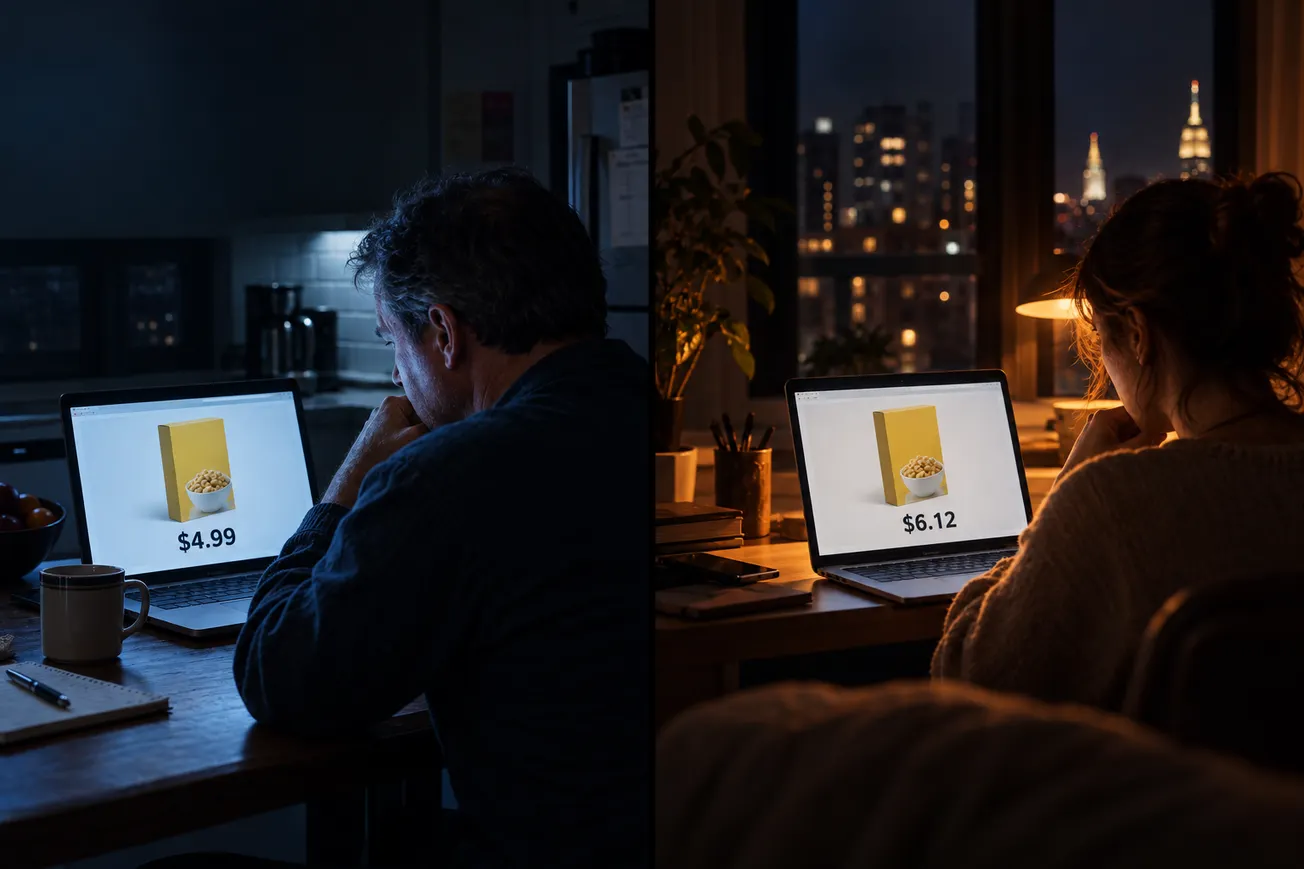
Owens discussed the Instacart experiment, in which her organization teamed up with Consumer Reports, recruited hundreds of shoppers, and had them simultaneously examine identical grocery baskets. Their research found that roughly three-quarters of the items were offered at different prices to different shoppers, sometimes by as much as 23 percent in the same store at the same time on the same day.
After the findings were published in December, Instacart stopped offering the technology that allowed retailers to charge different shoppers different prices. Instacart's decision shows that public scrutiny still matters in a digital marketplace. Transparency can limit practices consumers would otherwise never see. (Consumer Reports)
For decades, comparison shopping has been one of the simplest forms of consumer power. If one supermarket charges $4 for a box of cereal and another charges $3, shoppers can choose. If one airline charges $400 and another charges $300, travelers can compare the two fares.
A transparent price gives consumers information, which creates competition. But comparison shopping becomes harder when the price itself is moving. Imagine two shoppers looking at the same product and seeing different prices at the same store at the same time. Neither knows that the other has been offered a different deal. Neither can easily determine whether the difference reflects demand, location, shopping history, loyalty status, or something else entirely.
When families are already spending more on groceries, housing, transportation, and energy, an additional layer of opaque pricing can make inflation harder to understand. Consumers may see a higher bill without knowing whether it reflects higher costs, stronger demand, a retailer's pricing strategy, or an algorithm's assessment of their willingness to pay.
The larger affordability problem, then, has two dimensions. The first is familiar. Consumers are paying more for food, housing, transportation, health care, and other necessities. The second is harder to decipher. Consumers increasingly have to wonder whether the price in front of them is a market price, a promotional price, an algorithm-generated price, or a price calculated specifically for them. The distinction matters because consumers cannot negotiate with a pricing system they cannot see.
The affordability debate has traditionally focused on how much prices have increased. The next phase of the debate may have to focus on how those prices are being calculated.
Loved it, hated it, or somewhere in between — tell us. Grade this article here and help shape what lands in your inbox next.
🧭 Power & Capital · September 22, 2026
Where state power meets the boardroom.
🔷 Talarico’s Senate Campaign Backed By $11.5 Million From Donor With Ties To Jeffrey Epstein – Lauren Washburn, The Daily Signal
🔷 Democrats Flock To Left Coast Seeking California Cash As Midterm Fundraising Intensifies – Virginia Grace McKinnon, The Daily Signal
🌍 Global Affairs
The world's flashpoints, in motion.
🟥 Trump Offers No Military Pledge To Yemen In Call Over Houthi Gains – TIPP News
🟥 Trump Blames Ukraine War For Russia’s Refinery Disruptions – TIPP News
🟥 New Documentary Answers The Question UK’s Ruling Class Won’t Ask About Mass Immigration – Jarrett Stepman, The Daily Signal
🟥 9/11 And The Idealized “War On Terror” – Joshua Mawhorter, Mises Wire
🏛️ National Affairs
The fights shaping America right now.
🟫 Elon Musk Is Powering The American Renaissance – Victor Davis Hanson, The Daily Signal
🟫 Time To File A RICO Case Against Teachers’ Unions – Editorial Board, Issues & Insights
🟫 Firefighting Helicopter Crashes During Yosemite’s Dome Fire Response – TIPP News
🟫 Newsom Declares Emergency As California Braces For Historic El Niño – TIPP News
🟫 FAA Equipment Outage Triggers Major Delays At Northeast Airports – TIPP News
🟫 Hasan Piker: US Worse Than Al-Qaeda When It Comes To Terrorism – Al Perrotta, The Daily Signal
🟫 Some Democrats Bash Hasan Piker For Backing Iranian Regime, Al-Qaida In Prime-Time Interview – Pedro Rodriguez, The Daily Signal
🟫 ‘Evil Lawfare Needs To End’: Oversight Project Unveils New Firm To Combat Government Weaponization – Fred Lucas, The Daily Signal
🟫 Richard Allen Seeks New Trial In Delphi Teen Murders – TIPP News
🟫 Why Every State Should Study The Election Laws In Tennessee And Florida – Ken Cuccinelli, The Daily Signal
🟫 Secret Ballot At Risk: Unpacking Technology’s Hidden Dangers – Rebecca Buis, The Daily Signal
🟫 Texas 28 Race Pits Longtime Democrat Against Former Democrat-Turned-Republican – Emily Medeiros, The Daily Signal
🟫 Virginians, Don’t Fall For The Abortion Amendment Deception – Joe Thomas, The Daily Signal
🟫 Documentary Shows How Mass Muslim Migration Takes Advantage Of America – Malia Loock, The Daily Signal
🟫 How The Trump White House And The USDA Are Protecting People Of Faith – Steve Messeh, The Daily Signal
🟫 Belief In Action: Reps Mary Miller And Riley Moore Share How Faith Influences Their Lives – Malia Loock, The Daily Signal
🟫 Mississippi Wildlife Rescue Runs ‘Boot Camp’ For Orphaned Raccoons – TIPP News
💼 Markets & Business
The deals and tickers making moves.
🟧 AMD Surpasses $1 Trillion Market Value For The First Time – TIPP News
📊 Market Mood · September 22, 2026
How the trading day is setting up.
🟩 AI enthusiasm is driving markets again. The Nasdaq enters the morning at a record high after a powerful semiconductor rally, while strong early demand for Meta’s new AI assistant has reinforced confidence that AI spending remains robust.
🟧 Oil has bounced back above $102. Brent is up nearly 2% after four straight declines as traders await possible U.S.-Iran talks at the UN, although improving Saudi shipments through the Strait of Hormuz are easing some supply concerns.
🟦 Interest-rate concerns have not gone away. The dollar is firm as markets continue to price further Fed tightening, even after long-term Treasury yields retreated Monday and helped fuel the stock rally.
🟨 Diplomacy could increasingly move markets this week. Investors are watching today's UN meetings for signs of progress with Iran, followed by Thursday's Trump-Xi summit in Washington, where trade, technology and Taiwan are expected to feature prominently.
🗓️ Key Economic Events
On today's U.S. data calendar.
No major U.S. economic reports are scheduled today.
Letters to the editor email: editor-tippinsights@technometrica.com
Subscribe Today And Make A Difference. Consider supporting Independent Journalism by upgrading to a paid subscription or making a donation. Your support helps tippinsights thrive as a reader-supported publication. Contact us to discuss your research or polling needs.
Reach our audience. For sponsorship and advertising opportunities, visit our Partner With Us page.