

By Richard Haass, Project Syndicate | Jun 2, 2026
In a world in which the US cannot be counted on as it once was, the objective is not stability at any price, but rather stability on terms consistent with national and Western interests. This is achievable, but only if the friends of the US recognize the new reality and act individually and collectively to meet the challenge.
NEW YORK—US President Donald Trump’s second administration has been clear from the outset that it would recast American foreign policy in fundamental ways. Its National Security Strategy, released last November, declared that “The days of the United States propping up the entire world order like Atlas are over”—a shift that is especially significant for America’s many allies and partners, which have long made dependence on the US the central tenet of their national security.
The most recent articulation of the changed American approach came last week, in Defense Secretary Pete Hegseth’s speech in Singapore to a gathering of defense ministers and experts: “We need partners, not protectorates,” Hegseth declared. “We seek alliances built on shared responsibility, not dependency. This is the maturation of our alliances in a new era.”
This line of American thinking reflects, in part, the widely held view that for too long the country’s security partners have not carried their weight. There is more than a little truth to this, as many US allies have the economic wherewithal to spend more on defense. What has traditionally held them back has been domestic politics and even a presumption that the US would always defend them, come what may. That won’t be accepted in Washington anymore.
It is also reasonable for US allies and partners to shoulder responsibilities closer to home. The US has unique and extensive global responsibilities in multiple theaters, including Europe, the Indo-Pacific, the Middle East, and the Western Hemisphere, suggesting a larger US motive: narrowing the gap between America’s military capabilities and commitments. This gap would become readily apparent if more than one contingency arose simultaneously, which is more than a hypothetical possibility, given the number of threats, potential and actual, from state and non-state actors, confronting the US and its security partners.
But the Iran war already has brought into sharp relief the gap between US capabilities and commitments. America lacks not only the military systems relevant for this moment, but also the manufacturing base that would enable it to produce them quickly, cheaply, and at scale. Here the US would be wise to learn from Ukraine, which has emerged as a contemporary arsenal of democracy and is leading the world when it comes to the production and use of drones.
For these and other reasons—especially the erratic nature of a US foreign policy that no longer regards allies as privileged and deserving of unflinching support—America’s traditional partners have begun to rethink their own national security strategies. They are right to do so.
For starters, they should spend more on defense, but how is more important than how much. Increasing the share of GDP devoted to defense is necessary but not sufficient. Europe spends a good deal on military hardware, but the whole is less than the sum of its parts.
The same could be said about the Arab states that face Iran. In Asia, the hub-and-spokes alliance system with Washington at the center needs to make way for a networked approach, with US allies doing more with one another and playing complementary roles in deterring and responding to aggression.
Meaningful defense cooperation requires systems tailored to local strategic circumstances, reflecting geography, available manpower, likely aggressors’ capabilities and strategy, and assistance that can reasonably be expected from the outside. It also requires that governments be prepared to integrate defense forces rather than duplicate them country by country.
Greater self-reliance can and should be an element of strategic calculations, but self-sufficiency is rarely, if ever, a realistic option. Forging new and deeper partnerships is. Partnerships can involve the production of equipment and ammunition, intelligence sharing, and planning and training for joint military deployments and combat.
The most obvious partners are to be found in their respective regions: Japan and South Korea come to mind, as do European countries worried about Russia and Middle Eastern countries anxious about Iran.
But partnerships need not be only local. Saudi Arabia is forging new ties with Ukraine to benefit from Ukraine’s extensive experience manufacturing and deploying drones. South Korea is investing in missile production in Poland.
It also makes sense for countries to recast rather than reject their security relationships with the US. There is no reason to seek—and every reason to resist—a divorce. But to make the relationship with the US work nowadays calls for redefining the division of labor, rethinking roles, and restructuring command arrangements to give the partners a larger say.
There may well be a diplomatic dimension to all of this, to try to reduce tensions with potential or actual regional adversaries: China or North Korea in the Indo-Pacific, Russia in Europe, or Iran in the Middle East. But these potential or actual foes should be approached only from a position of military strength, which, as noted above, requires new and deeper partnerships. To attempt to accommodate any of them alone or absent a favorable military balance, and without effective deterrence, would be foolhardy, dangerous, or both.
In a world in which the US cannot be counted on as it once was, the objective is not stability at any price, but rather stability on terms consistent with national and Western interests. This is achievable, but only if the friends of the US recognize the new reality and act individually and collectively to meet the challenge.
Richard Haass, President Emeritus of the Council on Foreign Relations, senior counselor at Centerview Partners, and Distinguished University Scholar at New York University, previously served as Director of Policy Planning for the US State Department (2001-03), and was President George W. Bush's special envoy to Northern Ireland and Coordinator for the Future of Afghanistan. He is the author of The Bill of Obligations: The Ten Habits of Good Citizens (Penguin Press, 2023) and the weekly Substack newsletter Home & Away.
Copyright Project Syndicate
ChatGPT Reaches Billion MAUs In Record-Breaking Time
As rivalry grows between Anthropic and OpenAI for dominance in artificial intelligence, the latter’s ChatGPT app has surpassed 1 billion monthly active users worldwide – the fastest an app has ever reached that milestone.
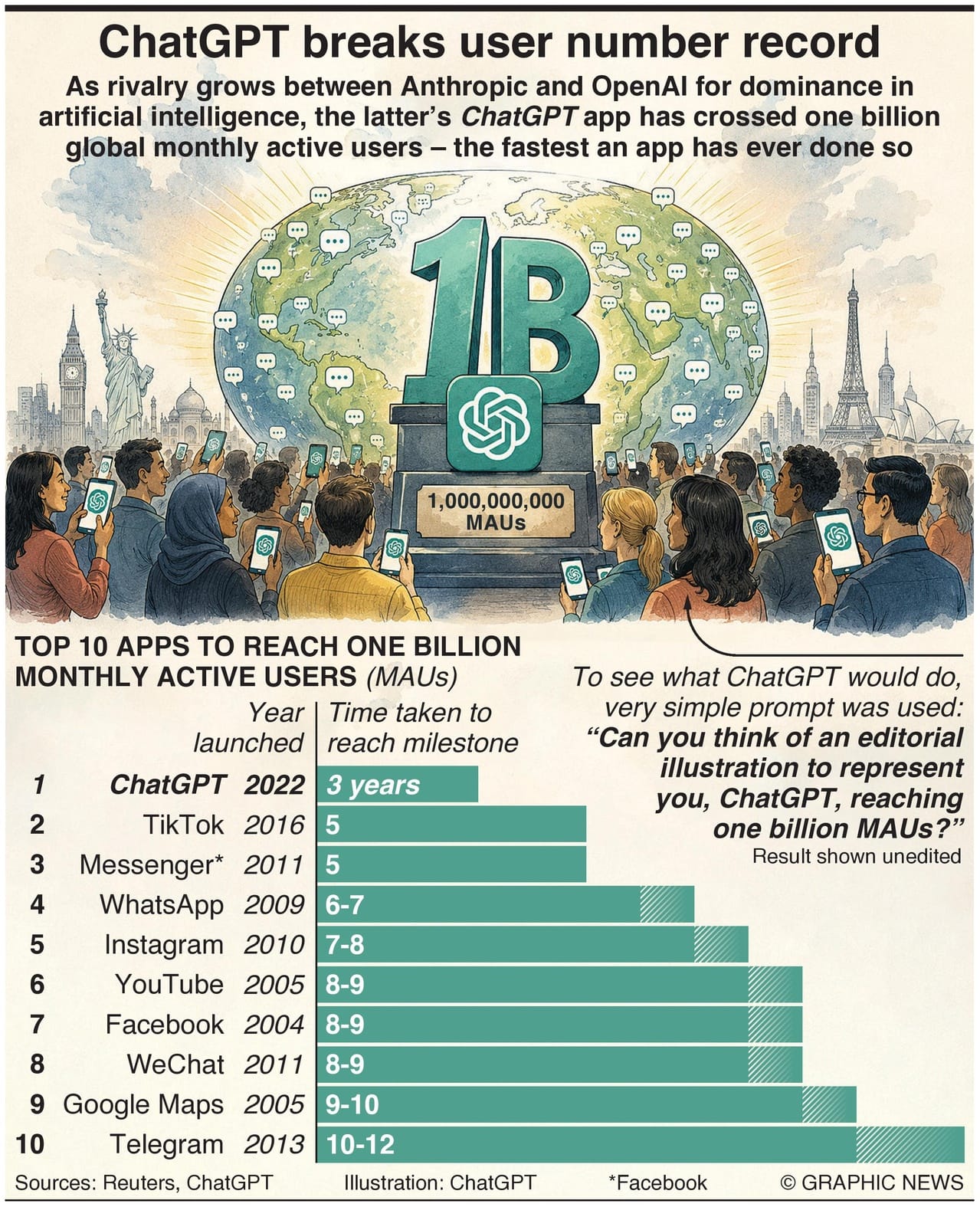
ChatGPT reached 1 billion global monthly active app users in May 2026, making it the fastest app ever to achieve the milestone.
OpenAI’s chatbot hit the mark in roughly three years, surpassing the growth rates of apps such as TikTok, Instagram, YouTube, and Google Maps.
The milestone comes amid an escalating race between OpenAI and Anthropic to dominate the booming AI sector, with Reuters reporting that OpenAI is preparing an IPO filing, following Anthropic’s own filing on June 1.
The stories and data that matter today — selected by the TIPP Insights editorial team.
Global Affairs
Why Does Rubio Say A Nuclear Deal With Iran Is Still Possible
U.N. Chief Unveils Options For New Force In South Lebanon
U.S. Targets Iranian Cryptocurrency Firms In Latest Sanctions Move
Trump Intervention Averts Beirut Strike As Fighting Rages In South Lebanon
What Did Netanyahu Say About His Disagreements With Trump
Congress Quietly Moves To Integrate US And Israeli Militaries
Ukrainian Drones Target St Petersburg During Key Economic Summit
What Is The EU’s New Tech Sovereignty Package
National Affairs
Trump’s Approval Ratings Remain Low As Voters Fret Over Economy, Inflation: I&I/TIPP Poll
California Primary Could Reshape State Politics And Congress
What Prompted The WHCA To Reschedule Its Annual Dinner
When Could Democrats Revisit the Question Of Trump Impeachment
Jimmy Gomez Acknowledges Personal Mistakes After Misconduct Allegations
Markets & Business
Trump Administration Proposes 25% Tariff On Brazilian Imports
Canada, Mexico Seek Long-Term Commitment To Free Trade Agreement
Trump Administration Targets Imports With Fresh Section 301 Tariffs
Why Is Morgan Stanley Opening Its Platforms To AI Tools
SpaceX Sets $135 Share Price For Record-Breaking IPO
Analysts Warn SpaceX May Be Overvalued Ahead Of Nasdaq Debut
Bitcoin Could Fall Below $60,000 In 2026, Forecasts Show
Letters to the editor email: editor-tippinsights@technometrica.com
Subscribe Today And Make A Difference. Consider supporting Independent Journalism by upgrading to a paid subscription or making a donation. Your support helps tippinsights thrive as a reader-supported publication. Contact us to discuss your research or polling needs.
Reach our audience. For sponsorship and advertising opportunities, visit our Partner With Us page.